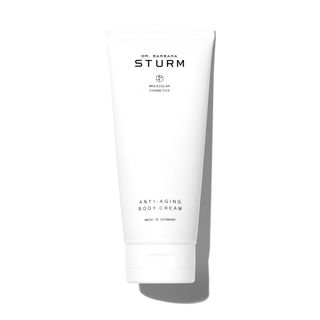
Dr. Barbara Sturm Anti-Aging Body Cream by Dr Barbara Sturm

Dr. Barbara Sturm Anti-Aging Body Cream by Dr Barbara Sturm

Efficacy41/100IrritancyHigh
Edit

Works for

1 of 3 advertised claims delivered

Moisturizing
14 ingredients credited for this claim
Good support
What the product description says
“Anti-Aging Body Cream by Dr Barbara Sturm”
From product name

This product can help improve hydration of the skin with the two types of ingredients.

The first type is called “humectants”:
these ingredients help attract water. When humectants are on the surface of the skin, they “pull in” the moisture from the outside environment, or from within deeper layers of the skin. The following ingredients in this product do the job: biosaccharide gum-1, glycerin.

This product also contains ingredients called “occlusives”. They help reduce the speed with which our skin loses moisture to the outside environment. These ingredients also help soften the upper layer of the skin, so it feels less tight and nicer to the touch. The following ingredients in this product do the job: butyrospermum parkii butter, squalane.

Biosaccharide gum-1Key active· HumectantEffect: HighHelps attract water to the upper layer of the skin and is claimed to provide a longer-lasting hydration because of its ability to create a water-binding film on the surface of the skin~0.25–0.4%
Butyrospermum parkii butterKey active· Emollient, OcclusiveEffect: HighA great moisturising ingredient that softens the skin and reduces water loss from its upper layer. It also can be helpful in protecting skin from free radicals~2.3–2.8%
GlycerinKey active· HumectantEffect: HighOne of the best moisturizing ingredients. Naturally present in skin. It attracts water to the upper layer of the skin working as a humectant~1.6–2%
Limnanthes alba seed oilKey active· EmollientEffect: HighThis oil's cmposition is closest to rapeseed oil. It is a very stable oil and serves as an emoillient~0.6–0.9%
PantolactoneKey active· HumectantEffect: HighHelps attract water to the upper layer of the skin~0.15–0.3%
SqualaneKey active· Emollient, OcclusiveEffect: HighAn oil naturally present in skin. Works as an emollient to soften the skin and form a protective layer on its surface without a greasy feeling.~4.3–5.2%
Vitis vinifera seed oilKey active· EmollientEffect: HighA great emollient that can also have anti-oxidant properties~7.5–9.1%
Cetearyl alcoholKey active· EmollientEffect: MediumA non-drying alcohol. Works as an emollient. Helps water and oil mix together and creates a nice product texture~1.5–1.8%
Hydrogenated vegetable glyceridesKey active· EmollientEffect: MediumHelp soften the upper layer of the skin~1.2–1.5%
Olea europaea fruit oilKey active· EmollientEffect: MediumAn emollient that helps soften the skin but is not effective for restoring its barrier function. Might be helpful to calm down inflammation~0.5–0.8%
Hydrogenated palm glycerides· EmollientEffect: LowAn emollient that softens the skin~0.5–0.75%
Dicaprylyl carbonate· EmollientEffect: LowHelps products spread more easily and works as an emollient to soften skin~3.1–3.8%
Lactic acidUnder-dosedEffect: HighAn exfoliating and moisturizing alpha-hydroxy acid (AHA). Typically causes less irritation than other AHAs, for example, glycolic acid. At high concentrations (about 15%), lactic acid can help reduce lines and wrinkles. Recent studies show that lactic acid can support the "good" bacteria living on skin's surface (healthy skin microbiome)~0.15–0.3%
Caprylic/capric triglycerideUnder-dosedEffect: HighA good mix of fatty acids that forms a protective layer on the skin. Improves the shelf life of products. Derived from coconut and glycerin~0.25–0.5%
Anti-aging
5 ingredients credited for this claim
Limited support
What the product description says
“Anti-Aging Body Cream by Dr Barbara Sturm”
From product name

This product does not contain ingredients that are able to reduce fine lines and wrinkles or help with skin elasticity, but it can improve the look of the skin temporarily through moisturization. Well-moisturized skin might also be able to repair the sun damage better.This ingredient - butyrospermum parkii butter - could be helpful for preventing or repairing signs of aging in theory, but there is no evidence that it actually works.

Butyrospermum parkii butterEffect: LowA great moisturising ingredient that softens the skin and reduces water loss from its upper layer. It also can be helpful in protecting skin from free radicals~2.3–2.8%
Limnanthes alba seed oilEffect: LowThis oil's cmposition is closest to rapeseed oil. It is a very stable oil and serves as an emoillient~0.6–0.9%
Ascorbic acidUnder-dosedEffect: HighThe most well-researched antioxidant that works in skin. Helps neutralize free radicals supporting collagen production, helping to even out the skin tone and preventing early signs of aging~0.05–0.1%
Lactic acidUnder-dosedEffect: MediumAn exfoliating and moisturizing alpha-hydroxy acid (AHA). Typically causes less irritation than other AHAs, for example, glycolic acid. At high concentrations (about 15%), lactic acid can help reduce lines and wrinkles. Recent studies show that lactic acid can support the "good" bacteria living on skin's surface (healthy skin microbiome)~0.15–0.3%
Ascorbyl palmitateEffect: Low, below effective doseBeing a lipid soluble form of vitamin C, it is more stable and can penetrate the skin better than L-Ascorbic acid. It is effective in protecting the skin from free radicals, as well as evening the skin tone, but is less effective in stimulating collagen production compared to L-Ascorbic acid.~0.1–0.2%
Anti-blemish
1 ingredient credited for this claim
Weak support
What the product description says
“It also works to safeguard skin from free radicals and minimise the appearance of blemishes and imperfections.”
Source: SpaceNK

Effective ingredients missing or their concentration is too low.

Lactobacillus/portulaca oleracea ferment extractEffect: LowObtained from fermenting a plant extract with bacteria Lactobacillus. The resulting compound might be able to calm down inflammation and have some anti-oxidant properties, but solid evidence is missing~1.7–2.1%

Can it cause trouble?

Irritancy
6 strong irritants: Phenol, Parfum + 4 more — patch-test recommended
High risk
We flagged 23 ingredients with irritancy potential. Severity depends on your sensitivity threshold; the table lists the worst offenders first.
IngredientFunctionIrritationEst. amount
Propylene glycolHelps oil and water mix together and can enhance the penetration of other ingredients into the skin. It can be irritatingHigh~0.55–0.85%est.
PhenolA harsh exfoliant and preservative. It is banned from using in cosmetics in the EUHigh~0.5–0.75%est.
Sambucus nigra flower extractA plant extract that might help neutralize free radicals in skinHigh~0.35–0.65%est.
ParfumAn aromatic blend of unspecified and possibly irritating ingredientsHigh~0.3–0.55%est.
AlcoholCan be drying and contribute to skin irritation. Used in formulars to dissolve other ingredients, create a thinner product consistency or for its antibacterial propertiesHigh~0.25–0.5%est.
LinaloolA fragrance. Can be irritatingHigh~0.15–0.3%est.
Benzyl alcoholA preservative. Can be used to mask unpleasant smell. Can be irritatingHigh~0.05–0.1%est.
Benzyl salicylateA fragrance. Is a likely irritantHigh~0.1–0.15%est.
GeraniolA fragrance. Can be irritatingHigh~0.1–0.2%est.
Ascorbic acidThe most well-researched antioxidant that works in skin. Helps neutralize free radicals supporting collagen production, helping to even out the skin tone and preventing early signs of agingHigh~0.05–0.1%est.
Vitis vinifera seed oilA great emollient that can also have anti-oxidant propertiesMedium~7.5–9.1%est.
Potassium cetyl phosphateHelps oil and water mix togetherMedium~1–1.2%est.
Olea europaea fruit oilAn emollient that helps soften the skin but is not effective for restoring its barrier function. Might be helpful to calm down inflammationMedium~0.5–0.8%est.
Tocopheryl acetateA more stable but less bio-available form of vitamin E compared to Tocopherol. Might help moisturize and protect the skin from free radicals, but mostly used in low concentrations to stabilize other ingredients.Medium~0.5–0.75%est.
PvpHelps evenly disperse other ingredients in a formulation and create an even layer on the surface of the skinMedium~0.3–0.6%est.
EthylhexylglycerinA preservativeMedium~0.25–0.5%est.
Potassium sorbateA preservativeMedium~0.25–0.45%est.
Leuconostoc/radish root ferment filtrateA preservative that comes from radishes fermented by a bacteria. New research suggests that the preservation properties in the ingredient come from an ammonium salt that is not present naturally in radish root but used in its cultivation. Is problematic because the exact amount of the preservative agents is difficult to determineMedium~0.25–0.45%est.
Disodium edtaStabilizes the product formulationMedium~0.25–0.45%est.
Caprylic/capric triglycerideA good mix of fatty acids that forms a protective layer on the skin. Improves the shelf life of products. Derived from coconut and glycerinMedium~0.25–0.5%est.
Lactic acidAn exfoliating and moisturizing alpha-hydroxy acid (AHA). Typically causes less irritation than other AHAs, for example, glycolic acid. At high concentrations (about 15%), lactic acid can help reduce lines and wrinkles. Recent studies show that lactic acid can support the "good" bacteria living on skin's surface (healthy skin microbiome)Medium~0.15–0.3%est.
Ascorbyl palmitateBeing a lipid soluble form of vitamin C, it is more stable and can penetrate the skin better than L-Ascorbic acid. It is effective in protecting the skin from free radicals, as well as evening the skin tone, but is less effective in stimulating collagen production compared to L-Ascorbic acid.Medium~0.1–0.2%est.
Citric acidCan work as an exfoliant but is typically used to adjust the product pHMedium~0.05%est.
Comedogenic
2 ingredients rated 2 or more on the 0–5 pore-clogging scale
2 flagged
These ingredients have a comedogenic rating of 2 or more on a 0–5 scale; the table shows each one's rating. In leave-on products they can clog pores in acne-prone skin.
IngredientFunctionRatingEst. amount
Butyrospermum parkii butterA great moisturising ingredient that softens the skin and reduces water loss from its upper layer. It also can be helpful in protecting skin from free radicals3/5~2.3–2.8%est.
Cetearyl alcoholA non-drying alcohol. Works as an emollient. Helps water and oil mix together and creates a nice product texture2/5~1.5–1.8%est.
Edit
Cheaper Alternatives
Similar formulations, better price
No cheaper similar product found.

User reviews

Would you recommend?
No community reviews yet.

Be the first — your take helps the next person decide.

Write a review · ~30s

Ingredients

Filter by role to see what each ingredient is doing.

Water~45–55%
Formula
Irritation risk
Low

Plain old water

More about Water
Vitis vinifera seed oil~7.5–9.1%
Key activeIrritant · medium
Irritation risk
Medium
Works for
MoisturizingAnti-oxidation

A great emollient that can also have anti-oxidant properties

More about Vitis vinifera seed oil
Squalane~4.3–5.2%
Key active
Irritation risk
Low
Works for
Moisturizing

An oil naturally present in skin. Works as an emollient to soften the skin and form a protective layer on its surface without a greasy feeling.

More about Squalane
Dicaprylyl carbonate~3.1–3.8%
Formula
Irritation risk
Low
Works for
Moisturizing

Helps products spread more easily and works as an emollient to soften skin

More about Dicaprylyl carbonate
Butyrospermum parkii butter~2.3–2.8%
Key activeComedogenic 3/5
Irritation risk
Low
Comedogenicity
3/5
Works for
MoisturizingAnti-agingAnti-oxidation

A great moisturising ingredient that softens the skin and reduces water loss from its upper layer. It also can be helpful in protecting skin from free radicals

More about Butyrospermum parkii butter
Lactobacillus/portulaca oleracea ferment extract~1.7–2.1%
Formula
Irritation risk
Low
Works for
Anti-inflammatoryAnti-blemishReduces irritationReduces rednessEvens skin tone

Obtained from fermenting a plant extract with bacteria Lactobacillus. The resulting compound might be able to calm down inflammation and have some anti-oxidant properties, but solid evidence is missing

More about Lactobacillus/portulaca oleracea ferment extract
Glycerin~1.6–2%
Key active
Irritation risk
Low
Works for
Moisturizing

One of the best moisturizing ingredients. Naturally present in skin. It attracts water to the upper layer of the skin working as a humectant

More about Glycerin
Cetearyl alcohol~1.5–1.8%
Key activeComedogenic 2/5
Irritation risk
Low
Comedogenicity
2/5
Works for
CleansingMoisturizing

A non-drying alcohol. Works as an emollient. Helps water and oil mix together and creates a nice product texture

More about Cetearyl alcohol
Hydrogenated vegetable glycerides~1.2–1.5%
Key active
Irritation risk
Low
Works for
CleansingMoisturizing

Help soften the upper layer of the skin

More about Hydrogenated vegetable glycerides
Potassium cetyl phosphate~1–1.2%
Irritant · medium
Irritation risk
Medium
Works for
Cleansing

Helps oil and water mix together

More about Potassium cetyl phosphate
Terminalia catappa leaf extract~0.7–1.05%
Formula
Propylene glycol~0.55–0.85%
Irritant · high
Irritation risk
High
Works for
Moisturizing

Helps oil and water mix together and can enhance the penetration of other ingredients into the skin. It can be irritating

More about Propylene glycol
Limnanthes alba seed oil~0.6–0.9%
Key active
Irritation risk
Low
Works for
MoisturizingAnti-agingAnti-oxidation

This oil's cmposition is closest to rapeseed oil. It is a very stable oil and serves as an emoillient

More about Limnanthes alba seed oil
Olea europaea fruit oil~0.5–0.8%
Key activeIrritant · medium
Irritation risk
Medium
Works for
Moisturizing

An emollient that helps soften the skin but is not effective for restoring its barrier function. Might be helpful to calm down inflammation

More about Olea europaea fruit oil
Tocopheryl acetate~0.5–0.75%
Irritant · medium
Irritation risk
Medium
Works for
Anti-oxidation

A more stable but less bio-available form of vitamin E compared to Tocopherol. Might help moisturize and protect the skin from free radicals, but mostly used in low concentrations to stabilize other ingredients.

More about Tocopheryl acetate
Phenoxyethanol~0.5–0.75%
Formula
Irritation risk
Low

A preservative. It helps prevent bacterial growth in cosmetic products

More about Phenoxyethanol
Phenol~0.5–0.75%
Irritant · high
Irritation risk
High
Works for
Exfoliation

A harsh exfoliant and preservative. It is banned from using in cosmetics in the EU

More about Phenol
Hydrogenated palm glycerides~0.5–0.75%
Formula
Irritation risk
Low
Works for
CleansingMoisturizing

An emollient that softens the skin

More about Hydrogenated palm glycerides
Sambucus nigra flower extract~0.35–0.65%
Irritant · high
Irritation risk
High
Works for
Anti-inflammatoryAnti-oxidation

A plant extract that might help neutralize free radicals in skin

More about Sambucus nigra flower extract
Parfum~0.3–0.55%
Irritant · high
Irritation risk
High

An aromatic blend of unspecified and possibly irritating ingredients

More about Parfum
Pvp~0.3–0.6%
Irritant · medium
Irritation risk
Medium

Helps evenly disperse other ingredients in a formulation and create an even layer on the surface of the skin

More about Pvp
Tannic acid~0.3–0.55%
Formula
Irritation risk
Low
More about Tannic acid
Carbomer~0.25–0.5%
Formula
Irritation risk
Low
Works for
Cleansing

Helps create a thicker or gel-like product texture. It is not a surfactant but can be used in gentle cleansing formulations

More about Carbomer
Alcohol~0.25–0.5%
Irritant · high
Irritation risk
High
Works for
Antibacterial

Can be drying and contribute to skin irritation. Used in formulars to dissolve other ingredients, create a thinner product consistency or for its antibacterial properties

More about Alcohol
Ethylhexylglycerin~0.25–0.5%
Irritant · medium
Irritation risk
Medium

A preservative

More about Ethylhexylglycerin
Xanthan gum~0.3–0.5%
Formula
Irritation risk
Low
Works for
Cleansing

Used to create a thicker product consistency

More about Xanthan gum
Leontopodium alpinum flower/leaf extract~0.25–0.45%
Formula
Potassium sorbate~0.25–0.45%
Irritant · medium
Irritation risk
Medium

A preservative

More about Potassium sorbate
Leuconostoc/radish root ferment filtrate~0.25–0.45%
Irritant · medium
Irritation risk
Medium

A preservative that comes from radishes fermented by a bacteria. New research suggests that the preservation properties in the ingredient come from an ammonium salt that is not present naturally in radish root but used in its cultivation. Is problematic because the exact amount of the preservative agents is difficult to determine

More about Leuconostoc/radish root ferment filtrate
Hydrolyzed cicer seed extract~0.25–0.45%
Formula
Disodium edta~0.25–0.45%
Irritant · medium
Irritation risk
Medium

Stabilizes the product formulation

More about Disodium edta
Biosaccharide gum-1~0.25–0.4%
Key active
Irritation risk
Low
Works for
Moisturizing

Helps attract water to the upper layer of the skin and is claimed to provide a longer-lasting hydration because of its ability to create a water-binding film on the surface of the skin

More about Biosaccharide gum-1
Caprylic/capric triglyceride~0.25–0.5%
Under-dosedIrritant · medium
Irritation risk
Medium
Works for
Moisturizing

A good mix of fatty acids that forms a protective layer on the skin. Improves the shelf life of products. Derived from coconut and glycerin

More about Caprylic/capric triglyceride
Sodium hydroxide~0.2–0.4%
Formula
Irritation risk
Low

Used to adjust the product's pH

More about Sodium hydroxide
Linalool~0.15–0.3%
Irritant · high
Irritation risk
High

A fragrance. Can be irritating

More about Linalool
Sodium benzoate~0.2–0.35%
Formula
Irritation risk
Low

A preservative

More about Sodium benzoate
Lactic acid~0.15–0.3%
Under-dosedIrritant · medium
Irritation risk
Medium
Works for
MoisturizingExfoliationEvens skin toneAnti-aging

An exfoliating and moisturizing alpha-hydroxy acid (AHA). Typically causes less irritation than other AHAs, for example, glycolic acid. At high concentrations (about 15%), lactic acid can help reduce lines and wrinkles. Recent studies show that lactic acid can support the "good" bacteria living on skin's surface (healthy skin microbiome)

More about Lactic acid
Pantolactone~0.15–0.3%
Key active
Irritation risk
Low
Works for
Moisturizing

Helps attract water to the upper layer of the skin

More about Pantolactone
Benzyl alcohol~0.05–0.1%
Irritant · high
Irritation risk
High

A preservative. Can be used to mask unpleasant smell. Can be irritating

More about Benzyl alcohol
Benzyl salicylate~0.1–0.15%
Irritant · high
Irritation risk
High

A fragrance. Is a likely irritant

More about Benzyl salicylate
Geraniol~0.1–0.2%
Irritant · high
Irritation risk
High

A fragrance. Can be irritating

More about Geraniol
Ascorbyl palmitate~0.1–0.2%
Irritant · medium
Irritation risk
Medium
Works for
Anti-agingAnti-oxidation

Being a lipid soluble form of vitamin C, it is more stable and can penetrate the skin better than L-Ascorbic acid. It is effective in protecting the skin from free radicals, as well as evening the skin tone, but is less effective in stimulating collagen production compared to L-Ascorbic acid.

More about Ascorbyl palmitate
Citric acid~0.05%
Irritant · medium
Irritation risk
Medium

Can work as an exfoliant but is typically used to adjust the product pH

More about Citric acid
Ascorbic acid~0.05–0.1%
Under-dosedIrritant · high
Irritation risk
High
Works for
Anti-oxidationEvens skin toneAnti-aging

The most well-researched antioxidant that works in skin. Helps neutralize free radicals supporting collagen production, helping to even out the skin tone and preventing early signs of aging

More about Ascorbic acid
Ingredient list view

Water, Vitis vinifera seed oil, Squalane, Dicaprylyl carbonate, Butyrospermum parkii butter, Lactobacillus/portulaca oleracea ferment extract, Glycerin, Cetearyl alcohol, Hydrogenated vegetable glycerides, Potassium cetyl phosphate, Terminalia catappa leaf extract, Propylene glycol, Limnanthes alba seed oil, Olea europaea fruit oil, Tocopheryl acetate, Phenoxyethanol, Phenol, Hydrogenated palm glycerides, Sambucus nigra flower extract, Parfum, Pvp, Tannic acid, Carbomer, Alcohol, Ethylhexylglycerin, Xanthan gum, Leontopodium alpinum flower/leaf extract, Potassium sorbate, Leuconostoc/radish root ferment filtrate, Hydrolyzed cicer seed extract, Disodium edta, Biosaccharide gum-1, Caprylic/capric triglyceride, Sodium hydroxide, Linalool, Sodium benzoate, Lactic acid, Pantolactone, Benzyl alcohol, Benzyl salicylate, Geraniol, Ascorbyl palmitate, Citric acid, Ascorbic acid

Compare prices

Retailers ranked by price — lowest first.

Amazon USPrice as of 10/15/2026 03:07 GMT
$130.00
Buy

Affiliate links · prices updated regularly · As an Amazon Associate, WIMJ earns from qualifying purchases.

Cheaper alternatives? See how this stacks up against similar formulas.
We compare ingredient profiles across our catalog — pick the closest match for your budget.
Open dupe finder
Dr. Barbara Sturm Anti-Aging Body Cream by Dr Barbara Sturm
Dr. Barbara SturmAnti-Aging Body Cream by Dr Barbara Sturm

Affiliate links · As an Amazon Associate, WIMJ earns from qualifying purchases.

As an Amazon Associate, WIMJ earns from qualifying purchases.