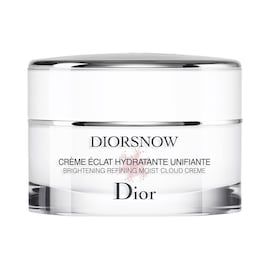
Dior snow Illuminating Cloud Cream

Dior snow Illuminating Cloud Cream

Efficacy75/100IrritancyHigh
Edit

Works for

3 of 3 advertised claims delivered

Evens skin tone
4 ingredients credited for this claim
Moderate support
What the product description says
“Dark spots, dullness, and uneven textrue Formulation.”
Source: Sephora

The following ingredient (ingredients) in this product might be helpful, but there is no evidence to confirm that it actually works: ascorbyl glucoside.

Ascorbyl glucosideKey activeEffect: MediumA vitamin C derivative that is more stable but less potent than pure form of vitamin C. Has a potential to boost collagen production, nutralise free radicals and reduce hyperpigmentation, but the required concentration is likely to be much higher than for the pure form of vitamin C, limiting the ingredient's effectiveness in products~1.4–1.8%
Zinc gluconateEffect: Low, below effective doseTypically used to stabilize the product formulations. It is a salt of a polyhydroxy acid (PHA) and in larger concentrations, can help shed the dead cells from the skin surface revealing smoother skin. It can help attract water to the upper layer of the skin. Might to be helpful against acne and clogged pores. Could be helpful in neutralizing free radicals, but solid research is missing. Due to the zinc content, might help calm down inflammation in skin~0.25–0.45%
Yeast extractEffect: Low, below effective doseHelps attract water to the upper layer of the skin and might have some anti-oxidant and skin lightening properties. It can help calm down inflammation in skin~0.25–0.45%
Dipotassium glycyrrhizateEffect: Low, below effective doseA salt derived from licorice. Works as an emollient to soften the upper layer of the skin and can help calm down inflammation. Might be helpful for skin lightening~0.25–0.5%
Moisturizing
14 ingredients credited for this claim
Good support
What the product description says
“snow Illuminating Cloud Cream”
From product name

This product can help improve hydration of the skin with the two types of ingredients.

The first type is called “humectants”:
these ingredients help attract water. When humectants are on the surface of the skin, they “pull in” the moisture from the outside environment, or from within deeper layers of the skin. The following ingredients in this product do the job: faex, glycerin.

This product also contains ingredients called “occlusives”. They help reduce the speed with which our skin loses moisture to the outside environment. These ingredients also help soften the upper layer of the skin, so it feels less tight and nicer to the touch. The following ingredients in this product do the job: caprylic/capric triglyceride, dimethicone.

DimethiconeKey active· Emollient, OcclusiveEffect: HighA silicone that helps to reduce water loss from the surface of the skin. Can temporarily "fill in" lines and wrinkles, absorb oil, and create a nice product finish~1–1.2%
GlycerinKey active· HumectantEffect: HighOne of the best moisturizing ingredients. Naturally present in skin. It attracts water to the upper layer of the skin working as a humectant~4.7–5.7%
AtelocollagenKey activeEffect: HighA protein that helps to attract moisture to the upper layer of the skin and might be helpful in reducing fine lines and wrinkles~0.25–0.45%
Caprylic/capric triglycerideKey active· Emollient, OcclusiveEffect: HighA good mix of fatty acids that forms a protective layer on the skin. Improves the shelf life of products. Derived from coconut and glycerin~1.6–2%
FaexKey active· HumectantEffect: HighYeast extract. Helps to attract water to the upper layer of the skin~0.25–0.45%
Sodium hyaluronateKey active· HumectantEffect: HighOne of the best moisturizing ingredients. Attracts water into the upper layer of the skin~0.2–0.4%
Cetyl alcoholKey active· EmollientEffect: MediumA non-drying alcohol that works to soften the skin and stabilize product formulations helping oil and water mix together~0.6–0.9%
Glucosyl hesperidinKey active· HumectantEffect: MediumMight be able to neutralize free radicals in skin. Also works as a humectant~0.25–0.45%
Pentylene glycol· EmollientEffect: LowUsed to preserve products, dissolve other ingredients and create a nice product texture~2.3–2.8%
Butylene glycol· HumectantEffect: LowUsed to create a nice product texture and help delivery of other ingredients. Might be somewhat helpful in attracting water to the upper layer of the skin~2.9–3.6%
Dipotassium glycyrrhizateUnder-dosedEffect: HighA salt derived from licorice. Works as an emollient to soften the upper layer of the skin and can help calm down inflammation. Might be helpful for skin lightening~0.25–0.5%
Zinc gluconateUnder-dosedEffect: HighTypically used to stabilize the product formulations. It is a salt of a polyhydroxy acid (PHA) and in larger concentrations, can help shed the dead cells from the skin surface revealing smoother skin. It can help attract water to the upper layer of the skin. Might to be helpful against acne and clogged pores. Could be helpful in neutralizing free radicals, but solid research is missing. Due to the zinc content, might help calm down inflammation in skin~0.25–0.45%
Yeast extractUnder-dosedEffect: HighHelps attract water to the upper layer of the skin and might have some anti-oxidant and skin lightening properties. It can help calm down inflammation in skin~0.25–0.45%
Stearic acidEffect: Low, below effective doseHelps oil and water mix together and works as an emollient~0.35–0.65%
Anti-aging
3 ingredients credited for this claim
Moderate support
What the product description says
“Helps diminish and prevent the appearance of dark spots, which may appear with aging or repeated sunlight exposure.”
Source: Sephora

This product contains ascorbyl glucoside, atelocollagen. These ingredients might be able to help reduce and prevent fine lines and wrinkles, improve skin elasticity and firmness, but there is not enough evidence that it actually works.

AtelocollagenKey activeEffect: MediumA protein that helps to attract moisture to the upper layer of the skin and might be helpful in reducing fine lines and wrinkles~0.25–0.45%
Ascorbyl glucosideKey activeEffect: MediumA vitamin C derivative that is more stable but less potent than pure form of vitamin C. Has a potential to boost collagen production, nutralise free radicals and reduce hyperpigmentation, but the required concentration is likely to be much higher than for the pure form of vitamin C, limiting the ingredient's effectiveness in products~1.4–1.8%
Zinc gluconateEffect: Low, below effective doseTypically used to stabilize the product formulations. It is a salt of a polyhydroxy acid (PHA) and in larger concentrations, can help shed the dead cells from the skin surface revealing smoother skin. It can help attract water to the upper layer of the skin. Might to be helpful against acne and clogged pores. Could be helpful in neutralizing free radicals, but solid research is missing. Due to the zinc content, might help calm down inflammation in skin~0.25–0.45%
Anti-oxidation
Not advertised by the brand · 5 ingredients credited for this claim
Moderate support

This product contains antioxidants (ascorbyl glucoside) that might be able to help neutralize free radicals in skin to lessen the damage it gets from the UV light (sun). There is not enough evidence to confirm their effectiveness in skin though.

Ascorbyl glucosideKey activeEffect: MediumA vitamin C derivative that is more stable but less potent than pure form of vitamin C. Has a potential to boost collagen production, nutralise free radicals and reduce hyperpigmentation, but the required concentration is likely to be much higher than for the pure form of vitamin C, limiting the ingredient's effectiveness in products~1.4–1.8%
Glucosyl hesperidinEffect: LowMight be able to neutralize free radicals in skin. Also works as a humectant~0.25–0.45%
ErgothioneineUnder-dosedEffect: HighCan help neutralize free radicals in skin. Preliminary studies show that it can be more effective than coenzyme Q10 but studies on effective concentration for topical applications are lacking~0.1–0.2%
Yeast extractUnder-dosedEffect: MediumHelps attract water to the upper layer of the skin and might have some anti-oxidant and skin lightening properties. It can help calm down inflammation in skin~0.25–0.45%
Zinc gluconateEffect: Low, below effective doseTypically used to stabilize the product formulations. It is a salt of a polyhydroxy acid (PHA) and in larger concentrations, can help shed the dead cells from the skin surface revealing smoother skin. It can help attract water to the upper layer of the skin. Might to be helpful against acne and clogged pores. Could be helpful in neutralizing free radicals, but solid research is missing. Due to the zinc content, might help calm down inflammation in skin~0.25–0.45%

Can it cause trouble?

Irritancy
6 strong irritants: Alcohol, Parfum + 4 more — patch-test recommended
High risk
We flagged 22 ingredients with irritancy potential. Severity depends on your sensitivity threshold; the table lists the worst offenders first.
IngredientFunctionIrritationEst. amount
AlcoholCan be drying and contribute to skin irritation. Used in formulars to dissolve other ingredients, create a thinner product consistency or for its antibacterial propertiesHigh~1.8–2.2%est.
ParfumAn aromatic blend of unspecified and possibly irritating ingredientsHigh~0.3–0.55%est.
Malva sylvestris extract—High~0.25–0.45%est.
Citrus unshiu peel extract—High~0.25–0.45%est.
Alpha-isomethyl iononeA fragrance. Potential allergen and can be irritatingHigh~0.2–0.4%est.
LinaloolA fragrance. Can be irritatingHigh~0.2–0.4%est.
CitronellolA fragrance. Can be irritatingHigh~0.2–0.4%est.
Pentylene glycolUsed to preserve products, dissolve other ingredients and create a nice product textureMedium~2.3–2.8%est.
Caprylic/capric triglycerideA good mix of fatty acids that forms a protective layer on the skin. Improves the shelf life of products. Derived from coconut and glycerinMedium~1.6–2%est.
Ascorbyl glucosideA vitamin C derivative that is more stable but less potent than pure form of vitamin C. Has a potential to boost collagen production, nutralise free radicals and reduce hyperpigmentation, but the required concentration is likely to be much higher than for the pure form of vitamin C, limiting the ingredient's effectiveness in productsMedium~1.4–1.8%est.
Steareth-21Helps oil and water mix togetherMedium~0.65–0.95%est.
Acrylates/c10-30 alkyl acrylate crosspolymerMaintains the texture of skincare products. Allows the product to spread evenly. Helps oil and water mix togetherMedium~0.45–0.65%est.
Sodium citrateHelps to control the skin's pH level. Maintains the skin's natural film of amino-lactic acids and oils. Helps to preserve productsMedium~0.4–0.6%est.
Steareth-2Helps oil and water mix togetherMedium~0.35–0.65%est.
Tetrasodium edtaHelps to stabilize the product formulationMedium~0.25–0.5%est.
Citric acidCan work as an exfoliant but is typically used to adjust the product pHMedium~0.25–0.45%est.
Sodium stearateHelps oil and water mix togetherMedium~0.65–1%est.
Potassium sorbateA preservativeMedium~0.25–0.45%est.
Zinc gluconateTypically used to stabilize the product formulations. It is a salt of a polyhydroxy acid (PHA) and in larger concentrations, can help shed the dead cells from the skin surface revealing smoother skin. It can help attract water to the upper layer of the skin. Might to be helpful against acne and clogged pores. Could be helpful in neutralizing free radicals, but solid research is missing. Due to the zinc content, might help calm down inflammation in skinMedium~0.25–0.45%est.
EthylhexylglycerinA preservativeMedium~0.2–0.4%est.
BhtA preservativeMedium~0.2–0.35%est.
Ci 14700A colorantMedium~0.1–0.25%est.
Comedogenic
Clean of flagged comedogenic ingredients
None flagged
Edit
Cheaper Alternatives
Similar formulations, better price
No cheaper similar product found.

User reviews

Would you recommend?
No community reviews yet.

Be the first — your take helps the next person decide.

Write a review · ~30s

Ingredients

Filter by role to see what each ingredient is doing.

Water~45–55%
Formula
Irritation risk
Low

Plain old water

More about Water
Glycerin~4.7–5.7%
Key active
Irritation risk
Low
Works for
Moisturizing

One of the best moisturizing ingredients. Naturally present in skin. It attracts water to the upper layer of the skin working as a humectant

More about Glycerin
Propylene glycol dicaprylate/dicaprate~4.1–5%
Formula
Butylene glycol~2.9–3.6%
Formula
Irritation risk
Low
Works for
Moisturizing

Used to create a nice product texture and help delivery of other ingredients. Might be somewhat helpful in attracting water to the upper layer of the skin

More about Butylene glycol
Pentylene glycol~2.3–2.8%
Irritant · medium
Irritation risk
Medium
Works for
Moisturizing

Used to preserve products, dissolve other ingredients and create a nice product texture

More about Pentylene glycol
Alcohol~1.8–2.2%
Irritant · high
Irritation risk
High
Works for
Antibacterial

Can be drying and contribute to skin irritation. Used in formulars to dissolve other ingredients, create a thinner product consistency or for its antibacterial properties

More about Alcohol
Caprylic/capric triglyceride~1.6–2%
Key activeIrritant · medium
Irritation risk
Medium
Works for
Moisturizing

A good mix of fatty acids that forms a protective layer on the skin. Improves the shelf life of products. Derived from coconut and glycerin

More about Caprylic/capric triglyceride
Ascorbyl glucoside~1.4–1.8%
Key activeIrritant · medium
Irritation risk
Medium
Works for
Anti-oxidationEvens skin toneAnti-aging

A vitamin C derivative that is more stable but less potent than pure form of vitamin C. Has a potential to boost collagen production, nutralise free radicals and reduce hyperpigmentation, but the required concentration is likely to be much higher than for the pure form of vitamin C, limiting the ingredient's effectiveness in products

More about Ascorbyl glucoside
Vinyl dimethicone/methicone silsesquioxane crosspolymer~1.1–1.4%
Formula
Irritation risk
Low

A type of silicone that create a smooth product finish and can create an optical soft-focus effect on the skin. Helps to thicken the product consistency

More about Vinyl dimethicone/methicone silsesquioxane crosspolymer
Dimethicone~1–1.2%
Key active
Irritation risk
Low
Works for
MoisturizingMattifying

A silicone that helps to reduce water loss from the surface of the skin. Can temporarily "fill in" lines and wrinkles, absorb oil, and create a nice product finish

More about Dimethicone
Tromethamine~0.65–1%
Formula
Irritation risk
Low

Helps adjust pH in products

More about Tromethamine
Steareth-21~0.65–0.95%
Irritant · medium
Irritation risk
Medium
Works for
Cleansing

Helps oil and water mix together

More about Steareth-21
Cetyl alcohol~0.6–0.9%
Key active
Irritation risk
Low
Works for
CleansingMoisturizing

A non-drying alcohol that works to soften the skin and stabilize product formulations helping oil and water mix together

More about Cetyl alcohol
Stearyl alcohol~0.55–0.85%
Formula
Irritation risk
Low
Works for
Cleansing

An emollient that helps soften the skin

More about Stearyl alcohol
Phenoxyethanol~0.45–0.65%
Formula
Irritation risk
Low

A preservative. It helps prevent bacterial growth in cosmetic products

More about Phenoxyethanol
Acrylates/c10-30 alkyl acrylate crosspolymer~0.45–0.65%
Irritant · medium
Irritation risk
Medium

Maintains the texture of skincare products. Allows the product to spread evenly. Helps oil and water mix together

More about Acrylates/c10-30 alkyl acrylate crosspolymer
Sodium citrate~0.4–0.6%
Irritant · medium
Irritation risk
Medium

Helps to control the skin's pH level. Maintains the skin's natural film of amino-lactic acids and oils. Helps to preserve products

More about Sodium citrate
Steareth-2~0.35–0.65%
Irritant · medium
Irritation risk
Medium
Works for
Cleansing

Helps oil and water mix together

More about Steareth-2
Parfum~0.3–0.55%
Irritant · high
Irritation risk
High

An aromatic blend of unspecified and possibly irritating ingredients

More about Parfum
Dipotassium glycyrrhizate~0.25–0.5%
Under-dosed
Irritation risk
Low
Works for
MoisturizingAnti-inflammatoryEvens skin tone

A salt derived from licorice. Works as an emollient to soften the upper layer of the skin and can help calm down inflammation. Might be helpful for skin lightening

More about Dipotassium glycyrrhizate
Tetrasodium edta~0.25–0.5%
Irritant · medium
Irritation risk
Medium

Helps to stabilize the product formulation

More about Tetrasodium edta
Xanthan gum~0.25–0.5%
Formula
Irritation risk
Low
Works for
Cleansing

Used to create a thicker product consistency

More about Xanthan gum
Cellulose~0.3–0.55%
Formula
Irritation risk
Low
Works for
Mattifying

Can be used to help absorb oil as well as add volume and imporve texture of products.

More about Cellulose
Silica~0.4–0.6%
Formula
Irritation risk
Low

Used to absorb oil and can temporarily mattify skin

More about Silica
Ci 77891~0.25–0.45%
Formula
Irritation risk
Low
More about Ci 77891
Titanium dioxide~0.35–0.6%
Formula
Irritation risk
Low
Works for
Sun protection

Works as a UV filter when used in high concentrations. It is photostable and is effective mostly against the UVB light, with some protection in the UVA range. In small concentrations, used for its ability to improve the color of cosmetic products. Is usually well tolerated by the skin

More about Titanium dioxide
Malva sylvestris extract~0.25–0.45%
Irritant · high
Citrus unshiu peel extract~0.25–0.45%
Irritant · high
Glucosyl hesperidin~0.25–0.45%
Key active
Irritation risk
Low
Works for
MoisturizingAnti-oxidation

Might be able to neutralize free radicals in skin. Also works as a humectant

More about Glucosyl hesperidin
Faex~0.25–0.45%
Key active
Irritation risk
Low
Works for
Moisturizing

Yeast extract. Helps to attract water to the upper layer of the skin

More about Faex
Yeast extract~0.25–0.45%
Under-dosed
Irritation risk
Low
Works for
MoisturizingAnti-oxidationAnti-inflammatoryReduces irritationEvens skin tone

Helps attract water to the upper layer of the skin and might have some anti-oxidant and skin lightening properties. It can help calm down inflammation in skin

More about Yeast extract
Citric acid~0.25–0.45%
Irritant · medium
Irritation risk
Medium

Can work as an exfoliant but is typically used to adjust the product pH

More about Citric acid
Carbomer~0.25–0.45%
Formula
Irritation risk
Low
Works for
Cleansing

Helps create a thicker or gel-like product texture. It is not a surfactant but can be used in gentle cleansing formulations

More about Carbomer
Aluminum hydroxide~0.3–0.5%
Formula
Irritation risk
Low

Is used to add opaque (non-transparent) appearance to formulations. Can be used to coat other ingredients for even dispersion. This is a different ingredient compared to the ones used in antipersperants (aluminium chloride and aluminium chlorohydrate)

More about Aluminum hydroxide
Leontopodium alpinum extract~0.25–0.45%
Formula
Sodium stearate~0.65–1%
Irritant · medium
Irritation risk
Medium
Works for
Cleansing

Helps oil and water mix together

More about Sodium stearate
Alpha-isomethyl ionone~0.2–0.4%
Irritant · high
Irritation risk
High

A fragrance. Potential allergen and can be irritating

More about Alpha-isomethyl ionone
Linalool~0.2–0.4%
Irritant · high
Irritation risk
High

A fragrance. Can be irritating

More about Linalool
Citronellol~0.2–0.4%
Irritant · high
Irritation risk
High

A fragrance. Can be irritating

More about Citronellol
Potassium sorbate~0.25–0.45%
Irritant · medium
Irritation risk
Medium

A preservative

More about Potassium sorbate
Atelocollagen~0.25–0.45%
Key active
Irritation risk
Low
Works for
MoisturizingAnti-aging

A protein that helps to attract moisture to the upper layer of the skin and might be helpful in reducing fine lines and wrinkles

More about Atelocollagen
Stearic acid~0.35–0.65%
Formula
Irritation risk
Low
Works for
CleansingMoisturizing

Helps oil and water mix together and works as an emollient

More about Stearic acid
Zinc gluconate~0.25–0.45%
Under-dosedIrritant · medium
Irritation risk
Medium
Works for
MoisturizingAnti-inflammatoryAnti-agingAnti-blemishAnti-oxidationExfoliationEvens skin tone

Typically used to stabilize the product formulations. It is a salt of a polyhydroxy acid (PHA) and in larger concentrations, can help shed the dead cells from the skin surface revealing smoother skin. It can help attract water to the upper layer of the skin. Might to be helpful against acne and clogged pores. Could be helpful in neutralizing free radicals, but solid research is missing. Due to the zinc content, might help calm down inflammation in skin

More about Zinc gluconate
Sodium hyaluronate~0.2–0.4%
Key active
Irritation risk
Low
Works for
Moisturizing

One of the best moisturizing ingredients. Attracts water into the upper layer of the skin

More about Sodium hyaluronate
Sodium chloride~0.25–0.45%
Formula
Irritation risk
Low

Used to stabilize mixtures of oil and water, and create thicker, gel-like product textures

More about Sodium chloride
Ethylhexylglycerin~0.2–0.4%
Irritant · medium
Irritation risk
Medium

A preservative

More about Ethylhexylglycerin
Sodium benzoate~0.2–0.35%
Formula
Irritation risk
Low

A preservative

More about Sodium benzoate
Bht~0.2–0.35%
Irritant · medium
Irritation risk
Medium

A preservative

More about Bht
Hydrated silica~0.3–0.55%
Formula
Irritation risk
Low
Works for
Mattifying
More about Hydrated silica
Hydrogen dimethicone~0.2–0.35%
Formula
Irritation risk
Low

Helps the function of sunscreen and pigment ingredients in the formulation

More about Hydrogen dimethicone
Sodium dna~0.15–0.25%
Formula
Irritation risk
Low
More about Sodium dna
Ci 14700~0.1–0.25%
Irritant · medium
Irritation risk
Medium

A colorant

More about Ci 14700
Disodium phosphate~0.1–0.25%
Formula
Irritation risk
Low

Helps adjust the product pH and stabilize the formulation

More about Disodium phosphate
Ergothioneine~0.1–0.2%
Under-dosed
Irritation risk
Low
Works for
Anti-oxidation

Can help neutralize free radicals in skin. Preliminary studies show that it can be more effective than coenzyme Q10 but studies on effective concentration for topical applications are lacking

More about Ergothioneine
Potassium chloride~0.1–0.15%
Formula
Potassium phosphate~0.1–0.15%
Formula
Irritation risk
Low

Helps regulate the pH of the formulation

More about Potassium phosphate
Ingredient list view

Water, Glycerin, Propylene glycol dicaprylate/dicaprate, Butylene glycol, Pentylene glycol, Alcohol, Caprylic/capric triglyceride, Ascorbyl glucoside, Vinyl dimethicone/methicone silsesquioxane crosspolymer, Dimethicone, Tromethamine, Steareth-21, Cetyl alcohol, Stearyl alcohol, Phenoxyethanol, Acrylates/c10-30 alkyl acrylate crosspolymer, Sodium citrate, Steareth-2, Parfum, Dipotassium glycyrrhizate, Tetrasodium edta, Xanthan gum, Cellulose, Silica, Ci 77891, Titanium dioxide, Malva sylvestris extract, Citrus unshiu peel extract, Glucosyl hesperidin, Faex, Yeast extract, Citric acid, Carbomer, Aluminum hydroxide, Leontopodium alpinum extract, Sodium stearate, Alpha-isomethyl ionone, Linalool, Citronellol, Potassium sorbate, Atelocollagen, Stearic acid, Zinc gluconate, Sodium hyaluronate, Sodium chloride, Ethylhexylglycerin, Sodium benzoate, Bht, Hydrated silica, Hydrogen dimethicone, Sodium dna, Ci 14700, Disodium phosphate, Ergothioneine, Potassium chloride, Potassium phosphate

Compare prices

Retailers ranked by price — lowest first.

No pricing data available yet for this product.
Cheaper alternatives? See how this stacks up against similar formulas.
We compare ingredient profiles across our catalog — pick the closest match for your budget.
Open dupe finder

Sources cited in this review

Every concentration estimate and effectiveness label is anchored to one of these 23 studies and safety reviews.

  1. 1
  2. 2
  3. 3
  4. 4
  5. 5
  6. 6
Dior snow Illuminating Cloud Cream
Diorsnow Illuminating Cloud Cream

Affiliate links · As an Amazon Associate, WIMJ earns from qualifying purchases.

As an Amazon Associate, WIMJ earns from qualifying purchases.