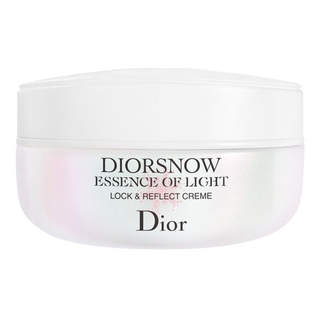
Dior Diorsnow Essence Of Light Lock & Reflect Creme
Works for
2 of 2 advertised claims delivered
Evens skin tone4 ingredients credited for this claimModerate support
“A moisturising brightening cream infused with brightening Edelweiss that hydrates the skin and revives its radiance.”
The following ingredient (ingredients) in this product might be helpful, but there is no evidence to confirm that it actually works: ascorbyl glucoside.
Moisturizing16 ingredients credited for this claimGood support
“A moisturising brightening cream infused with brightening Edelweiss that hydrates the skin and revives its radiance.”
This product can help improve hydration of the skin with the two types of ingredients.
The first type is called “humectants”:
these ingredients help attract water.
When humectants are on the surface of the skin, they “pull in” the moisture from the outside environment, or from
within deeper layers of the skin. The following ingredients in this product do the job:
glycerin, glucose.
This product also contains ingredients called “occlusives”. They help reduce the speed with which our skin loses moisture to the outside environment. These ingredients also help soften the upper layer of the skin, so it feels less tight and nicer to the touch. The following ingredients in this product do the job: caprylic/capric triglyceride, dimethicone.
Anti-agingNot advertised by the brand · 4 ingredients credited for this claimModerate support
This product contains ascorbyl glucoside. This ingredient might be able to help reduce and prevent fine lines and wrinkles, improve skin elasticity and firmness, but there is not enough evidence that it actually works.
Anti-oxidationNot advertised by the brand · 3 ingredients credited for this claimModerate support
This product contains antioxidants (ascorbyl glucoside) that might be able to help neutralize free radicals in skin to lessen the damage it gets from the UV light (sun). There is not enough evidence to confirm their effectiveness in skin though.
Can it cause trouble?
Irritancy3 strong irritants: Alcohol, Citrus unshiu peel extract + 1 more — patch-test recommendedHigh risk
ComedogenicClean of flagged comedogenic ingredientsNone flagged
User reviews
Be the first — your take helps the next person decide.
Ingredients
Filter by role to see what each ingredient is doing.
Water~40–60%
Glycerin~4–6.1%
- Irritation risk
- Low
One of the best moisturizing ingredients. Naturally present in skin. It attracts water to the upper layer of the skin working as a humectant
More about GlycerinPentylene glycol~3.6–5.4%
- Irritation risk
- Medium
Used to preserve products, dissolve other ingredients and create a nice product texture
More about Pentylene glycolPropylene glycol dicaprylate/dicaprate~2.7–4%
- Irritation risk
- Low
Butylene glycol~1.9–2.9%
- Irritation risk
- Low
Used to create a nice product texture and help delivery of other ingredients. Might be somewhat helpful in attracting water to the upper layer of the skin
More about Butylene glycolAlcohol~1.5–2.3%
- Irritation risk
- High
Can be drying and contribute to skin irritation. Used in formulars to dissolve other ingredients, create a thinner product consistency or for its antibacterial properties
More about AlcoholCaprylic/capric triglyceride~1.4–2%
- Irritation risk
- Medium
A good mix of fatty acids that forms a protective layer on the skin. Improves the shelf life of products. Derived from coconut and glycerin
More about Caprylic/capric triglycerideTromethamine~1.2–1.7%
Ascorbyl glucoside~1–1.5%
- Irritation risk
- Medium
A vitamin C derivative that is more stable but less potent than pure form of vitamin C. Has a potential to boost collagen production, nutralise free radicals and reduce hyperpigmentation, but the required concentration is likely to be much higher than for the pure form of vitamin C, limiting the ingredient's effectiveness in products
More about Ascorbyl glucosideArachidyl alcohol~0.6–1.35%
- Irritation risk
- Low
Used to soften the upper layer of the skin and create a thicker product consistency
More about Arachidyl alcoholCetyl alcohol~0.5–1.15%
- Irritation risk
- Low
A non-drying alcohol that works to soften the skin and stabilize product formulations helping oil and water mix together
More about Cetyl alcoholStearyl alcohol~0.4–0.95%
- Irritation risk
- Low
An emollient that helps soften the skin
More about Stearyl alcoholMalva sylvestris extract~0.15–0.55%
- Irritation risk
- High
Leontopodium alpinum extract~0.15–0.65%
- Irritation risk
- Low
Lactic acid~0.15–0.6%
- Irritation risk
- Medium
An exfoliating and moisturizing alpha-hydroxy acid (AHA). Typically causes less irritation than other AHAs, for example, glycolic acid. At high concentrations (about 15%), lactic acid can help reduce lines and wrinkles. Recent studies show that lactic acid can support the "good" bacteria living on skin's surface (healthy skin microbiome)
More about Lactic acidDipotassium glycyrrhizate~0.15–0.6%
- Irritation risk
- Low
A salt derived from licorice. Works as an emollient to soften the upper layer of the skin and can help calm down inflammation. Might be helpful for skin lightening
More about Dipotassium glycyrrhizateZinc gluconate~0.15–0.55%
- Irritation risk
- Medium
Typically used to stabilize the product formulations. It is a salt of a polyhydroxy acid (PHA) and in larger concentrations, can help shed the dead cells from the skin surface revealing smoother skin. It can help attract water to the upper layer of the skin. Might to be helpful against acne and clogged pores. Could be helpful in neutralizing free radicals, but solid research is missing. Due to the zinc content, might help calm down inflammation in skin
More about Zinc gluconateCitrus unshiu peel extract~0.15–0.5%
- Irritation risk
- High
Angelica acutiloba root extract~0.1–0.45%
- Irritation risk
- Low
Sodium dna~0.1–0.35%
- Irritation risk
- Low
Behenyl alcohol~0.1–0.5%
- Irritation risk
- Low
Non-drying alcohol that helps water and oil mix together. Also serves as an emollient
More about Behenyl alcoholSteareth-21~0.15–0.55%
Arachidyl glucoside~0.1–0.35%
Lauroyl lysine~0.05–0.3%
- Irritation risk
- Low
Helps soften the upper layer of the skin and creates a nice product texture
More about Lauroyl lysineSodium citrate~0.05–0.3%
- Irritation risk
- Medium
Helps to control the skin's pH level. Maintains the skin's natural film of amino-lactic acids and oils. Helps to preserve products
More about Sodium citrateEthylhexylglycerin~0.1–0.35%
Chlorphenesin~0.05–0.3%
Parfum~0.05–0.25%
- Irritation risk
- High
An aromatic blend of unspecified and possibly irritating ingredients
More about ParfumLecithin~0.1–0.4%
- Irritation risk
- Low
Used mostly for creating emulsions - helping oil and water mix together. Helps soften the upper layer of the skin
More about LecithinXanthan gum~0.1–0.3%
- Irritation risk
- Low
Used to create a thicker product consistency
More about Xanthan gumCitric acid~0.05–0.3%
- Irritation risk
- Medium
Can work as an exfoliant but is typically used to adjust the product pH
More about Citric acidPotassium sorbate~0.05–0.3%
Sodium metabisulfite~0.1–0.2%
Sodium benzoate~0.05–0.2%
Glucose~0.05–0.2%
- Irritation risk
- Low
Helps attract water to the upper layer of the skin. Could be helpful in restoring the skin barrier function
More about GlucoseTocopherol~0.05–0.2%
- Irritation risk
- Low
Pure form of vitamin E. Can help moisturise and protect the skin from free radicals. Often used to help stabilise other ingredients or the formula itself
More about TocopherolDimethicone~0.05–0.25%
- Irritation risk
- Low
A silicone that helps to reduce water loss from the surface of the skin. Can temporarily "fill in" lines and wrinkles, absorb oil, and create a nice product finish
More about DimethiconeCaprylyl glycol~0.05–0.15%
- Irritation risk
- Medium
Helps preserve products and creates a nice product texture
More about Caprylyl glycolCarbomer~0.01–0.05%
- Irritation risk
- Low
Helps create a thicker or gel-like product texture. It is not a surfactant but can be used in gentle cleansing formulations
More about CarbomerIngredient list view
Water, Glycerin, Pentylene glycol, Propylene glycol dicaprylate/dicaprate, Butylene glycol, Alcohol, Caprylic/capric triglyceride, Tromethamine, Ascorbyl glucoside, Arachidyl alcohol, Cetyl alcohol, Stearyl alcohol, Malva sylvestris extract, Leontopodium alpinum extract, Lactic acid, Dipotassium glycyrrhizate, Zinc gluconate, Citrus unshiu peel extract, Angelica acutiloba root extract, Sodium dna, Behenyl alcohol, Steareth-21, Arachidyl glucoside, Lauroyl lysine, Sodium citrate, Ethylhexylglycerin, Chlorphenesin, Parfum, Lecithin, Xanthan gum, Citric acid, Potassium sorbate, Sodium metabisulfite, Sodium benzoate, Glucose, Tocopherol, Dimethicone, Caprylyl glycol, Carbomer
Compare prices
Retailers ranked by price — lowest first.
Affiliate links · prices updated regularly · As an Amazon Associate, WIMJ earns from qualifying purchases.
Sources cited in this review
Every concentration estimate and effectiveness label is anchored to one of these 20 studies and safety reviews.
- 1
- 2Safety Assessment of Tromethamine as Used in Cosmeticscir-safety.org
- 3The Roles of Vitamin C in Skin Healthncbi.nlm.nih.gov
- 4
- 5Epidermal and dermal effects of topical lactic acidncbi.nlm.nih.gov
- 6Dual Effects of Alpha-Hydroxy Acids on the Skinpdfs.semanticscholar.org

Affiliate links · As an Amazon Associate, WIMJ earns from qualifying purchases.