Works for
Anti-agingLactic acid ~0.35–0.85%, below the ~2% it needs + 1 moreUnder-dosed
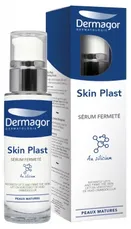
“Dermagor Skin Plast Firmness Serum 30ml is a care that acts against skin aging and visibly reduces the signs of aging thanks to:”
Effective ingredients missing or their concentration is too low.
MoisturizingSide benefit · Glycerin, Isopropyl myristate + 2 moreWorks
This product can help improve hydration of the skin with the two types of ingredients.
The first type is called “humectants”:
these ingredients help attract water.
When humectants are on the surface of the skin, they “pull in” the moisture from the outside environment, or from
within deeper layers of the skin. The following ingredients in this product do the job:
glycerin.
This product also contains ingredients called “occlusives”. They help reduce the speed with which our skin loses moisture to the outside environment. These ingredients also help soften the upper layer of the skin, so it feels less tight and nicer to the touch. The following ingredients in this product do the job: isopropyl myristate, isohexadecane.
Can it cause trouble?
Irritancy8 strong irritants: Parfum, Retinyl palmitate + 6 more — patch-test recommendedHigh risk
Comedogenic1 ingredient rated 2 or more on the 0–5 pore-clogging scale1 flagged


User reviews
Be the first — your take helps the next person decide.
Ingredients
Filter by role to see what each ingredient is doing.
Water~40–60%
Glycerin~4–6%
- Irritation risk
- Low
One of the best moisturizing ingredients. Naturally present in skin. It attracts water to the upper layer of the skin working as a humectant
More about GlycerinIsopropyl myristate~3.5–5.2%
- Irritation risk
- Low
- Comedogenicity
- 3/5
An emollient that helps soften the skin. Could be comedogenic
More about Isopropyl myristateMethylsilanol mannuronate~2.6–3.9%
- Irritation risk
- Low
Acrylates copolymer~2–3%
- Irritation risk
- Medium
Used to stabilize product formulation, help create an even product layer over skin (for example, in sunscreen) and create a thicker product consistency
More about Acrylates copolymerHydroxyethyl acrylate/sodium acryloyldimethyl taurate copolymer~1.6–2.4%
- Irritation risk
- Medium
A gelling agent that thickens the product consistency and leaves the skin with a velvety finish
More about Hydroxyethyl acrylate/sodium acryloyldimethyl taurate copolymerPhenoxyethanol~0.5–1%
- Irritation risk
- Low
A preservative. It helps prevent bacterial growth in cosmetic products
More about PhenoxyethanolIsohexadecane~1.3–1.9%
- Irritation risk
- Low
Improves the texture of the product and helps soften the skin. Helps oil and water mix together and can be used as a cleansing agent
More about IsohexadecaneAcacia senegal gum~1–1.5%
- Irritation risk
- Medium
Helps mask the small of other ingredients and improve the product texture
More about Acacia senegal gumXanthan gum~0.5–1.2%
- Irritation risk
- Low
Used to create a thicker product consistency
More about Xanthan gumLactic acid~0.35–0.85%
- Irritation risk
- Medium
An exfoliating and moisturizing alpha-hydroxy acid (AHA). Typically causes less irritation than other AHAs, for example, glycolic acid. At high concentrations (about 15%), lactic acid can help reduce lines and wrinkles. Recent studies show that lactic acid can support the "good" bacteria living on skin's surface (healthy skin microbiome)
More about Lactic acidParfum~0.2–0.7%
- Irritation risk
- High
An aromatic blend of unspecified and possibly irritating ingredients
More about ParfumPolysorbate 60~0.15–0.55%
Ethylhexylglycerin~0.1–0.45%
Sorbitan isostearate~0.1–0.45%
- Irritation risk
- Low
Helps oil and water mix together
More about Sorbitan isostearateTocopheryl acetate~0.1–0.45%
- Irritation risk
- Medium
A more stable but less bio-available form of vitamin E compared to Tocopherol. Might help moisturize and protect the skin from free radicals, but mostly used in low concentrations to stabilize other ingredients.
More about Tocopheryl acetateVp/polycarbamyl polyglycol ester~0.1–0.5%
- Irritation risk
- Low
Hydrolyzed sesame protein~0.1–0.4%
- Irritation risk
- Low
Retinyl palmitate~0.1–0.3%
- Irritation risk
- High
Three steps removed from the active form of vitamin A - retinoic acid. To have an effect in the skin, it first needs to be converted twice to become the retinoic acid. This means it is less potent than retinol, but could also be less irritating. Once converted to the retinoic acid in the skin, it helps against all signs of aging, improves skin cell turnover and helps fight blemishes and clogged pores. However, in many cosmetic formulations, it is used in a concentration that is too low to have the full effect
More about Retinyl palmitateArachis hypogaea oil~0.05–0.3%
- Irritation risk
- Low
Hexyl cinnamal~0.05–0.25%
Alpha-isomethyl ionone~0.05–0.25%
- Irritation risk
- High
A fragrance. Potential allergen and can be irritating
More about Alpha-isomethyl iononeAmyl cinnamal~0.05–0.2%
- Irritation risk
- High
Sorbic acid~0.05–0.2%
Linalool~0.05–0.15%
Citronellol~0.05–0.15%
Hydroxycitronellal~0.01–0.1%
- Irritation risk
- High
A fragrance. A likely allergen and can be irritating
More about HydroxycitronellalBha~0.01–0.05%
Bht~0.01–0.05%
Ingredient list view
Water, Glycerin, Isopropyl myristate, Methylsilanol mannuronate, Acrylates copolymer, Hydroxyethyl acrylate/sodium acryloyldimethyl taurate copolymer, Phenoxyethanol, Isohexadecane, Acacia senegal gum, Xanthan gum, Lactic acid, Parfum, Polysorbate 60, Ethylhexylglycerin, Sorbitan isostearate, Tocopheryl acetate, Vp/polycarbamyl polyglycol ester, Hydrolyzed sesame protein, Unknown, Retinyl palmitate, Arachis hypogaea oil, Hexyl cinnamal, Alpha-isomethyl ionone, Amyl cinnamal, Sorbic acid, Linalool, Citronellol, Hydroxycitronellal, Bha, Bht
Compare prices
Retailers ranked by price — lowest first.
Affiliate links · As an Amazon Associate, WIMJ earns from qualifying purchases.
Worth comparing, line by line.
Match % combines shared ingredients, the first five ingredients, shared actives and hero ingredients, irritancy (lower counts in the alternative's favour), texture and body area. Only products in the same routine step are compared.
| DermagorSkin Plast Firmness SerumYOUR PRODUCT | UriageAge Protect Multi-Action Intensive Serum | FacileClear Serum | AQ Skin SolutionsGF Active Serum | |
|---|---|---|---|---|
| Match | — | 61% | 59% | 59% |
| Price | $86.50 | $43.03−$43.47 | $38.00−$48.50 | $205.00+$118.50 |
| Shared key ingredients | — | 3 of 4 | 2 of 4 | 2 of 4 |
| Key difference | — | Adenosine | Niacinamide | Oligopeptide-1 |
| Irritancy | High | Medium | Low | Medium |
| Drying alcohol | — | — | — | — |
| View product | Shop | Shop | Shop |


More alternatives: Peter Thomas Roth Water Drench Hyaluronic Glow SerumDermalogica biolumin-c serum - deluxe
Product summary
"Dermagor - Skin Plast Firmness Serum" could be helpful for: Moisturizing, but its actives are not the most effective or are not well-studied.
Ingredient callouts
- this product includes a form of Retinoids (vitamin A) - retinyl palmitate 0.10% - 0.30%, but this type of vitamin A is not very effective. It could in theory help with fine lines and wrinkles, but the effect is most likely minimal.
- Humectants (glycerin 4.00% - 6.00%). These ingredients help attract water to the upper layer of the skin and improve the skin hydration.
Price
The product retails for 41.99$ in the United States and from 21.70£ up to 46.00£ in the United Kingdom.
For a detailed price comparison: click here.
Sources cited in this review
Every concentration estimate and effectiveness label is anchored to one of these 5 studies and safety reviews.
- 1
- 2
- 3
- 4Epidermal and dermal effects of topical lactic acidncbi.nlm.nih.gov
- 5Dual Effects of Alpha-Hydroxy Acids on the Skinpdfs.semanticscholar.org

Affiliate links · As an Amazon Associate, WIMJ earns from qualifying purchases.