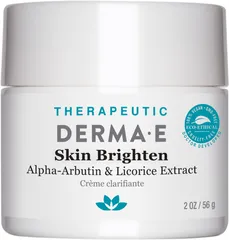
Works for:
based on ingredients and %- Evens skin tone
- Moisturizing
Can it cause trouble?
- Irritation risk: medium
- Comedogenic risk ingredients: 0
Key actives


Works for
Evens skin tone
What does the product description say?
Our therapeutic herbal effective herbal skin brightener contains a powerful blend of vitamins and herbal extracts that may help to brighten your complexion, reduce the appearance of age and liver spots, and even out skin tone, bikini area and underarms with this innovative, oil-free treatment that utilizes a unique blend of skin-brightening herbs and vitamins.
Source: Derma E
This product can help reduce hypepigmentation and even out the skin tone because it contains the following effective ingredients: alpha-arbutin
The following ingredient (ingredients) in this product might be helpful, but there is no evidence to confirm that it actually can help even out the skin tone: glycyrrhiza uralensis root extract.
Keep in mind that you would need to apply any topical skincare targetted at hypigmentation consistently for a couple of months to get a result. No topical skincare product can help get rid of hyperpigmentation (including post-acne marks and age spots) instantly.
Might help reduce hyperpigmentation when used regularly over a long period of time. Is more effective than beta-arbutin
Licorice root extract. Might be helpful in reducing hyperpigmentation
Moisturizing
This product can help improve hydration of the skin with the two types of ingredients.
The first type is called “humectants”:
these ingredients help attract water.
When humectants are on the surface of the skin, they “pull in” the moisture from the outside environment, or from
within deeper layers of the skin. The following ingredients in this product do the job:
glycerin.
This product also contains ingredients called “occlusives”. They help reduce the speed with which our skin loses moisture to the outside environment. These ingredients also help soften the upper layer of the skin, so it feels less tight and nicer to the touch. The following ingredients in this product do the job: caprylic/capric triglyceride, dimethicone.
An emollient made of jojoba oil. Helps soften the skin and support its barrier function
A silicone that helps to reduce water loss from the surface of the skin. Can temporarily "fill in" lines and wrinkles, absorb oil, and create a nice product finish
One of the best moisturizing ingredients. Naturally present in skin. It attracts water to the upper layer of the skin working as a humectant
A good mix of fatty acids that forms a protective layer on the skin. Improves the shelf life of products. Derived from coconut and glycerin
An emollient that softens skin and creates a nice product texture
A non-drying alcohol that works to soften the skin and stabilize product formulations helping oil and water mix together
Helps oil and water mix together and works as an emollient
An emollient that softens the skin and forms a protective layer on its surface. Helps water and oil mix together
Helps oil and water mix together while softening the upper layer of the skin
Softens the upper layer of skin and helps restore the healthy skin barrier. Has shown to help calm down inflammation in skin. It is a stable oil, meaning that it retains its properties even when exposed to air.
Might be able to help neutralize free radical, calm down inflammation in skin, and even skin tone
How honest is this product?
| Promise | Can it deliver? |
|---|---|
| Evens skin tone |
Total Promises Fulfilled score: 100/100.
We receive a small commission for purchases made through these links at no cost for you. Thank you for your support! Learn more
Potential irritants
Comedogenic ingredients
No comedogenic ingredients detected
User reviews (0)
Averages from community submissions.
No reviews yet for this product.
Be the first to share your experience!
Tried this product?
Help capture what the ingredient list can't—texture, finish, pilling, scent, and more. Answer what you can, skip the rest.
Takes ~30 seconds.
Reviews are shown in aggregate. No personal details.
| Product | Similarity | Price | Irritancy |
|---|---|---|---|
 Derma E Skin Brighten | Current | ≈ $13.98 | |
 Dr. Idriss Major Fade Hyper Serum | 57% | ≈ $68.59 | |
 PillowtalkDerm Major Fade Hyper Serum | 57% | - | |
![Best of You[th] Brightening Moisturizer](/_ipx/q_80&f_webp&fit_inside&s_160x160/https://image-delivery.nyc3.cdn.digitaloceanspaces.com/full/b8176924bd6c6074fb172cbc57a5445d.jpeg) Vasanti Best of You[th] Brightening Moisturizer | 57% | - | |
 Skinbetter Science Even Tone Correcting Serum Face | 57% | ≈ $157.20 | |
 Formulyst Anti-Aging Concentrate | 56% | - |
Key Actives
Might be able to help neutralize free radical, calm down inflammation in skin, and even skin tone
A silicone that helps to reduce water loss from the surface of the skin. Can temporarily "fill in" lines and wrinkles, absorb oil, and create a nice product finish
A good mix of fatty acids that forms a protective layer on the skin. Improves the shelf life of products. Derived from coconut and glycerin
One of the best moisturizing ingredients. Naturally present in skin. It attracts water to the upper layer of the skin working as a humectant
Might help reduce hyperpigmentation when used regularly over a long period of time. Is more effective than beta-arbutin
Works as a UV filter when used in high concentrations. It is photostable and is effective mostly against the UVB light, with some protection in the UVA range. In small concentrations, used for its ability to improve the color of cosmetic products. Is usually well tolerated by the skin
Softens the upper layer of skin and helps restore the healthy skin barrier. Has shown to help calm down inflammation in skin. It is a stable oil, meaning that it retains its properties even when exposed to air.
An emollient made of jojoba oil. Helps soften the skin and support its barrier function
Potential irritants
Can be drying and contribute to skin irritation. Used in formulars to dissolve other ingredients, create a thinner product consistency or for its antibacterial properties
Might be able to help neutralize free radical, calm down inflammation in skin, and even skin tone
A plant extract that might have some anti-inflammatory properties, but solid evidence is lacking. It can be irritating
A good mix of fatty acids that forms a protective layer on the skin. Improves the shelf life of products. Derived from coconut and glycerin
An emollient that softens skin and creates a nice product texture
Licorice root extract. Might be helpful in reducing hyperpigmentation
Might help reduce hyperpigmentation when used regularly over a long period of time. Is more effective than beta-arbutin
Being a lipid soluble form of vitamin C, it is more stable and can penetrate the skin better than L-Ascorbic acid. It is effective in protecting the skin from free radicals, as well as evening the skin tone, but is less effective in stimulating collagen production compared to L-Ascorbic acid.
Softens the upper layer of skin and helps restore the healthy skin barrier. Has shown to help calm down inflammation in skin. It is a stable oil, meaning that it retains its properties even when exposed to air.
Helps water and oil in the product mix well together and improves product texture
A more stable but less bio-available form of vitamin E compared to Tocopherol. Might help moisturize and protect the skin from free radicals, but mostly used in low concentrations to stabilize other ingredients.
An emollient made of jojoba oil. Helps soften the skin and support its barrier function
Comedogenic ingredients
We couldn't find any comedogenic ingredients in this product
All ingredients
A good mix of fatty acids that forms a protective layer on the skin. Improves the shelf life of products. Derived from coconut and glycerin
One of the best moisturizing ingredients. Naturally present in skin. It attracts water to the upper layer of the skin working as a humectant
A non-drying alcohol that works to soften the skin and stabilize product formulations helping oil and water mix together
Helps oil and water mix together while softening the upper layer of the skin
An emollient that softens skin and creates a nice product texture
Licorice root extract. Might be helpful in reducing hyperpigmentation
An emollient that softens the skin and forms a protective layer on its surface. Helps water and oil mix together
Might help reduce hyperpigmentation when used regularly over a long period of time. Is more effective than beta-arbutin
Being a lipid soluble form of vitamin C, it is more stable and can penetrate the skin better than L-Ascorbic acid. It is effective in protecting the skin from free radicals, as well as evening the skin tone, but is less effective in stimulating collagen production compared to L-Ascorbic acid.
A silicone that helps to reduce water loss from the surface of the skin. Can temporarily "fill in" lines and wrinkles, absorb oil, and create a nice product finish
Works as a UV filter when used in high concentrations. It is photostable and is effective mostly against the UVB light, with some protection in the UVA range. In small concentrations, used for its ability to improve the color of cosmetic products. Is usually well tolerated by the skin
Softens the upper layer of skin and helps restore the healthy skin barrier. Has shown to help calm down inflammation in skin. It is a stable oil, meaning that it retains its properties even when exposed to air.
Can be drying and contribute to skin irritation. Used in formulars to dissolve other ingredients, create a thinner product consistency or for its antibacterial properties
Might be able to help neutralize free radical, calm down inflammation in skin, and even skin tone
A plant extract that might have some anti-inflammatory properties, but solid evidence is lacking. It can be irritating
Helps water and oil in the product mix well together and improves product texture
A more stable but less bio-available form of vitamin E compared to Tocopherol. Might help moisturize and protect the skin from free radicals, but mostly used in low concentrations to stabilize other ingredients.
An emollient made of jojoba oil. Helps soften the skin and support its barrier function
The same compound that is used safely in dental implants and bone cements. In cosmetics, it is used to improve the consistency of products
A preservative. It helps prevent bacterial growth in cosmetic products
Ingredient list view
Water, Caprylic/capric triglyceride, Glycerin, Cetyl alcohol, Glyceryl stearate citrate, Stearic acid, Coco-caprylate, Glycyrrhiza uralensis root extract, Polysorbate 60, Glyceryl stearate, Alpha-arbutin, Ascorbyl palmitate, Dimethicone, Titanium dioxide, Simmondsia chinensis seed oil, Alcohol, Silybum marianum extract, Panax ginseng root extract, Xanthan gum, Cetearyl glucoside, Tocopheryl acetate, Jojoba esters, Alumina, Silica, Potassium sorbate, Phenoxyethanol, Ethylhexylglycerin