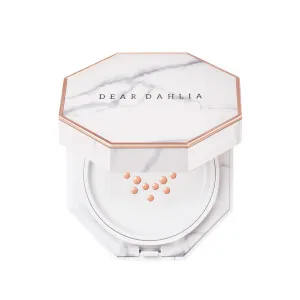
Dear Dahlia Skin Paradise Blooming Cushion
Works for
Anti-agingAdenosine, Prunus amygdalus dulcis oil + 1 moreWorks well
“The ingenious addition also possesses anti-ageing properties, allowing it to help with minimising the look of fine lines and wrinkles.”
This product can help reduce and prevent fine lines and wrinkles, improve skin elasticity and firmness because it contains adenosine.
Keep in mind that it typically takes at least 6 weeks to notice any results because the changes that are needed to improve fine lines and elasticity happen in the deeper layers of the skin. No topical anti-aging product can “erase” wrinkles or fully reverse signs of aging.
MoisturizingSide benefit · Glycerin, Phenyl trimethicone + 14 moreWorks
This product can help improve hydration of the skin with the two types of ingredients.
The first type is called “humectants”:
these ingredients help attract water.
When humectants are on the surface of the skin, they “pull in” the moisture from the outside environment, or from
within deeper layers of the skin. The following ingredients in this product do the job:
glycerin, caprylyl glycol.
This product also contains ingredients called “occlusives”. They help reduce the speed with which our skin loses moisture to the outside environment. These ingredients also help soften the upper layer of the skin, so it feels less tight and nicer to the touch. The following ingredients in this product do the job: dimethicone, methicone.
Can it cause trouble?
Irritancy5 strong irritants: Lavandula angustifolia oil, Citrus aurantium dulcis peel oil expressed + 3 more — patch-test recommendedHigh risk
ComedogenicClean of flagged comedogenic ingredientsNone flagged

User reviews
Be the first — your take helps the next person decide.
Ingredients
Filter by role to see what each ingredient is doing.
Water~45–55%
Methyl trimethicone~5–6.1%
- Irritation risk
- Low
A type of silicone that helps create a silky product finish and dissolve other ingredients
More about Methyl trimethiconeTitanium dioxide~4.7–5.8%
- Irritation risk
- Low
Works as a UV filter when used in high concentrations. It is photostable and is effective mostly against the UVB light, with some protection in the UVA range. In small concentrations, used for its ability to improve the color of cosmetic products. Is usually well tolerated by the skin
More about Titanium dioxideGlycerin~3.3–4%
- Irritation risk
- Low
One of the best moisturizing ingredients. Naturally present in skin. It attracts water to the upper layer of the skin working as a humectant
More about GlycerinPhenyl trimethicone~2.7–3.3%
- Irritation risk
- Low
A type of silicone that can decrease loss of moisture from the skin surface. It helps create a nice product texture
More about Phenyl trimethiconeButyloctyl salicylate~2.2–2.6%
- Irritation risk
- Medium
A synthetic ester of salicylic acid that is used to help disperse pigments and boost effectiveness of sunscreen ingredients. It is able to absorb UV light (working as an organic, or chemical filter), but is not approved as a sunscreen ingredient on its own
More about Butyloctyl salicylateDiisostearyl malate~1.8–2.3%
- Irritation risk
- Medium
Helps to soften the upper layer of the skin
More about Diisostearyl malatePentaerythrityl tetraisostearate~1.6–2%
- Irritation risk
- Medium
Used to create a thicker product consistency
More about Pentaerythrityl tetraisostearateCaprylyl methicone~1.4–1.7%
- Irritation risk
- Low
A type of silicone that helps to soften the upper layer of the skin and create a nice product finish on the skin
More about Caprylyl methiconeDipropylene glycol~1.2–1.4%
- Irritation risk
- Low
Helps to dissolve other ingredients in a formulation. Slows down the rate of product drying
More about Dipropylene glycolTrimethylsiloxysilicate~1.1–1.3%
- Irritation risk
- Low
A type of silicone that helps create a nice product consistency and support the delivery of other ingredients
More about TrimethylsiloxysilicateLauryl polyglyceryl-3 polydimethylsiloxyethyl dimethicone~0.9–1.1%
- Irritation risk
- Low
Polyglyceryl-3 polydimethylsiloxyethyl dimethicone~0.8–1.2%
- Irritation risk
- Low
Zinc oxide~1.1–1.4%
- Irritation risk
- Low
A broad spectrum sunblock (protects from both UVA and UVB rays). Is suitable for most sensitive skins. In small concentrations, can be used as a colorant
More about Zinc oxideTitanium dioxide~0.95–1.15%
- Irritation risk
- Low
Works as a UV filter when used in high concentrations. It is photostable and is effective mostly against the UVB light, with some protection in the UVA range. In small concentrations, used for its ability to improve the color of cosmetic products. Is usually well tolerated by the skin
More about Titanium dioxideSynthetic fluorphlogopite~0.7–1.05%
- Irritation risk
- Low
A mineral that is used as an optical filter (makes the skin looks nicer through light reflection) and to improve the texture of cosmetic products
More about Synthetic fluorphlogopiteCi 77492~0.65–1%
Magnesium sulfate~0.65–0.95%
Vinyl dimethicone/methicone silsesquioxane crosspolymer~0.6–0.9%
- Irritation risk
- Low
A type of silicone that create a smooth product finish and can create an optical soft-focus effect on the skin. Helps to thicken the product consistency
More about Vinyl dimethicone/methicone silsesquioxane crosspolymerDisteardimonium hectorite~0.55–0.85%
- Irritation risk
- Low
A type of clay that is used to thicken the product consistency
More about Disteardimonium hectoritePolyglyceryl-6 polyricinoleate~0.6–0.85%
- Irritation risk
- Medium
Helps oil and water mix together
More about Polyglyceryl-6 polyricinoleateBisabolol~0.5–0.75%
- Irritation risk
- Low
An active component of chamomile plant that historically has been used to calm down irritated skin. A recent study shows that bisabolol indeed can have some anti-inflammatory effect on skin, even though conclusive data is lacking. Bisabolol has a sweet floral scent and can be added to products for its aromatic properties
More about BisabololMethyl methacrylate crosspolymer~0.55–0.8%
- Irritation risk
- Low
Helps thicken the product consistency
More about Methyl methacrylate crosspolymer1,2-hexanediol~0.5–0.8%
Triethoxycaprylylsilane~0.5–0.8%
- Irritation risk
- Low
A type of silicone that helps oil and water mix well together. Helps to disperse other ingredients, e.g. pigments, evenly in a formulation
More about TriethoxycaprylylsilaneCi 77491~0.55–0.8%
- Irritation risk
- Low
A red colorant made of iron oxide. Typically is not irritating
More about Ci 77491Caprylyl glycol~0.55–0.8%
- Irritation risk
- Medium
Helps preserve products and creates a nice product texture
More about Caprylyl glycolPalmitic acid~0.6–0.85%
- Irritation risk
- Low
An emollient that is naturally present in skin and helps soften it
More about Palmitic acidAluminum hydroxide~0.55–0.85%
- Irritation risk
- Low
Is used to add opaque (non-transparent) appearance to formulations. Can be used to coat other ingredients for even dispersion. This is a different ingredient compared to the ones used in antipersperants (aluminium chloride and aluminium chlorohydrate)
More about Aluminum hydroxideDahlia variabilis flower extract~0.5–0.75%
- Irritation risk
- Low
Stearic acid~0.6–0.95%
- Irritation risk
- Low
Helps oil and water mix together and works as an emollient
More about Stearic acidGlyceryl caprylate~0.55–0.85%
- Irritation risk
- Low
An emollient that can also help water and oil mix together, as well as prevent bacteria growth in products
More about Glyceryl caprylateTrihydroxystearin~0.5–0.75%
- Irritation risk
- Low
Helps soften the upper layer of the skin and improve the product texture
More about TrihydroxystearinMethicone~0.5–0.75%
- Irritation risk
- Low
A type of silicone that helps soften the upper layer of the skin and reduces the water loss from the skin surface
More about MethiconeLavandula angustifolia oil~0.4–0.6%
- Irritation risk
- High
An essential oil. Potential allergen and can be irritating. It has some anti-bacterial properties
More about Lavandula angustifolia oilEthylhexylglycerin~0.4–0.6%
Ci 77499~0.4–0.6%
Adenosine~0.35–0.65%
- Irritation risk
- Low
Might help improve cell turnover and reduce inflammation in skin. One study shows that the ingredients might be able to help reduce dynamic wrinkles (for example, in the corners of the eyes or on the forehead)
More about AdenosineDimethicone~0.45–0.65%
- Irritation risk
- Low
A silicone that helps to reduce water loss from the surface of the skin. Can temporarily "fill in" lines and wrinkles, absorb oil, and create a nice product finish
More about DimethiconeCitrus aurantium dulcis peel oil expressed~0.3–0.55%
- Irritation risk
- High
Olea europaea fruit oil~0.3–0.55%
- Irritation risk
- Medium
An emollient that helps soften the skin but is not effective for restoring its barrier function. Might be helpful to calm down inflammation
More about Olea europaea fruit oilArgania spinosa kernel oil~0.3–0.55%
- Irritation risk
- Medium
An emollient that helps soften the upper layer of the skin. Might have some weak anti-oxidant properties
More about Argania spinosa kernel oilPrunus amygdalus dulcis oil~0.25–0.5%
- Irritation risk
- Low
An emollient that softens the skin
More about Prunus amygdalus dulcis oilCamellia sinensis leaf water~0.15–0.3%
- Irritation risk
- Low
Green tea leaf water. Might have some minimal anti-oxidant effect
More about Camellia sinensis leaf waterTilia vulgaris flower extract~0.15–0.25%
- Irritation risk
- High
Tocopherol~0.15–0.3%
- Irritation risk
- Low
Pure form of vitamin E. Can help moisturise and protect the skin from free radicals. Often used to help stabilise other ingredients or the formula itself
More about TocopherolBenzyl alcohol~0.15–0.25%
- Irritation risk
- High
A preservative. Can be used to mask unpleasant smell. Can be irritating
More about Benzyl alcoholDehydroacetic acid~0.15–0.25%
Limonene~0.1–0.15%
- Irritation risk
- High
A common frangrance that can easily irritate skin, especially if exposed to air, light or heat
More about LimoneneLinalool~0.05–0.15%
Ingredient list view
Water, Methyl trimethicone, Titanium dioxide, Glycerin, Phenyl trimethicone, Butyloctyl salicylate, Diisostearyl malate, Pentaerythrityl tetraisostearate, Caprylyl methicone, Dipropylene glycol, Trimethylsiloxysilicate, Lauryl polyglyceryl-3 polydimethylsiloxyethyl dimethicone, Polyglyceryl-3 polydimethylsiloxyethyl dimethicone, Zinc oxide, Titanium dioxide, Synthetic fluorphlogopite, Ci 77492, Magnesium sulfate, Vinyl dimethicone/methicone silsesquioxane crosspolymer, Disteardimonium hectorite, Polyglyceryl-6 polyricinoleate, Bisabolol, Methyl methacrylate crosspolymer, 1,2-hexanediol, Triethoxycaprylylsilane, Ci 77491, Caprylyl glycol, Palmitic acid, Aluminum hydroxide, Dahlia variabilis flower extract, Stearic acid, Glyceryl caprylate, Trihydroxystearin, Methicone, Lavandula angustifolia oil, Ethylhexylglycerin, Ci 77499, Adenosine, Dimethicone, Citrus aurantium dulcis peel oil expressed, Olea europaea fruit oil, Argania spinosa kernel oil, Prunus amygdalus dulcis oil, Camellia sinensis leaf water, Tilia vulgaris flower extract, Tocopherol, Benzyl alcohol, Dehydroacetic acid, Limonene, Linalool
Compare prices
Retailers ranked by price — lowest first.

Worth comparing, line by line.
Match % combines shared ingredients, the first five ingredients, shared actives and hero ingredients, irritancy (lower counts in the alternative's favour), texture and body area. Only products in the same routine step are compared.
| Dear DahliaSkin Paradise Blooming CushionYOUR PRODUCT | Purito SEOULWonder Releaf Centella BB Cushion | sieroDustin Dun BB Cream #Natural Beige | Etude HouseCorrect & Care CC Cream Glow 30 SPF | |
|---|---|---|---|---|
| Match | — | 58% | 57% | 56% |
| Price | — | $17.14 | $21.70 | — |
| Shared key ingredients | — | 5 of 11 | 8 of 11 | 7 of 11 |
| Key difference | — | Niacinamide | Niacinamide | Arbutin |
| Irritancy | High | Medium | Medium | Medium |
| Drying alcohol | — | — | — | — |
| View product | Shop | Shop | Shop |


More alternatives: so natural Tone Up Sun CreamBanila Co Covericious Skin Fit Tinted Moisturizer
Sources cited in this review
Every concentration estimate and effectiveness label is anchored to one of these 21 studies and safety reviews.
- 1
- 2
- 3
- 4A review of inorganic UV filters zinc oxide and titanium dioxideonlinelibrary.wiley.com
- 5
- 6

Affiliate links · As an Amazon Associate, WIMJ earns from qualifying purchases.