Works for
1 of 1 advertised claim delivered
Moisturizing9 ingredients credited for this claimStrong support
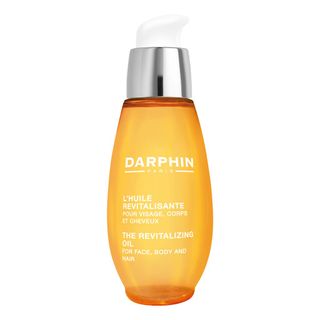
“Providing instant nourishment from head to toe, The Revitalising Oil (50ml) from Darphin hydrates and softens hair and the skin without feeling sticky or weighing hair down.”
This product can help soften the skin and reduce its moisture loss with emollients and occlusives: helianthus annuus seed oil, simmondsia chinensis seed oil.
Keep in mind that this product does not contain effective ingredients to attract water to the upper layer of the skin. This is why an additional product with humectants like glycerin or hyaluronic acid can be helpful (apply it before this product for the best results).
The following ingredients in this product are especially good for supporting the skin barrier and helping with the hydration level: linoleic acid
Can it cause trouble?
Irritancy12 strong irritants: Cananga odorata flower oil, Aniba rosaeodora wood extract + 10 more — patch-test recommendedHigh risk
Comedogenic1 ingredient rated 2 or more on the 0–5 pore-clogging scale1 flagged

User reviews
Be the first — your take helps the next person decide.
Ingredients
Filter by role to see what each ingredient is doing.
Prunus amygdalus dulcis seed extract~25–37%
- Irritation risk
- Low
Almond extract (oil) - helps soften the upper layer of the skin
More about Prunus amygdalus dulcis seed extractPrunus armeniaca fruit extract~4.6–6.9%
- Irritation risk
- Medium
A fruit extract that might have some antioxidant properties and might help attract water to the skin, but evidence of effectiveness is lacking
More about Prunus armeniaca fruit extractSimmondsia chinensis seed oil~4.7–7%
- Irritation risk
- Medium
Softens the upper layer of skin and helps restore the healthy skin barrier. Has shown to help calm down inflammation in skin. It is a stable oil, meaning that it retains its properties even when exposed to air.
More about Simmondsia chinensis seed oilHelianthus annuus seed oil~3.7–5.5%
- Irritation risk
- Low
A great emollient due to its high linoleic acid content. One of the most effective plant oils in helping skin hydration and repairing skin barrier function
More about Helianthus annuus seed oilPolysorbate 60~2.4–3.6%
Oenothera biennis extract~2–3%
- Irritation risk
- Low
Argania spinosa kernel oil~1.6–2.4%
- Irritation risk
- Medium
An emollient that helps soften the upper layer of the skin. Might have some weak anti-oxidant properties
More about Argania spinosa kernel oilCananga odorata flower oil~1.2–1.8%
Pelargonium graveolens extract~1.1–1.6%
- Irritation risk
- Low
Aniba rosaeodora wood extract~0.85–1.25%
- Irritation risk
- High
Squalane~0.8–1.2%
- Irritation risk
- Low
An oil naturally present in skin. Works as an emollient to soften the skin and form a protective layer on its surface without a greasy feeling.
More about SqualaneLinoleic acid~0.55–1.3%
- Irritation risk
- Low
An excellent emollient. Helps soften the skin, restore its barrier function, and can help to calm down inflammation. It can be helpful to prevent blemishes and clogged pores
More about Linoleic acidCalophyllum inophyllum leaf extract~0.4–0.95%
- Irritation risk
- Low
Rubus idaeus extract~0.4–0.9%
- Irritation risk
- High
Mostly used as a fragrance. Might have some anti-oxidant effect
More about Rubus idaeus extractRosa canina flower extract~0.35–0.85%
- Irritation risk
- High
Cholesterol~0.45–1%
- Irritation risk
- Low
An emollient that is naturally found in skin
More about CholesterolLavandula angustifolia extract~0.35–0.85%
- Irritation risk
- High
Used for fragrance and contains volatile compounds that can irritate the skin
More about Lavandula angustifolia extractVanilla planifolia fruit extract~0.35–0.75%
- Irritation risk
- High
A plant extract used as a fragrance. Can be irritating
More about Vanilla planifolia fruit extractAnogeissus leiocarpus bark extract~0.3–0.75%
- Irritation risk
- High
A tree bark extract that has antibacterial properties and might have an anti-oxidant effect. Its effectiveness in skin has not been studied
More about Anogeissus leiocarpus bark extractJasminum officinale extract~0.2–0.75%
Triticum vulgare germ extract~0.35–0.75%
- Irritation risk
- Medium
- Comedogenicity
- 3/5
Plant extract that might have moisturizing properties. Avoid if you suffer from wheat or gluten intolerance
More about Triticum vulgare germ extractHordeum vulgare extract~0.3–0.75%
- Irritation risk
- Medium
A plant extract that might have some anti-oxidant properties. Avoid if you are sensitive to gluten
More about Hordeum vulgare extractCoffea arabica seed extract~0.15–0.65%
- Irritation risk
- Low
Might be helpful in neutralizing free radicals in skin
More about Coffea arabica seed extractTocopheryl acetate~0.15–0.6%
- Irritation risk
- Medium
A more stable but less bio-available form of vitamin E compared to Tocopherol. Might help moisturize and protect the skin from free radicals, but mostly used in low concentrations to stabilize other ingredients.
More about Tocopheryl acetateTetrahexyldecyl ascorbate~0.15–0.55%
- Irritation risk
- Medium
Being a lipid soluble form of vitamin C, it is more stable than ascorbic acid, but still degrades quickly and needs to be stabilized in a formulation with another ingredient. It is claimed to penetrate skin better than pure vitamin C and have the the similar benefits, but solid studies of its effectiveness are lacking. Is likely to require a higher concentration in a product than pure vitamin C to be effective. It might be able to help reduce pore clogging.
More about Tetrahexyldecyl ascorbateWater~0.15–0.5%
Citronellol~0.1–0.4%
Geraniol~0.1–0.3%
Benzyl salicylate~0.05–0.3%
Farnesol~0.05–0.25%
Linalool~0.05–0.2%
Limonene~0.05–0.15%
- Irritation risk
- High
A common frangrance that can easily irritate skin, especially if exposed to air, light or heat
More about LimoneneIngredient list view
Prunus amygdalus dulcis seed extract, Prunus armeniaca fruit extract, Simmondsia chinensis seed oil, Helianthus annuus seed oil, Polysorbate 60, Oenothera biennis extract, Argania spinosa kernel oil, Cananga odorata flower oil, Pelargonium graveolens extract, Aniba rosaeodora wood extract, Squalane, Linoleic acid, Calophyllum inophyllum leaf extract, Rubus idaeus extract, Rosa canina flower extract, Cholesterol, Lavandula angustifolia extract, Vanilla planifolia fruit extract, Anogeissus leiocarpus bark extract, Jasminum officinale extract, Triticum vulgare germ extract, Hordeum vulgare extract, Coffea arabica seed extract, Tocopheryl acetate, Tetrahexyldecyl ascorbate, Water, Citronellol, Geraniol, Benzyl salicylate, Farnesol, Linalool, Limonene
Compare prices
Retailers ranked by price — lowest first.
Affiliate links · prices updated regularly · As an Amazon Associate, WIMJ earns from qualifying purchases.
Worth comparing, line by line.
Match % combines shared ingredients, the first five ingredients, shared actives and hero ingredients, irritancy (lower counts in the alternative's favour), texture and body area. Only products in the same routine step are compared.
| DarphinThe Revitalizing OilYOUR PRODUCT | Boost LabBio-Nourishing Oil | ExperimentBuffer Jelly | Alpha-HGolden Haze Face Oil | |
|---|---|---|---|---|
| Match | — | 56% | 54% | 53% |
| Price | $34.51 | $39.60+$5.09 | $31.99−$2.52 | $20.00−$14.51 |
| Shared key ingredients | — | 3 of 7 | 3 of 7 | 4 of 7 |
| Key difference | — | Linolenic Acid | Ceramide Np | Camellia Oleifera Seed Oil |
| Irritancy | High | Low | Low | High |
| Drying alcohol | — | — | — | — |
| View product | Shop | Shop | Shop |

Product summary
Judging from the ingredient list, "Darphin - The Revitalizing Oil" works well for improving skin hydration
Ingredient callouts
- Another helpful ingredient in this moisturizer is Linoleic Acid. It is one of the fatty acids naturally present in skin. It is part of the skin barrier. Preliminary research shows that it might be able to reduce clogged pores.
Irritation risk
There are quite a few common irritants in this product, including ingredients without particular skin benefits. We would not recommend it for sensitive skin. We assess the overall irritancy of this moisturizer to be high. For a detailed overview of all potential irritants: click here
You can see the detailed formula review with the breakdown of all actives in the product and the full ingredient list with estimated concentrations in the tables below.
Price
The product retails for 159.85CA$ in Canada, for 313.80A$ in Australia, for 99.00$ in the United States and from 26.10£ up to 32.00£ in the United Kingdom.
For a detailed price comparison: click here.
Sources cited in this review
Every concentration estimate and effectiveness label is anchored to one of these 16 studies and safety reviews.
- 1
- 2
- 3Effect of topically applied lipids on surfactant-irritated skinonlinelibrary.wiley.com
- 4
- 5
- 6

Affiliate links · As an Amazon Associate, WIMJ earns from qualifying purchases.