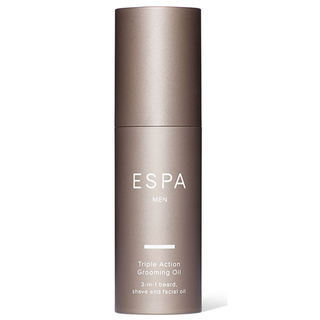
ESPA Men's Triple Action Grooming Oil

ESPA Men's Triple Action Grooming Oil

Efficacy100/100IrritancyHigh
Edit

Works for

1 of 1 advertised claim delivered

Moisturizing
Linoleic acid, Linolenic acid + 16 more
Strong evidence
What the product description says
“Achieve a close, comfortable shave with ESPA Men's Triple Action Grooming Oil , a multi-purpose formula that keeps skin soft and hydrated.”
Source: Recreate Yourself

This product can help soften the skin and reduce its moisture loss with emollients and occlusives: caprylic/capric triglyceride, helianthus annuus seed oil.

Keep in mind that this product does not contain effective ingredients to attract water to the upper layer of the skin. This is why an additional product with humectants like glycerin or hyaluronic acid can be helpful (apply it before this product for the best results).

The following ingredients in this product are especially good for supporting the skin barrier and helping with the hydration level: linoleic acid

Linoleic acidHero· EmollientEffect: HighAn excellent emollient. Helps soften the skin, restore its barrier function, and can help to calm down inflammation. It can be helpful to prevent blemishes and clogged pores~0.35–0.8%
Linolenic acidKey active· EmollientEffect: HighAn emollient that helps soften the skin and calm down inflammation~0.3–0.7%
Caprylic/capric triglycerideKey active· Emollient, OcclusiveEffect: HighA good mix of fatty acids that forms a protective layer on the skin. Improves the shelf life of products. Derived from coconut and glycerin~1.2–1.8%
Glycine soja oilKey active· EmollientEffect: HighA good emollient that helps soften the skin and helps repair its barrier function. It can clog pores if used in high concentrations.~22–33%
Helianthus annuus seed oilKey active· Emollient, OcclusiveEffect: HighA great emollient due to its high linoleic acid content. One of the most effective plant oils in helping skin hydration and repairing skin barrier function~0.15–0.7%
Caryodendron orinocense seed oilKey active· EmollientEffect: HighA plant oil with a high content of linoleic acid that helps soften the upper layer of the skin and helps strengthen the skin barrier. It is an excellent moisturizer. Might have an anti-oxidant effect~0.35–0.8%
Coconut alkanesKey active· EmollientEffect: MediumAn emollient that helps soften the skin~2–3%
Heptyl undecylenateKey active· Emollient, OcclusiveEffect: MediumHelps soften the upper layer of the skin, reduce water loss from the skin surface over time and create a nice product finish~1.4–2.1%
Prunus amygdalus dulcis oilKey active· EmollientEffect: MediumAn emollient that softens the skin~4.3–6.5%
Coco-caprylate/caprateKey active· EmollientEffect: MediumHelps to soften the upper layer of the skin without creating a greasy texture~0.4–0.95%
Oleic acid· EmollientEffect: LowHelps soften the upper layer of the skin. At the same time, it can weaken the skin's barrier enhancing penetration of other ingredients and increasing the risk of skin dryness~0.2–0.8%
Ethyl oleate· EmollientEffect: LowEthyl oleate is a long-chain fatty acid ethyl ester resulting from the formal condensation of the carboxy group of oleic acid with the hydroxy group of ethanol. It derives from an oleic acid. In skincare, it is used to soften the upper layer of the skin, improve the product texture and smell~1.5–2.2%
Isopropyl isostearate· EmollientEffect: LowAn emollient that helps soften the skin~3.6–5.4%
Glyceryl caprylate· EmollientEffect: LowAn emollient that can also help water and oil mix together, as well as prevent bacteria growth in products~3–4.5%
Palmitic acid· EmollientEffect: LowAn emollient that is naturally present in skin and helps soften it~0.15–0.7%
Alaria esculenta extractUnder-dosedEffect: MediumWorks as a humectant helping to attract water to the upper layer of the skin and might be effective as an anti-oxidant.~0.15–0.6%
Stearic acidEffect: Low, below effective doseHelps oil and water mix together and works as an emollient~0.15–0.6%
TocopherolEffect: Low, below effective dosePure form of vitamin E. Can help moisturise and protect the skin from free radicals. Often used to help stabilise other ingredients or the formula itself~0.15–0.7%
Evens skin tone
Not advertised by the brand · Retinyl palmitate
Moderate evidence

The following ingredient (ingredients) in this product might be helpful, but there is no evidence to confirm that it actually works: retinyl palmitate.

Retinyl palmitateKey activeEffect: MediumThree steps removed from the active form of vitamin A - retinoic acid. To have an effect in the skin, it first needs to be converted twice to become the retinoic acid. This means it is less potent than retinol, but could also be less irritating. Once converted to the retinoic acid in the skin, it helps against all signs of aging, improves skin cell turnover and helps fight blemishes and clogged pores. However, in many cosmetic formulations, it is used in a concentration that is too low to have the full effect~0.15–0.65%
Anti-aging
Not advertised by the brand · Retinyl palmitate, Prunus amygdalus dulcis oil + 2 more
Moderate evidence

This product contains retinyl palmitate. This ingredient might be able to help reduce and prevent fine lines and wrinkles, improve skin elasticity and firmness, but there is not enough evidence that it actually works.

Retinyl palmitateKey activeEffect: MediumThree steps removed from the active form of vitamin A - retinoic acid. To have an effect in the skin, it first needs to be converted twice to become the retinoic acid. This means it is less potent than retinol, but could also be less irritating. Once converted to the retinoic acid in the skin, it helps against all signs of aging, improves skin cell turnover and helps fight blemishes and clogged pores. However, in many cosmetic formulations, it is used in a concentration that is too low to have the full effect~0.15–0.65%
Prunus amygdalus dulcis oilEffect: LowAn emollient that softens the skin~4.3–6.5%
TocopherolEffect: Low, below effective dosePure form of vitamin E. Can help moisturise and protect the skin from free radicals. Often used to help stabilise other ingredients or the formula itself~0.15–0.7%
Alaria esculenta extractEffect: Low, below effective doseWorks as a humectant helping to attract water to the upper layer of the skin and might be effective as an anti-oxidant.~0.15–0.6%

Can it cause trouble?

Irritancy
14 strong irritants: Parfum, Eucalyptus globulus leaf oil + 12 more — patch-test recommended
High risk
We flagged 21 ingredients with irritancy potential. Severity depends on your sensitivity threshold; the table lists the worst offenders first.
IngredientFunctionIrritationEst. amount
ParfumAn aromatic blend of unspecified and possibly irritating ingredientsHigh~0.45–1.05%est.
Eucalyptus globulus leaf oilAn essential oil that can be very irritating. Has some anti-bacterial propertiesHigh~0.3–0.75%est.
Litsea cubeba fruit oilAn essential oil with a lemon-like smell that is extracted from a fruit grown in Asia. Used as a fragranceHigh~0.2–0.75%est.
Rosmarinus officinalis leaf oilA plant oil with high content of volatile compounds that can irritate the skin. Can be used as a fragrance. Has anti-bacterial properties and might help neutralize free radicals on the surface of the skinHigh~0.3–0.7%est.
Retinyl palmitateThree steps removed from the active form of vitamin A - retinoic acid. To have an effect in the skin, it first needs to be converted twice to become the retinoic acid. This means it is less potent than retinol, but could also be less irritating. Once converted to the retinoic acid in the skin, it helps against all signs of aging, improves skin cell turnover and helps fight blemishes and clogged pores. However, in many cosmetic formulations, it is used in a concentration that is too low to have the full effectHigh~0.15–0.65%est.
CitralA fragrance with a lemon scent. A likely irritantHigh~0.15–0.65%est.
EugenolA fragrance. Is a likely irritantHigh~0.15–0.55%est.
LinaloolA fragrance. Can be irritatingHigh~0.15–0.5%est.
Eugenia caryophyllus bud oilUsed as a fragrance. Can be irritatingHigh~0.1–0.5%est.
Mentha piperita oilUsed as a fragrance and can be irritatingHigh~0.1–0.45%est.
LimoneneA common frangrance that can easily irritate skin, especially if exposed to air, light or heatHigh~0.1–0.45%est.
GeraniolA fragrance. Can be irritatingHigh~0.1–0.35%est.
Pelargonium graveolens flower oilAn essential oil. Can be irritating. Can become an allergen with oxidationHigh~0.1–0.4%est.
CitronellolA fragrance. Can be irritatingHigh~0.05–0.2%est.
Glycine soja oilA good emollient that helps soften the skin and helps repair its barrier function. It can clog pores if used in high concentrations.Medium~22–33%est.
Coconut alkanesAn emollient that helps soften the skinMedium~2–3%est.
Ethyl oleateEthyl oleate is a long-chain fatty acid ethyl ester resulting from the formal condensation of the carboxy group of oleic acid with the hydroxy group of ethanol. It derives from an oleic acid. In skincare, it is used to soften the upper layer of the skin, improve the product texture and smellMedium~1.5–2.2%est.
Heptyl undecylenateHelps soften the upper layer of the skin, reduce water loss from the skin surface over time and create a nice product finishMedium~1.4–2.1%est.
Caprylic/capric triglycerideA good mix of fatty acids that forms a protective layer on the skin. Improves the shelf life of products. Derived from coconut and glycerinMedium~1.2–1.8%est.
Linolenic acidAn emollient that helps soften the skin and calm down inflammationMedium~0.3–0.7%est.
Oleic acidHelps soften the upper layer of the skin. At the same time, it can weaken the skin's barrier enhancing penetration of other ingredients and increasing the risk of skin drynessMedium~0.2–0.8%est.
Comedogenic
3 ingredients rated 2 or more on the 0–5 pore-clogging scale
3 flagged
These ingredients have a comedogenic rating of 2 or more on a 0–5 scale; the table shows each one's rating. In leave-on products they can clog pores in acne-prone skin.
IngredientFunctionRatingEst. amount
Isopropyl isostearateAn emollient that helps soften the skin3/5~3.6–5.4%est.
Glycine soja oilA good emollient that helps soften the skin and helps repair its barrier function. It can clog pores if used in high concentrations.2/5~22–33%est.
Coconut alkanesAn emollient that helps soften the skin2/5~2–3%est.
Edit

User reviews

Would you recommend?
No community reviews yet.

Be the first — your take helps the next person decide.

Write a review · ~30s

Ingredients

Filter by role to see what each ingredient is doing.

Glycine soja oil~22–33%
Key activeComedogenic 2/5Irritant · medium
Irritation risk
Medium
Comedogenicity
2/5
Works for
Moisturizing

A good emollient that helps soften the skin and helps repair its barrier function. It can clog pores if used in high concentrations.

More about Glycine soja oil
Prunus amygdalus dulcis oil~4.3–6.5%
Key active
Irritation risk
Low
Works for
MoisturizingAnti-oxidationAnti-aging

An emollient that softens the skin

More about Prunus amygdalus dulcis oil
Glyceryl caprylate~3–4.5%
Formula
Irritation risk
Low
Works for
CleansingMoisturizing

An emollient that can also help water and oil mix together, as well as prevent bacteria growth in products

More about Glyceryl caprylate
Isopropyl isostearate~3.6–5.4%
Comedogenic 3/5
Irritation risk
Low
Comedogenicity
3/5
Works for
Moisturizing

An emollient that helps soften the skin

More about Isopropyl isostearate
Polyglyceryl-3 palmitate~2.7–4%
Formula
Irritation risk
Low
Works for
Cleansing
More about Polyglyceryl-3 palmitate
Coconut alkanes~2–3%
Key activeComedogenic 2/5Irritant · medium
Irritation risk
Medium
Comedogenicity
2/5
Works for
Moisturizing

An emollient that helps soften the skin

More about Coconut alkanes
Ethyl oleate~1.5–2.2%
Irritant · medium
Irritation risk
Medium
Works for
Moisturizing

Ethyl oleate is a long-chain fatty acid ethyl ester resulting from the formal condensation of the carboxy group of oleic acid with the hydroxy group of ethanol. It derives from an oleic acid. In skincare, it is used to soften the upper layer of the skin, improve the product texture and smell

More about Ethyl oleate
Heptyl undecylenate~1.4–2.1%
Key activeIrritant · medium
Irritation risk
Medium
Works for
Moisturizing

Helps soften the upper layer of the skin, reduce water loss from the skin surface over time and create a nice product finish

More about Heptyl undecylenate
Caprylic/capric triglyceride~1.2–1.8%
Key activeIrritant · medium
Irritation risk
Medium
Works for
Moisturizing

A good mix of fatty acids that forms a protective layer on the skin. Improves the shelf life of products. Derived from coconut and glycerin

More about Caprylic/capric triglyceride
Olive oil polyglyceryl-6 esters~0.85–1.25%
Formula
Irritation risk
Low
Works for
Cleansing
More about Olive oil polyglyceryl-6 esters
Parfum~0.45–1.05%
Irritant · high
Irritation risk
High

An aromatic blend of unspecified and possibly irritating ingredients

More about Parfum
Bisabolol~0.35–0.85%
Formula
Irritation risk
Low
Works for
Reduces irritationAnti-inflammatoryAnti-oxidation

An active component of chamomile plant that historically has been used to calm down irritated skin. A recent study shows that bisabolol indeed can have some anti-inflammatory effect on skin, even though conclusive data is lacking. Bisabolol has a sweet floral scent and can be added to products for its aromatic properties

More about Bisabolol
Coco-caprylate/caprate~0.4–0.95%
Key active
Irritation risk
Low
Works for
Moisturizing

Helps to soften the upper layer of the skin without creating a greasy texture

More about Coco-caprylate/caprate
Eucalyptus globulus leaf oil~0.3–0.75%
Irritant · high
Irritation risk
High
Works for
Antibacterial

An essential oil that can be very irritating. Has some anti-bacterial properties

More about Eucalyptus globulus leaf oil
Litsea cubeba fruit oil~0.2–0.75%
Irritant · high
Irritation risk
High
Works for
Antibacterial

An essential oil with a lemon-like smell that is extracted from a fruit grown in Asia. Used as a fragrance

More about Litsea cubeba fruit oil
Rosmarinus officinalis leaf oil~0.3–0.7%
Irritant · high
Irritation risk
High
Works for
AntibacterialAnti-oxidation

A plant oil with high content of volatile compounds that can irritate the skin. Can be used as a fragrance. Has anti-bacterial properties and might help neutralize free radicals on the surface of the skin

More about Rosmarinus officinalis leaf oil
Caryodendron orinocense seed oil~0.35–0.8%
Key active
Irritation risk
Low
Works for
MoisturizingAnti-oxidation

A plant oil with a high content of linoleic acid that helps soften the upper layer of the skin and helps strengthen the skin barrier. It is an excellent moisturizer. Might have an anti-oxidant effect

More about Caryodendron orinocense seed oil
Retinyl palmitate~0.15–0.65%
Key activeIrritant · high
Irritation risk
High
Works for
Evens skin toneAnti-blemishAnti-agingExfoliation

Three steps removed from the active form of vitamin A - retinoic acid. To have an effect in the skin, it first needs to be converted twice to become the retinoic acid. This means it is less potent than retinol, but could also be less irritating. Once converted to the retinoic acid in the skin, it helps against all signs of aging, improves skin cell turnover and helps fight blemishes and clogged pores. However, in many cosmetic formulations, it is used in a concentration that is too low to have the full effect

More about Retinyl palmitate
Citral~0.15–0.65%
Irritant · high
Irritation risk
High

A fragrance with a lemon scent. A likely irritant

More about Citral
Eugenol~0.15–0.55%
Irritant · high
Irritation risk
High

A fragrance. Is a likely irritant

More about Eugenol
Linolenic acid~0.3–0.7%
Key activeIrritant · medium
Irritation risk
Medium
Works for
CleansingMoisturizingAnti-inflammatoryReduces irritation

An emollient that helps soften the skin and calm down inflammation

More about Linolenic acid
Linalool~0.15–0.5%
Irritant · high
Irritation risk
High

A fragrance. Can be irritating

More about Linalool
Eugenia caryophyllus bud oil~0.1–0.5%
Irritant · high
Irritation risk
High

Used as a fragrance. Can be irritating

More about Eugenia caryophyllus bud oil
Mentha piperita oil~0.1–0.45%
Irritant · high
Irritation risk
High

Used as a fragrance and can be irritating

More about Mentha piperita oil
Limonene~0.1–0.45%
Irritant · high
Irritation risk
High

A common frangrance that can easily irritate skin, especially if exposed to air, light or heat

More about Limonene
Tocopherol~0.15–0.7%
Formula
Irritation risk
Low
Works for
Anti-oxidationAnti-agingAnti-inflammatoryMoisturizing

Pure form of vitamin E. Can help moisturise and protect the skin from free radicals. Often used to help stabilise other ingredients or the formula itself

More about Tocopherol
Alaria esculenta extract~0.15–0.6%
Under-dosed
Irritation risk
Low
Works for
MoisturizingAnti-oxidationAnti-aging

Works as a humectant helping to attract water to the upper layer of the skin and might be effective as an anti-oxidant.

More about Alaria esculenta extract
Linoleic acid~0.35–0.8%
Hero · Moisturizing
Irritation risk
Low
Works for
CleansingMoisturizingAnti-blemish

An excellent emollient. Helps soften the skin, restore its barrier function, and can help to calm down inflammation. It can be helpful to prevent blemishes and clogged pores

More about Linoleic acid
Oleic acid~0.2–0.8%
Irritant · medium
Irritation risk
Medium
Works for
CleansingMoisturizingAnti-inflammatory

Helps soften the upper layer of the skin. At the same time, it can weaken the skin's barrier enhancing penetration of other ingredients and increasing the risk of skin dryness

More about Oleic acid
Helianthus annuus seed oil~0.15–0.7%
Key active
Irritation risk
Low
Works for
Moisturizing

A great emollient due to its high linoleic acid content. One of the most effective plant oils in helping skin hydration and repairing skin barrier function

More about Helianthus annuus seed oil
Palmitic acid~0.15–0.7%
Formula
Irritation risk
Low
Works for
CleansingMoisturizing

An emollient that is naturally present in skin and helps soften it

More about Palmitic acid
Geraniol~0.1–0.35%
Irritant · high
Irritation risk
High

A fragrance. Can be irritating

More about Geraniol
Pelargonium graveolens flower oil~0.1–0.4%
Irritant · high
Irritation risk
High
Works for
Anti-oxidation

An essential oil. Can be irritating. Can become an allergen with oxidation

More about Pelargonium graveolens flower oil
Opuntia ficus-indica stem extract~0.1–0.35%
Formula
Stearic acid~0.15–0.6%
Formula
Irritation risk
Low
Works for
CleansingMoisturizing

Helps oil and water mix together and works as an emollient

More about Stearic acid
Citronellol~0.05–0.2%
Irritant · high
Irritation risk
High

A fragrance. Can be irritating

More about Citronellol
Ingredient list view

Glycine soja oil, Prunus amygdalus dulcis oil, Glyceryl caprylate, Isopropyl isostearate, Polyglyceryl-3 palmitate, Coconut alkanes, Ethyl oleate, Heptyl undecylenate, Caprylic/capric triglyceride, Olive oil polyglyceryl-6 esters, Parfum, Bisabolol, Coco-caprylate/caprate, Eucalyptus globulus leaf oil, Litsea cubeba fruit oil, Rosmarinus officinalis leaf oil, Caryodendron orinocense seed oil, Retinyl palmitate, Citral, Eugenol, Linolenic acid, Linalool, Eugenia caryophyllus bud oil, Mentha piperita oil, Limonene, Tocopherol, Alaria esculenta extract, Linoleic acid, Oleic acid, Helianthus annuus seed oil, Palmitic acid, Geraniol, Pelargonium graveolens flower oil, Opuntia ficus-indica stem extract, Stearic acid, Citronellol

Compare prices

Retailers ranked by price — lowest first.

Dermstore
$42.56
Buy

Affiliate links · prices updated regularly

Worth comparing, line by line.

Match % combines shared ingredients, the first five ingredients, shared actives and hero ingredients, irritancy (lower counts in the alternative's favour), texture and body area. Only products in the same routine step are compared.

Side-by-side comparison of this product against its closest alternatives
ESPAMen's Triple Action Grooming OilYOUR PRODUCTEstée LauderResilience Multi-Effect - Oil-in-Creme Infusion
Match—56%
Price$34.00$105.67+$71.67
Shared key ingredients—4 of 8
Key difference—Aminopropyl Ascorbyl Phosphate
Irritancy High Medium
Drying alcohol——
View product Shop
Cheaper alternatives? See how this stacks up against similar formulas.
We compare ingredient profiles across our catalog — pick the closest match for your budget.
Open dupe finder

Sources cited in this review

Every concentration estimate and effectiveness label is anchored to one of these 23 studies and safety reviews.

  1. 1
  2. 2
  3. 3
  4. 4
  5. 5
  6. 6
ESPA Men's Triple Action Grooming Oil
ESPAMen's Triple Action Grooming Oil

Affiliate links · As an Amazon Associate, WIMJ earns from qualifying purchases.

As an Amazon Associate, WIMJ earns from qualifying purchases.