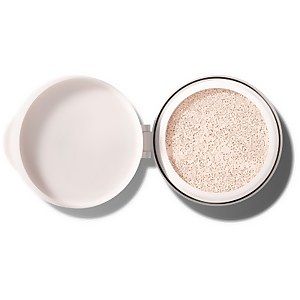
Crème de la Mer Cushion Compact
Works for
1 of 2 advertised claims delivered
Sun protectionSPF 20 · 1 UV filter · Partial spectrumWeak protectionSPF under 30
This product does not offer good protection against UVA rays.
This product can be considered "reef safe" because it does not contain the UV filters (oxybenzone and octinoxate) that can be harmful to coral reefs when present in the water in high concentrations.
Moisturizing28 ingredients credited for this claimStrong support
“It also locks in hydration for lasting, all-day comfort, which is all thanks to the addition of Miracle BrothTM.”
This product can help improve hydration of the skin with the two types of ingredients.
The first type is called “humectants”:
these ingredients help attract water.
When humectants are on the surface of the skin, they “pull in” the moisture from the outside environment, or from
within deeper layers of the skin. The following ingredients in this product do the job:
algae extract, faex.
This product also contains ingredients called “occlusives”. They help reduce the speed with which our skin loses moisture to the outside environment. These ingredients also help soften the upper layer of the skin, so it feels less tight and nicer to the touch. The following ingredients in this product do the job: dimethicone, peg-10 dimethicone.
The following ingredients in this product are especially good for supporting the skin barrier and helping with the hydration level: acetyl hexapeptide-8
Anti-agingNot advertised by the brand · 7 ingredients credited for this claimModerate support
This product contains acetyl hexapeptide-8. This ingredient might be able to help reduce and prevent fine lines and wrinkles, improve skin elasticity and firmness, but there is not enough evidence that it actually works. The biggest anti-aging effect in this product comes from sun protection. Sun damage is the main factor causing early signs of skin aging. We, however, do not recommend using this product as a sunscreen because the protection it offers is not strong enough).
Can it cause trouble?
Irritancy9 strong irritants: Eucalyptus globulus leaf oil, Citrus aurantifolia peel extract + 7 more — patch-test recommendedHigh risk
Comedogenic4 ingredients rated 2 or more on the 0–5 pore-clogging scale4 flagged

User reviews
Ingredients
Filter by role to see what each ingredient is doing.
Water~45–55%
Butylene glycol dicaprylate/dicaprate~6.2–7.5%
- Irritation risk
- Low
Helps soften the upper layer of the skin
More about Butylene glycol dicaprylate/dicaprateDimethicone~5.2–6.3%
- Irritation risk
- Low
A silicone that helps to reduce water loss from the surface of the skin. Can temporarily "fill in" lines and wrinkles, absorb oil, and create a nice product finish
More about DimethiconeMethyl trimethicone~3.6–4.4%
- Irritation risk
- Low
A type of silicone that helps create a silky product finish and dissolve other ingredients
More about Methyl trimethiconeTitanium dioxide~3.5–4.3%
- Irritation risk
- Low
Works as a UV filter when used in high concentrations. It is photostable and is effective mostly against the UVB light, with some protection in the UVA range. In small concentrations, used for its ability to improve the color of cosmetic products. Is usually well tolerated by the skin
More about Titanium dioxideDiphenylsiloxy phenyl trimethicone~2.2–2.7%
- Irritation risk
- Low
Help improve the product's texture
More about Diphenylsiloxy phenyl trimethiconeLauryl peg-9 polydimethylsiloxyethyl dimethicone~1.8–2.2%
- Irritation risk
- Low
A type of silicone that helps to soften upper layer of the skin and create a nice product texture
More about Lauryl peg-9 polydimethylsiloxyethyl dimethiconeGlycerin~1.6–2%
- Irritation risk
- Low
One of the best moisturizing ingredients. Naturally present in skin. It attracts water to the upper layer of the skin working as a humectant
More about GlycerinButylene glycol~1.3–1.6%
- Irritation risk
- Low
Used to create a nice product texture and help delivery of other ingredients. Might be somewhat helpful in attracting water to the upper layer of the skin
More about Butylene glycolPentylene glycol~1.1–1.3%
- Irritation risk
- Medium
Used to preserve products, dissolve other ingredients and create a nice product texture
More about Pentylene glycolPeg-10 dimethicone~0.75–1.15%
- Irritation risk
- Low
A silicone that works to soften the upper layer of the skin and reduce its water loss
More about Peg-10 dimethiconeAlgae extract~0.65–1%
- Irritation risk
- Low
- Comedogenicity
- 3/5
Plant extract that helps the skin to attract water and make it more smooth for touch. Also shows promise of anti-aging properties, but research is not extensive yet
More about Algae extractSesamum indicum seed oil~0.55–0.85%
- Irritation risk
- Low
A good moisturizing plant oil. Due to the high linoleic acid content, it helps soften the upper layer of the skin, reduce water loss and support skin barrier function
More about Sesamum indicum seed oilMedicago sativa seed powder~0.5–0.7%
- Irritation risk
- Medium
Might help soften the upper layer of the skin and help thicken the product formulation. It might have some anti-oxidant effect
More about Medicago sativa seed powderHelianthus annuus seedcake~0.6–0.95%
Prunus amygdalus dulcis seed meal~0.6–0.9%
Eucalyptus globulus leaf oil~0.4–0.6%
- Irritation risk
- High
An essential oil that can be very irritating. Has some anti-bacterial properties
More about Eucalyptus globulus leaf oilSodium gluconate~0.35–0.65%
Copper gluconate~0.3–0.6%
- Irritation risk
- Medium
Typically used to stabilize the product formulations. It is a salt of polyhydroxy acid (PHA) and in larger concentrations, can help shed the dead cells from the skin surface revealing smoother skin. It can help attract water to the upper layer of the skin. Might to be helpful against acne and clogged pores. Could be helpful in neutralizing free radicals, but solid research is missing
More about Copper gluconateCalcium gluconate~0.35–0.65%
- Irritation risk
- Low
Helps attract water to the upper layer of the skin and helps to improve appearance of the product
More about Calcium gluconateMagnesium gluconate~0.3–0.55%
- Irritation risk
- Low
A mineral that might be able to support skin hydration, but convincing research on its effectiveness in topical skincare is lacking
More about Magnesium gluconateZinc gluconate~0.3–0.5%
- Irritation risk
- Medium
Typically used to stabilize the product formulations. It is a salt of a polyhydroxy acid (PHA) and in larger concentrations, can help shed the dead cells from the skin surface revealing smoother skin. It can help attract water to the upper layer of the skin. Might to be helpful against acne and clogged pores. Could be helpful in neutralizing free radicals, but solid research is missing. Due to the zinc content, might help calm down inflammation in skin
More about Zinc gluconateTocopheryl succinate~0.3–0.5%
Niacin~0.3–0.5%
- Irritation risk
- High
A form of vitamin B3. It is similar in action to niacinamide, but is more likely to cause red flashes in skin as the side effect
More about NiacinSesamum indicum seed powder~0.25–0.5%
- Irritation risk
- Low
Citrus aurantifolia peel extract~0.3–0.55%
- Irritation risk
- High
Codium tomentosum extract~0.3–0.5%
- Irritation risk
- Low
Eryngium maritimum extract~0.25–0.5%
- Irritation risk
- Low
Laminaria digitata extract~0.3–0.55%
- Irritation risk
- Low
- Comedogenicity
- 3/5
Seaweed extract that helps the skin to attract water and make it more smooth for touch. Also shows promise of anti-aging properties, but good research is lacking at the moment
More about Laminaria digitata extractSigesbeckia orientalis extract~0.25–0.5%
- Irritation risk
- Medium
A plant extract that can contain an anti-inflammatory compound
More about Sigesbeckia orientalis extractAcetyl hexapeptide-8~0.3–0.5%
- Irritation risk
- Low
A type of peptide. Peptides are excellent moisturizers and might be able support collagen production reducing fine lines and wrinkles
More about Acetyl hexapeptide-8Magnesium sulfate~0.3–0.6%
Acrylates/stearyl acrylate/dimethicone methacrylate copolymer~0.3–0.55%
- Irritation risk
- Low
Disteardimonium hectorite~0.3–0.55%
- Irritation risk
- Low
A type of clay that is used to thicken the product consistency
More about Disteardimonium hectoriteDimethicone crosspolymer~0.3–0.55%
- Irritation risk
- Low
Used to create a thicker product texture. Helps soften the upper layer of the skin and might be able to prevent moisture loss from its surface
More about Dimethicone crosspolymerLauroyl lysine~0.3–0.5%
- Irritation risk
- Low
Helps soften the upper layer of the skin and creates a nice product texture
More about Lauroyl lysineEthylhexylglycerin~0.3–0.55%
Polyhydroxystearic acid~0.3–0.6%
- Irritation risk
- Medium
Used to create a thicker product consistency and stabilize the formulation
More about Polyhydroxystearic acidYeast extract~0.3–0.55%
- Irritation risk
- Low
Helps attract water to the upper layer of the skin and might have some anti-oxidant and skin lightening properties. It can help calm down inflammation in skin
More about Yeast extractFaex~0.3–0.5%
- Irritation risk
- Low
Yeast extract. Helps to attract water to the upper layer of the skin
More about FaexYeast extract~0.3–0.55%
- Irritation risk
- Low
Helps attract water to the upper layer of the skin and might have some anti-oxidant and skin lightening properties. It can help calm down inflammation in skin
More about Yeast extractCaprylyl glycol~0.3–0.6%
- Irritation risk
- Medium
Helps preserve products and creates a nice product texture
More about Caprylyl glycolLecithin~0.3–0.6%
- Irritation risk
- Low
Used mostly for creating emulsions - helping oil and water mix together. Helps soften the upper layer of the skin
More about LecithinIsopropyl myristate~0.3–0.6%
- Irritation risk
- Low
- Comedogenicity
- 3/5
An emollient that helps soften the skin. Could be comedogenic
More about Isopropyl myristateIsostearic acid~0.4–0.65%
- Irritation risk
- Low
Used to create a nice product texture
More about Isostearic acidEthylhexyl palmitate~0.3–0.6%
- Irritation risk
- Low
- Comedogenicity
- 3/5
An emollient that helps soften the skin and create a nice product texture
More about Ethylhexyl palmitateStearic acid~0.45–0.7%
- Irritation risk
- Low
Helps oil and water mix together and works as an emollient
More about Stearic acidPolyglyceryl-3 polyricinoleate~0.3–0.6%
- Irritation risk
- Medium
Helps oil and water mix together
More about Polyglyceryl-3 polyricinoleateAlumina~0.45–0.7%
- Irritation risk
- Low
The same compound that is used safely in dental implants and bone cements. In cosmetics, it is used to improve the consistency of products
More about AluminaAluminum hydroxide~0.3–0.6%
- Irritation risk
- Low
Is used to add opaque (non-transparent) appearance to formulations. Can be used to coat other ingredients for even dispersion. This is a different ingredient compared to the ones used in antipersperants (aluminium chloride and aluminium chlorohydrate)
More about Aluminum hydroxideTriethoxycaprylylsilane~0.3–0.55%
- Irritation risk
- Low
A type of silicone that helps oil and water mix well together. Helps to disperse other ingredients, e.g. pigments, evenly in a formulation
More about TriethoxycaprylylsilaneTocopherol~0.3–0.55%
- Irritation risk
- Low
Pure form of vitamin E. Can help moisturise and protect the skin from free radicals. Often used to help stabilise other ingredients or the formula itself
More about TocopherolParfum~0.25–0.5%
- Irritation risk
- High
An aromatic blend of unspecified and possibly irritating ingredients
More about ParfumPotassium sorbate~0.3–0.55%
Alcohol denat.~0.3–0.55%
- Irritation risk
- High
Produces temporary toning effect. Can help dissolve other ingredients or preserve products
More about Alcohol denat.Disodium edta~0.3–0.55%
Bht~0.25–0.5%
Linalool~0.25–0.5%
Citronellol~0.3–0.5%
Geraniol~0.25–0.5%
Limonene~0.3–0.5%
- Irritation risk
- High
A common frangrance that can easily irritate skin, especially if exposed to air, light or heat
More about LimoneneHydroxycitronellal~0.3–0.5%
- Irritation risk
- High
A fragrance. A likely allergen and can be irritating
More about HydroxycitronellalPhenoxyethanol~0.3–0.55%
- Irritation risk
- Low
A preservative. It helps prevent bacterial growth in cosmetic products
More about PhenoxyethanolMica~0.3–0.6%
- Irritation risk
- Low
Creates an illusion of smoother and more radiant skin tone. Adds shimmer to the skin by reflecting light
More about MicaTitanium dioxide~0.45–0.65%
- Irritation risk
- Low
Works as a UV filter when used in high concentrations. It is photostable and is effective mostly against the UVB light, with some protection in the UVA range. In small concentrations, used for its ability to improve the color of cosmetic products. Is usually well tolerated by the skin
More about Titanium dioxideCi 77891~0.25–0.5%
- Irritation risk
- Low
Iron oxides~0.25–0.45%
- Irritation risk
- Low
An umbrella term for the following three colorants: CI 77491, CI 77492, CI 77499. They might be able to offer some protection against visible light, but the degree of the protection is not clear
More about Iron oxidesCi 77492~0.25–0.45%
Iron oxides~0.2–0.4%
- Irritation risk
- Low
An umbrella term for the following three colorants: CI 77491, CI 77492, CI 77499. They might be able to offer some protection against visible light, but the degree of the protection is not clear
More about Iron oxidesCi 77491~0.2–0.4%
- Irritation risk
- Low
A red colorant made of iron oxide. Typically is not irritating
More about Ci 77491Iron oxides~0.15–0.3%
- Irritation risk
- Low
An umbrella term for the following three colorants: CI 77491, CI 77492, CI 77499. They might be able to offer some protection against visible light, but the degree of the protection is not clear
More about Iron oxidesCi 77499~0.15–0.3%
Ingredient list view
Water, Butylene glycol dicaprylate/dicaprate, Dimethicone, Methyl trimethicone, Titanium dioxide, Diphenylsiloxy phenyl trimethicone, Lauryl peg-9 polydimethylsiloxyethyl dimethicone, Glycerin, Butylene glycol, Pentylene glycol, Peg-10 dimethicone, Algae extract, Sesamum indicum seed oil, Medicago sativa seed powder, Helianthus annuus seedcake, Prunus amygdalus dulcis seed meal, Eucalyptus globulus leaf oil, Sodium gluconate, Copper gluconate, Calcium gluconate, Magnesium gluconate, Zinc gluconate, Tocopheryl succinate, Niacin, Sesamum indicum seed powder, Citrus aurantifolia peel extract, Codium tomentosum extract, Eryngium maritimum extract, Laminaria digitata extract, Sigesbeckia orientalis extract, Acetyl hexapeptide-8, Magnesium sulfate, Acrylates/stearyl acrylate/dimethicone methacrylate copolymer, Disteardimonium hectorite, Dimethicone crosspolymer, Lauroyl lysine, Ethylhexylglycerin, Polyhydroxystearic acid, Yeast extract, Faex, Yeast extract, Caprylyl glycol, Lecithin, Isopropyl myristate, Isostearic acid, Ethylhexyl palmitate, Stearic acid, Polyglyceryl-3 polyricinoleate, Alumina, Aluminum hydroxide, Triethoxycaprylylsilane, Tocopherol, Parfum, Potassium sorbate, Alcohol denat., Disodium edta, Bht, Linalool, Citronellol, Geraniol, Limonene, Hydroxycitronellal, Phenoxyethanol, Mica, Titanium dioxide, Ci 77891, Iron oxides, Ci 77492, Iron oxides, Ci 77491, Iron oxides, Ci 77499
Compare prices
Retailers ranked by price — lowest first.

Worth comparing, line by line.
Match % combines shared ingredients, the first five ingredients, shared actives and hero ingredients, irritancy (lower counts in the alternative's favour), texture and body area. Only products in the same routine step are compared.
| Crème de la MerCushion CompactYOUR PRODUCT | Estée LauderDouble Wear Cushion BB All Day Wear Liquid Compact SPF 50 | Dermaquest IncEssential Youth Protection SPF 30 | |
|---|---|---|---|
| Match | — | 51% | 50% |
| Price | $59.49 | $48.92−$10.57 | — |
| Shared key ingredients | — | 4 of 15 | 5 of 15 |
| Key difference | — | Ascorbyl Glucoside | Acetyl Hexapeptide-30 |
| Irritancy | High | Medium | Medium |
| SPF | SPF 20 | SPF 50 | SPF 30 |
| Drying alcohol | Contains drying alcohol | — | — |
| View product | Shop | Shop |

Product summary
"Crème de la Mer - Cushion Compact" does not provide enough UVA protection. UVA rays do not cause sunburn, but still damage the skin, leading to early signs of aging and pigmentation issues.
It contains good moisturizing ingredients and can double as a hydrating day cream.
Sunscreen filters
This product is a mineral sunscreen. It uses titanium dioxide for sun protection. Titanium dioxide almost never irritates the skin or stings eyes, but it can leave a white cast.
Irritation risk
There are quite a few common irritants in this product, including ingredients without particular skin benefits. We would not recommend it for sensitive skin. We assess the overall irritancy of it to be high. For a detailed overview of all potential irritants: click here
You can see the detailed formula review with the breakdown of all actives in the product and the full ingredient list with estimated concentrations in the tables below.
Price
The product retails from 45.00£ up to 118.22£ in the United Kingdom.
For a detailed price comparison: click here.
Sources cited in this review
Every concentration estimate and effectiveness label is anchored to one of these 23 studies and safety reviews.
- 1
- 2Final Report on the Safety Assessment of Dimethicone Copolyoljournals.sagepub.com
- 3
- 4
- 5Triglyceride composition of Sesamum indicum seed oilonlinelibrary.wiley.com
- 6

Affiliate links · As an Amazon Associate, WIMJ earns from qualifying purchases.