Works for
2 of 2 advertised claims delivered
Moisturizing25 ingredients credited for this claimStrong support
“The light texture cream melts into the epidermis, it intensively hydrates the skin by replenishing the cellular water reserves.”
This product can help improve hydration of the skin with the two types of ingredients.
The first type is called “humectants”:
these ingredients help attract water.
When humectants are on the surface of the skin, they “pull in” the moisture from the outside environment, or from
within deeper layers of the skin. The following ingredients in this product do the job:
anhydroxylitol, glycerin.
This product also contains ingredients called “occlusives”. They help reduce the speed with which our skin loses moisture to the outside environment. These ingredients also help soften the upper layer of the skin, so it feels less tight and nicer to the touch. The following ingredients in this product do the job: glycine soja oil, triticum vulgare germ oil.
The following ingredients in this product are especially good for supporting the skin barrier and helping with the hydration level: panthenol, urea
Anti-aging5 ingredients credited for this claimModerate support
“Specially designed for urban and polluted environments, the luxurious formula helps diminish the penetration of carbon particles into the skin and protects against fine particles (PM2.”
This product contains resveratrol. This ingredient might be able to help reduce and prevent fine lines and wrinkles, improve skin elasticity and firmness, but there is not enough evidence that it actually works.
Anti-oxidationNot advertised by the brand · 5 ingredients credited for this claimStrong support
This product contains antioxidants (resveratrol) that can help neutralize free radicals in skin. By doing so, they can lessen the damage the skin gets from the UV light (sun).
Can it cause trouble?
Irritancy8 strong irritants: Melissa officinalis flower/leaf/stem water, Alcohol + 6 more — patch-test recommendedHigh risk
Comedogenic3 ingredients rated 2 or more on the 0–5 pore-clogging scale3 flagged
User reviews
Be the first — your take helps the next person decide.
Ingredients
Filter by role to see what each ingredient is doing.
Water~45–55%
Propanediol~4.3–5.3%
- Irritation risk
- Low
Acts as a solvent for other ingredients. Speeds up the absorption of other ingredients into the skin
More about PropanediolPropylene glycol dicaprylate~4.1–5%
- Irritation risk
- Low
Helps soften the upper layer of the skin and create a nice product texture
More about Propylene glycol dicaprylateMelissa officinalis flower/leaf/stem water~3.1–3.7%
- Irritation risk
- High
Isononyl isononanoate~2.4–2.9%
- Irritation risk
- Low
Forms a protective film on the surface of the skin to prevent moisture loss. Gives a velvety feel to products while reducing tackiness
More about Isononyl isononanoateCoco-caprylate/caprate~1.9–2.4%
- Irritation risk
- Low
Helps to soften the upper layer of the skin without creating a greasy texture
More about Coco-caprylate/caprateC12-16 alcohols~1.6–1.9%
- Irritation risk
- Medium
Helps soften the upper layer of the skin and improve the product's texture
More about C12-16 alcoholsGlycerin~1.5–1.8%
- Irritation risk
- Low
One of the best moisturizing ingredients. Naturally present in skin. It attracts water to the upper layer of the skin working as a humectant
More about GlycerinXylitylglucoside~1.1–1.4%
- Irritation risk
- Low
Helps attract water to the upper layer of the skin and repair the skin barrier function
More about XylitylglucosideC10-18 triglycerides~1–1.2%
- Irritation risk
- Low
Helps soften the skin and attract water to its upper layer. Helps create nice product texture
More about C10-18 triglyceridesAnhydroxylitol~0.7–1.05%
- Irritation risk
- Low
Helps attract water to the upper layer of the skin and repair the skin barrir function
More about AnhydroxylitolHydrogenated lecithin~0.6–0.95%
- Irritation risk
- Low
Helps to retain moisture by creating a protective barrier on the skin. Rich in fatty acids. Improves product texture and helps with the penetration of other ingredients.
More about Hydrogenated lecithinPalmitic acid~0.6–0.9%
- Irritation risk
- Low
An emollient that is naturally present in skin and helps soften it
More about Palmitic acidAloe barbadensis leaf juice powder~0.5–0.75%
- Irritation risk
- Medium
Traditionally used to treat sunburns, dermatitis and inflammation, but evidence for its effectiveness is lacking. The extract can contain humectants that help attract water into the skin
More about Aloe barbadensis leaf juice powderPanthenol~0.5–0.75%
- Irritation risk
- Low
Helps attract water to the upper layer of the skin and can help improve skin barrier function
More about PanthenolTriticum vulgare seed extract~0.5–0.7%
- Irritation risk
- Low
- Comedogenicity
- 2/5
Lysolecithin~0.5–0.75%
- Irritation risk
- Low
Lecithin derivative. It helps oil and water mix together and can enhance penetration of other ingredients. It helps soften the upper layer of the skin
More about LysolecithinSclerotium gum~0.45–0.65%
- Irritation risk
- Low
Used to create gel-like formulas and stabilize emulsions
More about Sclerotium gumSodium benzoate~0.25–0.5%
Xylitol~0.35–0.6%
- Irritation risk
- Low
Helps attract water to the upper layer of the skin and repair the skin barrier function
More about XylitolInulin lauryl carbamate~0.35–0.6%
Alcohol~0.35–0.6%
- Irritation risk
- High
Can be drying and contribute to skin irritation. Used in formulars to dissolve other ingredients, create a thinner product consistency or for its antibacterial properties
More about AlcoholHydrogenated olive oil unsaponifiables~0.35–0.6%
- Irritation risk
- Low
Help soften the upper layer of the skin
More about Hydrogenated olive oil unsaponifiablesChlorphenesin~0.16–0.32%
Levulinic acid~0.3–0.5%
Pullulan~0.35–0.6%
- Irritation risk
- High
Creates a thin drying film on the skin resulting in a short-term tightening effect
More about PullulanXanthan gum~0.3–0.6%
- Irritation risk
- Low
Used to create a thicker product consistency
More about Xanthan gumButylene glycol~0.3–0.55%
- Irritation risk
- Low
Used to create a nice product texture and help delivery of other ingredients. Might be somewhat helpful in attracting water to the upper layer of the skin
More about Butylene glycolCi 77891~0.3–0.5%
- Irritation risk
- Low
Titanium dioxide~0.45–0.7%
- Irritation risk
- Low
Works as a UV filter when used in high concentrations. It is photostable and is effective mostly against the UVB light, with some protection in the UVA range. In small concentrations, used for its ability to improve the color of cosmetic products. Is usually well tolerated by the skin
More about Titanium dioxideParfum~0.3–0.55%
- Irritation risk
- High
An aromatic blend of unspecified and possibly irritating ingredients
More about ParfumLactuca scariola sativa leaf extract~0.3–0.55%
- Irritation risk
- Low
Tocopherol~0.3–0.6%
- Irritation risk
- Low
Pure form of vitamin E. Can help moisturise and protect the skin from free radicals. Often used to help stabilise other ingredients or the formula itself
More about TocopherolSodium levulinate~0.3–0.55%
Sodium cocoyl glutamate~0.45–0.65%
- Irritation risk
- Medium
Helps oil and water mix together
More about Sodium cocoyl glutamateGluconolactone~0.3–0.55%
- Irritation risk
- Medium
A polyhydroxy acid (PHA) that helps shed the dead cells from the skin surface revealing smoother skin. Is believed to be genter than AHAs. It helps attract water to the upper layer of the skin and can stimulate production of skin's own hyaluronic acid resulting in improved hydration levels. It has been shown to be helpful against acne and clogged pores if used consistently (e.g over a period of 12 weeks) in high enough concentration. It can help reduce fine lines and wrinkles and improve skin tone with long-term application. Can help neutralize free radicals
More about GluconolactoneCaprylyl glycol~0.35–0.6%
- Irritation risk
- Medium
Helps preserve products and creates a nice product texture
More about Caprylyl glycolGlycine soja oil~0.3–0.6%
- Irritation risk
- Medium
- Comedogenicity
- 2/5
A good emollient that helps soften the skin and helps repair its barrier function. It can clog pores if used in high concentrations.
More about Glycine soja oil1,2-hexanediol~0.3–0.55%
Ethylhexylglycerin~0.3–0.55%
Lactococcus ferment extract~0.3–0.55%
- Irritation risk
- Low
Citric acid~0.3–0.55%
- Irritation risk
- Medium
Can work as an exfoliant but is typically used to adjust the product pH
More about Citric acidSodium phytate~0.3–0.55%
Centella asiatica extract~0.45–0.65%
- Irritation risk
- Medium
A plant extract that has been shown to be able to reduce inflammation in skin, support restoration of skin barrier function, as well as support collagen production. Contains active compounds called centelloids: asiaticoside, madecasosside, asiatic acid and madecassic acid. Might be helpful in preventing stretch marks. It can be itself be irritating though.
More about Centella asiatica extractSilica~0.45–0.7%
Biosaccharide gum-4~0.3–0.55%
Sodium hydroxide~0.3–0.55%
Pichia/resveratrol ferment extract~0.3–0.55%
- Irritation risk
- Low
Citral~0.3–0.55%
Lactic acid~0.3–0.55%
- Irritation risk
- Medium
An exfoliating and moisturizing alpha-hydroxy acid (AHA). Typically causes less irritation than other AHAs, for example, glycolic acid. At high concentrations (about 15%), lactic acid can help reduce lines and wrinkles. Recent studies show that lactic acid can support the "good" bacteria living on skin's surface (healthy skin microbiome)
More about Lactic acidGlucose~0.3–0.55%
- Irritation risk
- Low
Helps attract water to the upper layer of the skin. Could be helpful in restoring the skin barrier function
More about GlucoseLimonene~0.3–0.5%
- Irritation risk
- High
A common frangrance that can easily irritate skin, especially if exposed to air, light or heat
More about LimoneneUrea~0.3–0.55%
- Irritation risk
- Low
Naturally present in skin (urea makes up about 7% of natural moisturizing factors in skin). Attracts water to the upper layer of the skin. Also has a positive effect on the skin barrier beyond the humectant action. Can enhance penetration of other ingredients. Is an exfoliating ingredient when used in high concentrations
More about UreaCalcium gluconate~0.3–0.6%
- Irritation risk
- Low
Helps attract water to the upper layer of the skin and helps to improve appearance of the product
More about Calcium gluconateGeraniol~0.25–0.45%
Rosa damascena extract~0.25–0.5%
- Irritation risk
- High
Oil of a very fragrant pink rose used as fragrance in cosmetics. Extensive research has shown it has mixed benefits. In the pro column, inhaling this flower’s scent seems to have relaxing properties and the plant’s petals contain skin-soothing and antioxidant compounds that can benefit skin. On the flipside, the numerous chemicals that create this rose’s distinctive fragrance pose a risk of causing skin aggravation.
More about Rosa damascena extractCentella asiatica extract~0.3–0.6%
- Irritation risk
- Medium
A plant extract that has been shown to be able to reduce inflammation in skin, support restoration of skin barrier function, as well as support collagen production. Contains active compounds called centelloids: asiaticoside, madecasosside, asiatic acid and madecassic acid. Might be helpful in preventing stretch marks. It can be itself be irritating though.
More about Centella asiatica extractResveratrol~0.25–0.45%
- Irritation risk
- Medium
Helps neutralize free radicals in skin and might help reduce fine lines and wrinkles, as well as even out the skin tone
More about ResveratrolRosa damascena extract~0.2–0.4%
- Irritation risk
- High
Oil of a very fragrant pink rose used as fragrance in cosmetics. Extensive research has shown it has mixed benefits. In the pro column, inhaling this flower’s scent seems to have relaxing properties and the plant’s petals contain skin-soothing and antioxidant compounds that can benefit skin. On the flipside, the numerous chemicals that create this rose’s distinctive fragrance pose a risk of causing skin aggravation.
More about Rosa damascena extractTriticum vulgare germ oil~0.2–0.35%
- Irritation risk
- Low
- Comedogenicity
- 3/5
A good emoillient. Contains vitamin E which can help neutralise free radicals, however the oil is unstable. Avoid if you have gluten or wheat sensitivity (including food allergies).
More about Triticum vulgare germ oilAloe barbadensis extract~0.15–0.25%
- Irritation risk
- Medium
Traditionally used to treat sunburns, dermatitis and inflammation, but evidence for its effectiveness is lacking. The extract can contain humectants that help attract water into the skin
More about Aloe barbadensis extractCitrus limon peel oil~0.1–0.2%
Water~0.1–0.15%
Ingredient list view
Water, Propanediol, Propylene glycol dicaprylate, Melissa officinalis flower/leaf/stem water, Isononyl isononanoate, Coco-caprylate/caprate, C12-16 alcohols, Glycerin, Xylitylglucoside, C10-18 triglycerides, Anhydroxylitol, Hydrogenated lecithin, Palmitic acid, Aloe barbadensis leaf juice powder, Panthenol, Triticum vulgare seed extract, Lysolecithin, Sclerotium gum, Sodium benzoate, Xylitol, Inulin lauryl carbamate, Alcohol, Hydrogenated olive oil unsaponifiables, Chlorphenesin, Levulinic acid, Pullulan, Xanthan gum, Butylene glycol, Ci 77891, Titanium dioxide, Parfum, Lactuca scariola sativa leaf extract, Tocopherol, Sodium levulinate, Sodium cocoyl glutamate, Gluconolactone, Caprylyl glycol, Glycine soja oil, 1,2-hexanediol, Ethylhexylglycerin, Lactococcus ferment extract, Citric acid, Sodium phytate, Centella asiatica extract, Silica, Biosaccharide gum-4, Sodium hydroxide, Pichia/resveratrol ferment extract, Citral, Lactic acid, Glucose, Limonene, Urea, Calcium gluconate, Geraniol, Rosa damascena extract, Centella asiatica extract, Resveratrol, Rosa damascena extract, Triticum vulgare germ oil, Aloe barbadensis extract, Citrus limon peel oil, Water
Compare prices
Retailers ranked by price — lowest first.
Affiliate links · prices updated regularly · As an Amazon Associate, WIMJ earns from qualifying purchases.
Product summary
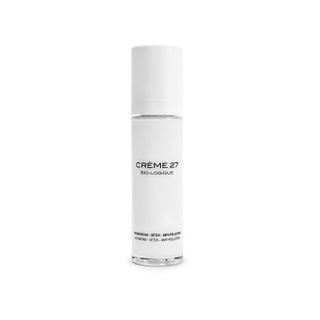
Judging from the ingredient list, "Cosmetics 27 - Creme Bio-Logique 27" works well for improving skin hydration As we expect from a proper moisturizer, the formula includes a combo of effective humectants and emollients. These are the two different types of ingredients that are essential for improving the skin hydration and supporting a healthy skin barrier. Humectants in this product (panthenol, urea, anhydroxylitol, glycerin and xylitylglucoside) help to increase the water content in the upper layer of the skin. (These ingredients do so by "capturing" water molecules from the outside air or from within the deeper layers of the skin). Emollients in this formulation (glycine soja oil, triticum vulgare germ oil, c10-18 triglycerides, coco-caprylate/caprate and hydrogenated olive oil unsaponifiables) help to reduce the moisture loss from the skin. They also soften the skin surface and relieve the feeling of dryness and tightness.
Ingredient callouts
- This product contains acids (gluconolactone and lactic acid). Their concentration is low, and they will not have a strong exfoliating effect. Instead, they work to support the skin natural acid mantle and to attract water (as humectants). PHAs (gluconolactone) especially are great for improving skin hydration. They might be even able to stimulate the production of skin's natural humectants and support the healthy skin microbiome.
Irritation risk
This moisturizer contains a bunch of common irritants, including ingredients that do not provide any known benefit for the skin. It might not be the best choice if your skin is sensitive. We assess the overall irritancy of this moisturizer to be high. For a detailed overview of all potential irritants: click here
You can see the detailed formula review with the breakdown of all actives in the product and the full ingredient list with estimated concentrations in the tables below.
Price
The product retails for 75.00£ in the United Kingdom.
For a detailed price comparison: click here.
Sources cited in this review
Every concentration estimate and effectiveness label is anchored to one of these 38 studies and safety reviews.
- 1Safety Assessment of Alkyl Esters as Used in Cosmeticscir-safety.org
- 2
- 3Skin moisturizing effects of panthenol-based formulationspdfs.semanticscholar.org
- 4
- 5Vitamin E in dermatologyncbi.nlm.nih.gov
- 6Vitamin E and Skin Healthlpi.oregonstate.edu

Affiliate links · As an Amazon Associate, WIMJ earns from qualifying purchases.