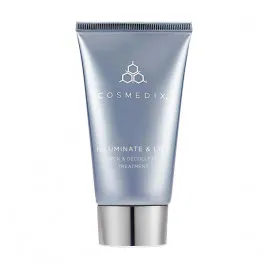
CosMedix Illuminate & Lift

CosMedix Illuminate & Lift

Efficacy0/100IrritancyMedium

Works for

Evens skin tone
Tetrahexyldecyl ascorbate ~0.45–0.7%, below the ~4% it needs + 1 more
Under-dosed
What the product description says
“Helps to even skin tone by reducing the look of acne scars, dark spots and hyper-pigmentation.”
Source: Cosmedix

Effective ingredients missing or their concentration is too low

Salicylic acidEffect: Low, below effective doseUsed for skin exfoliation. It has an anti-inflammatory and anti-bacterial effect, helps to unclog pores, prevent blemishes and speed up healing of the existing ones. Sometimes referred to as a BHA (beta-hydroxy acid)~0.15–0.25%
Tetrahexyldecyl ascorbateUnder-dosedBeing a lipid soluble form of vitamin C, it is more stable than ascorbic acid, but still degrades quickly and needs to be stabilized in a formulation with another ingredient. It is claimed to penetrate skin better than pure vitamin C and have the the similar benefits, but solid studies of its effectiveness are lacking. Is likely to require a higher concentration in a product than pure vitamin C to be effective. It might be able to help reduce pore clogging.~0.45–0.7%
Retinyl palmitateUnder-dosedThree steps removed from the active form of vitamin A - retinoic acid. To have an effect in the skin, it first needs to be converted twice to become the retinoic acid. This means it is less potent than retinol, but could also be less irritating. Once converted to the retinoic acid in the skin, it helps against all signs of aging, improves skin cell turnover and helps fight blemishes and clogged pores. However, in many cosmetic formulations, it is used in a concentration that is too low to have the full effect~0.25–0.45%
Moisturizing
Side benefit · Linoleic acid, Palmitoyl tripeptide-38 + 21 more
Works well

This product can help improve hydration of the skin with the two types of ingredients.

The first type is called “humectants”:
these ingredients help attract water. When humectants are on the surface of the skin, they “pull in” the moisture from the outside environment, or from within deeper layers of the skin. The following ingredients in this product do the job: anhydroxylitol, glycerin.

This product also contains ingredients called “occlusives”. They help reduce the speed with which our skin loses moisture to the outside environment. These ingredients also help soften the upper layer of the skin, so it feels less tight and nicer to the touch. The following ingredients in this product do the job: caprylic/capric triglyceride, helianthus annuus seed oil.

The following ingredients in this product are especially good for supporting the skin barrier and helping with the hydration level: linoleic acid, palmitoyl tripeptide-38, panthenol

Linoleic acidHero· EmollientEffect: HighAn excellent emollient. Helps soften the skin, restore its barrier function, and can help to calm down inflammation. It can be helpful to prevent blemishes and clogged pores~0.55–0.8%
Palmitoyl tripeptide-38HeroEffect: HighA type of peptide. Peptides are excellent moisturizers and might be able support collagen production reducing fine lines and wrinkles~0.45–0.7%
PanthenolHero· HumectantEffect: HighHelps attract water to the upper layer of the skin and can help improve skin barrier function~0.25–0.5%
GlycerinKey active· HumectantEffect: HighOne of the best moisturizing ingredients. Naturally present in skin. It attracts water to the upper layer of the skin working as a humectant~3.8–4.6%
Cetyl alcoholKey active· EmollientEffect: MediumA non-drying alcohol that works to soften the skin and stabilize product formulations helping oil and water mix together~2.3–2.9%
Ethylhexyl palmitateKey active· EmollientEffect: MediumAn emollient that helps soften the skin and create a nice product texture~2–2.4%
Helianthus annuus seed oilKey active· Emollient, OcclusiveEffect: HighA great emollient due to its high linoleic acid content. One of the most effective plant oils in helping skin hydration and repairing skin barrier function~1.5–1.8%
Caprylic/capric triglycerideKey active· Emollient, OcclusiveEffect: HighA good mix of fatty acids that forms a protective layer on the skin. Improves the shelf life of products. Derived from coconut and glycerin~1–1.2%
Theobroma cacao seed butterKey active· EmollientEffect: HighHelps soften the upper layer of the skin and can be helpful in restoring the skin barrier function. Might have some anti-oxidant effect~0.55–0.85%
Linolenic acidKey active· EmollientEffect: HighAn emollient that helps soften the skin and calm down inflammation~0.45–0.7%
Leontopodium alpinum callus culture extractKey active· HumectantEffect: MediumA plant stem cell extract that might help neutralize free radicals and reduce inflammation in skin~0.45–0.7%
Hydrolyzed hyaluronic acidKey active· HumectantEffect: HighOne of the best moisturizing ingredients. Attracts water into the upper layer of the skin. A version of it is naturally present in skin~0.3–0.55%
Mangifera indica seed butterKey activeEffect: HighHelps to soften the upper layer of the skin and might have some anti-oxidant effect~0.3–0.55%
AnhydroxylitolKey active· HumectantEffect: HighHelps attract water to the upper layer of the skin and repair the skin barrir function~0.25–0.5%
XylitylglucosideKey active· HumectantEffect: HighHelps attract water to the upper layer of the skin and repair the skin barrier function~0.25–0.5%
PhospholipidsKey activeEffect: MediumEmollients that are naturaly present in skin. In addition, they help water and oil mix together in the product~0.25–0.5%
Glyceryl stearate· EmollientEffect: LowAn emollient that softens the skin and forms a protective layer on its surface. Helps water and oil mix together~1.2–1.5%
Isohexadecane· EmollientEffect: LowImproves the texture of the product and helps soften the skin. Helps oil and water mix together and can be used as a cleansing agent~0.4–0.6%
Hydroxypropyl cyclodextrin· EmollientEffect: LowUsed to stabilize product formulations and help soften the upper layer of the skin~0.3–0.55%
TocopherolEffect: Low, below effective dosePure form of vitamin E. Can help moisturise and protect the skin from free radicals. Often used to help stabilise other ingredients or the formula itself~0.35–0.6%
Aloe barbadensis leaf juiceEffect: Low, below effective doseTraditionally used to treat sunburns, dermatitis and inflammation, but evidence for its effectiveness is lacking. The extract can contain humectants that help attract water into the skin~0.25–0.5%
Butyrospermum parkii butterUnder-dosedA great moisturising ingredient that softens the skin and reduces water loss from its upper layer. It also can be helpful in protecting skin from free radicals~0.65–0.95%
AllantoinUnder-dosedHelps calm down inflammation in skin and can help reduce itching. Helps to repair the skin barrier and keep skin hydrated~0.25–0.45%
Anti-oxidation
Side benefit · Vitis vinifera seed extract, Theobroma cacao seed butter + 7 more
Works well

This product contains antioxidants (vitis vinifera seed extract) that can help neutralize free radicals in skin. By doing so, they can lessen the damage the skin gets from the UV light (sun).

Vitis vinifera seed extractKey activeEffect: HighA plant extract that contains resveratrol and other anti-oxidant compounds that can help neutralize free radicals, reduce inflammation in skin and even out its tone. Can be also used to stabilize the product formulation~0.3–0.5%
Theobroma cacao seed butterEffect: LowHelps soften the upper layer of the skin and can be helpful in restoring the skin barrier function. Might have some anti-oxidant effect~0.55–0.85%
Leontopodium alpinum callus culture extractEffect: LowA plant stem cell extract that might help neutralize free radicals and reduce inflammation in skin~0.45–0.7%
Mangifera indica seed butterEffect: LowHelps to soften the upper layer of the skin and might have some anti-oxidant effect~0.3–0.55%
Butyrospermum parkii butterEffect: Low, below effective doseA great moisturising ingredient that softens the skin and reduces water loss from its upper layer. It also can be helpful in protecting skin from free radicals~0.65–0.95%
Tocopheryl acetateEffect: Low, below effective doseA more stable but less bio-available form of vitamin E compared to Tocopherol. Might help moisturize and protect the skin from free radicals, but mostly used in low concentrations to stabilize other ingredients.~0.3–0.5%
Ascorbyl palmitateEffect: Low, below effective doseBeing a lipid soluble form of vitamin C, it is more stable and can penetrate the skin better than L-Ascorbic acid. It is effective in protecting the skin from free radicals, as well as evening the skin tone, but is less effective in stimulating collagen production compared to L-Ascorbic acid.~0.25–0.5%
Tetrahexyldecyl ascorbateUnder-dosedBeing a lipid soluble form of vitamin C, it is more stable than ascorbic acid, but still degrades quickly and needs to be stabilized in a formulation with another ingredient. It is claimed to penetrate skin better than pure vitamin C and have the the similar benefits, but solid studies of its effectiveness are lacking. Is likely to require a higher concentration in a product than pure vitamin C to be effective. It might be able to help reduce pore clogging.~0.45–0.7%
TocopherolUnder-dosedPure form of vitamin E. Can help moisturise and protect the skin from free radicals. Often used to help stabilise other ingredients or the formula itself~0.35–0.6%
Anti-aging
Side benefit · Palmitoyl tripeptide-38, Vitis vinifera seed extract + 7 more
May help

This product contains palmitoyl tripeptide-38, vitis vinifera seed extract. There is some human evidence that these ingredients help reduce and prevent fine lines and wrinkles and improve skin elasticity and firmness, though it is smaller or less consistent than the evidence for the best anti-aging ingredients.

Palmitoyl tripeptide-38Key activeEffect: MediumA type of peptide. Peptides are excellent moisturizers and might be able support collagen production reducing fine lines and wrinkles~0.45–0.7%
Vitis vinifera seed extractKey activeEffect: MediumA plant extract that contains resveratrol and other anti-oxidant compounds that can help neutralize free radicals, reduce inflammation in skin and even out its tone. Can be also used to stabilize the product formulation~0.3–0.5%
Magnesium aluminum silicateEffect: LowMight be helpful in restoring skin barrier function and, when combined with zinc carbonate and malonic acid, reducing fine lines and wrinkles by stimulating elastin production. Also helps stabilize the product formulation~0.3–0.5%
Butyrospermum parkii butterEffect: Low, below effective doseA great moisturising ingredient that softens the skin and reduces water loss from its upper layer. It also can be helpful in protecting skin from free radicals~0.65–0.95%
TocopherolEffect: Low, below effective dosePure form of vitamin E. Can help moisturise and protect the skin from free radicals. Often used to help stabilise other ingredients or the formula itself~0.35–0.6%
Ascorbyl palmitateEffect: Low, below effective doseBeing a lipid soluble form of vitamin C, it is more stable and can penetrate the skin better than L-Ascorbic acid. It is effective in protecting the skin from free radicals, as well as evening the skin tone, but is less effective in stimulating collagen production compared to L-Ascorbic acid.~0.25–0.5%
Aloe barbadensis leaf juiceEffect: Low, below effective doseTraditionally used to treat sunburns, dermatitis and inflammation, but evidence for its effectiveness is lacking. The extract can contain humectants that help attract water into the skin~0.25–0.5%
Tetrahexyldecyl ascorbateUnder-dosedBeing a lipid soluble form of vitamin C, it is more stable than ascorbic acid, but still degrades quickly and needs to be stabilized in a formulation with another ingredient. It is claimed to penetrate skin better than pure vitamin C and have the the similar benefits, but solid studies of its effectiveness are lacking. Is likely to require a higher concentration in a product than pure vitamin C to be effective. It might be able to help reduce pore clogging.~0.45–0.7%
Retinyl palmitateUnder-dosedThree steps removed from the active form of vitamin A - retinoic acid. To have an effect in the skin, it first needs to be converted twice to become the retinoic acid. This means it is less potent than retinol, but could also be less irritating. Once converted to the retinoic acid in the skin, it helps against all signs of aging, improves skin cell turnover and helps fight blemishes and clogged pores. However, in many cosmetic formulations, it is used in a concentration that is too low to have the full effect~0.25–0.45%

Can it cause trouble?

Irritancy
2 strong irritants: Retinyl palmitate, Alcohol
Medium risk
We flagged 21 ingredients with irritancy potential. Severity depends on your sensitivity threshold; the table lists the worst offenders first.
IngredientFunctionIrritationEst. amount
Chamomilla recutita flower extractPlant extract that can have healing and anti-inflammatory properties. It is a potential allergen and can be irritatingHigh~0.25–0.5%est.
Retinyl palmitateThree steps removed from the active form of vitamin A - retinoic acid. To have an effect in the skin, it first needs to be converted twice to become the retinoic acid. This means it is less potent than retinol, but could also be less irritating. Once converted to the retinoic acid in the skin, it helps against all signs of aging, improves skin cell turnover and helps fight blemishes and clogged pores. However, in many cosmetic formulations, it is used in a concentration that is too low to have the full effectHigh~0.25–0.45%est.
Salicylic acidUsed for skin exfoliation. It has an anti-inflammatory and anti-bacterial effect, helps to unclog pores, prevent blemishes and speed up healing of the existing ones. Sometimes referred to as a BHA (beta-hydroxy acid)High~0.15–0.25%est.
AlcoholCan be drying and contribute to skin irritation. Used in formulars to dissolve other ingredients, create a thinner product consistency or for its antibacterial propertiesHigh~0.05–0.1%est.
Polyglyceryl-2 stearateHelps water and oil mix togetherMedium~4–4.9%est.
Silybum marianum ethyl esterHelps to create a nice product texture. Used to substitute siliconesMedium~1.6–2%est.
Caprylic/capric triglycerideA good mix of fatty acids that forms a protective layer on the skin. Improves the shelf life of products. Derived from coconut and glycerinMedium~1–1.2%est.
Tetrahexyldecyl ascorbateBeing a lipid soluble form of vitamin C, it is more stable than ascorbic acid, but still degrades quickly and needs to be stabilized in a formulation with another ingredient. It is claimed to penetrate skin better than pure vitamin C and have the the similar benefits, but solid studies of its effectiveness are lacking. Is likely to require a higher concentration in a product than pure vitamin C to be effective. It might be able to help reduce pore clogging.Medium~0.45–0.7%est.
Linolenic acidAn emollient that helps soften the skin and calm down inflammationMedium~0.45–0.7%est.
Aloe barbadensis leaf juiceTraditionally used to treat sunburns, dermatitis and inflammation, but evidence for its effectiveness is lacking. The extract can contain humectants that help attract water into the skinMedium~0.25–0.5%est.
Tocopheryl acetateA more stable but less bio-available form of vitamin E compared to Tocopherol. Might help moisturize and protect the skin from free radicals, but mostly used in low concentrations to stabilize other ingredients.Medium~0.3–0.5%est.
Ascorbyl palmitateBeing a lipid soluble form of vitamin C, it is more stable and can penetrate the skin better than L-Ascorbic acid. It is effective in protecting the skin from free radicals, as well as evening the skin tone, but is less effective in stimulating collagen production compared to L-Ascorbic acid.Medium~0.25–0.5%est.
Sorbitan oleateHelps oil and water mix togetherMedium~0.3–0.5%est.
Sorbitan laurateHelps water and oil mix togetherMedium~0.3–0.5%est.
Hydroxypropyl cyclodextrinUsed to stabilize product formulations and help soften the upper layer of the skinMedium~0.3–0.55%est.
Polysorbate 60Helps oil and water mix togetherMedium~0.3–0.55%est.
EthylhexylglycerinA preservativeMedium~0.2–0.4%est.
Sorbic acidA preservativeMedium~0.1–0.2%est.
Sodium metabisulfiteA preservativeMedium~0.1–0.2%est.
Calcium chlorideHelps create a thicker product consistency. Might be irritatingMedium~0.15–0.25%est.
Citric acidCan work as an exfoliant but is typically used to adjust the product pHMedium~0.1–0.2%est.
Comedogenic
4 ingredients rated 2 or more on the 0–5 pore-clogging scale
4 flagged
These ingredients have a comedogenic rating of 2 or more on a 0–5 scale; the table shows each one's rating. In leave-on products they can clog pores in acne-prone skin.
IngredientFunctionRatingEst. amount
Ethylhexyl palmitateAn emollient that helps soften the skin and create a nice product texture3/5~2–2.4%est.
Butyrospermum parkii butterA great moisturising ingredient that softens the skin and reduces water loss from its upper layer. It also can be helpful in protecting skin from free radicals3/5~0.65–0.95%est.
Theobroma cacao seed butterHelps soften the upper layer of the skin and can be helpful in restoring the skin barrier function. Might have some anti-oxidant effect3/5~0.55–0.85%est.
Sorbitan oleateHelps oil and water mix together2/5~0.3–0.5%est.
Did this help you decide?

User reviews

Would you recommend?
No community reviews yet.

Be the first — your take helps the next person decide.

Ingredients

Filter by role to see what each ingredient is doing.

Water~45–55%
Formula
Irritation risk
Low

Plain old water

More about Water
Polyglyceryl-2 stearate~4–4.9%
Irritant · medium
Irritation risk
Medium
Works for
Cleansing

Helps water and oil mix together

More about Polyglyceryl-2 stearate
Glycerin~3.8–4.6%
Key active
Irritation risk
Low
Works for
Moisturizing

One of the best moisturizing ingredients. Naturally present in skin. It attracts water to the upper layer of the skin working as a humectant

More about Glycerin
Propanediol~3–3.7%
Formula
Irritation risk
Low

Acts as a solvent for other ingredients. Speeds up the absorption of other ingredients into the skin

More about Propanediol
Cetyl alcohol~2.3–2.9%
Key active
Irritation risk
Low
Works for
CleansingMoisturizing

A non-drying alcohol that works to soften the skin and stabilize product formulations helping oil and water mix together

More about Cetyl alcohol
Ethylhexyl palmitate~2–2.4%
Key activeComedogenic 3/5
Irritation risk
Low
Comedogenicity
3/5
Works for
Moisturizing

An emollient that helps soften the skin and create a nice product texture

More about Ethylhexyl palmitate
Silybum marianum ethyl ester~1.6–2%
Irritant · medium
Irritation risk
Medium

Helps to create a nice product texture. Used to substitute silicones

More about Silybum marianum ethyl ester
Helianthus annuus seed oil~1.5–1.8%
Key active
Irritation risk
Low
Works for
Moisturizing

A great emollient due to its high linoleic acid content. One of the most effective plant oils in helping skin hydration and repairing skin barrier function

More about Helianthus annuus seed oil
Glyceryl stearate~1.2–1.5%
Formula
Irritation risk
Low
Works for
CleansingMoisturizing

An emollient that softens the skin and forms a protective layer on its surface. Helps water and oil mix together

More about Glyceryl stearate
Caprylic/capric triglyceride~1–1.2%
Key activeIrritant · medium
Irritation risk
Medium
Works for
Moisturizing

A good mix of fatty acids that forms a protective layer on the skin. Improves the shelf life of products. Derived from coconut and glycerin

More about Caprylic/capric triglyceride
Stearyl alcohol~0.75–1.15%
Formula
Irritation risk
Low
Works for
Cleansing

An emollient that helps soften the skin

More about Stearyl alcohol
Butyrospermum parkii butter~0.65–0.95%
Under-dosedComedogenic 3/5
Irritation risk
Low
Comedogenicity
3/5
Works for
MoisturizingAnti-oxidationAnti-aging

A great moisturising ingredient that softens the skin and reduces water loss from its upper layer. It also can be helpful in protecting skin from free radicals

More about Butyrospermum parkii butter
Theobroma cacao seed butter~0.55–0.85%
Key activeComedogenic 3/5
Irritation risk
Low
Comedogenicity
3/5
Works for
MoisturizingAnti-oxidationAnti-dandruff

Helps soften the upper layer of the skin and can be helpful in restoring the skin barrier function. Might have some anti-oxidant effect

More about Theobroma cacao seed butter
Polysorbate 80~0.5–0.8%
Formula
Irritation risk
Low
Works for
Cleansing

Helps water and oil mix together

More about Polysorbate 80
Leontopodium alpinum callus culture extract~0.45–0.7%
Key active
Irritation risk
Low
Works for
MoisturizingAnti-inflammatoryAnti-oxidation

A plant stem cell extract that might help neutralize free radicals and reduce inflammation in skin

More about Leontopodium alpinum callus culture extract
Palmitoyl tripeptide-38~0.45–0.7%
Hero · Moisturizing
Irritation risk
Low
Works for
MoisturizingAnti-aging

A type of peptide. Peptides are excellent moisturizers and might be able support collagen production reducing fine lines and wrinkles

More about Palmitoyl tripeptide-38
Tetrahexyldecyl ascorbate~0.45–0.7%
Under-dosedIrritant · medium
Irritation risk
Medium
Works for
Evens skin toneAnti-agingAnti-oxidation

Being a lipid soluble form of vitamin C, it is more stable than ascorbic acid, but still degrades quickly and needs to be stabilized in a formulation with another ingredient. It is claimed to penetrate skin better than pure vitamin C and have the the similar benefits, but solid studies of its effectiveness are lacking. Is likely to require a higher concentration in a product than pure vitamin C to be effective. It might be able to help reduce pore clogging.

More about Tetrahexyldecyl ascorbate
Linoleic acid~0.55–0.8%
Hero · Moisturizing
Irritation risk
Low
Works for
MoisturizingCleansingAnti-blemish

An excellent emollient. Helps soften the skin, restore its barrier function, and can help to calm down inflammation. It can be helpful to prevent blemishes and clogged pores

More about Linoleic acid
Linolenic acid~0.45–0.7%
Key activeIrritant · medium
Irritation risk
Medium
Works for
MoisturizingCleansingReduces irritationAnti-inflammatory

An emollient that helps soften the skin and calm down inflammation

More about Linolenic acid
Tocopherol~0.35–0.6%
Under-dosed
Irritation risk
Low
Works for
Anti-oxidationMoisturizingAnti-inflammatoryAnti-aging

Pure form of vitamin E. Can help moisturise and protect the skin from free radicals. Often used to help stabilise other ingredients or the formula itself

More about Tocopherol
Hydrolyzed hyaluronic acid~0.3–0.55%
Key active
Irritation risk
Low
Works for
Moisturizing

One of the best moisturizing ingredients. Attracts water into the upper layer of the skin. A version of it is naturally present in skin

More about Hydrolyzed hyaluronic acid
Mangifera indica seed butter~0.3–0.55%
Key active
Irritation risk
Low
Works for
MoisturizingAnti-oxidation

Helps to soften the upper layer of the skin and might have some anti-oxidant effect

More about Mangifera indica seed butter
Aloe barbadensis leaf juice~0.25–0.5%
Irritant · medium
Irritation risk
Medium
Works for
MoisturizingAntibacterialAnti-inflammatoryReduces rednessReduces irritationAnti-blemishAnti-aging

Traditionally used to treat sunburns, dermatitis and inflammation, but evidence for its effectiveness is lacking. The extract can contain humectants that help attract water into the skin

More about Aloe barbadensis leaf juice
Myristyl malate phosphonic acid~0.25–0.5%
Formula
Xylitylglucoside~0.25–0.5%
Key active
Irritation risk
Low
Works for
Moisturizing

Helps attract water to the upper layer of the skin and repair the skin barrier function

More about Xylitylglucoside
Anhydroxylitol~0.25–0.5%
Key active
Irritation risk
Low
Works for
Moisturizing

Helps attract water to the upper layer of the skin and repair the skin barrir function

More about Anhydroxylitol
Xylitol~0.25–0.45%
Formula
Irritation risk
Low

Helps attract water to the upper layer of the skin and repair the skin barrier function

More about Xylitol
Chamomilla recutita flower extract~0.25–0.5%
Irritant · high
Irritation risk
High
Works for
Anti-inflammatory

Plant extract that can have healing and anti-inflammatory properties. It is a potential allergen and can be irritating

More about Chamomilla recutita flower extract
Vitis vinifera seed extract~0.3–0.5%
Key active
Irritation risk
Low
Works for
Anti-oxidationAnti-agingAnti-inflammatoryAntibacterial

A plant extract that contains resveratrol and other anti-oxidant compounds that can help neutralize free radicals, reduce inflammation in skin and even out its tone. Can be also used to stabilize the product formulation

More about Vitis vinifera seed extract
Phospholipids~0.25–0.5%
Key active
Irritation risk
Low
Works for
Moisturizing

Emollients that are naturaly present in skin. In addition, they help water and oil mix together in the product

More about Phospholipids
Tocopheryl acetate~0.3–0.5%
Irritant · medium
Irritation risk
Medium
Works for
Anti-oxidation

A more stable but less bio-available form of vitamin E compared to Tocopherol. Might help moisturize and protect the skin from free radicals, but mostly used in low concentrations to stabilize other ingredients.

More about Tocopheryl acetate
Retinyl palmitate~0.25–0.45%
Under-dosedIrritant · high
Irritation risk
High
Works for
Anti-agingEvens skin toneAnti-blemishExfoliation

Three steps removed from the active form of vitamin A - retinoic acid. To have an effect in the skin, it first needs to be converted twice to become the retinoic acid. This means it is less potent than retinol, but could also be less irritating. Once converted to the retinoic acid in the skin, it helps against all signs of aging, improves skin cell turnover and helps fight blemishes and clogged pores. However, in many cosmetic formulations, it is used in a concentration that is too low to have the full effect

More about Retinyl palmitate
Ascorbyl palmitate~0.25–0.5%
Irritant · medium
Irritation risk
Medium
Works for
Anti-oxidationAnti-aging

Being a lipid soluble form of vitamin C, it is more stable and can penetrate the skin better than L-Ascorbic acid. It is effective in protecting the skin from free radicals, as well as evening the skin tone, but is less effective in stimulating collagen production compared to L-Ascorbic acid.

More about Ascorbyl palmitate
Allantoin~0.25–0.45%
Under-dosed
Irritation risk
Low
Works for
MoisturizingAnti-inflammatoryReduces irritationReduces rednessAnti-blemishExfoliation

Helps calm down inflammation in skin and can help reduce itching. Helps to repair the skin barrier and keep skin hydrated

More about Allantoin
Panthenol~0.25–0.5%
Hero · Moisturizing
Irritation risk
Low
Works for
Reduces rednessMoisturizingReduces irritation

Helps attract water to the upper layer of the skin and can help improve skin barrier function

More about Panthenol
Magnesium aluminum silicate~0.3–0.5%
Formula
Irritation risk
Low
Works for
Anti-aging

Might be helpful in restoring skin barrier function and, when combined with zinc carbonate and malonic acid, reducing fine lines and wrinkles by stimulating elastin production. Also helps stabilize the product formulation

More about Magnesium aluminum silicate
Xanthan gum~0.3–0.5%
Formula
Irritation risk
Low
Works for
Cleansing

Used to create a thicker product consistency

More about Xanthan gum
Sorbitan oleate~0.3–0.5%
Comedogenic 2/5Irritant · medium
Irritation risk
Medium
Comedogenicity
2/5
Works for
Cleansing

Helps oil and water mix together

More about Sorbitan oleate
Sorbitan laurate~0.3–0.5%
Irritant · medium
Irritation risk
Medium
Works for
Cleansing

Helps water and oil mix together

More about Sorbitan laurate
Hydroxypropyl cyclodextrin~0.3–0.55%
Irritant · medium
Irritation risk
Medium
Works for
Moisturizing

Used to stabilize product formulations and help soften the upper layer of the skin

More about Hydroxypropyl cyclodextrin
Sodium acrylate/acryloyldimethyltaurate/dimethylacrylamide crosspolymer~0.25–0.5%
Formula
Isohexadecane~0.4–0.6%
Formula
Irritation risk
Low
Works for
CleansingMoisturizing

Improves the texture of the product and helps soften the skin. Helps oil and water mix together and can be used as a cleansing agent

More about Isohexadecane
Polysorbate 60~0.3–0.55%
Irritant · medium
Irritation risk
Medium
Works for
Cleansing

Helps oil and water mix together

More about Polysorbate 60
Sodium phytate~0.25–0.45%
Formula
Irritation risk
Low

Used to stabilize product formulations

More about Sodium phytate
Sodium hydroxide~0.25–0.45%
Formula
Irritation risk
Low

Used to adjust the product's pH

More about Sodium hydroxide
Phenoxyethanol~0.25–0.45%
Formula
Irritation risk
Low

A preservative. It helps prevent bacterial growth in cosmetic products

More about Phenoxyethanol
Ethylhexylglycerin~0.2–0.4%
Irritant · medium
Irritation risk
Medium

A preservative

More about Ethylhexylglycerin
Titanium dioxide~0.3–0.55%
Formula
Irritation risk
Low
Works for
Sun protection

Works as a UV filter when used in high concentrations. It is photostable and is effective mostly against the UVB light, with some protection in the UVA range. In small concentrations, used for its ability to improve the color of cosmetic products. Is usually well tolerated by the skin

More about Titanium dioxide
Quartz~0.25–0.5%
Formula
Irritation risk
Low

A mineral. It does not have any confirmed benefit for the skin

More about Quartz
Salicylic acid~0.15–0.25%
Irritant · high
Irritation risk
High
Works for
Anti-blemishExfoliationAnti-inflammatoryAntibacterialEvens skin tone

Used for skin exfoliation. It has an anti-inflammatory and anti-bacterial effect, helps to unclog pores, prevent blemishes and speed up healing of the existing ones. Sometimes referred to as a BHA (beta-hydroxy acid)

More about Salicylic acid
Sorbic acid~0.1–0.2%
Irritant · medium
Irritation risk
Medium

A preservative

More about Sorbic acid
Sodium metabisulfite~0.1–0.2%
Irritant · medium
Irritation risk
Medium

A preservative

More about Sodium metabisulfite
Calcium chloride~0.15–0.25%
Irritant · medium
Irritation risk
Medium

Helps create a thicker product consistency. Might be irritating

More about Calcium chloride
Citric acid~0.1–0.2%
Irritant · medium
Irritation risk
Medium

Can work as an exfoliant but is typically used to adjust the product pH

More about Citric acid
Sorbitan isostearate~0.1–0.15%
Formula
Irritation risk
Low
Works for
Cleansing

Helps oil and water mix together

More about Sorbitan isostearate
Alcohol~0.05–0.1%
Irritant · high
Irritation risk
High
Works for
Antibacterial

Can be drying and contribute to skin irritation. Used in formulars to dissolve other ingredients, create a thinner product consistency or for its antibacterial properties

More about Alcohol
Ingredient list view

Water, Polyglyceryl-2 stearate, Glycerin, Propanediol, Cetyl alcohol, Ethylhexyl palmitate, Silybum marianum ethyl ester, Helianthus annuus seed oil, Glyceryl stearate, Caprylic/capric triglyceride, Stearyl alcohol, Butyrospermum parkii butter, Theobroma cacao seed butter, Polysorbate 80, Leontopodium alpinum callus culture extract, Palmitoyl tripeptide-38, Tetrahexyldecyl ascorbate, Linoleic acid, Linolenic acid, Tocopherol, Hydrolyzed hyaluronic acid, Mangifera indica seed butter, Aloe barbadensis leaf juice, Myristyl malate phosphonic acid, Xylitylglucoside, Anhydroxylitol, Xylitol, Chamomilla recutita flower extract, Vitis vinifera seed extract, Phospholipids, Tocopheryl acetate, Retinyl palmitate, Ascorbyl palmitate, Allantoin, Panthenol, Magnesium aluminum silicate, Xanthan gum, Sorbitan oleate, Sorbitan laurate, Hydroxypropyl cyclodextrin, Sodium acrylate/acryloyldimethyltaurate/dimethylacrylamide crosspolymer, Isohexadecane, Polysorbate 60, Sodium phytate, Sodium hydroxide, Phenoxyethanol, Ethylhexylglycerin, Titanium dioxide, Quartz, Salicylic acid, Sorbic acid, Sodium metabisulfite, Calcium chloride, Citric acid, Sorbitan isostearate, Alcohol

Compare prices

Retailers ranked by price — lowest first.

🇦🇺 Amazon Australia (AU)
Price unavailable Out of stock
Check
🇬🇧 Amazon UK (UK)
Price unavailable Out of stock
Check

Affiliate links · As an Amazon Associate, WIMJ earns from qualifying purchases.

Worth comparing, line by line.

Match % combines shared ingredients, the first five ingredients, shared actives and hero ingredients, irritancy (lower counts in the alternative's favour), texture and body area. Only products in the same routine step are compared.

Side-by-side comparison of this product against its closest alternatives
CosMedixIlluminate & LiftYOUR PRODUCTPour Moi SkincareHydrating Balancer Arid ConditionsThe Jojoba CompanyIntense Overnight Renewal CreamThe INKEY List CA360° Acne Clearing Duo
Match—69%69%68%
Price—$47.00$30.88$34.20
Shared key ingredients—4 of 205 of 204 of 20
Key difference—Lactic AcidCamellia Sinensis Leaf ExtractPolysilicone-11
Irritancy Medium Low Low Low
Drying alcohol Contains drying alcohol ———
View product Shop Shop Shop

More alternatives: Paula's choice MOISTURE BOOST Essential Hydrating TonerAvatara The Simple Shield

Cheaper alternatives? Browse formulas in the same category.
We compare ingredient profiles across our catalog — pick the closest match for your budget.
Open dupe finder

Sources cited in this review

Every concentration estimate and effectiveness label is anchored to one of these 37 studies and safety reviews.

  1. 1
  2. 2
  3. 3
  4. 4
  5. 5
  6. 6
CosMedix Illuminate & Lift
CosMedixIlluminate & Lift

Affiliate links · As an Amazon Associate, WIMJ earns from qualifying purchases.

As an Amazon Associate, WIMJ earns from qualifying purchases.