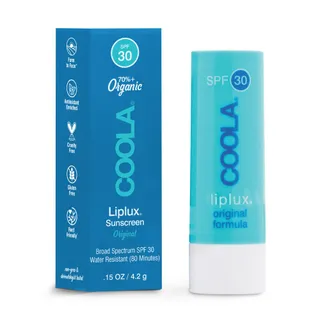
Coola Classic Liplux Organic Lip Balm Sunscreen SPF 30
Works for
Sun protectionSPF 30 · 5 UV filtersBroad spectrum
This product offers a good level of protection against both UVB and UVA rays.
This sunscreen uses organic (so-called "chemical") sunscreen filters. Organic, or "chemical" filters usually provide reliable sun protection and rarely leave a white cast. Sunscreens with organic filters can sting eyes.
This product can be considered "reef safe" because it does not contain the UV filters (oxybenzone and octinoxate) that can be harmful to coral reefs when present in the water in high concentrations.
MoisturizingSide benefit the brand mentions · Linoleic acid, Caprylic/capric triglyceride + 13 moreWorks well
“Pucker perfection! Our new and improved organic lip balm with broad spectrum UVA/UVB protection hydrates and smoothes dry, chapped lips.”
This product can help soften the skin and reduce its moisture loss with emollients and occlusives: caprylic/capric triglyceride, cocos nucifera oil.
Keep in mind that this product does not contain effective ingredients to attract water to the upper layer of the skin. This is why an additional product with humectants like glycerin or hyaluronic acid can be helpful (apply it before this product for the best results).
The following ingredients in this product are especially good for supporting the skin barrier and helping with the hydration level: linoleic acid
Anti-agingSide benefit · Tocopherol, Tetrahexyldecyl ascorbateWorks well
This product can help prevent early signs of skin aging because it offers a good level of broad spectrum sun protection. Sun damage is the main cause of premature skin aging, and protecting your skin from the sun is the best anti-aging strategy.
Anti-oxidationSide benefit · Rubus idaeus seed oil, Bisabolol + 6 moreMay help
This product contains antioxidants (rubus idaeus seed oil) that might be able to help neutralize free radicals in skin to lessen the damage it gets from the UV light (sun). There is not enough evidence to confirm their effectiveness in skin though.
Can it cause trouble?
Irritancy2 strong irritants: Parfum, Rosmarinus officinalis leaf extractMedium risk
Comedogenic1 ingredient rated 2 or more on the 0–5 pore-clogging scale1 flagged
User reviews
Be the first — your take helps the next person decide.
Ingredients
Filter by role to see what each ingredient is doing.
Butyl methoxydibenzoylmethane2.9%
- Irritation risk
- Medium
Avobenzone. An organic, or so-called "chemical" UV filter. Protects against both UVA and UVB rays. Needs to be combined with other filters in a formulation to be stable.
More about Butyl methoxydibenzoylmethaneEthylhexyl salicylate4.9%
- Irritation risk
- Low
Octisalate. A UV filter. It offers some protection against the sun rays that cause sunburn (UVB), but does not protect against the most aging sun rays (UVA). It loses its effectiveness quickly when exposed to sunlight. It is an organic, or so called "chemical" sunscreen
More about Ethylhexyl salicylateOctocrylene7.6%
- Irritation risk
- Medium
A weak sunscreen that protects against the sun rays that cause sunburn (UVB) and is somewhat effective against the UVA rays. It is quite stable and can help stabilize other, more vulnerable, sunscreen ingredients like Avobenzone. It is an organic, or so called "chemical" sunscreen
More about OctocryleneAcacia senegal gum~23–34%
- Irritation risk
- Medium
Helps mask the small of other ingredients and improve the product texture
More about Acacia senegal gumAloe barbadensis leaf extract~3.9–5.8%
- Irritation risk
- Medium
Traditionally used to treat sunburns, dermatitis and inflammation, but evidence for its effectiveness is lacking. The extract can contain humectants that help attract water into the skin
More about Aloe barbadensis leaf extractAstrocaryum vulgare kernel oil~4.2–6.3%
- Irritation risk
- Low
Behenyl behenate~3.5–5.2%
- Irritation risk
- Low
Bisabolol~2.5–3.7%
- Irritation risk
- Low
An active component of chamomile plant that historically has been used to calm down irritated skin. A recent study shows that bisabolol indeed can have some anti-inflammatory effect on skin, even though conclusive data is lacking. Bisabolol has a sweet floral scent and can be added to products for its aromatic properties
More about BisabololButyloctyl salicylate~1.8–2.7%
- Irritation risk
- Medium
A synthetic ester of salicylic acid that is used to help disperse pigments and boost effectiveness of sunscreen ingredients. It is able to absorb UV light (working as an organic, or chemical filter), but is not approved as a sunscreen ingredient on its own
More about Butyloctyl salicylateCalcium sodium borosilicate~1.4–2%
Caprylic/capric triglyceride~1.4–2%
- Irritation risk
- Medium
A good mix of fatty acids that forms a protective layer on the skin. Improves the shelf life of products. Derived from coconut and glycerin
More about Caprylic/capric triglycerideCarthamus tinctorius seed oil~0.95–1.45%
- Irritation risk
- Low
An emollient that helps soften the skin and might help calm down inflammation
More about Carthamus tinctorius seed oilCitric acid~0.5–1.2%
- Irritation risk
- Medium
Can work as an exfoliant but is typically used to adjust the product pH
More about Citric acidCocos nucifera oil~0.4–1%
- Irritation risk
- Low
- Comedogenicity
- 3/5
An emollient. Found to be as effective as a moisturizer for dry skin as mineral oil. Could be comedogenic
More about Cocos nucifera oilCopernicia cerifera wax~0.4–0.9%
- Irritation risk
- Low
Helps to soften the upper layer of the skin and create a nice product consistency
More about Copernicia cerifera waxEuphorbia cerifera wax~0.3–0.75%
- Irritation risk
- Low
Parfum~0.1–0.45%
- Irritation risk
- High
An aromatic blend of unspecified and possibly irritating ingredients
More about ParfumHelianthus annuus seed oil~0.15–0.55%
- Irritation risk
- Low
A great emollient due to its high linoleic acid content. One of the most effective plant oils in helping skin hydration and repairing skin barrier function
More about Helianthus annuus seed oilIpomoea batatas tuber extract~0.1–0.4%
- Irritation risk
- Low
Iron oxides~0.1–0.4%
- Irritation risk
- Low
An umbrella term for the following three colorants: CI 77491, CI 77492, CI 77499. They might be able to offer some protection against visible light, but the degree of the protection is not clear
More about Iron oxidesLinoleic acid~0.2–0.7%
- Irritation risk
- Low
An excellent emollient. Helps soften the skin, restore its barrier function, and can help to calm down inflammation. It can be helpful to prevent blemishes and clogged pores
More about Linoleic acidMaltodextrin~0.15–0.55%
- Irritation risk
- Low
Used to stabilize the product formulation and can help absorb oil
More about MaltodextrinOctyldodecyl oleate~0.1–0.5%
- Irritation risk
- Low
Persea gratissima oil~0.1–0.45%
- Irritation risk
- Medium
An emollient that helps soften the skin and could be helpful in repairing its barrier function
More about Persea gratissima oilPhospholipids~0.05–0.3%
- Irritation risk
- Low
Emollients that are naturaly present in skin. In addition, they help water and oil mix together in the product
More about PhospholipidsPhytosterols~0.1–0.4%
- Irritation risk
- Medium
Lipids that work as an emollient and can be helpful in repairing skin barrier function
More about PhytosterolsPolyhydroxystearic acid~0.05–0.25%
- Irritation risk
- Medium
Used to create a thicker product consistency and stabilize the formulation
More about Polyhydroxystearic acidRaphanus sativus root extract~0.05–0.25%
- Irritation risk
- Low
Ricinus communis seed oil~0.1–0.35%
- Irritation risk
- Medium
A plant oil that can help soften the skin. It might be helpful in calming down inflammation, but solid research is lacking. Is often used in lip products to create the needed product consistency
More about Ricinus communis seed oilRosa canina fruit extract~0.05–0.25%
- Irritation risk
- Medium
A plant extract that might have some anti-oxidant properties, but evidence is lacking
More about Rosa canina fruit extractRosmarinus officinalis leaf extract~0.05–0.2%
- Irritation risk
- High
Can be helpful in reducing inflammation in skin, including inflamed acne. It can be irritating
More about Rosmarinus officinalis leaf extractRubus idaeus seed oil~0.1–0.5%
- Irritation risk
- Medium
A plant oil that might be able to help neutralize free radicals in skin
More about Rubus idaeus seed oilSimmondsia chinensis seed oil~0.15–0.5%
- Irritation risk
- Medium
Softens the upper layer of skin and helps restore the healthy skin barrier. Has shown to help calm down inflammation in skin. It is a stable oil, meaning that it retains its properties even when exposed to air.
More about Simmondsia chinensis seed oilStevia rebaudiana extract~0.05–0.25%
- Irritation risk
- Medium
A plant extract that adds a sweat taste to products (for example, for lip products). Might help to attract water to the upper layer of the skin and have some anti-oxidant effect
More about Stevia rebaudiana extractTapioca starch~0.05–0.3%
Tetrahexyldecyl ascorbate~0.1–0.3%
- Irritation risk
- Medium
Being a lipid soluble form of vitamin C, it is more stable than ascorbic acid, but still degrades quickly and needs to be stabilized in a formulation with another ingredient. It is claimed to penetrate skin better than pure vitamin C and have the the similar benefits, but solid studies of its effectiveness are lacking. Is likely to require a higher concentration in a product than pure vitamin C to be effective. It might be able to help reduce pore clogging.
More about Tetrahexyldecyl ascorbateTheobroma grandiflorum seed butter~0.1–0.3%
- Irritation risk
- Medium
Helps soften the upper layer of the skin and might as well help to attract moisture to its upper layer
More about Theobroma grandiflorum seed butterTitanium dioxide~0.05–0.2%
- Irritation risk
- Low
Works as a UV filter when used in high concentrations. It is photostable and is effective mostly against the UVB light, with some protection in the UVA range. In small concentrations, used for its ability to improve the color of cosmetic products. Is usually well tolerated by the skin
More about Titanium dioxideTocopherol~0.05–0.25%
- Irritation risk
- Low
Pure form of vitamin E. Can help moisturise and protect the skin from free radicals. Often used to help stabilise other ingredients or the formula itself
More about TocopherolIngredient list view
Butyl methoxydibenzoylmethane, Ethylhexyl salicylate, Octocrylene, Acacia senegal gum, Aloe barbadensis leaf extract, Astrocaryum vulgare kernel oil, Behenyl behenate, Bisabolol, Butyloctyl salicylate, Calcium sodium borosilicate, Caprylic/capric triglyceride, Carthamus tinctorius seed oil, Citric acid, Cocos nucifera oil, Copernicia cerifera wax, Euphorbia cerifera wax, Parfum, Helianthus annuus seed oil, Ipomoea batatas tuber extract, Iron oxides, Linoleic acid, Maltodextrin, Octyldodecyl oleate, Persea gratissima oil, Phospholipids, Phytosterols, Polyhydroxystearic acid, Raphanus sativus root extract, Ricinus communis seed oil, Rosa canina fruit extract, Rosmarinus officinalis leaf extract, Rubus idaeus seed oil, Simmondsia chinensis seed oil, Stevia rebaudiana extract, Tapioca starch, Tetrahexyldecyl ascorbate, Theobroma grandiflorum seed butter, Titanium dioxide, Tocopherol
Compare prices
Retailers ranked by price — lowest first.

Worth comparing, line by line.
Match % combines shared ingredients, the first five ingredients, shared actives and hero ingredients, irritancy (lower counts in the alternative's favour), texture and body area. Only products in the same routine step are compared.
| CoolaClassic Liplux Organic Lip Balm Sunscreen SPF 30YOUR PRODUCT | M-61Hydraboost Moisturizer SPF 30 | Specific BeautyActive Brightening Day Moisture Broad Spectrum SPF 30 | Supergoop!Shine On Lip Screen SPF 40 | |
|---|---|---|---|---|
| Match | — | 38% | 36% | 36% |
| Price | $30.00 | — | — | — |
| Shared key ingredients | — | 5 of 16 | 3 of 16 | 5 of 16 |
| Key difference | — | Urea | Niacinamide | Butyrospermum Parkii Butter |
| Irritancy | Medium | Medium | Medium | Low |
| SPF | SPF 30 | SPF 30 | SPF 30 | SPF 40 |
| Drying alcohol | — | — | — | — |
| View product | Shop | Shop | Shop |


More alternatives: MDSolarSciences Hydrating Sheer Lip Balm SPF30OARS + ALPS Everyday Anti-Aging Face Moisturizer with SPF 37
Product summary
We believe that "Coola - Classic Liplux Organic Lip Balm Sunscreen SPF 30" can provide reliable sun protection based on the ingredients listed. We love that it can protect from both UVA and UVB rays (not all sunscreens with SPF ratings give UVA protection. UVA rays do not cause sunburn, but still damage our skin and lead to early aging).
Sunscreen filters
This sunscreen uses so-called "chemical", or organic UV filters (organic simply means that their molecules contain atoms of carbon). These filters typically give good sun protection and rarely leave a white cast, but they can be irritating for sensitive skin. Here are the exact UV filters in this sunscreen: avobenzone 2.80% (declared), butyloctyl salicylate 0.15% - 0.60%, octisalate 4.90% (declared) and octocrylene 7.60% (declared).
Irritation risk
There are some common irritants in this product, including ingredients that do not have benefits for the skin. We assess the overall irritancy of it to be high. For a detailed overview of all potential irritants: click here
You can see the detailed formula review with the breakdown of all actives in the product and the full ingredient list with estimated concentrations in the tables below.
About the brand
According to Cruelty-Free Kitty "Coola" is cruelty free, but its parent company is not.
Price
The product retails from 10.00$ up to 12.00$ in the United States.
For a detailed price comparison: click here.
Sources cited in this review
Every concentration estimate and effectiveness label is anchored to one of these 20 studies and safety reviews.
- 1
- 2
- 3
- 4
- 5Effect of topically applied lipids on surfactant-irritated skinonlinelibrary.wiley.com
- 6

Affiliate links · As an Amazon Associate, WIMJ earns from qualifying purchases.