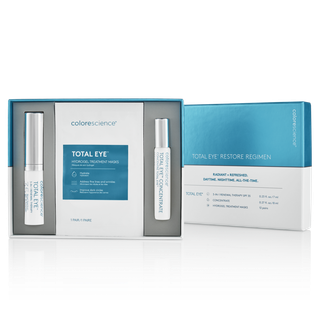
Colorescience Total Eye Restore Regimen
Works for
1 of 1 advertised claim delivered
Anti-aging4 ingredients credited for this claimStrong support
“With powerful, clinical ingredients, the regimen works to immediately minimize the appearance of dark circles, puffiness, fine lines, and wrinkles, while delivering long-term results to restore the eye area .”
This product can help reduce and prevent fine lines and wrinkles, improve skin elasticity and firmness because it contains retinol, niacinamide.
These ingredients in the product can also be helpful, even though there is less evidence for their effectiveness: palmitoyl tripeptide-5.
Keep in mind that it typically takes at least 6 weeks to notice any results because the changes that are needed to improve fine lines and elasticity happen in the deeper layers of the skin. No topical anti-aging product can “erase” wrinkles or fully reverse signs of aging.
Anti-oxidationNot advertised by the brand · 9 ingredients credited for this claimStrong support
This product contains antioxidants (retinol) that can help neutralize free radicals in skin. By doing so, they can lessen the damage the skin gets from the UV light (sun).
The following ingredients - tartaric acid also can have an antioxidant effect, but there is less evidence to confirm their effectiveness in skin.
ExfoliationNot advertised by the brand · 3 ingredients credited for this claimStrong support
This product can help exfoliate the skin. In other words, it helps break down the bonds between dead cells on the surface of the skin and speed up the skin turnover. Skin often appears softer and brighter after exfoliation, but overdoing it can result in disrupted skin barrier. The following ingredient is doing the exfoliating job in this product: retinol, salicylic acid.
MoisturizingNot advertised by the brand · 29 ingredients credited for this claimStrong support
This product can help improve hydration of the skin with the two types of ingredients.
The first type is called “humectants”:
these ingredients help attract water.
When humectants are on the surface of the skin, they “pull in” the moisture from the outside environment, or from
within deeper layers of the skin. The following ingredients in this product do the job:
betaine, glycerin.
This product also contains ingredients called “occlusives”. They help reduce the speed with which our skin loses moisture to the outside environment. These ingredients also help soften the upper layer of the skin, so it feels less tight and nicer to the touch. The following ingredients in this product do the job: caprylic/capric triglyceride, dimethicone.
The following ingredients in this product are especially good for supporting the skin barrier and helping with the hydration level: niacinamide, palmitoyl tripeptide-5, panthenol
Evens skin toneNot advertised by the brand · 4 ingredients credited for this claimStrong support
This product can help reduce hypepigmentation and even out the skin tone because it contains the following effective ingredients: retinol.
In addition, this product contains niacinamide, salicylic acid. This ingredient (ingredients) might help reduce hyperpigmentation, but the effect, if any, is likely to be small.
The following ingredient (ingredients) in this product might be helpful, but there is no evidence to confirm that it actually can help even out the skin tone: albizia julibrissin bark extract.
Keep in mind that you would need to apply any topical skincare targetted at hypigmentation consistently for a couple of months to get a result. No topical skincare product can help get rid of hyperpigmentation (including post-acne marks and age spots) instantly.
Can it cause trouble?
Irritancy2 strong irritants: Retinol, Illicium verum fruit extract — patch-test recommendedHigh risk
Comedogenic2 ingredients rated 2 or more on the 0–5 pore-clogging scale2 flagged


User reviews
Be the first — your take helps the next person decide.
Ingredients
Filter by role to see what each ingredient is doing.
Retinol~25–38%
- Irritation risk
- High
Two steps removed from the active form of vitamin A - retinoic acid. Once converted to the retinoic acid in the skin, retinol is proven to be effective against all signs of aging. It improves skin cell turnover, helps fight blemishes and clogged pores, can regulate excess oil production and even skin tone. It can, however, be quite irritating
More about RetinolTin~7.9–11.9%
Salicylic acid~1.25–2.5%
- Irritation risk
- High
Used for skin exfoliation. It has an anti-inflammatory and anti-bacterial effect, helps to unclog pores, prevent blemishes and speed up healing of the existing ones. Sometimes referred to as a BHA (beta-hydroxy acid)
More about Salicylic acidNiacinamide~4.1–6.1%
- Irritation risk
- Low
Is proven to be effective in reducing blemishes, evening out skin tone and helping to improve lines and wrinkles. It helps the skin to repair sun damage, calm down inflammation and keep maintain good levels of moisture. The concentration of about 2% is effective for supporting the skin barrier and evening out the skin tone. Concentration of 4-6% is better for helping with acne and balancing the sebum production
More about NiacinamideTitanium dioxide7.9%
- Irritation risk
- Low
Works as a UV filter when used in high concentrations. It is photostable and is effective mostly against the UVB light, with some protection in the UVA range. In small concentrations, used for its ability to improve the color of cosmetic products. Is usually well tolerated by the skin
More about Titanium dioxideZinc oxide6.7%
- Irritation risk
- Low
A broad spectrum sunblock (protects from both UVA and UVB rays). Is suitable for most sensitive skins. In small concentrations, can be used as a colorant
More about Zinc oxideWater~3–4.4%
Hydrogenated polyisobutene~2.6–3.9%
- Irritation risk
- Low
Used to improve the product consistency and soften the upper layer of the skin
More about Hydrogenated polyisobuteneCyclopentasiloxane~2–3%
- Irritation risk
- Low
A silicone that helps improve the product texture and spreadability. Can absorb oil creating a short-term mattifying effect on the skin
More about CyclopentasiloxaneCaprylic/capric triglyceride~1.9–2.8%
- Irritation risk
- Medium
A good mix of fatty acids that forms a protective layer on the skin. Improves the shelf life of products. Derived from coconut and glycerin
More about Caprylic/capric triglycerideLauryl polyglyceryl-3 polydimethylsiloxyethyl dimethicone~1.4–2%
- Irritation risk
- Low
Glycerin~1.2–1.8%
- Irritation risk
- Low
One of the best moisturizing ingredients. Naturally present in skin. It attracts water to the upper layer of the skin working as a humectant
More about GlycerinPanthenol~0.95–1.4%
- Irritation risk
- Low
Helps attract water to the upper layer of the skin and can help improve skin barrier function
More about PanthenolMica~1–1.45%
- Irritation risk
- Low
Creates an illusion of smoother and more radiant skin tone. Adds shimmer to the skin by reflecting light
More about MicaDimethicone crosspolymer~0.6–1.35%
- Irritation risk
- Low
Used to create a thicker product texture. Helps soften the upper layer of the skin and might be able to prevent moisture loss from its surface
More about Dimethicone crosspolymerAlbizia julibrissin bark extract~0.55–1.3%
- Irritation risk
- High
A plant extract that might help to neutralize free radicals in skin. Is claimed to help reduce hyperpigmentation but evidence is missing
More about Albizia julibrissin bark extractSea water~0.55–1.25%
- Irritation risk
- Low
Dissolves other ingredients. It does not have additional skin benefits compared to plain water
More about Sea waterSorbitol~0.55–1.25%
- Irritation risk
- Low
Helps attract water to the upper layer of the skin and improves the product texture
More about SorbitolJojoba esters~0.6–1.35%
- Irritation risk
- Medium
An emollient made of jojoba oil. Helps soften the skin and support its barrier function
More about Jojoba estersSodium hyaluronate~0.5–1.15%
- Irritation risk
- Low
One of the best moisturizing ingredients. Attracts water into the upper layer of the skin
More about Sodium hyaluronatePalmitoyl tripeptide-5~0.45–1.1%
- Irritation risk
- Low
A type of peptide. Peptides are excellent moisturizers and might be able support collagen production reducing fine lines and wrinkles
More about Palmitoyl tripeptide-5Tremella fuciformis sporocarp extract~0.45–1.05%
- Irritation risk
- Low
Mushroom extract that helps attract water to the upper layer of the skin
More about Tremella fuciformis sporocarp extractHydrolyzed algin~0.45–1.05%
- Irritation risk
- Low
- Comedogenicity
- 3/5
Derived from brown algae. Helps attract water to the upper layer of the skin
More about Hydrolyzed alginAscophyllum nodosum extract~0.45–1%
- Irritation risk
- Low
Brown seaweed extract. Can help attract water to the upper layer of the skin and might have some antioxidant effect
More about Ascophyllum nodosum extractBetaine~0.4–0.95%
- Irritation risk
- Low
Helps attract water to the upper layer of the skin and improves the product texture
More about BetaineDunaliella salina extract~0.4–1%
- Irritation risk
- Low
A green micro-algae extract that might help neutralize free radicals in skin, but solid evidence is lacking. It helps to soften the upper layer of the skin
More about Dunaliella salina extractAsparagopsis armata extract~0.45–1%
- Irritation risk
- Low
Red seaweed extract. Can help attract water to the upper layer of the skin and might have some antioxidant effect
More about Asparagopsis armata extractSucrose~0.4–0.95%
- Irritation risk
- Low
Can help attract water to the upper layer of the skin. In crystal form, it can work as a gentle exfoliant, gentler than the salt scrub. Helps stabilize the emulsion
More about SucroseDarutoside~0.4–1%
- Irritation risk
- Low
Pantolactone~0.4–0.95%
- Irritation risk
- Low
Helps attract water to the upper layer of the skin
More about PantolactoneTocopherol~0.45–1%
- Irritation risk
- Low
Pure form of vitamin E. Can help moisturise and protect the skin from free radicals. Often used to help stabilise other ingredients or the formula itself
More about TocopherolSodium chloride~0.45–1.05%
- Irritation risk
- Low
Used to stabilize mixtures of oil and water, and create thicker, gel-like product textures
More about Sodium chlorideDimethicone/vinyl dimethicone crosspolymer~0.45–1%
- Irritation risk
- Low
Used to stabilize product formulations and create a nice product texture
More about Dimethicone/vinyl dimethicone crosspolymerSilica~0.5–1.2%
Polyhydroxystearic acid~0.45–1.05%
- Irritation risk
- Medium
Used to create a thicker product consistency and stabilize the formulation
More about Polyhydroxystearic acidGlyceryl behenate/eicosadioate~0.5–1.15%
Dimethicone~0.5–1.15%
- Irritation risk
- Low
A silicone that helps to reduce water loss from the surface of the skin. Can temporarily "fill in" lines and wrinkles, absorb oil, and create a nice product finish
More about DimethiconeLauroyl lysine~0.4–1%
- Irritation risk
- Low
Helps soften the upper layer of the skin and creates a nice product texture
More about Lauroyl lysineDimethiconol~0.5–1.15%
- Irritation risk
- Low
A silicone that makes products more spreadable and keeps skin smooth. Helps to add gloss to skin and may visually fill in fine lines/wrinkles for short time
More about DimethiconolEthylhexylglycerin~0.45–1%
Triethoxycaprylylsilane~0.45–1%
- Irritation risk
- Low
A type of silicone that helps oil and water mix well together. Helps to disperse other ingredients, e.g. pigments, evenly in a formulation
More about TriethoxycaprylylsilaneAlumina~0.55–1.25%
- Irritation risk
- Low
The same compound that is used safely in dental implants and bone cements. In cosmetics, it is used to improve the consistency of products
More about AluminaPhenoxyethanol~0.5–1%
- Irritation risk
- Low
A preservative. It helps prevent bacterial growth in cosmetic products
More about PhenoxyethanolPotassium sorbate~0.3–0.6%
Sodium benzoate~0.25–0.5%
Citric acid~0.45–1%
- Irritation risk
- Medium
Can work as an exfoliant but is typically used to adjust the product pH
More about Citric acidIron oxides~0.4–0.95%
- Irritation risk
- Low
An umbrella term for the following three colorants: CI 77491, CI 77492, CI 77499. They might be able to offer some protection against visible light, but the degree of the protection is not clear
More about Iron oxidesWater~0.45–1%
Glycerin~0.45–1.05%
- Irritation risk
- Low
One of the best moisturizing ingredients. Naturally present in skin. It attracts water to the upper layer of the skin working as a humectant
More about GlycerinSorbitol~0.4–1%
- Irritation risk
- Low
Helps attract water to the upper layer of the skin and improves the product texture
More about SorbitolPanthenol~0.4–1%
- Irritation risk
- Low
Helps attract water to the upper layer of the skin and can help improve skin barrier function
More about PanthenolAlbizia julibrissin bark extract~0.4–1%
- Irritation risk
- High
A plant extract that might help to neutralize free radicals in skin. Is claimed to help reduce hyperpigmentation but evidence is missing
More about Albizia julibrissin bark extractSea water~0.4–1%
- Irritation risk
- Low
Dissolves other ingredients. It does not have additional skin benefits compared to plain water
More about Sea waterBetaine~0.4–0.95%
- Irritation risk
- Low
Helps attract water to the upper layer of the skin and improves the product texture
More about BetaineDunaliella salina extract~0.4–1%
- Irritation risk
- Low
A green micro-algae extract that might help neutralize free radicals in skin, but solid evidence is lacking. It helps to soften the upper layer of the skin
More about Dunaliella salina extractAsparagopsis armata extract~0.45–1%
- Irritation risk
- Low
Red seaweed extract. Can help attract water to the upper layer of the skin and might have some antioxidant effect
More about Asparagopsis armata extractSodium hyaluronate~0.4–1%
- Irritation risk
- Low
One of the best moisturizing ingredients. Attracts water into the upper layer of the skin
More about Sodium hyaluronatePalmitoyl tripeptide-5~0.4–1%
- Irritation risk
- Low
A type of peptide. Peptides are excellent moisturizers and might be able support collagen production reducing fine lines and wrinkles
More about Palmitoyl tripeptide-5Hydrolyzed algin~0.4–1%
- Irritation risk
- Low
- Comedogenicity
- 3/5
Derived from brown algae. Helps attract water to the upper layer of the skin
More about Hydrolyzed alginAscophyllum nodosum extract~0.4–1%
- Irritation risk
- Low
Brown seaweed extract. Can help attract water to the upper layer of the skin and might have some antioxidant effect
More about Ascophyllum nodosum extractTremella fuciformis sporocarp extract~0.4–1%
- Irritation risk
- Low
Mushroom extract that helps attract water to the upper layer of the skin
More about Tremella fuciformis sporocarp extractSucrose~0.4–0.95%
- Irritation risk
- Low
Can help attract water to the upper layer of the skin. In crystal form, it can work as a gentle exfoliant, gentler than the salt scrub. Helps stabilize the emulsion
More about SucroseDarutoside~0.4–1%
- Irritation risk
- Low
Pantolactone~0.4–0.95%
- Irritation risk
- Low
Helps attract water to the upper layer of the skin
More about PantolactoneTocopherol~0.45–1%
- Irritation risk
- Low
Pure form of vitamin E. Can help moisturise and protect the skin from free radicals. Often used to help stabilise other ingredients or the formula itself
More about TocopherolXanthan gum~0.45–1%
- Irritation risk
- Low
Used to create a thicker product consistency
More about Xanthan gumPolysorbate 20~0.45–1.05%
Caprylyl glycol~0.45–1.1%
- Irritation risk
- Medium
Helps preserve products and creates a nice product texture
More about Caprylyl glycolCaprylhydroxamic acid~0.45–1%
Citric acid~0.45–1%
- Irritation risk
- Medium
Can work as an exfoliant but is typically used to adjust the product pH
More about Citric acidEthylhexylglycerin~0.45–1%
Phenoxyethanol~0.5–1%
- Irritation risk
- Low
A preservative. It helps prevent bacterial growth in cosmetic products
More about PhenoxyethanolPotassium sorbate~0.3–0.6%
Sodium benzoate~0.25–0.5%
Water~0.45–1%
Glycerin~0.45–1.05%
- Irritation risk
- Low
One of the best moisturizing ingredients. Naturally present in skin. It attracts water to the upper layer of the skin working as a humectant
More about GlycerinPolyvinyl alcohol~0.55–1.25%
Gelatin~0.55–1.25%
Sodium polyacrylate~0.55–1.35%
- Irritation risk
- Low
Used to create a gel-like product texture, as well as to stabilize emulsions
More about Sodium polyacrylateSorbitol~0.4–1%
- Irritation risk
- Low
Helps attract water to the upper layer of the skin and improves the product texture
More about SorbitolAsparagopsis armata extract~0.45–1%
- Irritation risk
- Low
Red seaweed extract. Can help attract water to the upper layer of the skin and might have some antioxidant effect
More about Asparagopsis armata extractAscophyllum nodosum extract~0.4–1%
- Irritation risk
- Low
Brown seaweed extract. Can help attract water to the upper layer of the skin and might have some antioxidant effect
More about Ascophyllum nodosum extractBetaine~0.4–0.95%
- Irritation risk
- Low
Helps attract water to the upper layer of the skin and improves the product texture
More about BetaineTremella fuciformis sporocarp extract~0.4–1%
- Irritation risk
- Low
Mushroom extract that helps attract water to the upper layer of the skin
More about Tremella fuciformis sporocarp extractIllicium verum fruit extract~0.4–0.9%
- Irritation risk
- High
Anise fruit extract. Used as a fragrance. Can be irritating
More about Illicium verum fruit extractScutellaria baicalensis root extract~0.4–0.95%
- Irritation risk
- High
A plant extract that might contain a compound baicalin that could be helpful in neutralizing free radicals and reducing inflammation in skin. The baicalin concentration in skincare products is often too low for an effective action. Can be used for its fragrant properties
More about Scutellaria baicalensis root extractTartaric acid~0.45–1%
- Irritation risk
- Medium
An AHA (alpha-hydroxy acid). It oxidizes quickly which makes it less effective in skincare formulations. It can support skin's barrier and moisture levels
More about Tartaric acidCaprylyl/capryl glucoside~0.45–1.05%
- Irritation risk
- Medium
Helps oil and water mix together. Can be used as a cleansing agent
More about Caprylyl/capryl glucosideSaccharomyces cerevisiae extract~0.4–0.95%
- Irritation risk
- Medium
A moisturizing ingredient that works as a humectant to attract water to the upper layer of the skin.
More about Saccharomyces cerevisiae extractPentylene glycol~0.5–1.1%
- Irritation risk
- Medium
Used to preserve products, dissolve other ingredients and create a nice product texture
More about Pentylene glycol1,2-hexanediol~0.4–0.95%
Butylene glycol~0.4–0.9%
- Irritation risk
- Low
Used to create a nice product texture and help delivery of other ingredients. Might be somewhat helpful in attracting water to the upper layer of the skin
More about Butylene glycolRhodiola rosea root extract~0.45–1.05%
- Irritation risk
- Low
Cyclopentasiloxane~0.4–1%
- Irritation risk
- Low
A silicone that helps improve the product texture and spreadability. Can absorb oil creating a short-term mattifying effect on the skin
More about CyclopentasiloxaneCellulose gum~0.35–0.85%
- Irritation risk
- Low
Used to create thicker product consistency and stabilize emulsions
More about Cellulose gumAluminum glycinate~0.15–0.7%
- Irritation risk
- Low
Disodium edta~0.15–0.6%
Phenoxyethanol~0.15–0.65%
- Irritation risk
- Low
A preservative. It helps prevent bacterial growth in cosmetic products
More about PhenoxyethanolPotassium sorbate~0.15–0.55%
Sodium dehydroacetate~0.15–0.55%
Ingredient list view
Retinol, Unknown, Tin, Unknown, Salicylic acid, Unknown, Niacinamide, Titanium dioxide, Zinc oxide, Water, Hydrogenated polyisobutene, Cyclopentasiloxane, Caprylic/capric triglyceride, Lauryl polyglyceryl-3 polydimethylsiloxyethyl dimethicone, Glycerin, Panthenol, Mica, Dimethicone crosspolymer, Albizia julibrissin bark extract, Sea water, Sorbitol, Jojoba esters, Sodium hyaluronate, Palmitoyl tripeptide-5, Tremella fuciformis sporocarp extract, Hydrolyzed algin, Ascophyllum nodosum extract, Betaine, Dunaliella salina extract, Asparagopsis armata extract, Sucrose, Darutoside, Pantolactone, Tocopherol, Sodium chloride, Dimethicone/vinyl dimethicone crosspolymer, Silica, Polyhydroxystearic acid, Glyceryl behenate/eicosadioate, Dimethicone, Lauroyl lysine, Dimethiconol, Ethylhexylglycerin, Triethoxycaprylylsilane, Alumina, Phenoxyethanol, Potassium sorbate, Sodium benzoate, Citric acid, Iron oxides, Water, Glycerin, Sorbitol, Panthenol, Albizia julibrissin bark extract, Sea water, Betaine, Dunaliella salina extract, Asparagopsis armata extract, Sodium hyaluronate, Palmitoyl tripeptide-5, Hydrolyzed algin, Ascophyllum nodosum extract, Tremella fuciformis sporocarp extract, Sucrose, Darutoside, Pantolactone, Tocopherol, Xanthan gum, Polysorbate 20, Caprylyl glycol, Caprylhydroxamic acid, Citric acid, Ethylhexylglycerin, Phenoxyethanol, Potassium sorbate, Sodium benzoate, Water, Glycerin, Polyvinyl alcohol, Gelatin, Sodium polyacrylate, Sorbitol, Asparagopsis armata extract, Ascophyllum nodosum extract, Betaine, Tremella fuciformis sporocarp extract, Illicium verum fruit extract, Scutellaria baicalensis root extract, Tartaric acid, Caprylyl/capryl glucoside, Saccharomyces cerevisiae extract, Pentylene glycol, 1,2-hexanediol, Butylene glycol, Rhodiola rosea root extract, Cyclopentasiloxane, Cellulose gum, Aluminum glycinate, Disodium edta, Phenoxyethanol, Potassium sorbate, Sodium dehydroacetate
Compare prices
Retailers ranked by price — lowest first.

Worth comparing, line by line.
Match % combines shared ingredients, the first five ingredients, shared actives and hero ingredients, irritancy (lower counts in the alternative's favour), texture and body area. Only products in the same routine step are compared.
| ColorescienceTotal Eye Restore RegimenYOUR PRODUCT | Skincare by Dr VTRIO Blemish PM Gel Moisturiser | Community Sixty-SixHydrating Caffeine Eye Cream | REVOLUTION SKINCARERetinol Eye Cream | |
|---|---|---|---|---|
| Match | — | 58% | 55% | 55% |
| Price | $165.00 | $71.39−$93.61 | $18.00−$147.00 | $13.22−$151.78 |
| Shared key ingredients | — | 5 of 24 | 6 of 24 | 6 of 24 |
| Key difference | — | Retinal | Ferulic Acid | Caffeine |
| Irritancy | High | Medium | Medium | Medium |
| Drying alcohol | — | — | — | Contains drying alcohol |
| View product | Shop | Shop | Shop |


Product summary
Based on the ingredient list, "Colorescience - Total Eye Restore Regimen" can work well for skin moisturization. To work well, any moisturizer needs to include a combination of water-binding and emollient ingredients. Colorescience - Total Eye Restore Regimen ticks this box. Panthenol, betaine, glycerin, pantolactone and saccharomyces cerevisiae extract in this product (humectants) attract water molecules to the upper layer of the skin (the water comes from the outside air or from the deeper layers of the skin if the air is dry). Emollients in this formulation (jojoba esters, caprylic/capric triglyceride, dimethicone, dimethiconol and cyclopentasiloxane) help to reduce the moisture loss from the skin. They also soften the skin surface and relieve the feeling of dryness and tightness.
Ingredient callouts
- We particularly like that there is a good concentration of niacinamide (niacinamide 4.10% - 6.10%) in this moisturizer. Niacinamide is a well-studied multi-tasking active. It is a great ingredient to have in a moisturizer. It is stable, and can work well in almost any hydrating formulation. There is solid evidence that niacinamide can help support skin barrier, regulate oil production and reduce acne and clogged pores. It also helps to fight photodamage and help improve the skin tone, reducing pigmentation marks.
- This moisturizer contains an effective form of retinoids (vitamin A): retinol 25.00% - 38.00%. Retinoids are potent multitasking actives. They work to improve and prevent early signs of aging, reduce hyperpigmentation (age spots and post-acne marks), and prevent inflamed blemishes and clogged pores. The downside of retinoids is that they can be irritating. If you are not already using a retinoid in your routine, it is best to start slowly and apply the retinoid product only a few times per week. If your skin tolerates it well, you can gradually increase the frequency to daily. Because of the irritation risk of retinoids, we recommend to have another, retinoid-free moisturizer in your routine to use on the alternative days or when your skin feels dry.
- We like that this moisturizer contains peptides (palmitoyl tripeptide-5 0.40% - 1.00% and palmitoyl tripeptide-5 0.45% - 1.10%). There are many different kind of peptides and they are naturally present in our skin. They all are a combination of amino-acids. Some of them work as natural anti-biotics, promote wound-healing and production of collagen. The science is still not settled on how effective peptides in skincare are, but it is very likely that they have a benefit. Peptides might help restore the skin barrier and fight the signs of aging. At the very least, peptides work as humectants: they attract water to the upper layer of the skin and improve its hydration.
- This formulation also uses an effective concentration of panthenol (pro-vitamin B5) - about 0.40% - 1.00%. Panthenol helps strengthen the skin barrier, improve hydration and reduce inflammation in skin.
Irritation risk
There are some common irritants in this product, including ingredients that do not have benefits for the skin. We assess the overall irritancy of this moisturizer to be high. For a detailed overview of all potential irritants: click here
You can see the detailed formula review with the breakdown of all actives in the product and the full ingredient list with estimated concentrations in the tables below.
Price
The product retails for 165.00$ in the United States.
For a detailed price comparison: click here.
Sources cited in this review
Every concentration estimate and effectiveness label is anchored to one of these 41 studies and safety reviews.
- 1
- 2Improvement of naturally aged skin with vitamin A (retinol)ncbi.nlm.nih.gov
- 3
- 4Salicylic acid as a peeling agent: a comprehensive reviewncbi.nlm.nih.gov
- 5Beta Hydroxy Acidsfda.gov
- 6A review of toxicity from topical salicylic acid preparationssciencedirect.com

Affiliate links · As an Amazon Associate, WIMJ earns from qualifying purchases.