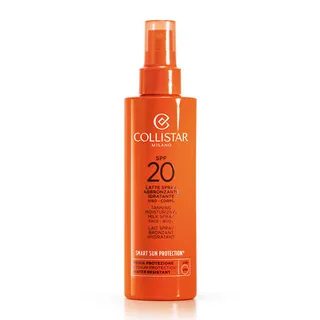
Collistar Tanning Moisturizing Milk Spray Face-Body SPF20
Works for
Sun protectionSPF 20 · 5 UV filters · Broad spectrumWeak protectionSPF under 30
This product offers broad spectrum sun protection, but it is weak. We recommend to use a broad spectrum sunscreen with at least SPF 30.
This product can be considered "reef safe" because it does not contain the UV filters (oxybenzone and octinoxate) that can be harmful to coral reefs when present in the water in high concentrations.
MoisturizingGlycerin, Ectoin + 14 moreWorks
“Tanning Moisturizing Milk Spray Face-Body SPF20”
This product can help improve hydration of the skin with the two types of ingredients.
The first type is called “humectants”:
these ingredients help attract water.
When humectants are on the surface of the skin, they “pull in” the moisture from the outside environment, or from
within deeper layers of the skin. The following ingredients in this product do the job:
arginine, glycerin.
This product also contains ingredients called “occlusives”. They help reduce the speed with which our skin loses moisture to the outside environment. These ingredients also help soften the upper layer of the skin, so it feels less tight and nicer to the touch. The following ingredients in this product do the job: arginine, helianthus annuus seed oil.
Evens skin toneAscorbyl tetraisopalmitateNot delivered
“Contains the exclusive Unipertan, a special complex that accelerates and intensifies the skin pigmentation process.”
This product contains ingredients () that could help reduce hyperpigmentation (for example, post-acne marks or age spots) in theory, but there is not enough evidence that they actually work.
The biggest effect for evening out skin tone in this product comes from sun protection. Sun damage is the main factor causing age spots, darkening of post-acne marks and other discolorations. This is why sun protection is the best strategy for maintaining an even skin tone. We, however, do not recommend using this product as a sunscreen because the protection it offers is not strong enough).
Anti-agingSide benefit · Adenosine triphosphate, Tocopherol + 2 moreMay help
This product contains adenosine triphosphate. There is some human evidence that this ingredient helps reduce and prevent fine lines and wrinkles and improve skin elasticity and firmness, though it is smaller or less consistent than the evidence for the best anti-aging ingredients. The biggest anti-aging effect in this product comes from sun protection. Sun damage is the main factor causing early signs of skin aging. We, however, do not recommend using this product as a sunscreen because the protection it offers is not strong enough).
Can it cause trouble?
Irritancy9 strong irritants: Parfum, Alpha-isomethyl ionone + 7 more — patch-test recommendedHigh risk
ComedogenicClean of flagged comedogenic ingredientsNone flagged
User reviews
Be the first — your take helps the next person decide.
Ingredients
Filter by role to see what each ingredient is doing.
Water~45–55%
Dibutyl adipate~5.8–7.1%
- Irritation risk
- Low
Helps soften the upper layer of the skin and create a nice product consistency
More about Dibutyl adipateEthylhexyl salicylate~4.4–5.4%
- Irritation risk
- Low
Octisalate. A UV filter. It offers some protection against the sun rays that cause sunburn (UVB), but does not protect against the most aging sun rays (UVA). It loses its effectiveness quickly when exposed to sunlight. It is an organic, or so called "chemical" sunscreen
More about Ethylhexyl salicylateDiethylamino hydroxybenzoyl hexyl benzoate~3.4–4.2%
- Irritation risk
- Medium
Uvinul A Plus. A new generation broad spectrum sunscreen that offers an effective protection especially in the UVA range. It is stable in formulations. Unfortunately, is not approved by the FDA (US) yet
More about Diethylamino hydroxybenzoyl hexyl benzoateBis-ethylhexyloxyphenol methoxyphenyl triazine~3–3.7%
- Irritation risk
- Medium
Tinosorb S. One of the most effective broad spectrum sunscreen ingredients. Protects from both UVA and UVB rays. It is photostable. Approved by the US FDA in 2026 (listed as bemotrizinol on US labels).
More about Bis-ethylhexyloxyphenol methoxyphenyl triazineGlycerin~2–2.4%
- Irritation risk
- Low
One of the best moisturizing ingredients. Naturally present in skin. It attracts water to the upper layer of the skin working as a humectant
More about GlycerinPentylene glycol~1.7–2.1%
- Irritation risk
- Medium
Used to preserve products, dissolve other ingredients and create a nice product texture
More about Pentylene glycolC15-19 alkane~1.4–1.7%
- Irritation risk
- Low
Helps soften the upper layer of the skin and create a nice product texture
More about C15-19 alkanePolyester-5~1.2–1.5%
- Irritation risk
- Low
Dicaprylyl ether~0.95–1.15%
- Irritation risk
- Low
Helps soften the upper layer of the skin while creating a non-greasy feel on the skin. Helps to dissolve other ingredients
More about Dicaprylyl etherAcrylates/c12-22 alkyl methacrylate copolymer~0.7–1%
- Irritation risk
- Low
Ethylhexyl triazone~0.75–1.1%
- Irritation risk
- Medium
Uvinul T. A UV filter. Effective against UVB rays. It is photostable. Can increase water resistance properties of the sunscreen. Unfortunately, not approved by the FDA (US) yet
More about Ethylhexyl triazonePhenoxyethanol~0.45–0.65%
- Irritation risk
- Low
A preservative. It helps prevent bacterial growth in cosmetic products
More about PhenoxyethanolPolyglyceryl-3 cocoate~0.45–0.65%
- Irritation risk
- Medium
Helps oil and water mix together
More about Polyglyceryl-3 cocoateDiethylhexyl butamido triazone~0.55–0.8%
- Irritation risk
- Medium
Uvasorb HEB. A UV filter. Is effective against UVB and UVA II rays (but not UVA I). It is photostable. Unfortunately, is not approved by FDA (US) yet
More about Diethylhexyl butamido triazone1,2-hexanediol~0.3–0.6%
Sodium stearoyl glutamate~0.4–0.6%
- Irritation risk
- Medium
Helps oil and water mix together
More about Sodium stearoyl glutamatePotassium cetyl phosphate~0.3–0.55%
- Irritation risk
- Medium
Helps oil and water mix together
More about Potassium cetyl phosphateParfum~0.25–0.45%
- Irritation risk
- High
An aromatic blend of unspecified and possibly irritating ingredients
More about ParfumAcrylates/beheneth-25 methacrylate copolymer~0.25–0.4%
- Irritation risk
- Low
Caprylyl glycol~0.25–0.4%
- Irritation risk
- Medium
Helps preserve products and creates a nice product texture
More about Caprylyl glycolHydroxyacetophenone~0.2–0.35%
Polyacrylate crosspolymer-6~0.2–0.35%
- Irritation risk
- Low
Chlorphenesin~0.15–0.3%
Arginine~0.15–0.3%
- Irritation risk
- Low
An amino acid that is naturally present in skin and helps keep it hydrated. When used together with AHAs, it can reduce their irritating effect on the skin
More about ArginineCoco-glucoside~0.2–0.4%
- Irritation risk
- High
Used as a cleansing agent (surfactant) in cleansers. Helps water and oil mix together in lotions. Can be irritating
More about Coco-glucosideTetrasodium glutamate diacetate~0.2–0.35%
- Irritation risk
- Low
Helps stabilize the product formulation
More about Tetrasodium glutamate diacetateLecithin~0.2–0.4%
- Irritation risk
- Low
Used mostly for creating emulsions - helping oil and water mix together. Helps soften the upper layer of the skin
More about LecithinSodium hydroxide~0.2–0.35%
Disodium lauryl sulfosuccinate~0.25–0.45%
- Irritation risk
- Medium
Used as a cleansing agent. Helps water and oil mix together
More about Disodium lauryl sulfosuccinateButylene glycol~0.2–0.35%
- Irritation risk
- Low
Used to create a nice product texture and help delivery of other ingredients. Might be somewhat helpful in attracting water to the upper layer of the skin
More about Butylene glycolEctoin~0.2–0.35%
- Irritation risk
- Low
Softens the upper layer of the skin and can support skin barrier function
More about EctoinAcetyl tyrosine~0.2–0.35%
- Irritation risk
- Low
Tocopherol~0.2–0.35%
- Irritation risk
- Low
Pure form of vitamin E. Can help moisturise and protect the skin from free radicals. Often used to help stabilise other ingredients or the formula itself
More about TocopherolCanola oil~0.2–0.4%
- Irritation risk
- Medium
A plant oil that can help soften the upper layer of the skin
More about Canola oilAscorbyl palmitate~0.2–0.35%
- Irritation risk
- Medium
Being a lipid soluble form of vitamin C, it is more stable and can penetrate the skin better than L-Ascorbic acid. It is effective in protecting the skin from free radicals, as well as evening the skin tone, but is less effective in stimulating collagen production compared to L-Ascorbic acid.
More about Ascorbyl palmitateHydrolyzed vegetable protein~0.2–0.35%
Adenosine triphosphate~0.2–0.35%
Citric acid~0.2–0.35%
- Irritation risk
- Medium
Can work as an exfoliant but is typically used to adjust the product pH
More about Citric acidRiboflavin~0.15–0.3%
- Irritation risk
- Low
Caprylic/capric triglyceride~0.25–0.45%
- Irritation risk
- Medium
A good mix of fatty acids that forms a protective layer on the skin. Improves the shelf life of products. Derived from coconut and glycerin
More about Caprylic/capric triglycerideDaucus carota sativa root extract~0.15–0.3%
- Irritation risk
- Low
Carrot extract. Might have anti-oxidant properties and be used to add orange color
More about Daucus carota sativa root extractDaucus carota sativa seed oil~0.2–0.4%
- Irritation risk
- Low
A plant oil that might help neutralize free radicals and have an anti-bacterial effect
More about Daucus carota sativa seed oilAscorbyl tetraisopalmitate~0.2–0.4%
- Irritation risk
- Medium
A vitamin C derivative. Studies show that is might be effective in reducing hyperpigmentation, but there are no studies confirming that it is effectively converted into the bioavailable form of Vitamin C in skin. It is not clear how this derivative compares in effectiveness to the topical application of bioavailable form of vitamin C (L-ascorbic acid)
More about Ascorbyl tetraisopalmitateCarbomer~0.2–0.35%
- Irritation risk
- Low
Helps create a thicker or gel-like product texture. It is not a surfactant but can be used in gentle cleansing formulations
More about CarbomerTocopheryl acetate~0.2–0.35%
- Irritation risk
- Medium
A more stable but less bio-available form of vitamin E compared to Tocopherol. Might help moisturize and protect the skin from free radicals, but mostly used in low concentrations to stabilize other ingredients.
More about Tocopheryl acetateHelianthus annuus seed oil~0.2–0.4%
- Irritation risk
- Low
A great emollient due to its high linoleic acid content. One of the most effective plant oils in helping skin hydration and repairing skin barrier function
More about Helianthus annuus seed oilBeta-carotene~0.2–0.35%
Dna~0.2–0.35%
- Irritation risk
- Low
Alpha-isomethyl ionone~0.15–0.3%
- Irritation risk
- High
A fragrance. Potential allergen and can be irritating
More about Alpha-isomethyl iononeBenzyl salicylate~0.15–0.3%
Citronellol~0.15–0.25%
Eugenol~0.15–0.25%
Geraniol~0.15–0.25%
Hydroxycitronellal~0.15–0.25%
- Irritation risk
- High
A fragrance. A likely allergen and can be irritating
More about HydroxycitronellalLimonene~0.1–0.15%
- Irritation risk
- High
A common frangrance that can easily irritate skin, especially if exposed to air, light or heat
More about LimoneneLinalool~0.1–0.15%
Ingredient list view
Water, Dibutyl adipate, Ethylhexyl salicylate, Diethylamino hydroxybenzoyl hexyl benzoate, Bis-ethylhexyloxyphenol methoxyphenyl triazine, Glycerin, Pentylene glycol, C15-19 alkane, Polyester-5, Dicaprylyl ether, Acrylates/c12-22 alkyl methacrylate copolymer, Ethylhexyl triazone, Phenoxyethanol, Polyglyceryl-3 cocoate, Diethylhexyl butamido triazone, 1,2-hexanediol, Sodium stearoyl glutamate, Potassium cetyl phosphate, Parfum, Acrylates/beheneth-25 methacrylate copolymer, Caprylyl glycol, Hydroxyacetophenone, Polyacrylate crosspolymer-6, Chlorphenesin, Arginine, Coco-glucoside, Tetrasodium glutamate diacetate, Lecithin, Sodium hydroxide, Disodium lauryl sulfosuccinate, Butylene glycol, Ectoin, Acetyl tyrosine, Tocopherol, Canola oil, Ascorbyl palmitate, Hydrolyzed vegetable protein, Adenosine triphosphate, Citric acid, Riboflavin, Caprylic/capric triglyceride, Daucus carota sativa root extract, Daucus carota sativa seed oil, Ascorbyl tetraisopalmitate, Carbomer, Tocopheryl acetate, Helianthus annuus seed oil, Beta-carotene, Dna, Alpha-isomethyl ionone, Benzyl salicylate, Citronellol, Eugenol, Geraniol, Hydroxycitronellal, Limonene, Linalool
Compare prices
Retailers ranked by price — lowest first.
Worth comparing, line by line.
Match % combines shared ingredients, the first five ingredients, shared actives and hero ingredients, irritancy (lower counts in the alternative's favour), texture and body area. Only products in the same routine step are compared.
| CollistarTanning Moisturizing Milk Spray Face-Body SPF20YOUR PRODUCT | MustelaHigh Protection Sun Spray Baby-Children-Family SPF50 | UltrasunTransparent Urban UV Protection Mist SPF50 | E45Sun Care Sensitive Spray SPF 50+ | |
|---|---|---|---|---|
| Match | — | 42% | 41% | 41% |
| Price | — | $24.07 | $33.53 | $18.29 |
| Shared key ingredients | — | 9 of 11 | 8 of 11 | 6 of 11 |
| Key difference | — | Persea Gratissima Fruit Extract | Glycine Soja Oil | Persea Gratissima Oil |
| Irritancy | High | Low | Low | Low |
| SPF | SPF 20 | SPF 50 | SPF 50 | SPF 50 |
| Drying alcohol | — | — | — | — |
| View product | Shop | Shop | Shop |


More alternatives: Rougj Sunscreen Cream Anti-Spot SPF50+SVR Sun Secure Spray SPF50+
Product summary
"Collistar - Tanning Moisturizing Milk Spray Face-Body SPF20" offers broad spectrum protection. It means that it protects from both UVA and UVB rays (you can remember UVB as "burning" sunlight - they cause sunburn. You can remember UVA rays as "aging" - they do not lead to sunburn, but they cause photodamage and contribute to early signs of skin aging and hyperpigmentation). On the negative side, the SPF of it is not high enough. We recommend to use a sunscreen with at least SPF 30 daily.
It contains good moisturizing ingredients and can double as a hydrating day cream.
Sunscreen filters
This is a so-called "chemical" sunscreen. It means that it uses organic UV filters. They typically offer good sun protection and rarely leave a white cast, but they can be irritating for some people with sensitive skin. Here are the exact UV filters in this sunscreen: tinosorb s 3.00% - 3.70%, uvinul a plus 3.40% - 4.20%, uvasorb heb 0.55% - 0.80%, octisalate 4.40% - 5.40% and uvinul t 0.75% - 1.10%.
Irritation risk
This sunscreen contains a bunch of common irritants, including ingredients that do not provide any known benefit for the skin. It might not be the best choice if your skin is sensitive. We assess the overall irritancy of this product to be high. For a detailed overview of all potential irritants: click here
You can see the detailed formula review with the breakdown of all actives in the product and the full ingredient list with estimated concentrations in the tables below.
Price
The product retails from 32.83£ up to 34.70£ in the United Kingdom.
For a detailed price comparison: click here.
Sources cited in this review
Every concentration estimate and effectiveness label is anchored to one of these 17 studies and safety reviews.
- 1
- 2
- 3
- 4Allergen of the Year—Alkyl Glucosidepracticeupdate.com
- 5Vitamin E in dermatologyncbi.nlm.nih.gov
- 6Vitamin E and Skin Healthlpi.oregonstate.edu

Affiliate links · As an Amazon Associate, WIMJ earns from qualifying purchases.