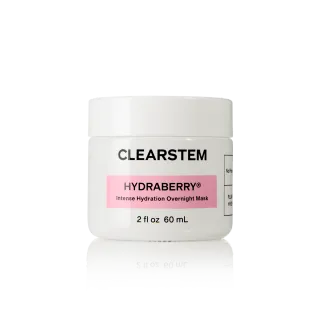
CLEARSTEM Skincare HYDRABERRY Barrier Mask
Works for
MoisturizingPhytosphingosine, Ceramide np + 17 moreWorks well
“Drench your skin in HYDRABERRY® to infuse and lock moisture into your skin without clogging pores.”
This product can help improve hydration of the skin with the two types of ingredients.
The first type is called “humectants”:
these ingredients help attract water.
When humectants are on the surface of the skin, they “pull in” the moisture from the outside environment, or from
within deeper layers of the skin. The following ingredients in this product do the job:
copper pca, glycerin.
This product also contains ingredients called “occlusives”. They help reduce the speed with which our skin loses moisture to the outside environment. These ingredients also help soften the upper layer of the skin, so it feels less tight and nicer to the touch. The following ingredients in this product do the job: caprylic/capric triglyceride, squalane.
The following ingredients in this product are especially good for supporting the skin barrier and helping with the hydration level: ceramide np, phytosphingosine
Anti-oxidationSide benefit · Camellia sinensis leaf extract, Hibiscus sabdariffa flower extract + 2 moreMay help
This product contains antioxidants (camellia sinensis leaf extract) that might be able to help neutralize free radicals in skin to lessen the damage it gets from the UV light (sun). There is not enough evidence to confirm their effectiveness in skin though.
Can it cause trouble?
Irritancy9 strong irritants: Hibiscus sabdariffa flower extract, Arnica montana flower extract + 7 more — patch-test recommendedHigh risk
ComedogenicClean of flagged comedogenic ingredientsNone flagged

User reviews
Be the first — your take helps the next person decide.
Ingredients
Filter by role to see what each ingredient is doing.
Water~45–55%
Caprylic/capric triglyceride~5.3–6.5%
- Irritation risk
- Medium
A good mix of fatty acids that forms a protective layer on the skin. Improves the shelf life of products. Derived from coconut and glycerin
More about Caprylic/capric triglyceridePropanediol~4–4.9%
- Irritation risk
- Low
Acts as a solvent for other ingredients. Speeds up the absorption of other ingredients into the skin
More about PropanediolGlycerin~3.1–3.8%
- Irritation risk
- Low
One of the best moisturizing ingredients. Naturally present in skin. It attracts water to the upper layer of the skin working as a humectant
More about GlycerinCetearyl olivate~2.3–2.8%
Ethylhexyl olivate~1.9–2.3%
- Irritation risk
- Low
Helps soften the upper layer of the skin
More about Ethylhexyl olivatePolyglyceryl-6 distearate~1.6–2%
- Irritation risk
- Medium
Helps oil and water mix together while softening the upper layer of the skin
More about Polyglyceryl-6 distearateSqualane~1.5–1.8%
- Irritation risk
- Low
An oil naturally present in skin. Works as an emollient to soften the skin and form a protective layer on its surface without a greasy feeling.
More about SqualaneEthyl macadamiate~1.1–1.4%
Sorbitan olivate~0.9–1.1%
Sodium stearoyl glutamate~0.7–1.05%
- Irritation risk
- Medium
Helps oil and water mix together
More about Sodium stearoyl glutamateCarbomer~0.55–0.8%
- Irritation risk
- Low
Helps create a thicker or gel-like product texture. It is not a surfactant but can be used in gentle cleansing formulations
More about CarbomerJojoba esters~0.5–0.75%
- Irritation risk
- Medium
An emollient made of jojoba oil. Helps soften the skin and support its barrier function
More about Jojoba estersPentylene glycol~0.5–0.75%
- Irritation risk
- Medium
Used to preserve products, dissolve other ingredients and create a nice product texture
More about Pentylene glycolPolyglyceryl-3 beeswax~0.45–0.7%
- Irritation risk
- Medium
Helps water and oil mix together. Could be an allergen (beeswax)
More about Polyglyceryl-3 beeswaxCetyl alcohol~0.5–0.75%
- Irritation risk
- Low
A non-drying alcohol that works to soften the skin and stabilize product formulations helping oil and water mix together
More about Cetyl alcoholButylene glycol~0.4–0.6%
- Irritation risk
- Low
Used to create a nice product texture and help delivery of other ingredients. Might be somewhat helpful in attracting water to the upper layer of the skin
More about Butylene glycolSodium gluconate~0.3–0.6%
Potassium sorbate~0.3–0.6%
Phenethyl alcohol~0.3–0.55%
Sodium hydroxide~0.3–0.55%
Glyceryl polyacrylate~0.3–0.55%
- Irritation risk
- Low
Helps to create a nice product texture and spread the product more easily on the skin
More about Glyceryl polyacrylateHibiscus sabdariffa flower extract~0.25–0.45%
- Irritation risk
- High
A plant extract that can be irritating. It might contain a compound anthocyanin that could be helpful in neutralizing free radicals
More about Hibiscus sabdariffa flower extractPseudoalteromonas ferment extract~0.25–0.45%
- Irritation risk
- Low
Phenoxyethanol~0.25–0.5%
- Irritation risk
- Low
A preservative. It helps prevent bacterial growth in cosmetic products
More about PhenoxyethanolAloe barbadensis leaf juice~0.25–0.45%
- Irritation risk
- Medium
Traditionally used to treat sunburns, dermatitis and inflammation, but evidence for its effectiveness is lacking. The extract can contain humectants that help attract water into the skin
More about Aloe barbadensis leaf juiceCamellia sinensis leaf extract~0.25–0.5%
- Irritation risk
- Low
Can contain potent anti-oxidant compounds (abbreviated ECG, GCG, EGC, and EGCG) that might help protect the skin from free radicals. Can help calm down inflammation and has some anti-bacterial properties. Unfortunately, these antioxidants are unstable and lose their effectiveness very quickly in products. The concentration of the antioxidant compounds in the extract also tends to be low to be effective in topical formulation
More about Camellia sinensis leaf extractArnica montana flower extract~0.2–0.4%
- Irritation risk
- High
A plant extract that can be irritating. It can have some anti-bacterial properties, but there are no evidence of a beneficial effect for skin
More about Arnica montana flower extractAlteromonas ferment extract~0.25–0.45%
- Irritation risk
- Low
A marine extract that helps attract water to the upper layer of the skin. It is claimed to have anti-inflammatory properties but research is lacking
More about Alteromonas ferment extractPhytosphingosine~0.3–0.55%
- Irritation risk
- Low
A type of lipid that is naturally present in skin. It might help in repairing skin barrier function and has anti-bacterial effect
More about PhytosphingosineSodium hyaluronate~0.25–0.45%
- Irritation risk
- Low
One of the best moisturizing ingredients. Attracts water into the upper layer of the skin
More about Sodium hyaluronateCeramide np~0.3–0.55%
- Irritation risk
- Low
A type of lipid similar to ceramides naturally present in skin. Helps to soften the upper layer of the skin and supports the skin barrier function to keep it hydrated. Can help to prevent inflammation in skin
More about Ceramide npSalicylic acid~0.25–0.45%
- Irritation risk
- High
Used for skin exfoliation. It has an anti-inflammatory and anti-bacterial effect, helps to unclog pores, prevent blemishes and speed up healing of the existing ones. Sometimes referred to as a BHA (beta-hydroxy acid)
More about Salicylic acidMagnesium pca~0.25–0.45%
- Irritation risk
- Low
Helps attract water to the upper layer of the skin
More about Magnesium pcaZinc pca~0.2–0.4%
- Irritation risk
- Low
A compound that combines zinc with a hydrating ingredient PCA. Might to be helpful against acne and clogged pores. Can help calm down inflammation in skin. Could be helpful in reducing the formation of free radicals in skin. Might help to reduce fine lines in wrinkles, but solid evidence is missing
More about Zinc pcaCopper pca~0.25–0.45%
- Irritation risk
- Low
Helps attract water to the upper layer of the skin
More about Copper pcaCurcuma longa root extract~0.25–0.4%
- Irritation risk
- High
A plant extract that can contain an active compound curcumin, that may have some anti-inflammatory properties when applied to the skin, but solid research is lacking and the typical concentration used in skincare products is too low. Can be an irritant
More about Curcuma longa root extractCitric acid~0.25–0.45%
- Irritation risk
- Medium
Can work as an exfoliant but is typically used to adjust the product pH
More about Citric acidDiglucosyl gallic acid~0.25–0.45%
- Irritation risk
- Low
Polylysine~0.25–0.5%
- Irritation risk
- Low
Linalool~0.25–0.4%
Tocopherol~0.25–0.5%
- Irritation risk
- Low
Pure form of vitamin E. Can help moisturise and protect the skin from free radicals. Often used to help stabilise other ingredients or the formula itself
More about TocopherolSorbic acid~0.25–0.45%
Malic acid~0.25–0.45%
Limonene~0.25–0.4%
- Irritation risk
- High
A common frangrance that can easily irritate skin, especially if exposed to air, light or heat
More about LimoneneCinnamal~0.25–0.4%
- Irritation risk
- High
Eugenol~0.2–0.4%
Citral~0.25–0.4%
Hexanal~0.25–0.45%
- Irritation risk
- Low
Ethyl isovalerate~0.2–0.4%
- Irritation risk
- Low
Benzaldehyde~0.2–0.4%
- Irritation risk
- Low
Cis-3-hexenyl acetate~0.2–0.4%
- Irritation risk
- Low
Isoamyl isovalerate~0.2–0.4%
- Irritation risk
- Low
Maltol~0.2–0.4%
- Irritation risk
- Low
Anisaldehyde~0.2–0.35%
- Irritation risk
- Low
Methyl anthranilate~0.2–0.4%
- Irritation risk
- Medium
Used as a fragrance. It can be used a booster for UV filters in non-European sunscreen formulations. A draft regulation in the EU proposes to restrict the usage of this ingredient to a low concentration in sunscreens because of concerns of photo-toxicity
More about Methyl anthranilateVanillin~0.2–0.35%
- Irritation risk
- Low
Phenethyl alcohol~0.2–0.4%
Gamma-decalactone~0.15–0.25%
- Irritation risk
- Low
Triethyl citrate~0.15–0.3%
Citrus aurantium dulcis peel oil~0.15–0.25%
- Irritation risk
- High
An essentil oil from orange peel. Potential allergen and can be irritating
More about Citrus aurantium dulcis peel oilDimethylhydroxy furanone~0.1–0.15%
- Irritation risk
- Low
Ocimum basilicum oil~0.1–0.15%
Ingredient list view
Water, Caprylic/capric triglyceride, Propanediol, Glycerin, Cetearyl olivate, Ethylhexyl olivate, Polyglyceryl-6 distearate, Squalane, Ethyl macadamiate, Sorbitan olivate, Sodium stearoyl glutamate, Carbomer, Jojoba esters, Pentylene glycol, Polyglyceryl-3 beeswax, Cetyl alcohol, Butylene glycol, Sodium gluconate, Potassium sorbate, Phenethyl alcohol, Sodium hydroxide, Glyceryl polyacrylate, Hibiscus sabdariffa flower extract, Pseudoalteromonas ferment extract, Phenoxyethanol, Aloe barbadensis leaf juice, Camellia sinensis leaf extract, Arnica montana flower extract, Alteromonas ferment extract, Phytosphingosine, Sodium hyaluronate, Ceramide np, Salicylic acid, Magnesium pca, Zinc pca, Copper pca, Curcuma longa root extract, Citric acid, Diglucosyl gallic acid, Polylysine, Linalool, Tocopherol, Sorbic acid, Malic acid, Limonene, Cinnamal, Eugenol, Citral, Hexanal, Ethyl isovalerate, Benzaldehyde, Cis-3-hexenyl acetate, Isoamyl isovalerate, Maltol, Anisaldehyde, Methyl anthranilate, Vanillin, Phenethyl alcohol, Unknown, Gamma-decalactone, Triethyl citrate, Citrus aurantium dulcis peel oil, Dimethylhydroxy furanone, Ocimum basilicum oil
Compare prices
Retailers ranked by price — lowest first.

Worth comparing, line by line.
Match % combines shared ingredients, the first five ingredients, shared actives and hero ingredients, irritancy (lower counts in the alternative's favour), texture and body area. Only products in the same routine step are compared.
| CLEARSTEM SkincareHYDRABERRY Barrier MaskYOUR PRODUCT | Drunk ElephantF-Balm Electrolyte Waterfacial Hydrating Mask | AvedaTulasara Wedding Face Masque | DermedecineRetinol Detox High Potency Mask | |
|---|---|---|---|---|
| Match | — | 82% | 72% | 70% |
| Price | $18.00 | $36.07+$18.07 | — | $35.00+$17.00 |
| Shared key ingredients | — | 8 of 15 | 7 of 15 | 4 of 15 |
| Key difference | — | Niacinamide | Tetrahexyldecyl Ascorbate | Retinol |
| Irritancy | High | Medium | High | Medium |
| Drying alcohol | — | — | — | — |
| View product | Shop | Shop | Shop |


More alternatives: Jan Marini Retinol Plus MaskImage skincare IMAGE MD restoring overnight retinol masque
Sources cited in this review
Every concentration estimate and effectiveness label is anchored to one of these 25 studies and safety reviews.
- 1
- 2
- 3Final Report on the Safety Assessment of Phenethyl Alcoholsemanticscholar.org
- 4
- 5Hibiscus sabdariffa L. – A phytochemical and pharmacological reviewsciencedirect.com
- 6

Affiliate links · As an Amazon Associate, WIMJ earns from qualifying purchases.