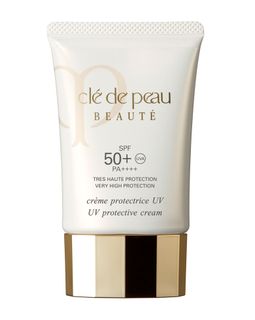
Clé de Peau Beauté UV Protective Cream
Works for
3 of 3 advertised claims delivered
Sun protectionSPF 50 · 8 UV filtersBroad spectrum
This product offers a good level of protection against both UVB and UVA rays.
This sunscreen uses organic (so-called "chemical") sunscreen filters. Organic, or "chemical" filters usually provide reliable sun protection and rarely leave a white cast. Sunscreens with organic filters can sting eyes.
This product can be considered "reef safe" because it does not contain the UV filters (oxybenzone and octinoxate) that can be harmful to coral reefs when present in the water in high concentrations.
Evens skin tone1 ingredient credited for this claimStrong support
“Hyaluronic acid and antioxidant-rich botanicals ensure plump, supple and even skin with vitamins C and E, while the brand’s infamous ‘Illuminating Complex’ (which stars precious diamond, silk and pearl powders) gets to work on balancing moisture levels, smoothing and evening tone.”
This product offers broad spectrum sun protection. It means that it can prevent hyperpigmentation and help keep the skin tone even (sun damage is the main factor causing age spots, darkening of post-acne marks and other discolorations).
Anti-aging1 ingredient credited for this claimStrong support
“Velveteen and easily absorbed, this weightless shield even tickles the senses with a sweet medley of natural rose, rare orchid, grapefruit, mandarin, and peach, while mangosteen extract and hibiscus sabdariffa flower essence reduce the appearance of fine lines and sagging.”
This product can help prevent early signs of skin aging because it offers a good level of broad spectrum sun protection. Sun damage is the main cause of premature skin aging, and protecting your skin from the sun is the best anti-aging strategy.
Anti-oxidationNot advertised by the brand · 7 ingredients credited for this claimModerate support
This product contains antioxidants (ginkgo biloba leaf extract) that might be able to help neutralize free radicals in skin to lessen the damage it gets from the UV light (sun). There is not enough evidence to confirm their effectiveness in skin though.
MoisturizingNot advertised by the brand · 15 ingredients credited for this claimGood support
This product can help improve hydration of the skin with the two types of ingredients.
The first type is called “humectants”:
these ingredients help attract water.
When humectants are on the surface of the skin, they “pull in” the moisture from the outside environment, or from
within deeper layers of the skin. The following ingredients in this product do the job:
glycerin, sodium acetylated hyaluronate.
This product also contains ingredients called “occlusives”. They help reduce the speed with which our skin loses moisture to the outside environment. These ingredients also help soften the upper layer of the skin, so it feels less tight and nicer to the touch. The following ingredients in this product do the job: dimethicone, diisopropyl sebacate.
Can it cause trouble?
Irritancy11 strong irritants: Benzophenone-3, Parfum + 9 more — patch-test recommendedHigh risk
ComedogenicClean of flagged comedogenic ingredientsNone flagged
User reviews
Be the first — your take helps the next person decide.
Ingredients
Filter by role to see what each ingredient is doing.
Water~45–55%
Polysilicone-15~4.4–5.4%
- Irritation risk
- Medium
A UV filter. Effective against UVB rays, but does not protect against the most aging UVA light
More about Polysilicone-15Diisopropyl sebacate~4–4.9%
- Irritation risk
- Low
Helps soften the upper layer of the skin without creatng a greasy finish
More about Diisopropyl sebacateButylene glycol~3–3.6%
- Irritation risk
- Low
Used to create a nice product texture and help delivery of other ingredients. Might be somewhat helpful in attracting water to the upper layer of the skin
More about Butylene glycolGlycerin~2.4–2.9%
- Irritation risk
- Low
One of the best moisturizing ingredients. Naturally present in skin. It attracts water to the upper layer of the skin working as a humectant
More about GlycerinOctocrylene~2.5–3%
- Irritation risk
- Medium
A weak sunscreen that protects against the sun rays that cause sunburn (UVB) and is somewhat effective against the UVA rays. It is quite stable and can help stabilize other, more vulnerable, sunscreen ingredients like Avobenzone. It is an organic, or so called "chemical" sunscreen
More about OctocryleneBis-ethylhexyloxyphenol methoxyphenyl triazine~2–2.5%
- Irritation risk
- Medium
Tinosorb S. One of the most effective broad spectrum sunscreen ingredients. Protects from both UVA and UVB rays. It is photostable. Unfortunately, not approved by FDA (US) yet.
More about Bis-ethylhexyloxyphenol methoxyphenyl triazineHdi/trimethylol hexyllactone crosspolymer~1.4–1.7%
- Irritation risk
- Low
Used to create a silky product texture and add volume to products
More about Hdi/trimethylol hexyllactone crosspolymerButyl methoxydibenzoylmethane~1.6–2%
- Irritation risk
- Medium
Avobenzone. An organic, or so-called "chemical" UV filter. Protects against both UVA and UVB rays. Needs to be combined with other filters in a formulation to be stable.
More about Butyl methoxydibenzoylmethaneDimethicone~1–1.2%
- Irritation risk
- Low
A silicone that helps to reduce water loss from the surface of the skin. Can temporarily "fill in" lines and wrinkles, absorb oil, and create a nice product finish
More about DimethiconeAlcohol denat.~0.7–1.05%
- Irritation risk
- High
Produces temporary toning effect. Can help dissolve other ingredients or preserve products
More about Alcohol denat.Behenyl alcohol~0.7–1%
- Irritation risk
- Low
Non-drying alcohol that helps water and oil mix together. Also serves as an emollient
More about Behenyl alcoholDipropylene glycol~0.55–0.8%
- Irritation risk
- Low
Helps to dissolve other ingredients in a formulation. Slows down the rate of product drying
More about Dipropylene glycolPolybutylene glycol/ppg-9/1 copolymer~0.55–0.8%
- Irritation risk
- Low
Peg/ppg-14/7 dimethyl ether~0.55–0.8%
- Irritation risk
- Low
An emollient that helps soften the skin. It also forms a protective on its surface to reduce water loss
More about Peg/ppg-14/7 dimethyl etherPhenylbenzimidazole sulfonic acid~0.7–1%
- Irritation risk
- Medium
Ensulizole. A UV filter that is effective against UVB rays. Does not protect against UVA light. It is photostable and can be used to help stabilize other sunscreen ingredients. It is water-soluble meaning that it can help create lighter sunscreen formulations
More about Phenylbenzimidazole sulfonic acidDiethylamino hydroxybenzoyl hexyl benzoate~0.65–1%
- Irritation risk
- Medium
Uvinul A Plus. A new generation broad spectrum sunscreen that offers an effective protection especially in the UVA range. It is stable in formulations. Unfortunately, is not approved by the FDA (US) yet
More about Diethylamino hydroxybenzoyl hexyl benzoateTriethanolamine~0.45–0.7%
- Irritation risk
- Medium
Used to adjust pH of the product and can help improve the product's smell
More about TriethanolamineBenzophenone-3~0.6–0.9%
- Irritation risk
- High
Same as oxybenzone. Protects in the UVB and short UVA range. In small concentrations, used to stabilize product formulation. Can be irritating. Is shown to be harmful to coral reefs - consider avoiding bathing in coral reef areas when wearing a product with this ingredient. It can penetrate the skin and get absorbed into bloodstream faster than other popular filters available in the US. The study that produced this finding did not address any potential health effects of the absorption
More about Benzophenone-3Trehalose~0.35–0.65%
- Irritation risk
- Low
A sugar that attracts water to the upper layer of the skin
More about TrehaloseBeheneth-20~0.35–0.65%
Phenoxyethanol~0.35–0.6%
- Irritation risk
- Low
A preservative. It helps prevent bacterial growth in cosmetic products
More about PhenoxyethanolStearyl alcohol~0.35–0.65%
- Irritation risk
- Low
An emollient that helps soften the skin
More about Stearyl alcoholSilica~0.5–0.7%
Parfum~0.3–0.55%
- Irritation risk
- High
An aromatic blend of unspecified and possibly irritating ingredients
More about ParfumAlcohol~0.3–0.55%
- Irritation risk
- High
Can be drying and contribute to skin irritation. Used in formulars to dissolve other ingredients, create a thinner product consistency or for its antibacterial properties
More about AlcoholAcrylates/c10-30 alkyl acrylate crosspolymer~0.3–0.6%
- Irritation risk
- Medium
Maintains the texture of skincare products. Allows the product to spread evenly. Helps oil and water mix together
More about Acrylates/c10-30 alkyl acrylate crosspolymerTocopheryl acetate~0.3–0.6%
- Irritation risk
- Medium
A more stable but less bio-available form of vitamin E compared to Tocopherol. Might help moisturize and protect the skin from free radicals, but mostly used in low concentrations to stabilize other ingredients.
More about Tocopheryl acetateCarbomer~0.3–0.55%
- Irritation risk
- Low
Helps create a thicker or gel-like product texture. It is not a surfactant but can be used in gentle cleansing formulations
More about CarbomerSodium metaphosphate~0.3–0.55%
Polyquaternium-51~0.3–0.6%
- Irritation risk
- Low
An emollient that helps create a nice silky finish on the skin
More about Polyquaternium-51Limonene~0.3–0.55%
- Irritation risk
- High
A common frangrance that can easily irritate skin, especially if exposed to air, light or heat
More about LimoneneTrisodium edta~0.3–0.55%
Dipotassium glycyrrhizate~0.3–0.55%
- Irritation risk
- Low
A salt derived from licorice. Works as an emollient to soften the upper layer of the skin and can help calm down inflammation. Might be helpful for skin lightening
More about Dipotassium glycyrrhizateSodium acetylated hyaluronate~0.3–0.55%
- Irritation risk
- Low
A type of hyaluronic acid that works as an excellent moisturizer by attracting water into the upper layer of the skin. Is typically feels less sticky on the skin compared to the usual hyaluronic acid
More about Sodium acetylated hyaluronateLinalool~0.3–0.55%
Iron oxides~0.3–0.55%
- Irritation risk
- Low
An umbrella term for the following three colorants: CI 77491, CI 77492, CI 77499. They might be able to offer some protection against visible light, but the degree of the protection is not clear
More about Iron oxidesCi 77491~0.3–0.55%
- Irritation risk
- Low
A red colorant made of iron oxide. Typically is not irritating
More about Ci 77491Hexyl cinnamal~0.3–0.55%
Citronellol~0.3–0.55%
Alpha-isomethyl ionone~0.25–0.5%
- Irritation risk
- High
A fragrance. Potential allergen and can be irritating
More about Alpha-isomethyl iononeSaxifraga sarmentosa extract~0.3–0.55%
- Irritation risk
- Low
Titanium dioxide~0.45–0.7%
- Irritation risk
- Low
Works as a UV filter when used in high concentrations. It is photostable and is effective mostly against the UVB light, with some protection in the UVA range. In small concentrations, used for its ability to improve the color of cosmetic products. Is usually well tolerated by the skin
More about Titanium dioxideGeraniol~0.3–0.55%
Benzyl benzoate~0.3–0.5%
- Irritation risk
- High
Fragrance with sweet balsamic smell. Help to preserve products and dissolve other ingredients. Could trigger allergic reactions and be irritating
More about Benzyl benzoateSodium metabisulfite~0.1–0.2%
Mica~0.35–0.6%
- Irritation risk
- Low
Creates an illusion of smoother and more radiant skin tone. Adds shimmer to the skin by reflecting light
More about MicaGinkgo biloba leaf extract~0.3–0.55%
- Irritation risk
- High
A plant extract that might help neutralize free radicals and reduce inflammation in skin. It can be irritating
More about Ginkgo biloba leaf extractThymus serpyllum extract~0.3–0.55%
- Irritation risk
- High
Crataegus monogyna flower extract~0.3–0.5%
- Irritation risk
- Low
Talc~0.45–0.65%
Hydrolyzed silk~0.25–0.5%
- Irritation risk
- Medium
Can help attract water to the upper layer of the skin
More about Hydrolyzed silk2-o-ethyl ascorbic acid~0.25–0.45%
- Irritation risk
- Low
Scutellaria baicalensis root extract~0.2–0.4%
- Irritation risk
- High
A plant extract that might contain a compound baicalin that could be helpful in neutralizing free radicals and reducing inflammation in skin. The baicalin concentration in skincare products is often too low for an effective action. Can be used for its fragrant properties
More about Scutellaria baicalensis root extractUncaria gambir extract~0.2–0.4%
- Irritation risk
- High
A plant extract that might be helpful in neutralizing free radicals, but solid research is missing. Can be irritating
More about Uncaria gambir extractHibiscus sabdariffa flower extract~0.2–0.35%
- Irritation risk
- High
A plant extract that can be irritating. It might contain a compound anthocyanin that could be helpful in neutralizing free radicals
More about Hibiscus sabdariffa flower extractGarcinia mangostana peel extract~0.15–0.3%
- Irritation risk
- Low
Panax ginseng root extract~0.2–0.35%
- Irritation risk
- High
A plant extract that might have some anti-inflammatory properties, but solid evidence is lacking. It can be irritating
More about Panax ginseng root extractBupleurum falcatum root extract~0.15–0.3%
- Irritation risk
- High
A plant extract that might help to attract water to the upper layer of the skin, but it is not well studied. It can be irritating
More about Bupleurum falcatum root extractTocopherol~0.15–0.3%
- Irritation risk
- Low
Pure form of vitamin E. Can help moisturise and protect the skin from free radicals. Often used to help stabilise other ingredients or the formula itself
More about TocopherolTheanine~0.1–0.25%
- Irritation risk
- Low
Hydrolyzed conchiolin protein~0.1–0.15%
Ingredient list view
Water, Polysilicone-15, Diisopropyl sebacate, Butylene glycol, Glycerin, Octocrylene, Bis-ethylhexyloxyphenol methoxyphenyl triazine, Hdi/trimethylol hexyllactone crosspolymer, Butyl methoxydibenzoylmethane, Dimethicone, Alcohol denat., Behenyl alcohol, Dipropylene glycol, Polybutylene glycol/ppg-9/1 copolymer, Peg/ppg-14/7 dimethyl ether, Phenylbenzimidazole sulfonic acid, Diethylamino hydroxybenzoyl hexyl benzoate, Triethanolamine, Benzophenone-3, Trehalose, Beheneth-20, Phenoxyethanol, Stearyl alcohol, Silica, Parfum, Alcohol, Acrylates/c10-30 alkyl acrylate crosspolymer, Tocopheryl acetate, Carbomer, Sodium metaphosphate, Polyquaternium-51, Limonene, Trisodium edta, Dipotassium glycyrrhizate, Sodium acetylated hyaluronate, Linalool, Iron oxides, Ci 77491, Hexyl cinnamal, Citronellol, Alpha-isomethyl ionone, Saxifraga sarmentosa extract, Titanium dioxide, Geraniol, Benzyl benzoate, Sodium metabisulfite, Mica, Ginkgo biloba leaf extract, Thymus serpyllum extract, Crataegus monogyna flower extract, Talc, Hydrolyzed silk, 2-o-ethyl ascorbic acid, Scutellaria baicalensis root extract, Uncaria gambir extract, Hibiscus sabdariffa flower extract, Garcinia mangostana peel extract, Panax ginseng root extract, Bupleurum falcatum root extract, Tocopherol, Theanine, Hydrolyzed conchiolin protein
Compare prices
Retailers ranked by price — lowest first.
Affiliate links · prices updated regularly · As an Amazon Associate, WIMJ earns from qualifying purchases.
Product summary
The ingredient list suggests that this product can provide reliable sun protection. It can protect from both UVA and UVB rays. This is great news because not all sunscreens with SPF ratings give UVA protection. (UVA rays do not cause sunburn, but still damage our skin and lead to early aging).
Because it includes good moisturizing ingredients, it can also work as a hydrating day cream. Like all broad-spectrum sunscreens, this product has an anti-aging benefit.
Sunscreen filters
This sunscreen uses a mixture of both mineral and organic (so-called "chemical") UV filters. The organic filters in the product are: oxybenzone, tinosorb s, avobenzone, uvinul a plus, octocrylene, ensulizole and polysilicone-15. As for the mineral filters, this sunscreen uses titanium dioxide.
Irritation risk
This product contains a bunch of common irritants, including ingredients that do not provide any known benefit for the skin. It might not be the best choice if your skin is sensitive. We assess the overall irritancy of this sunscreen to be high. For a detailed overview of all potential irritants: click here
You can see the detailed formula review with the breakdown of all actives in the product and the full ingredient list with estimated concentrations in the tables below.
Sources cited in this review
Every concentration estimate and effectiveness label is anchored to one of these 29 studies and safety reviews.
- 1
- 2
- 3
- 4Final Report on the Safety Assessment of Dimethicone Copolyoljournals.sagepub.com
- 5
- 6

Affiliate links · As an Amazon Associate, WIMJ earns from qualifying purchases.