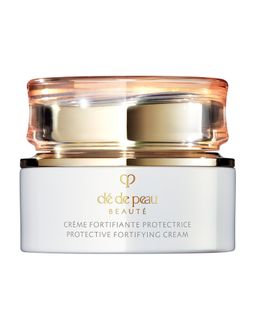
Clé de Peau Beauté Protective Fortifying Cream
Works for
1 of 2 advertised claims delivered
Moisturizing16 ingredients credited for this claimGood evidence
“Rich and deeply moisturising”
This product can help improve hydration of the skin with the two types of ingredients.
The first type is called “humectants”:
these ingredients help attract water.
When humectants are on the surface of the skin, they “pull in” the moisture from the outside environment, or from
within deeper layers of the skin. The following ingredients in this product do the job:
glycerin, glycine.
This product also contains ingredients called “occlusives”. They help reduce the speed with which our skin loses moisture to the outside environment. These ingredients also help soften the upper layer of the skin, so it feels less tight and nicer to the touch. The following ingredients in this product do the job: phytosteryl macadamiate, cyclopentasiloxane.
Anti-aging1 ingredient credited for this claimLimited evidence
“looking vibrant and youthful”
This product does not contain ingredients that are able to reduce fine lines and wrinkles or help with skin elasticity, but it can improve the look of the skin temporarily through moisturization. Well-moisturized skin might also be able to repair the sun damage better.
This ingredient ginkgo biloba leaf extract might be able to help neutralize free radicals in skin and help it fight off some of the sun damage.
Anti-oxidationNot advertised by the brand · 8 ingredients credited for this claimModerate evidence
This product contains antioxidants (ginkgo biloba leaf extract) that might be able to help neutralize free radicals in skin to lessen the damage it gets from the UV light (sun). There is not enough evidence to confirm their effectiveness in skin though.
Can it cause trouble?
Irritancy12 strong irritants: Alcohol denat., Benzophenone-3 + 10 more — patch-test recommendedHigh risk
ComedogenicClean of flagged comedogenic ingredientsNone flagged
User reviews
Be the first — your take helps the next person decide.
Ingredients
Filter by role to see what each ingredient is doing.
Water~45–55%
Cyclopentasiloxane~6.2–7.6%
- Irritation risk
- Low
A silicone that helps improve the product texture and spreadability. Can absorb oil creating a short-term mattifying effect on the skin
More about CyclopentasiloxaneGlycerin~4.2–5.1%
- Irritation risk
- Low
One of the best moisturizing ingredients. Naturally present in skin. It attracts water to the upper layer of the skin working as a humectant
More about GlycerinDiisopropyl sebacate~3.2–3.9%
- Irritation risk
- Low
Helps soften the upper layer of the skin without creatng a greasy finish
More about Diisopropyl sebacateOctocrylene~3.2–3.9%
- Irritation risk
- Medium
A weak sunscreen that protects against the sun rays that cause sunburn (UVB) and is somewhat effective against the UVA rays. It is quite stable and can help stabilize other, more vulnerable, sunscreen ingredients like Avobenzone. It is an organic, or so called "chemical" sunscreen
More about OctocrylenePolysilicone-15~2.5–3.1%
- Irritation risk
- Medium
A UV filter. Effective against UVB rays, but does not protect against the most aging UVA light
More about Polysilicone-15Butylene glycol~1.6–2%
- Irritation risk
- Low
Used to create a nice product texture and help delivery of other ingredients. Might be somewhat helpful in attracting water to the upper layer of the skin
More about Butylene glycolDiethylhexyl succinate~1.5–1.8%
- Irritation risk
- Low
Helps soften the upper layer of the skin and create a nice product texture
More about Diethylhexyl succinateAlcohol denat.~1.1–1.4%
- Irritation risk
- High
Produces temporary toning effect. Can help dissolve other ingredients or preserve products
More about Alcohol denat.Bis-ethylhexyloxyphenol methoxyphenyl triazine~1.3–1.6%
- Irritation risk
- Medium
Tinosorb S. One of the most effective broad spectrum sunscreen ingredients. Protects from both UVA and UVB rays. It is photostable. Unfortunately, not approved by FDA (US) yet.
More about Bis-ethylhexyloxyphenol methoxyphenyl triazineDiethylamino hydroxybenzoyl hexyl benzoate~1–1.2%
- Irritation risk
- Medium
Uvinul A Plus. A new generation broad spectrum sunscreen that offers an effective protection especially in the UVA range. It is stable in formulations. Unfortunately, is not approved by the FDA (US) yet
More about Diethylamino hydroxybenzoyl hexyl benzoatePeg/ppg-14/7 dimethyl ether~0.55–0.85%
- Irritation risk
- Low
An emollient that helps soften the skin. It also forms a protective on its surface to reduce water loss
More about Peg/ppg-14/7 dimethyl etherBenzophenone-3~0.7–1%
- Irritation risk
- High
Same as oxybenzone. Protects in the UVB and short UVA range. In small concentrations, used to stabilize product formulation. Can be irritating. Is shown to be harmful to coral reefs - consider avoiding bathing in coral reef areas when wearing a product with this ingredient. It can penetrate the skin and get absorbed into bloodstream faster than other popular filters available in the US. The study that produced this finding did not address any potential health effects of the absorption
More about Benzophenone-3Polysorbate 20~0.45–0.65%
Trehalose~0.35–0.6%
- Irritation risk
- Low
A sugar that attracts water to the upper layer of the skin
More about TrehaloseBeheneth-20~0.45–0.65%
Ppg-17~0.35–0.65%
- Irritation risk
- Low
Dimethicone/vinyl dimethicone crosspolymer~0.35–0.6%
- Irritation risk
- Low
Used to stabilize product formulations and create a nice product texture
More about Dimethicone/vinyl dimethicone crosspolymerDimethylacrylamide/sodium acryloyldimethyltaurate crosspolymer~0.3–0.55%
- Irritation risk
- Low
Behenyl alcohol~0.35–0.6%
- Irritation risk
- Low
Non-drying alcohol that helps water and oil mix together. Also serves as an emollient
More about Behenyl alcoholPhenoxyethanol~0.25–0.5%
- Irritation risk
- Low
A preservative. It helps prevent bacterial growth in cosmetic products
More about PhenoxyethanolStearyl alcohol~0.3–0.55%
- Irritation risk
- Low
An emollient that helps soften the skin
More about Stearyl alcoholTheanine~0.25–0.5%
- Irritation risk
- Low
Disodium edta~0.25–0.45%
Hydroxypropyl methylcellulose stearoxy ether~0.25–0.45%
- Irritation risk
- Low
Helps create a thicker product formulation
More about Hydroxypropyl methylcellulose stearoxy etherMethylparaben~0.15–0.3%
Mica~0.3–0.55%
- Irritation risk
- Low
Creates an illusion of smoother and more radiant skin tone. Adds shimmer to the skin by reflecting light
More about MicaPeg/ppg-17/4 dimethyl ether~0.25–0.45%
Tocopheryl acetate~0.25–0.5%
- Irritation risk
- Medium
A more stable but less bio-available form of vitamin E compared to Tocopherol. Might help moisturize and protect the skin from free radicals, but mostly used in low concentrations to stabilize other ingredients.
More about Tocopheryl acetatePhytosteryl macadamiate~0.3–0.5%
- Irritation risk
- Low
Helps soften the upper layer of the skin
More about Phytosteryl macadamiateTitanium dioxide~0.35–0.65%
- Irritation risk
- Low
Works as a UV filter when used in high concentrations. It is photostable and is effective mostly against the UVB light, with some protection in the UVA range. In small concentrations, used for its ability to improve the color of cosmetic products. Is usually well tolerated by the skin
More about Titanium dioxideSodium citrate~0.25–0.45%
- Irritation risk
- Medium
Helps to control the skin's pH level. Maintains the skin's natural film of amino-lactic acids and oils. Helps to preserve products
More about Sodium citrateParfum~0.25–0.4%
- Irritation risk
- High
An aromatic blend of unspecified and possibly irritating ingredients
More about ParfumAlcohol~0.25–0.45%
- Irritation risk
- High
Can be drying and contribute to skin irritation. Used in formulars to dissolve other ingredients, create a thinner product consistency or for its antibacterial properties
More about AlcoholSodium metaphosphate~0.25–0.45%
Polyquaternium-51~0.25–0.5%
- Irritation risk
- Low
An emollient that helps create a nice silky finish on the skin
More about Polyquaternium-51Citric acid~0.25–0.45%
- Irritation risk
- Medium
Can work as an exfoliant but is typically used to adjust the product pH
More about Citric acidHexyl cinnamal~0.25–0.4%
Alpha-isomethyl ionone~0.2–0.4%
- Irritation risk
- High
A fragrance. Potential allergen and can be irritating
More about Alpha-isomethyl iononeCitronellol~0.25–0.4%
Limonene~0.25–0.4%
- Irritation risk
- High
A common frangrance that can easily irritate skin, especially if exposed to air, light or heat
More about LimoneneLinalool~0.25–0.4%
Geraniol~0.25–0.4%
Benzyl benzoate~0.25–0.4%
- Irritation risk
- High
Fragrance with sweet balsamic smell. Help to preserve products and dissolve other ingredients. Could trigger allergic reactions and be irritating
More about Benzyl benzoateGinkgo biloba leaf extract~0.25–0.45%
- Irritation risk
- High
A plant extract that might help neutralize free radicals and reduce inflammation in skin. It can be irritating
More about Ginkgo biloba leaf extractIron oxides~0.25–0.45%
- Irritation risk
- Low
An umbrella term for the following three colorants: CI 77491, CI 77492, CI 77499. They might be able to offer some protection against visible light, but the degree of the protection is not clear
More about Iron oxidesAngelica acutiloba root extract~0.25–0.45%
- Irritation risk
- Low
Paeonia albiflora root extract~0.25–0.45%
- Irritation risk
- Low
Crataegus monogyna flower extract~0.25–0.45%
- Irritation risk
- Low
Panax ginseng root extract~0.25–0.5%
- Irritation risk
- High
A plant extract that might have some anti-inflammatory properties, but solid evidence is lacking. It can be irritating
More about Panax ginseng root extractBht~0.25–0.45%
Hydrolyzed silk~0.25–0.5%
- Irritation risk
- Medium
Can help attract water to the upper layer of the skin
More about Hydrolyzed silkGlycine~0.25–0.5%
- Irritation risk
- Low
Helps to attract water to the upper layer of the skin and can help restore the skin barrier function
More about GlycineOnonis spinosa root extract~0.25–0.4%
- Irritation risk
- Low
Rosa canina fruit extract~0.25–0.45%
- Irritation risk
- Medium
A plant extract that might have some anti-oxidant properties, but evidence is lacking
More about Rosa canina fruit extractTocopherol~0.25–0.45%
- Irritation risk
- Low
Pure form of vitamin E. Can help moisturise and protect the skin from free radicals. Often used to help stabilise other ingredients or the formula itself
More about TocopherolHibiscus esculentus fruit extract~0.25–0.45%
- Irritation risk
- High
A plant extract that might help to neutralize free radicals. It can be irritating
More about Hibiscus esculentus fruit extractZanthoxylum piperitum peel extract~0.25–0.45%
- Irritation risk
- Low
Fagus sylvatica bud extract~0.2–0.4%
- Irritation risk
- Low
Sodium acetylated hyaluronate~0.2–0.4%
- Irritation risk
- Low
A type of hyaluronic acid that works as an excellent moisturizer by attracting water into the upper layer of the skin. Is typically feels less sticky on the skin compared to the usual hyaluronic acid
More about Sodium acetylated hyaluronatePerilla ocymoides leaf extract~0.2–0.35%
- Irritation risk
- High
A plant extract that might help neutralize free radicals in skin but solid research is lacking. Contains a number of volatile compounds and could be irritating
More about Perilla ocymoides leaf extractBenzoic acid~0.15–0.3%
Rosa roxburghii fruit extract~0.15–0.3%
- Irritation risk
- Medium
A fruit extract that might help neutralize free radicals in skin, but evidence of effectiveness is missing
More about Rosa roxburghii fruit extractIsodonis japonicus leaf/stalk extract~0.15–0.3%
- Irritation risk
- Low
Hydrolyzed conchiolin protein~0.1–0.2%
Bupleurum falcatum root extract~0.1–0.2%
- Irritation risk
- High
A plant extract that might help to attract water to the upper layer of the skin, but it is not well studied. It can be irritating
More about Bupleurum falcatum root extractIngredient list view
Water, Cyclopentasiloxane, Glycerin, Diisopropyl sebacate, Octocrylene, Polysilicone-15, Butylene glycol, Diethylhexyl succinate, Alcohol denat., Bis-ethylhexyloxyphenol methoxyphenyl triazine, Diethylamino hydroxybenzoyl hexyl benzoate, Peg/ppg-14/7 dimethyl ether, Benzophenone-3, Polysorbate 20, Trehalose, Beheneth-20, Ppg-17, Dimethicone/vinyl dimethicone crosspolymer, Dimethylacrylamide/sodium acryloyldimethyltaurate crosspolymer, Behenyl alcohol, Phenoxyethanol, Stearyl alcohol, Theanine, Disodium edta, Hydroxypropyl methylcellulose stearoxy ether, Methylparaben, Mica, Peg/ppg-17/4 dimethyl ether, Tocopheryl acetate, Phytosteryl macadamiate, Titanium dioxide, Sodium citrate, Parfum, Alcohol, Sodium metaphosphate, Polyquaternium-51, Citric acid, Hexyl cinnamal, Alpha-isomethyl ionone, Citronellol, Limonene, Linalool, Geraniol, Benzyl benzoate, Ginkgo biloba leaf extract, Iron oxides, Angelica acutiloba root extract, Paeonia albiflora root extract, Crataegus monogyna flower extract, Panax ginseng root extract, Bht, Hydrolyzed silk, Glycine, Ononis spinosa root extract, Rosa canina fruit extract, Tocopherol, Hibiscus esculentus fruit extract, Zanthoxylum piperitum peel extract, Fagus sylvatica bud extract, Sodium acetylated hyaluronate, Perilla ocymoides leaf extract, Benzoic acid, Rosa roxburghii fruit extract, Isodonis japonicus leaf/stalk extract, Hydrolyzed conchiolin protein, Bupleurum falcatum root extract
Compare prices
Retailers ranked by price — lowest first.

Sources cited in this review
Every concentration estimate and effectiveness label is anchored to one of these 20 studies and safety reviews.
- 1
- 2
- 3
- 4On Photostability of Oxybenzonecore.ac.uk
- 5Safety Assessment of Phytosterols as Used in Cosmeticscir-safety.org
- 6

Affiliate links · As an Amazon Associate, WIMJ earns from qualifying purchases.