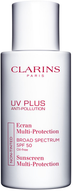
Clarins UV Plus Anti-Pollution Sunscreen Multi-Protection Broad Spectrum SPF 50

Clarins UV Plus Anti-Pollution Sunscreen Multi-Protection Broad Spectrum SPF 50

SPF 50Efficacy60/100IrritancyHigh·4 UV filters
Edit

Works for

0 of 2 advertised claims delivered

Sun protection
SPF 50 · 4 UV filters · Partial spectrum
Weak protection
SPF 50Partial spectrumMineral + chemical filtersTinted

This product does not offer good protection against UVA rays.

UV spectrum
UVB290–320 nmUVA II320–340 nmUVA I340–400 nm
Homosalate
Octocrylene
Titanium Dioxide
Oxybenzone
FilterCoverageWhat it doesEst. amount
HomosalateUVB Photo-stable A weak sunscreen that offers some protection against the sun rays that cause sunburn (UVB), but does not offer meaningful protection against protect against the most aging sun rays (UVA). It loses its effectiveness quickly when exposed to sunlight. It is an organic, or so called "chemical" sunscreen. When used in low concentrations, helps to stabilize the product formulation4%
OctocryleneUVB Photo-stable A weak sunscreen that protects against the sun rays that cause sunburn (UVB) and is somewhat effective against the UVA rays. It is quite stable and can help stabilize other, more vulnerable, sunscreen ingredients like Avobenzone. It is an organic, or so called "chemical" sunscreen4%
Titanium Dioxide Mineral UVBUVA2 Photo-stable Works as a UV filter when used in high concentrations. It is photostable and is effective mostly against the UVB light, with some protection in the UVA range. In small concentrations, used for its ability to improve the color of cosmetic products. Is usually well tolerated by the skin10.9%
OxybenzoneBenzophenone-3UVBUVA2Same as oxybenzone. Protects in the UVB and short UVA range. In small concentrations, used to stabilize product formulation. Can be irritating. Is shown to be harmful to coral reefs - consider avoiding bathing in coral reef areas when wearing a product with this ingredient. It can penetrate the skin and get absorbed into bloodstream faster than other popular filters available in the US. The study that produced this finding did not address any potential health effects of the absorption1.5%
Anti-oxidation
4 ingredients credited for this claim
Limited evidence

This product contains antioxidants (cucumis melo fruit extract, thermus thermophillus ferment). In theory, they could help neutralize free radicals in skin and lessen the damage it gets from the UV light (sun), but there is no evidence that these ingredients can have a noticeable effect in skin.

Cucumis melo fruit extractEffect: LowA fruit extract that might have some anti-oxidant properties~0.1–0.2%
Thermus thermophillus fermentEffect: LowMight be helpful in neutralising free radicals in skin and have some hydration properties~0.25–0.45%
Camellia sinensis leaf extractUnder-dosedEffect: MediumCan contain potent anti-oxidant compounds (abbreviated ECG, GCG, EGC, and EGCG) that might help protect the skin from free radicals. Can help calm down inflammation and has some anti-bacterial properties. Unfortunately, these antioxidants are unstable and lose their effectiveness very quickly in products. The concentration of the antioxidant compounds in the extract also tends to be low to be effective in topical formulation~0.15–0.25%
Tocopheryl acetateEffect: Low, below effective doseA more stable but less bio-available form of vitamin E compared to Tocopherol. Might help moisturize and protect the skin from free radicals, but mostly used in low concentrations to stabilize other ingredients.~0.45–0.65%
Moisturizing
Not advertised by the brand · 11 ingredients credited for this claim
Good evidence

This product can help improve hydration of the skin with the two types of ingredients.

The first type is called “humectants”:
these ingredients help attract water. When humectants are on the surface of the skin, they “pull in” the moisture from the outside environment, or from within deeper layers of the skin. The following ingredients in this product do the job: glycerin, sodium hyaluronate.

This product also contains ingredients called “occlusives”. They help reduce the speed with which our skin loses moisture to the outside environment. These ingredients also help soften the upper layer of the skin, so it feels less tight and nicer to the touch. The following ingredients in this product do the job: dimethicone, stearic acid.

Thermus thermophillus fermentKey active· HumectantEffect: HighMight be helpful in neutralising free radicals in skin and have some hydration properties~0.25–0.45%
Peg/ppg-18/18 dimethiconeKey activeEffect: HighA silicone that mixes with water creating nice light-weight product texture~0.55–0.85%
DimethiconeKey active· Emollient, OcclusiveEffect: HighA silicone that helps to reduce water loss from the surface of the skin. Can temporarily "fill in" lines and wrinkles, absorb oil, and create a nice product finish~7.8–9.5%
Sodium hyaluronateKey active· HumectantEffect: HighOne of the best moisturizing ingredients. Attracts water into the upper layer of the skin~0.25–0.5%
GlycerinKey active· HumectantEffect: HighOne of the best moisturizing ingredients. Naturally present in skin. It attracts water to the upper layer of the skin working as a humectant~0.5–0.8%
Peg-12 dimethiconeKey activeEffect: MediumHelps soften the upper layer of the skin and create a nice product texture~1.5–1.8%
Stearic acid· EmollientEffect: LowHelps oil and water mix together and works as an emollient~2.3–2.9%
Sanicula europaea extractEffect: LowClaimed to be helpful for restoring skin barrier function but solid research is lacking~0.4–0.6%
Butylene glycol· HumectantEffect: LowUsed to create a nice product texture and help delivery of other ingredients. Might be somewhat helpful in attracting water to the upper layer of the skin~0.3–0.6%
Lapsana communis flower/leaf/stem extractEffect: LowUsed for its fragrance. Can be irritating~0.25–0.45%
Camellia sinensis leaf extractEffect: Low, below effective doseCan contain potent anti-oxidant compounds (abbreviated ECG, GCG, EGC, and EGCG) that might help protect the skin from free radicals. Can help calm down inflammation and has some anti-bacterial properties. Unfortunately, these antioxidants are unstable and lose their effectiveness very quickly in products. The concentration of the antioxidant compounds in the extract also tends to be low to be effective in topical formulation~0.15–0.25%

Can it cause trouble?

Irritancy
3 strong irritants: Benzophenone-3, Parfum + 1 more — patch-test recommended
High risk
We flagged 15 ingredients with irritancy potential. Severity depends on your sensitivity threshold; the table lists the worst offenders first.
IngredientFunctionIrritationEst. amount
Benzophenone-3Same as oxybenzone. Protects in the UVB and short UVA range. In small concentrations, used to stabilize product formulation. Can be irritating. Is shown to be harmful to coral reefs - consider avoiding bathing in coral reef areas when wearing a product with this ingredient. It can penetrate the skin and get absorbed into bloodstream faster than other popular filters available in the US. The study that produced this finding did not address any potential health effects of the absorptionHigh1.5%
AlcoholCan be drying and contribute to skin irritation. Used in formulars to dissolve other ingredients, create a thinner product consistency or for its antibacterial propertiesHigh~5.4–6.6%est.
ParfumAn aromatic blend of unspecified and possibly irritating ingredientsHigh~0.65–0.95%est.
Sanicula europaea extractClaimed to be helpful for restoring skin barrier function but solid research is lackingHigh~0.4–0.6%est.
Lapsana communis flower/leaf/stem extractUsed for its fragrance. Can be irritatingHigh~0.25–0.45%est.
Sodium lauryl sulfateA cleansing agent (SLS). It can be irritatingHigh~0.4–0.6%est.
HomosalateA weak sunscreen that offers some protection against the sun rays that cause sunburn (UVB), but does not offer meaningful protection against protect against the most aging sun rays (UVA). It loses its effectiveness quickly when exposed to sunlight. It is an organic, or so called "chemical" sunscreen. When used in low concentrations, helps to stabilize the product formulationMedium4%
OctocryleneA weak sunscreen that protects against the sun rays that cause sunburn (UVB) and is somewhat effective against the UVA rays. It is quite stable and can help stabilize other, more vulnerable, sunscreen ingredients like Avobenzone. It is an organic, or so called "chemical" sunscreenMedium4%
EthylhexylglycerinA preservativeMedium~0.45–0.7%est.
Tocopheryl acetateA more stable but less bio-available form of vitamin E compared to Tocopherol. Might help moisturize and protect the skin from free radicals, but mostly used in low concentrations to stabilize other ingredients.Medium~0.45–0.65%est.
Disodium edtaStabilizes the product formulationMedium~0.4–0.65%est.
Thermus thermophillus fermentMight be helpful in neutralising free radicals in skin and have some hydration propertiesMedium~0.25–0.45%est.
Potassium sorbateA preservativeMedium~0.15–0.25%est.
Citric acidCan work as an exfoliant but is typically used to adjust the product pHMedium~0.15–0.3%est.
Cucumis melo fruit extractA fruit extract that might have some anti-oxidant propertiesMedium~0.1–0.2%est.
Comedogenic
1 ingredient rated 2 or more on the 0–5 pore-clogging scale
1 flagged
These ingredients have a comedogenic rating of 2 or more on a 0–5 scale; the table shows each one's rating. In leave-on products they can clog pores in acne-prone skin.
IngredientFunctionRatingEst. amount
Sodium lauryl sulfateA cleansing agent (SLS). It can be irritating3/5~0.4–0.6%est.
Edit
Cheaper Alternatives
Similar formulations, better price
No cheaper similar product found.

User reviews

Would you recommend?
No community reviews yet.

Be the first — your take helps the next person decide.

Write a review · ~30s

Ingredients

Filter by role to see what each ingredient is doing.

Titanium dioxide10.9%
UV filterKey active
Irritation risk
Low
Works for
Sun protection

Works as a UV filter when used in high concentrations. It is photostable and is effective mostly against the UVB light, with some protection in the UVA range. In small concentrations, used for its ability to improve the color of cosmetic products. Is usually well tolerated by the skin

More about Titanium dioxide
Homosalate4%
UV filterKey activeIrritant · medium
Irritation risk
Medium
Works for
Sun protection

A weak sunscreen that offers some protection against the sun rays that cause sunburn (UVB), but does not offer meaningful protection against protect against the most aging sun rays (UVA). It loses its effectiveness quickly when exposed to sunlight. It is an organic, or so called "chemical" sunscreen. When used in low concentrations, helps to stabilize the product formulation

More about Homosalate
Octocrylene4%
UV filterKey activeIrritant · medium
Irritation risk
Medium
Works for
Sun protection

A weak sunscreen that protects against the sun rays that cause sunburn (UVB) and is somewhat effective against the UVA rays. It is quite stable and can help stabilize other, more vulnerable, sunscreen ingredients like Avobenzone. It is an organic, or so called "chemical" sunscreen

More about Octocrylene
Benzophenone-31.5%
UV filterKey activeIrritant · high
Irritation risk
High
Works for
Sun protection

Same as oxybenzone. Protects in the UVB and short UVA range. In small concentrations, used to stabilize product formulation. Can be irritating. Is shown to be harmful to coral reefs - consider avoiding bathing in coral reef areas when wearing a product with this ingredient. It can penetrate the skin and get absorbed into bloodstream faster than other popular filters available in the US. The study that produced this finding did not address any potential health effects of the absorption

More about Benzophenone-3
Water~45–55%
Formula
Irritation risk
Low

Plain old water

More about Water
Dimethicone~7.8–9.5%
Key active
Irritation risk
Low
Works for
MoisturizingMattifying

A silicone that helps to reduce water loss from the surface of the skin. Can temporarily "fill in" lines and wrinkles, absorb oil, and create a nice product finish

More about Dimethicone
Alcohol~5.4–6.6%
Irritant · high
Irritation risk
High
Works for
Antibacterial

Can be drying and contribute to skin irritation. Used in formulars to dissolve other ingredients, create a thinner product consistency or for its antibacterial properties

More about Alcohol
Polyglyceryl-3 polydimethylsiloxyethyl dimethicone~3.6–4.4%
Formula
Aluminum hydroxide~2.7–3.3%
Formula
Irritation risk
Low

Is used to add opaque (non-transparent) appearance to formulations. Can be used to coat other ingredients for even dispersion. This is a different ingredient compared to the ones used in antipersperants (aluminium chloride and aluminium chlorohydrate)

More about Aluminum hydroxide
Stearic acid~2.3–2.9%
Formula
Irritation risk
Low
Works for
CleansingMoisturizing

Helps oil and water mix together and works as an emollient

More about Stearic acid
Nylon-12~1.8–2.2%
Formula
Irritation risk
Low

Used to create a nice product consistency

More about Nylon-12
Peg-12 dimethicone~1.5–1.8%
Key active
Irritation risk
Low
Works for
Moisturizing

Helps soften the upper layer of the skin and create a nice product texture

More about Peg-12 dimethicone
Sodium chloride~1.3–1.6%
Formula
Irritation risk
Low

Used to stabilize mixtures of oil and water, and create thicker, gel-like product textures

More about Sodium chloride
Phenoxyethanol~0.5–1%
Formula
Irritation risk
Low

A preservative. It helps prevent bacterial growth in cosmetic products

More about Phenoxyethanol
Parfum~0.65–0.95%
Irritant · high
Irritation risk
High

An aromatic blend of unspecified and possibly irritating ingredients

More about Parfum
Peg/ppg-18/18 dimethicone~0.55–0.85%
Key active
Irritation risk
Low
Works for
MoisturizingCleansing

A silicone that mixes with water creating nice light-weight product texture

More about Peg/ppg-18/18 dimethicone
Glycerin~0.5–0.8%
Key active
Irritation risk
Low
Works for
Moisturizing

One of the best moisturizing ingredients. Naturally present in skin. It attracts water to the upper layer of the skin working as a humectant

More about Glycerin
Ethylhexylglycerin~0.45–0.7%
Irritant · medium
Irritation risk
Medium

A preservative

More about Ethylhexylglycerin
Tocopheryl acetate~0.45–0.65%
Irritant · medium
Irritation risk
Medium
Works for
Anti-oxidation

A more stable but less bio-available form of vitamin E compared to Tocopherol. Might help moisturize and protect the skin from free radicals, but mostly used in low concentrations to stabilize other ingredients.

More about Tocopheryl acetate
Disodium edta~0.4–0.65%
Irritant · medium
Irritation risk
Medium

Stabilizes the product formulation

More about Disodium edta
Sanicula europaea extract~0.4–0.6%
Irritant · high
Irritation risk
High
Works for
MoisturizingAntibacterialAnti-aging

Claimed to be helpful for restoring skin barrier function but solid research is lacking

More about Sanicula europaea extract
Butylene glycol~0.3–0.6%
Formula
Irritation risk
Low
Works for
Moisturizing

Used to create a nice product texture and help delivery of other ingredients. Might be somewhat helpful in attracting water to the upper layer of the skin

More about Butylene glycol
Sodium hyaluronate~0.25–0.5%
Key active
Irritation risk
Low
Works for
Moisturizing

One of the best moisturizing ingredients. Attracts water into the upper layer of the skin

More about Sodium hyaluronate
Hydroxypropyltrimonium maltodextrin crosspolymer~0.25–0.45%
Formula
Thermus thermophillus ferment~0.25–0.45%
Key activeIrritant · medium
Irritation risk
Medium
Works for
MoisturizingAnti-oxidationAnti-aging

Might be helpful in neutralising free radicals in skin and have some hydration properties

More about Thermus thermophillus ferment
Lapsana communis flower/leaf/stem extract~0.25–0.45%
Irritant · high
Irritation risk
High
Works for
Moisturizing

Used for its fragrance. Can be irritating

More about Lapsana communis flower/leaf/stem extract
Ribes nigrum bud extract~0.2–0.35%
Formula
Potassium sorbate~0.15–0.25%
Irritant · medium
Irritation risk
Medium

A preservative

More about Potassium sorbate
Citric acid~0.15–0.3%
Irritant · medium
Irritation risk
Medium

Can work as an exfoliant but is typically used to adjust the product pH

More about Citric acid
Camellia sinensis leaf extract~0.15–0.25%
Under-dosed
Irritation risk
Low
Works for
AntibacterialAnti-oxidationAnti-agingAnti-blemishEvens skin toneMoisturizing

Can contain potent anti-oxidant compounds (abbreviated ECG, GCG, EGC, and EGCG) that might help protect the skin from free radicals. Can help calm down inflammation and has some anti-bacterial properties. Unfortunately, these antioxidants are unstable and lose their effectiveness very quickly in products. The concentration of the antioxidant compounds in the extract also tends to be low to be effective in topical formulation

More about Camellia sinensis leaf extract
Cucumis melo fruit extract~0.1–0.2%
Irritant · medium
Irritation risk
Medium
Works for
Anti-oxidation

A fruit extract that might have some anti-oxidant properties

More about Cucumis melo fruit extract
Sodium lauryl sulfate~0.4–0.6%
Comedogenic 3/5Irritant · high
Irritation risk
High
Comedogenicity
3/5
Works for
Cleansing

A cleansing agent (SLS). It can be irritating

More about Sodium lauryl sulfate
Ingredient list view

Titanium dioxide, Homosalate, Octocrylene, Benzophenone-3, Water, Dimethicone, Alcohol, Polyglyceryl-3 polydimethylsiloxyethyl dimethicone, Aluminum hydroxide, Stearic acid, Nylon-12, Peg-12 dimethicone, Sodium chloride, Phenoxyethanol, Parfum, Peg/ppg-18/18 dimethicone, Glycerin, Ethylhexylglycerin, Tocopheryl acetate, Disodium edta, Sanicula europaea extract, Butylene glycol, Sodium hyaluronate, Hydroxypropyltrimonium maltodextrin crosspolymer, Thermus thermophillus ferment, Lapsana communis flower/leaf/stem extract, Ribes nigrum bud extract, Potassium sorbate, Citric acid, Camellia sinensis leaf extract, Cucumis melo fruit extract, Sodium lauryl sulfate

Compare prices

Retailers ranked by price — lowest first.

Walmart
$16.00
Buy
Clarins
$49.00
Buy

Affiliate links · prices updated regularly

Cheaper alternatives? See how this stacks up against similar formulas.
We compare ingredient profiles across our catalog — pick the closest match for your budget.
Open dupe finder
Clarins UV Plus Anti-Pollution Sunscreen Multi-Protection Broad Spectrum SPF 50
ClarinsUV Plus Anti-Pollution Sunscreen Multi-Protection Broad Spectrum SPF 50

Affiliate links · As an Amazon Associate, WIMJ earns from qualifying purchases.

As an Amazon Associate, WIMJ earns from qualifying purchases.