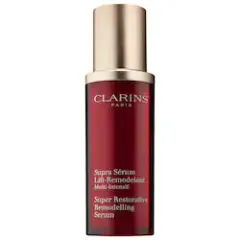
Works for:
based on ingredients and %- Moisturizing
Doesn't work for:
based on ingredients and %- Anti-aging
- Evens skin tone
Can it cause trouble?
- Irritation risk: high
- Comedogenic risk ingredients: 1
Key actives

Product Summary
"Clarins - Super Restorative Remodelling Serum" is effective for: Moisturizing
This product could be helpful for: Anti-aging, but its actives are not the most effective or are not well-studied.
Ingredient callouts
- This product also contains Vitamin C (Ascorbic Acid). It can be an effective active for anti-aging and evening out the skin tone, but in this product it is used for stabilizing other ingredients in the formulation. In this concentration (0.05% - 0.10%) it cannot have a noticeable benefit for the skin.
- Peptides (acetyl tetrapeptide-2 0.05% - 0.20%). There are many different kind of Peptides and they are naturally present in our skin. They all are a combination of aminoacids. Some of them work as natural antibiotics, promote wound-healing and production of collagen. The science is still not settled on how effective Peptides are in skincare, but it is very likely that they have a benefit. They might help restore the skin barrier and fight the signs of aging. At the very least, Peptides work as humectants: they attract water to the upper layer of the skin and improve its hydration.
- Humectants (sodium hyaluronate 0.95% - 1.45%, dextran 0.01% - 0.10%, biosaccharide gum-1 0.10% - 0.45% and glycerin 4.30% - 6.50%). These ingredients help attract water to the upper layer of the skin and improve the skin hydration.
Price
The product retails for 124.26€ in Germany, for 145.00$ in the United States, from 80.64£ up to 2271.00£ in the United Kingdom and for 121.89A$ in Australia.
For a detailed price comparison: click here.
Moisturizing
What does the product description say?
The lightweight texture smooths over the face and neck, working to support a more lifted, refined look to facial contours while helping skin feel comfortably hydrated and supple.
Source: Allbeauty
This product can help improve hydration of the skin with the two types of ingredients.
The first type is called “humectants”:
these ingredients help attract water.
When humectants are on the surface of the skin, they “pull in” the moisture from the outside environment, or from
within deeper layers of the skin. The following ingredients in this product do the job:
glycerin, butylene glycol.
This product also contains ingredients called “occlusives”. They help reduce the speed with which our skin loses moisture to the outside environment. These ingredients also help soften the upper layer of the skin, so it feels less tight and nicer to the touch. The following ingredients in this product do the job: caprylic/capric triglyceride, dimethicone.
A good mix of fatty acids that forms a protective layer on the skin. Improves the shelf life of products. Derived from coconut and glycerin
A silicone that helps to reduce water loss from the surface of the skin. Can temporarily "fill in" lines and wrinkles, absorb oil, and create a nice product finish
One of the best moisturizing ingredients. Naturally present in skin. It attracts water to the upper layer of the skin working as a humectant
Helps soften the upper layer of the skin
Enhances the product texture and makes it more spreadable. Helps reduce water loss from the outer layer of skin. Extands the shelf life by preventing bacteria growth
Used to create a nice product texture and help delivery of other ingredients. Might be somewhat helpful in attracting water to the upper layer of the skin
Helps soften the upper layer of the skin, dissolve other ingredients and create a thicker product consistency
Helps preserve products and creates a nice product texture
An emollient that helps soften the skin
Used to create a nice product consistency
Forms a protective film on the surface of the skin to prevent moisture loss. Gives a velvety feel to products while reducing tackiness
Pure form of vitamin E. Can help moisturise and protect the skin from free radicals. Often used to help stabilise other ingredients or the formula itself
Anti-aging
What does the product description say?
Clarins' Super Restorative Remodeling Serum targets facial volume, age spots, visibly lifts and helps define facial contours.
Source: Ulta
Effective ingredients missing or their concentration is too low.
Pure form of vitamin E. Can help moisturise and protect the skin from free radicals. Often used to help stabilise other ingredients or the formula itself
Evens skin tone
What does the product description say?
Visibly reduces age-related dark spots
Source: Ulta
Effective ingredients missing or their concentration is too low
How honest is this product?
| Promise | Can it deliver? |
|---|---|
| Moisturizing | |
| Anti-aging | |
| Evens skin tone |
Total Promises Fulfilled score: 25/100.
We receive a small commission for purchases made through these links at no cost for you. Thank you for your support! Learn more
Potential irritants
Comedogenic ingredients
User reviews (0)
Averages from community submissions.
No reviews yet for this product.
Be the first to share your experience!
Tried this product?
Help capture what the ingredient list can't—texture, finish, pilling, scent, and more. Answer what you can, skip the rest.
Takes ~30 seconds.
Reviews are shown in aggregate. No personal details.
| Product | Similarity | Price | Irritancy |
|---|---|---|---|
 Clarins Super Restorative Remodelling Serum | Current | ≈ $114.30 | |
 Revision Skincare Advanced Pigment Corrector+ ™ | 40% | $165.00 | |
 Avant Skincare Daily Deal: Avant Skincare Eight-hour Anti-Oxidising & Retexturing Hyaluronic Facial Serum | 39% | - | |
 EISENBERG Comforting Calming Serum | 39% | ≈ $147.05 | |
 BABE LABORATORIOS Multi Rejuvenating Revitalising Booster Serum | 39% | - | |
 mirenesse Fast Fix Chin Tuck V Shape Lifting Serum | 39% | - |
Key Actives
Can be helpful in reducing inflammation in skin, including inflamed acne. It can be irritating
Might be helpful in neutralizing free radicals. Can have a dehydration effect that might somewhat decrease the look of puffy eyes
A silicone that helps to reduce water loss from the surface of the skin. Can temporarily "fill in" lines and wrinkles, absorb oil, and create a nice product finish
A good mix of fatty acids that forms a protective layer on the skin. Improves the shelf life of products. Derived from coconut and glycerin
One of the best moisturizing ingredients. Naturally present in skin. It attracts water to the upper layer of the skin working as a humectant
Helps soften the upper layer of the skin
Used to create a gel-like product texture, as well as to stabilize emulsions
Potential irritants
A fragrance. Potential allergen and can be irritating
A fragrance. Can trigger allergic reactions and be irritating
A plant extract traditionally used for anti-bacterial properties. Can be irritating.
An aromatic blend of unspecified and possibly irritating ingredients
Can be helpful in reducing inflammation in skin, including inflamed acne. It can be irritating
Maintains the texture of skincare products. Allows the product to spread evenly. Helps oil and water mix together
Might be helpful in neutralizing free radicals. Can have a dehydration effect that might somewhat decrease the look of puffy eyes
A good mix of fatty acids that forms a protective layer on the skin. Improves the shelf life of products. Derived from coconut and glycerin
Helps preserve products and creates a nice product texture
Can work as an exfoliant but is typically used to adjust the product pH
Used to improve product texture and help oil and water mix together
Helps to control the skin's pH level. Maintains the skin's natural film of amino-lactic acids and oils. Helps to preserve products
A more stable but less bio-available form of vitamin E compared to Tocopherol. Might help moisturize and protect the skin from free radicals, but mostly used in low concentrations to stabilize other ingredients.
Comedogenic ingredients
All ingredients
Maintains the texture of skincare products. Allows the product to spread evenly. Helps oil and water mix together
A fragrance. Potential allergen and can be irritating
Used to create a nice product texture and help delivery of other ingredients. Might be somewhat helpful in attracting water to the upper layer of the skin
A fragrance. Can trigger allergic reactions and be irritating
Enhances the product texture and makes it more spreadable. Helps reduce water loss from the outer layer of skin. Extands the shelf life by preventing bacteria growth
Helps soften the upper layer of the skin, dissolve other ingredients and create a thicker product consistency
Might be helpful in neutralizing free radicals. Can have a dehydration effect that might somewhat decrease the look of puffy eyes
A good mix of fatty acids that forms a protective layer on the skin. Improves the shelf life of products. Derived from coconut and glycerin
Helps preserve products and creates a nice product texture
Can work as an exfoliant but is typically used to adjust the product pH
A silicone that helps to reduce water loss from the surface of the skin. Can temporarily "fill in" lines and wrinkles, absorb oil, and create a nice product finish
A plant extract traditionally used for anti-bacterial properties. Can be irritating.
One of the best moisturizing ingredients. Naturally present in skin. It attracts water to the upper layer of the skin working as a humectant
Used to thicken product formulations and create gel-like textures
Forms a protective film on the surface of the skin to prevent moisture loss. Gives a velvety feel to products while reducing tackiness
An aromatic blend of unspecified and possibly irritating ingredients
A preservative. It helps prevent bacterial growth in cosmetic products
Used to improve product texture and help oil and water mix together
Can be helpful in reducing inflammation in skin, including inflamed acne. It can be irritating
Helps to control the skin's pH level. Maintains the skin's natural film of amino-lactic acids and oils. Helps to preserve products
Used to create a gel-like product texture, as well as to stabilize emulsions
Pure form of vitamin E. Can help moisturise and protect the skin from free radicals. Often used to help stabilise other ingredients or the formula itself
A more stable but less bio-available form of vitamin E compared to Tocopherol. Might help moisturize and protect the skin from free radicals, but mostly used in low concentrations to stabilize other ingredients.
Ingredient list view
Acrylates/c10-30 alkyl acrylate crosspolymer, Alpha-isomethyl ionone, Water, Buddleja officinalis leaf extract, Butylene glycol, Butylphenyl methylpropional, C12-15 alkyl benzoate, C13-14 isoparaffin, Caffeine, Caprylic/capric triglyceride, Caprylyl glycol, Carum petroselinum extract, Cetearyl ethylhexanoate, Ci 14700, Citric acid, Citronellol, Dimethicone, Diospyros kaki fruit extract, Dipsacus sylvestris extract, Disodium edta, Ethylhexylglycerin, Glycerin, Hexyl cinnamal, Hydrolyzed linseed extract, Hydroxyethylcellulose, Isononyl isononanoate, Laureth-7, Linalool, Parfum, Peg-8, Peg-20 methyl glucose sesquistearate, Pelvetia canaliculata extract, Phenoxyethanol, Polyacrylamide, Potassium sorbate, Pueraria lobata root extract, Rosmarinus officinalis leaf extract, Siloxanetriol alginate, Solanum lycopersicum fruit extract, Sodium citrate, Sodium polyacrylate, Sorbic acid, Stearyl heptanoate, Thymus vulgaris flower/leaf/stem extract, Tocopherol, Tocopheryl acetate, Tromethamine
- Safety Assessment of Isoparaffins as Used in Cosmetics
- Dimethicone as a protective ingredient in topical medications
- Final Report on the Safety Assessment of Dimethicone Copolyol
- Glycerol and the skin: holistic approach to its origin and functions
- Allergic contact dermatitis induced by rosemary leaf extract in a cleansing gel