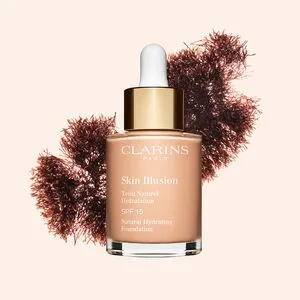
Clarins Skin Illusion Natural Hydrating Foundation SPF 15
Works for
Sun protectionSPF 15 · 1 UV filter · Partial spectrumWeak protectionSPF under 30
This product does not offer good protection against UVA rays.
This product can be considered "reef safe" because it does not contain the UV filters (oxybenzone and octinoxate) that can be harmful to coral reefs when present in the water in high concentrations.
MoisturizingDimethicone, Isododecane + 12 moreWorks
“Skin Illusion Natural Hydrating Foundation SPF 15”
This product can help improve hydration of the skin with the two types of ingredients.
The first type is called “humectants”:
these ingredients help attract water.
When humectants are on the surface of the skin, they “pull in” the moisture from the outside environment, or from
within deeper layers of the skin. The following ingredients in this product do the job:
glycerin, hydroxyethyl urea.
This product also contains ingredients called “occlusives”. They help reduce the speed with which our skin loses moisture to the outside environment. These ingredients also help soften the upper layer of the skin, so it feels less tight and nicer to the touch. The following ingredients in this product do the job: dimethicone, squalane.
Can it cause trouble?
Irritancy5 strong irritants: Alcohol, Parfum + 3 more — patch-test recommendedHigh risk
Comedogenic1 ingredient rated 2 or more on the 0–5 pore-clogging scale1 flagged
User reviews
Be the first — your take helps the next person decide.
Ingredients
Filter by role to see what each ingredient is doing.
Water~45–55%
Methyl trimethicone~5.5–6.7%
- Irritation risk
- Low
A type of silicone that helps create a silky product finish and dissolve other ingredients
More about Methyl trimethiconeDimethicone~4.2–5.1%
- Irritation risk
- Low
A silicone that helps to reduce water loss from the surface of the skin. Can temporarily "fill in" lines and wrinkles, absorb oil, and create a nice product finish
More about DimethiconeAlcohol~3.1–3.8%
- Irritation risk
- High
Can be drying and contribute to skin irritation. Used in formulars to dissolve other ingredients, create a thinner product consistency or for its antibacterial properties
More about AlcoholIsododecane~2.4–2.9%
- Irritation risk
- Low
An emollient that helps soften the skin and can decrease moisture loss. Helps create a nice product texture
More about IsododecaneButylene glycol~1.9–2.4%
- Irritation risk
- Low
Used to create a nice product texture and help delivery of other ingredients. Might be somewhat helpful in attracting water to the upper layer of the skin
More about Butylene glycolTitanium dioxide~2–2.5%
- Irritation risk
- Low
Works as a UV filter when used in high concentrations. It is photostable and is effective mostly against the UVB light, with some protection in the UVA range. In small concentrations, used for its ability to improve the color of cosmetic products. Is usually well tolerated by the skin
More about Titanium dioxidePeg-9 polydimethylsiloxyethyl dimethicone~1.4–1.7%
- Irritation risk
- Medium
A type of silicone that helps water and oil mix together
More about Peg-9 polydimethylsiloxyethyl dimethiconeHdi/trimethylol hexyllactone crosspolymer~1.1–1.4%
- Irritation risk
- Low
Used to create a silky product texture and add volume to products
More about Hdi/trimethylol hexyllactone crosspolymerGlycerin~1–1.2%
- Irritation risk
- Low
One of the best moisturizing ingredients. Naturally present in skin. It attracts water to the upper layer of the skin working as a humectant
More about GlycerinDimethicone/peg-10/15 crosspolymer~0.7–1.05%
Polyglyceryl-3 polydimethylsiloxyethyl dimethicone~0.55–0.8%
- Irritation risk
- Low
Sodium chloride~0.55–0.8%
- Irritation risk
- Low
Used to stabilize mixtures of oil and water, and create thicker, gel-like product textures
More about Sodium chlorideSqualane~0.55–0.8%
- Irritation risk
- Low
An oil naturally present in skin. Works as an emollient to soften the skin and form a protective layer on its surface without a greasy feeling.
More about SqualaneAluminum hydroxide~0.5–0.75%
- Irritation risk
- Low
Is used to add opaque (non-transparent) appearance to formulations. Can be used to coat other ingredients for even dispersion. This is a different ingredient compared to the ones used in antipersperants (aluminium chloride and aluminium chlorohydrate)
More about Aluminum hydroxideStearic acid~0.6–0.85%
- Irritation risk
- Low
Helps oil and water mix together and works as an emollient
More about Stearic acidParfum~0.4–0.6%
- Irritation risk
- High
An aromatic blend of unspecified and possibly irritating ingredients
More about ParfumSilybum marianum seed oil~0.35–0.6%
- Irritation risk
- High
A plant oil that contains essential oils that can be irritating. Can help soften the upper layer of the skin. Might have some anti-oxidant activity but evidence is lacking
More about Silybum marianum seed oilDisteardimonium hectorite~0.35–0.6%
- Irritation risk
- Low
A type of clay that is used to thicken the product consistency
More about Disteardimonium hectoritePropylene carbonate~0.35–0.6%
- Irritation risk
- Low
Is used to dissolve other ingredients and create nice product texture
More about Propylene carbonateEthylhexylglycerin~0.3–0.55%
Tocopheryl acetate~0.3–0.55%
- Irritation risk
- Medium
A more stable but less bio-available form of vitamin E compared to Tocopherol. Might help moisturize and protect the skin from free radicals, but mostly used in low concentrations to stabilize other ingredients.
More about Tocopheryl acetateTriethoxycaprylylsilane~0.25–0.5%
- Irritation risk
- Low
A type of silicone that helps oil and water mix well together. Helps to disperse other ingredients, e.g. pigments, evenly in a formulation
More about TriethoxycaprylylsilaneDisodium edta~0.25–0.5%
Hydroxyethyl urea~0.25–0.5%
- Irritation risk
- Low
A synthetic humectant made from urea. It pulls water into the upper layer of the skin about as well as glycerin, but without glycerin's stickiness. Unlike urea, it has not been shown to exfoliate. Lab and animal tests suggest a low risk of irritation at the levels used in products.
More about Hydroxyethyl ureaSynthetic fluorphlogopite~0.3–0.5%
- Irritation risk
- Low
A mineral that is used as an optical filter (makes the skin looks nicer through light reflection) and to improve the texture of cosmetic products
More about Synthetic fluorphlogopiteDipropylene glycol~0.25–0.45%
- Irritation risk
- Low
Helps to dissolve other ingredients in a formulation. Slows down the rate of product drying
More about Dipropylene glycolKalanchoe pinnata leaf extract~0.25–0.5%
- Irritation risk
- High
Is claimed to improve skin's ability to produce its natural moisturizers, but solid research is lacking
More about Kalanchoe pinnata leaf extractPhenoxyethanol~0.3–0.5%
- Irritation risk
- Low
A preservative. It helps prevent bacterial growth in cosmetic products
More about PhenoxyethanolAlgin~0.25–0.5%
- Irritation risk
- Low
- Comedogenicity
- 3/5
Used to thicken product formulation. Can help attract water to the upper layer of the skin
More about AlginSodium citrate~0.25–0.5%
- Irritation risk
- Medium
Helps to control the skin's pH level. Maintains the skin's natural film of amino-lactic acids and oils. Helps to preserve products
More about Sodium citrateCitric acid~0.25–0.5%
- Irritation risk
- Medium
Can work as an exfoliant but is typically used to adjust the product pH
More about Citric acidAcacia senegal gum~0.3–0.55%
- Irritation risk
- Medium
Helps mask the small of other ingredients and improve the product texture
More about Acacia senegal gumJania rubens extract~0.25–0.45%
- Irritation risk
- Low
Furcellaria lumbricalis extract~0.25–0.45%
- Irritation risk
- Medium
Might be able to support collagen production, but no solid research is available
More about Furcellaria lumbricalis extractSodium benzoate~0.25–0.45%
Potassium sorbate~0.25–0.45%
Camellia sinensis leaf extract~0.25–0.45%
- Irritation risk
- Low
Can contain potent anti-oxidant compounds (abbreviated ECG, GCG, EGC, and EGCG) that might help protect the skin from free radicals. Can help calm down inflammation and has some anti-bacterial properties. Unfortunately, these antioxidants are unstable and lose their effectiveness very quickly in products. The concentration of the antioxidant compounds in the extract also tends to be low to be effective in topical formulation
More about Camellia sinensis leaf extractTocopherol~0.25–0.45%
- Irritation risk
- Low
Pure form of vitamin E. Can help moisturise and protect the skin from free radicals. Often used to help stabilise other ingredients or the formula itself
More about TocopherolLapsana communis flower/leaf/stem extract~0.2–0.4%
- Irritation risk
- High
Used for its fragrance. Can be irritating
More about Lapsana communis flower/leaf/stem extractMaris sal~0.2–0.35%
- Irritation risk
- Medium
Used to thicken the product formulation and might help to add minerals to the surface of the skin. It is used in scrubs as a physical exfoliant. Can increase sensitivity to other ingredients if left on the skin or used in high concentration
More about Maris salMica~0.2–0.35%
- Irritation risk
- Low
Creates an illusion of smoother and more radiant skin tone. Adds shimmer to the skin by reflecting light
More about MicaSilica~0.25–0.45%
Titanium dioxide~0.2–0.4%
- Irritation risk
- Low
Works as a UV filter when used in high concentrations. It is photostable and is effective mostly against the UVB light, with some protection in the UVA range. In small concentrations, used for its ability to improve the color of cosmetic products. Is usually well tolerated by the skin
More about Titanium dioxideIron oxides~0.1–0.2%
- Irritation risk
- Low
An umbrella term for the following three colorants: CI 77491, CI 77492, CI 77499. They might be able to offer some protection against visible light, but the degree of the protection is not clear
More about Iron oxidesIron oxides~0.1–0.2%
- Irritation risk
- Low
An umbrella term for the following three colorants: CI 77491, CI 77492, CI 77499. They might be able to offer some protection against visible light, but the degree of the protection is not clear
More about Iron oxidesIron oxides~0.05–0.15%
- Irritation risk
- Low
An umbrella term for the following three colorants: CI 77491, CI 77492, CI 77499. They might be able to offer some protection against visible light, but the degree of the protection is not clear
More about Iron oxidesIngredient list view
Water, Methyl trimethicone, Dimethicone, Alcohol, Isododecane, Butylene glycol, Titanium dioxide, Peg-9 polydimethylsiloxyethyl dimethicone, Hdi/trimethylol hexyllactone crosspolymer, Glycerin, Dimethicone/peg-10/15 crosspolymer, Polyglyceryl-3 polydimethylsiloxyethyl dimethicone, Sodium chloride, Squalane, Aluminum hydroxide, Stearic acid, Parfum, Silybum marianum seed oil, Disteardimonium hectorite, Propylene carbonate, Ethylhexylglycerin, Tocopheryl acetate, Triethoxycaprylylsilane, Disodium edta, Hydroxyethyl urea, Synthetic fluorphlogopite, Dipropylene glycol, Kalanchoe pinnata leaf extract, Phenoxyethanol, Algin, Sodium citrate, Citric acid, Acacia senegal gum, Jania rubens extract, Furcellaria lumbricalis extract, Sodium benzoate, Potassium sorbate, Camellia sinensis leaf extract, Tocopherol, Lapsana communis flower/leaf/stem extract, Maris sal, Mica, Silica, Titanium dioxide, Iron oxides, Iron oxides, Iron oxides
Compare prices
Retailers ranked by price — lowest first.

Worth comparing, line by line.
Match % combines shared ingredients, the first five ingredients, shared actives and hero ingredients, irritancy (lower counts in the alternative's favour), texture and body area. Only products in the same routine step are compared.
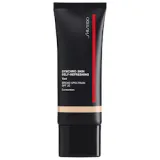
| ClarinsSkin Illusion Natural Hydrating Foundation SPF 15YOUR PRODUCT | CliniqueEven Better Brightening Cushion Compact SPF 33/PA+++ | Estée LauderPerfectionist Pro Multi-Defense UV Fluid SPF45 with 8 Anti-Oxidants | ShiseidoSynchro Skin Self-Refreshing Tint SPF 20 | |
|---|---|---|---|---|
| Match | — | 38% | 37% | 36% |
| Price | — | $42.71 | $48.00 | — |
| Shared key ingredients | — | 5 of 7 | 5 of 7 | 5 of 7 |
| Key difference | — | Ascorbyl Glucoside | Tetrahexyldecyl Ascorbate | Octinoxate |
| Irritancy | High | Low | Medium | Medium |
| SPF | SPF 15 | SPF 33 | SPF 45 | SPF 20 |
| Drying alcohol | Contains drying alcohol | — | — | — |
| View product | Shop | Shop | Shop |


More alternatives: Almay Smart Shade Skintone Matching Makeup, Light/Medium Mine 200, SPF 15Tula Mineral Sunscreen Fluid Broad Spectrum SPF 30
Sources cited in this review
Every concentration estimate and effectiveness label is anchored to one of these 14 studies and safety reviews.
- 1
- 2Final Report on the Safety Assessment of Dimethicone Copolyoljournals.sagepub.com
- 3
- 4
- 5
- 6

Affiliate links · As an Amazon Associate, WIMJ earns from qualifying purchases.