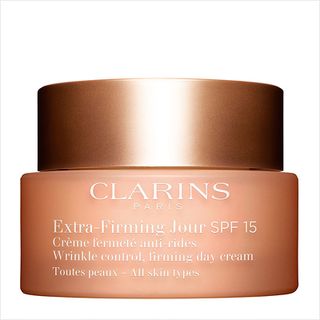
Clarins Extra-Firming Day Cream SPF15
Works for
1 of 3 advertised claims delivered
Sun protectionSPF 15 · 4 UV filters · Broad spectrumWeak protectionSPF under 30
This product offers broad spectrum sun protection, but it is weak. We recommend to use a broad spectrum sunscreen with at least SPF 30.
This product can be considered "reef safe" because it does not contain the UV filters (oxybenzone and octinoxate) that can be harmful to coral reefs when present in the water in high concentrations.
Moisturizing18 ingredients credited for this claimGood support
“Extra-Firming Day Cream SPF15”
This product can help improve hydration of the skin with the two types of ingredients.
The first type is called “humectants”:
these ingredients help attract water.
When humectants are on the surface of the skin, they “pull in” the moisture from the outside environment, or from
within deeper layers of the skin. The following ingredients in this product do the job:
betaine, glycerin.
This product also contains ingredients called “occlusives”. They help reduce the speed with which our skin loses moisture to the outside environment. These ingredients also help soften the upper layer of the skin, so it feels less tight and nicer to the touch. The following ingredients in this product do the job: butyrospermum parkii butter, dimethicone.
Anti-aging6 ingredients credited for this claimLimited support
“Key ingredient Kangaroo flower, helps plump and firm the skin for a smoother, radiant and visibly younger-looking complexion.”
This product does not contain ingredients that are able to reduce fine lines and wrinkles or help with skin elasticity, but it can improve the look of the skin temporarily through moisturization. Well-moisturized skin might also be able to repair the sun damage better.This ingredient - butyrospermum parkii butter - could be helpful for preventing or repairing signs of aging in theory, but there is no evidence that it actually works.
The biggest anti-aging effect in this product comes from sun protection. Sun damage is the main factor causing early signs of skin aging. We, however, do not recommend using this product as a sunscreen because the protection it offers is not strong enough).
Can it cause trouble?
Irritancy7 strong irritants: Parfum, Anigozanthos flavidus extract + 5 more — patch-test recommendedHigh risk
Comedogenic2 ingredients rated 2 or more on the 0–5 pore-clogging scale2 flagged
User reviews
Be the first — your take helps the next person decide.
Ingredients
Filter by role to see what each ingredient is doing.
Water~45–55%
Homosalate~5.4–6.6%
- Irritation risk
- Medium
A weak sunscreen that offers some protection against the sun rays that cause sunburn (UVB), but does not offer meaningful protection against protect against the most aging sun rays (UVA). It loses its effectiveness quickly when exposed to sunlight. It is an organic, or so called "chemical" sunscreen. When used in low concentrations, helps to stabilize the product formulation
More about HomosalateOctocrylene~4.4–5.4%
- Irritation risk
- Medium
A weak sunscreen that protects against the sun rays that cause sunburn (UVB) and is somewhat effective against the UVA rays. It is quite stable and can help stabilize other, more vulnerable, sunscreen ingredients like Avobenzone. It is an organic, or so called "chemical" sunscreen
More about OctocryleneGlycerin~3–3.7%
- Irritation risk
- Low
One of the best moisturizing ingredients. Naturally present in skin. It attracts water to the upper layer of the skin working as a humectant
More about GlycerinButyloctyl salicylate~2.3–2.8%
- Irritation risk
- Medium
A synthetic ester of salicylic acid that is used to help disperse pigments and boost effectiveness of sunscreen ingredients. It is able to absorb UV light (working as an organic, or chemical filter), but is not approved as a sunscreen ingredient on its own
More about Butyloctyl salicylateButyrospermum parkii butter~2–2.4%
- Irritation risk
- Low
- Comedogenicity
- 3/5
A great moisturising ingredient that softens the skin and reduces water loss from its upper layer. It also can be helpful in protecting skin from free radicals
More about Butyrospermum parkii butterDimethicone~1.7–2%
- Irritation risk
- Low
A silicone that helps to reduce water loss from the surface of the skin. Can temporarily "fill in" lines and wrinkles, absorb oil, and create a nice product finish
More about DimethiconeButyl methoxydibenzoylmethane~2–2.4%
- Irritation risk
- Medium
Avobenzone. An organic, or so-called "chemical" UV filter. Protects against both UVA and UVB rays. Needs to be combined with other filters in a formulation to be stable.
More about Butyl methoxydibenzoylmethaneC12-15 alkyl benzoate~1.2–1.4%
- Irritation risk
- Low
Enhances the product texture and makes it more spreadable. Helps reduce water loss from the outer layer of skin. Extands the shelf life by preventing bacteria growth
More about C12-15 alkyl benzoateCetearyl alcohol~1–1.2%
- Irritation risk
- Low
- Comedogenicity
- 2/5
A non-drying alcohol. Works as an emollient. Helps water and oil mix together and creates a nice product texture
More about Cetearyl alcoholMethyl methacrylate crosspolymer~0.7–1.05%
- Irritation risk
- Low
Helps thicken the product consistency
More about Methyl methacrylate crosspolymerPotassium cetyl phosphate~0.55–0.8%
- Irritation risk
- Medium
Helps oil and water mix together
More about Potassium cetyl phosphateParfum~0.45–0.65%
- Irritation risk
- High
An aromatic blend of unspecified and possibly irritating ingredients
More about ParfumCetearyl glucoside~0.45–0.65%
- Irritation risk
- Medium
Helps water and oil in the product mix well together and improves product texture
More about Cetearyl glucosideDimethicone/vinyl dimethicone crosspolymer~0.4–0.6%
- Irritation risk
- Low
Used to stabilize product formulations and create a nice product texture
More about Dimethicone/vinyl dimethicone crosspolymerPhenoxyethanol~0.4–0.6%
- Irritation risk
- Low
A preservative. It helps prevent bacterial growth in cosmetic products
More about PhenoxyethanolButylene glycol~0.35–0.65%
- Irritation risk
- Low
Used to create a nice product texture and help delivery of other ingredients. Might be somewhat helpful in attracting water to the upper layer of the skin
More about Butylene glycolAcrylates/c10-30 alkyl acrylate crosspolymer~0.35–0.6%
- Irritation risk
- Medium
Maintains the texture of skincare products. Allows the product to spread evenly. Helps oil and water mix together
More about Acrylates/c10-30 alkyl acrylate crosspolymerCaprylyl glycol~0.3–0.6%
- Irritation risk
- Medium
Helps preserve products and creates a nice product texture
More about Caprylyl glycolTromethamine~0.25–0.5%
Avena sativa kernel extract~0.25–0.45%
- Irritation risk
- Low
An effective moisturizing and skin barrier repair ingredient. Helps calm down inflammation and has some anti-oxidant properties
More about Avena sativa kernel extractDisodium edta~0.2–0.4%
Tocopheryl acetate~0.2–0.4%
- Irritation risk
- Medium
A more stable but less bio-available form of vitamin E compared to Tocopherol. Might help moisturize and protect the skin from free radicals, but mostly used in low concentrations to stabilize other ingredients.
More about Tocopheryl acetateXanthan gum~0.2–0.4%
- Irritation risk
- Low
Used to create a thicker product consistency
More about Xanthan gumDimethiconol~0.25–0.45%
- Irritation risk
- Low
A silicone that makes products more spreadable and keeps skin smooth. Helps to add gloss to skin and may visually fill in fine lines/wrinkles for short time
More about DimethiconolTocopherol~0.2–0.4%
- Irritation risk
- Low
Pure form of vitamin E. Can help moisturise and protect the skin from free radicals. Often used to help stabilise other ingredients or the formula itself
More about TocopherolAnigozanthos flavidus extract~0.2–0.35%
- Irritation risk
- High
Claimed to have anti-oxidant properties but no evidence is available
More about Anigozanthos flavidus extractCaprylic/capric triglyceride~0.25–0.45%
- Irritation risk
- Medium
A good mix of fatty acids that forms a protective layer on the skin. Improves the shelf life of products. Derived from coconut and glycerin
More about Caprylic/capric triglycerideBetaine~0.2–0.35%
- Irritation risk
- Low
Helps attract water to the upper layer of the skin and improves the product texture
More about BetaineSilica~0.3–0.55%
Sorbitol~0.2–0.35%
- Irritation risk
- Low
Helps attract water to the upper layer of the skin and improves the product texture
More about SorbitolDiospyros mespiliformis leaf extract~0.2–0.35%
- Irritation risk
- High
Can have some anti-bacterial properties
More about Diospyros mespiliformis leaf extractMaltodextrin~0.2–0.4%
- Irritation risk
- Low
Used to stabilize the product formulation and can help absorb oil
More about MaltodextrinSanicula europaea extract~0.2–0.4%
- Irritation risk
- High
Claimed to be helpful for restoring skin barrier function but solid research is lacking
More about Sanicula europaea extractSodium benzoate~0.2–0.35%
Kalanchoe pinnata leaf extract~0.2–0.35%
- Irritation risk
- High
Is claimed to improve skin's ability to produce its natural moisturizers, but solid research is lacking
More about Kalanchoe pinnata leaf extractBalanites roxburghii seed oil~0.2–0.35%
- Irritation risk
- High
An emollient. Could be irritating
More about Balanites roxburghii seed oilMitracarpus scaber extract~0.2–0.35%
- Irritation risk
- High
Used for its fragrance. Has some anti-bacterial properties. Can be irritating
More about Mitracarpus scaber extractCitric acid~0.2–0.35%
- Irritation risk
- Medium
Can work as an exfoliant but is typically used to adjust the product pH
More about Citric acidMalpighia emarginata seed extract~0.15–0.3%
- Irritation risk
- High
Can help neutralize free radicals in skin but is typically not used in a high enough concentration
More about Malpighia emarginata seed extractLapsana communis flower/leaf/stem extract~0.15–0.3%
- Irritation risk
- High
Used for its fragrance. Can be irritating
More about Lapsana communis flower/leaf/stem extractFurcellaria lumbricalis extract~0.15–0.3%
- Irritation risk
- Medium
Might be able to support collagen production, but no solid research is available
More about Furcellaria lumbricalis extractCi 15985~0.15–0.25%
Potassium sorbate~0.15–0.3%
Maris sal~0.15–0.25%
- Irritation risk
- Medium
Used to thicken the product formulation and might help to add minerals to the surface of the skin. It is used in scrubs as a physical exfoliant. Can increase sensitivity to other ingredients if left on the skin or used in high concentration
More about Maris salSea salt~0.1–0.2%
- Irritation risk
- Medium
Used to thicken the product formulation and might help to add minerals to the surface of the skin. It is used in scrubs as a physical exfoliant. Can increase sensitivity to other ingredients if left on the skin or used in high concentration
More about Sea saltIngredient list view
Water, Homosalate, Octocrylene, Glycerin, Butyloctyl salicylate, Butyrospermum parkii butter, Dimethicone, Butyl methoxydibenzoylmethane, C12-15 alkyl benzoate, Cetearyl alcohol, Methyl methacrylate crosspolymer, Potassium cetyl phosphate, Parfum, Cetearyl glucoside, Dimethicone/vinyl dimethicone crosspolymer, Phenoxyethanol, Butylene glycol, Acrylates/c10-30 alkyl acrylate crosspolymer, Caprylyl glycol, Tromethamine, Avena sativa kernel extract, Disodium edta, Tocopheryl acetate, Xanthan gum, Dimethiconol, Tocopherol, Anigozanthos flavidus extract, Caprylic/capric triglyceride, Betaine, Silica, Sorbitol, Diospyros mespiliformis leaf extract, Maltodextrin, Sanicula europaea extract, Sodium benzoate, Kalanchoe pinnata leaf extract, Balanites roxburghii seed oil, Mitracarpus scaber extract, Citric acid, Malpighia emarginata seed extract, Lapsana communis flower/leaf/stem extract, Furcellaria lumbricalis extract, Ci 15985, Potassium sorbate, Maris sal, Sea salt
Compare prices
Retailers ranked by price — lowest first.
Product summary
"Clarins - Extra-Firming Day Cream SPF15" offers broad spectrum protection. It means that it protects from both UVA and UVB rays (you can remember UVB as "burning" sunlight - they cause sunburn. You can remember UVA rays as "aging" - they do not lead to sunburn, but they cause photodamage and contribute to early signs of skin aging and hyperpigmentation). On the negative side, the SPF of this moisturizer is not high enough. We recommend to use a sunscreen with at least SPF 30 daily.
Its formula is also hydrating, so you might not need an additional moistruizer during the day.
Sunscreen filters
This sunscreen uses so-called "chemical", or organic UV filters (organic simply means that their molecules contain atoms of carbon). These filters typically give good sun protection and rarely leave a white cast, but they can be irritating for sensitive skin. Here are the exact UV filters in this sunscreen: avobenzone 2.00% - 2.40%, butyloctyl salicylate 2.30% - 2.80%, homosalate 5.40% - 6.60% and octocrylene 4.40% - 5.40%.
Irritation risk
This moisturizer contains a bunch of common irritants, including ingredients that do not provide any known benefit for the skin. It might not be the best choice if your skin is sensitive. We assess the overall irritancy of this moisturizer to be high. For a detailed overview of all potential irritants: click here
You can see the detailed formula review with the breakdown of all actives in the product and the full ingredient list with estimated concentrations in the tables below.
Price
The product retails for 59.97£ in the United Kingdom.
For a detailed price comparison: click here.
Sources cited in this review
Every concentration estimate and effectiveness label is anchored to one of these 8 studies and safety reviews.
- 1
- 2
- 3
- 4
- 5Final Report on the Safety Assessment of Dimethicone Copolyoljournals.sagepub.com
- 6Safety Assessment of Tromethamine as Used in Cosmeticscir-safety.org

Affiliate links · As an Amazon Associate, WIMJ earns from qualifying purchases.