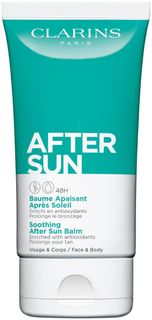
Works for
1 of 1 advertised claim delivered
Moisturizing11 ingredients credited for this claimGood support
“Aloe Vera: Hydrates and calms sun-stressed skin.”
This product can help improve hydration of the skin with the two types of ingredients.
The first type is called “humectants”:
these ingredients help attract water.
When humectants are on the surface of the skin, they “pull in” the moisture from the outside environment, or from
within deeper layers of the skin. The following ingredients in this product do the job:
glycerin, trehalose.
This product also contains ingredients called “occlusives”. They help reduce the speed with which our skin loses moisture to the outside environment. These ingredients also help soften the upper layer of the skin, so it feels less tight and nicer to the touch. The following ingredients in this product do the job: butyrospermum parkii butter, dimethicone.
Can it cause trouble?
Irritancy2 strong irritants: Alcohol, ParfumMedium risk
Comedogenic1 ingredient rated 2 or more on the 0–5 pore-clogging scale1 flagged
User reviews
Be the first — your take helps the next person decide.
Ingredients
Filter by role to see what each ingredient is doing.
Water~40–60%
Cetearyl isononanoate~4.4–6.6%
- Irritation risk
- Low
An emollient that softens the skin and helps prevent moisture loss.
More about Cetearyl isononanoateGlycerin~3.3–5%
- Irritation risk
- Low
One of the best moisturizing ingredients. Naturally present in skin. It attracts water to the upper layer of the skin working as a humectant
More about GlycerinButyrospermum parkii butter~2.8–4.2%
- Irritation risk
- Low
- Comedogenicity
- 3/5
A great moisturising ingredient that softens the skin and reduces water loss from its upper layer. It also can be helpful in protecting skin from free radicals
More about Butyrospermum parkii butterAlcohol~2.1–3.1%
- Irritation risk
- High
Can be drying and contribute to skin irritation. Used in formulars to dissolve other ingredients, create a thinner product consistency or for its antibacterial properties
More about AlcoholAloe barbadensis leaf juice~1.7–2.6%
- Irritation risk
- Medium
Traditionally used to treat sunburns, dermatitis and inflammation, but evidence for its effectiveness is lacking. The extract can contain humectants that help attract water into the skin
More about Aloe barbadensis leaf juiceEthylhexyl stearate~1.5–2.2%
- Irritation risk
- Low
Helps soften the upper layer of the skin
More about Ethylhexyl stearatePentaerythrityl distearate~1.3–1.9%
Dimethicone~1.1–1.7%
- Irritation risk
- Low
A silicone that helps to reduce water loss from the surface of the skin. Can temporarily "fill in" lines and wrinkles, absorb oil, and create a nice product finish
More about DimethiconeC14-22 alcohols~0.6–1.4%
- Irritation risk
- Low
A non-drying alcohol that helps stabilize product formulations
More about C14-22 alcoholsParfum~0.4–1%
- Irritation risk
- High
An aromatic blend of unspecified and possibly irritating ingredients
More about ParfumSodium polyacrylate~0.4–0.9%
- Irritation risk
- Low
Used to create a gel-like product texture, as well as to stabilize emulsions
More about Sodium polyacrylateAluminum starch octenylsuccinate~0.15–0.65%
- Irritation risk
- Medium
Used to thicken the product's consistency
More about Aluminum starch octenylsuccinatePotassium cetyl phosphate~0.15–0.6%
- Irritation risk
- Medium
Helps oil and water mix together
More about Potassium cetyl phosphateTrehalose~0.15–0.55%
- Irritation risk
- Low
A sugar that attracts water to the upper layer of the skin
More about TrehaloseAllantoin~0.1–0.5%
- Irritation risk
- Low
Helps calm down inflammation in skin and can help reduce itching. Helps to repair the skin barrier and keep skin hydrated
More about AllantoinC12-20 alkyl glucoside~0.15–0.55%
- Irritation risk
- Medium
Helps water and oil mix together
More about C12-20 alkyl glucosideEthylhexylglycerin~0.15–0.55%
Tocopheryl acetate~0.15–0.55%
- Irritation risk
- Medium
A more stable but less bio-available form of vitamin E compared to Tocopherol. Might help moisturize and protect the skin from free radicals, but mostly used in low concentrations to stabilize other ingredients.
More about Tocopheryl acetateDimethiconol~0.15–0.55%
- Irritation risk
- Low
A silicone that makes products more spreadable and keeps skin smooth. Helps to add gloss to skin and may visually fill in fine lines/wrinkles for short time
More about DimethiconolHydroxyethylcellulose~0.1–0.45%
- Irritation risk
- Low
Used to thicken product formulations and create gel-like textures
More about HydroxyethylcelluloseSorbic acid~0.1–0.4%
Tocopherol~0.1–0.35%
- Irritation risk
- Low
Pure form of vitamin E. Can help moisturise and protect the skin from free radicals. Often used to help stabilise other ingredients or the formula itself
More about TocopherolHelianthus annuus seed extract~0.1–0.3%
- Irritation risk
- Low
Tetramethyl acetyloctahydronaphthalenes~0.05–0.25%
- Irritation risk
- Low
Pogostemon cablin oil~0.05–0.25%
- Irritation risk
- Low
1,2-hexanediol~0.1–0.35%
Caprylyl glycol~0.1–0.45%
- Irritation risk
- Medium
Helps preserve products and creates a nice product texture
More about Caprylyl glycolHelianthus annuus seed oil~0.1–0.45%
- Irritation risk
- Low
A great emollient due to its high linoleic acid content. One of the most effective plant oils in helping skin hydration and repairing skin barrier function
More about Helianthus annuus seed oilCarthamus tinctorius seedcake extract~0.1–0.35%
- Irritation risk
- Low
Citric acid~0.1–0.3%
- Irritation risk
- Medium
Can work as an exfoliant but is typically used to adjust the product pH
More about Citric acidPotassium sorbate~0.1–0.3%
Sodium benzoate~0.05–0.25%
Linalyl acetate~0.05–0.2%
- Irritation risk
- Low
Rose ketones~0.05–0.15%
- Irritation risk
- Low
Ingredient list view
Water, Cetearyl isononanoate, Glycerin, Butyrospermum parkii butter, Alcohol, Aloe barbadensis leaf juice, Ethylhexyl stearate, Pentaerythrityl distearate, Dimethicone, C14-22 alcohols, Parfum, Sodium polyacrylate, Aluminum starch octenylsuccinate, Potassium cetyl phosphate, Trehalose, Allantoin, C12-20 alkyl glucoside, Ethylhexylglycerin, Tocopheryl acetate, Dimethiconol, Hydroxyethylcellulose, Sorbic acid, Tocopherol, Helianthus annuus seed extract, Tetramethyl acetyloctahydronaphthalenes, Pogostemon cablin oil, 1,2-hexanediol, Caprylyl glycol, Helianthus annuus seed oil, Carthamus tinctorius seedcake extract, Citric acid, Potassium sorbate, Sodium benzoate, Linalyl acetate, Rose ketones
Compare prices
Retailers ranked by price — lowest first.


Sources cited in this review
Every concentration estimate and effectiveness label is anchored to one of these 13 studies and safety reviews.
- 1
- 2
- 3Final Report on the Safety Assessment of Dimethicone Copolyoljournals.sagepub.com
- 4
- 5
- 6Safety Assessment of Decyl Glucoside and Other Alkyl Glucosides as Used in Cosmeticsciteseerx.ist.psu.edu

Affiliate links · As an Amazon Associate, WIMJ earns from qualifying purchases.