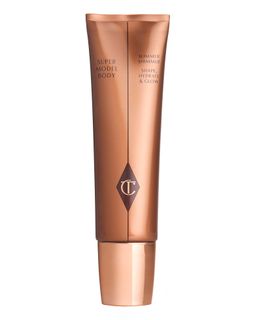
Charlotte Tilbury Supermodel Body
Works for
1 of 2 advertised claims delivered
Moisturizing15 ingredients credited for this claimGood support
“nourishing lotion”
This product can help improve hydration of the skin with the two types of ingredients.
The first type is called “humectants”:
these ingredients help attract water.
When humectants are on the surface of the skin, they “pull in” the moisture from the outside environment, or from
within deeper layers of the skin. The following ingredients in this product do the job:
glycerin, sodium hyaluronate.
This product also contains ingredients called “occlusives”. They help reduce the speed with which our skin loses moisture to the outside environment. These ingredients also help soften the upper layer of the skin, so it feels less tight and nicer to the touch. The following ingredients in this product do the job: caprylic/capric triglyceride, dimethicone.
Anti-aging3 ingredients credited for this claimWeak support
“firming 'FermiProtect'”
Effective ingredients missing or their concentration is too low.
Can it cause trouble?
Irritancy9 strong irritants: Alcohol denat., Menthyl lactate + 7 more — patch-test recommendedHigh risk
Comedogenic1 ingredient rated 2 or more on the 0–5 pore-clogging scale1 flagged
User reviews
Be the first — your take helps the next person decide.
Ingredients
Filter by role to see what each ingredient is doing.
Water~45–55%
Caprylic/capric triglyceride~5.5–6.7%
- Irritation risk
- Medium
A good mix of fatty acids that forms a protective layer on the skin. Improves the shelf life of products. Derived from coconut and glycerin
More about Caprylic/capric triglycerideButylene glycol~4.3–5.3%
- Irritation risk
- Low
Used to create a nice product texture and help delivery of other ingredients. Might be somewhat helpful in attracting water to the upper layer of the skin
More about Butylene glycolDimethicone~3.3–4.1%
- Irritation risk
- Low
A silicone that helps to reduce water loss from the surface of the skin. Can temporarily "fill in" lines and wrinkles, absorb oil, and create a nice product finish
More about DimethiconeMica~2.5–3.1%
- Irritation risk
- Low
Creates an illusion of smoother and more radiant skin tone. Adds shimmer to the skin by reflecting light
More about MicaGlycerin~2.1–2.6%
- Irritation risk
- Low
One of the best moisturizing ingredients. Naturally present in skin. It attracts water to the upper layer of the skin working as a humectant
More about GlycerinGlyceryl stearate~1.8–2.2%
- Irritation risk
- Low
An emollient that softens the skin and forms a protective layer on its surface. Helps water and oil mix together
More about Glyceryl stearatePeg-100 stearate~1.6–1.9%
- Irritation risk
- Low
Helps oil and water mix togehter and creates a nice product texture
More about Peg-100 stearateAlcohol denat.~1.2–1.5%
- Irritation risk
- High
Produces temporary toning effect. Can help dissolve other ingredients or preserve products
More about Alcohol denat.Cetearyl alcohol~1.1–1.3%
- Irritation risk
- Low
- Comedogenicity
- 2/5
A non-drying alcohol. Works as an emollient. Helps water and oil mix together and creates a nice product texture
More about Cetearyl alcoholTitanium dioxide~1.1–1.3%
- Irritation risk
- Low
Works as a UV filter when used in high concentrations. It is photostable and is effective mostly against the UVB light, with some protection in the UVA range. In small concentrations, used for its ability to improve the color of cosmetic products. Is usually well tolerated by the skin
More about Titanium dioxideMenthyl lactate~0.6–0.9%
Phenoxyethanol~0.5–0.8%
- Irritation risk
- Low
A preservative. It helps prevent bacterial growth in cosmetic products
More about PhenoxyethanolHydroxyethylcellulose~0.5–0.75%
- Irritation risk
- Low
Used to thicken product formulations and create gel-like textures
More about HydroxyethylcelluloseCaramel~0.45–0.7%
- Irritation risk
- Low
Ethylhexylglycerin~0.45–0.7%
Carbomer~0.45–0.65%
- Irritation risk
- Low
Helps create a thicker or gel-like product texture. It is not a surfactant but can be used in gentle cleansing formulations
More about CarbomerIron oxides~0.45–0.65%
- Irritation risk
- Low
An umbrella term for the following three colorants: CI 77491, CI 77492, CI 77499. They might be able to offer some protection against visible light, but the degree of the protection is not clear
More about Iron oxidesXanthan gum~0.35–0.6%
- Irritation risk
- Low
Used to create a thicker product consistency
More about Xanthan gumSilica~0.5–0.7%
Hydrolyzed viola tricolor extract~0.3–0.55%
- Irritation risk
- High
Might have some moisturizing and anti-inflammatory properties. Can be added to products to create a nice smell.
More about Hydrolyzed viola tricolor extractAllantoin~0.25–0.5%
- Irritation risk
- Low
Helps calm down inflammation in skin and can help reduce itching. Helps to repair the skin barrier and keep skin hydrated
More about AllantoinCaffeine~0.25–0.5%
- Irritation risk
- Medium
Might be helpful in neutralizing free radicals. Can have a dehydration effect that might somewhat decrease the look of puffy eyes
More about CaffeineDisodium edta~0.25–0.5%
Menthol~0.25–0.45%
- Irritation risk
- High
Camellia oleifera seed oil~0.3–0.55%
- Irritation risk
- Medium
An emollient that does not leave a greasy finish
More about Camellia oleifera seed oilRosa canina fruit oil~0.3–0.55%
- Irritation risk
- Medium
A great emollient. Contains vitamin E (tocopherol) which may give it some anti-oxidant properties. Can contain volatile compounds and can be irritating
More about Rosa canina fruit oilIron oxides~0.25–0.45%
- Irritation risk
- Low
An umbrella term for the following three colorants: CI 77491, CI 77492, CI 77499. They might be able to offer some protection against visible light, but the degree of the protection is not clear
More about Iron oxidesSodium hydroxide~0.25–0.5%
Iron oxides~0.25–0.45%
- Irritation risk
- Low
An umbrella term for the following three colorants: CI 77491, CI 77492, CI 77499. They might be able to offer some protection against visible light, but the degree of the protection is not clear
More about Iron oxidesRosa damascena extract~0.25–0.5%
- Irritation risk
- High
Oil of a very fragrant pink rose used as fragrance in cosmetics. Extensive research has shown it has mixed benefits. In the pro column, inhaling this flower’s scent seems to have relaxing properties and the plant’s petals contain skin-soothing and antioxidant compounds that can benefit skin. On the flipside, the numerous chemicals that create this rose’s distinctive fragrance pose a risk of causing skin aggravation.
More about Rosa damascena extractPeg-8~0.3–0.55%
- Irritation risk
- Medium
Used to create a nice product consistency
More about Peg-8Aloe barbadensis leaf juice powder~0.25–0.5%
- Irritation risk
- Medium
Traditionally used to treat sunburns, dermatitis and inflammation, but evidence for its effectiveness is lacking. The extract can contain humectants that help attract water into the skin
More about Aloe barbadensis leaf juice powderMichelia alba leaf oil~0.25–0.45%
- Irritation risk
- High
An essential oil used in cosmetics for its smell. Can be irritating
More about Michelia alba leaf oilSodium hyaluronate~0.25–0.5%
- Irritation risk
- Low
One of the best moisturizing ingredients. Attracts water into the upper layer of the skin
More about Sodium hyaluronateTocopherol~0.25–0.45%
- Irritation risk
- Low
Pure form of vitamin E. Can help moisturise and protect the skin from free radicals. Often used to help stabilise other ingredients or the formula itself
More about TocopherolPentylene glycol~0.3–0.55%
- Irritation risk
- Medium
Used to preserve products, dissolve other ingredients and create a nice product texture
More about Pentylene glycolLentinus edodes extract~0.25–0.45%
- Irritation risk
- Low
Tin oxide~0.4–0.6%
- Irritation risk
- Low
A colorant that can add a pearl-like appearance to the formulation
More about Tin oxideAscorbyl palmitate~0.2–0.35%
- Irritation risk
- Medium
Being a lipid soluble form of vitamin C, it is more stable and can penetrate the skin better than L-Ascorbic acid. It is effective in protecting the skin from free radicals, as well as evening the skin tone, but is less effective in stimulating collagen production compared to L-Ascorbic acid.
More about Ascorbyl palmitateAscorbic acid~0.15–0.3%
- Irritation risk
- High
The most well-researched antioxidant that works in skin. Helps neutralize free radicals supporting collagen production, helping to even out the skin tone and preventing early signs of aging
More about Ascorbic acidCitric acid~0.2–0.35%
- Irritation risk
- Medium
Can work as an exfoliant but is typically used to adjust the product pH
More about Citric acidLinalool~0.15–0.3%
Citronellol~0.1–0.2%
Geraniol~0.1–0.2%
Ingredient list view
Water, Caprylic/capric triglyceride, Butylene glycol, Dimethicone, Mica, Glycerin, Glyceryl stearate, Peg-100 stearate, Alcohol denat., Cetearyl alcohol, Titanium dioxide, Menthyl lactate, Phenoxyethanol, Hydroxyethylcellulose, Caramel, Ethylhexylglycerin, Carbomer, Iron oxides, Xanthan gum, Silica, Hydrolyzed viola tricolor extract, Allantoin, Caffeine, Disodium edta, Menthol, Camellia oleifera seed oil, Rosa canina fruit oil, Iron oxides, Sodium hydroxide, Iron oxides, Rosa damascena extract, Peg-8, Aloe barbadensis leaf juice powder, Michelia alba leaf oil, Sodium hyaluronate, Tocopherol, Pentylene glycol, Lentinus edodes extract, Tin oxide, Ascorbyl palmitate, Ascorbic acid, Citric acid, Linalool, Citronellol, Geraniol
Compare prices
Retailers ranked by price — lowest first.
Affiliate links · prices updated regularly · As an Amazon Associate, WIMJ earns from qualifying purchases.
Sources cited in this review
Every concentration estimate and effectiveness label is anchored to one of these 10 studies and safety reviews.
- 1
- 2Final Report on the Safety Assessment of Dimethicone Copolyoljournals.sagepub.com
- 3
- 4
- 5Hyaluronic acid: A key molecule in skin agingncbi.nlm.nih.gov
- 6

Affiliate links · As an Amazon Associate, WIMJ earns from qualifying purchases.