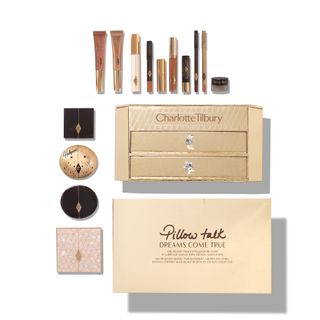
Charlotte Tilbury Pillow Talk Dreams Come True
Works for
1 of 1 advertised claim delivered
Moisturizing44 ingredients credited for this claimStrong support
“NEW IN , DR JART This velvety cream delivers a burst of long-lasting hydration whilst protecting the skin barrier. SHOP NOW”
This product can help improve hydration of the skin with the two types of ingredients.
The first type is called “humectants”:
these ingredients help attract water.
When humectants are on the surface of the skin, they “pull in” the moisture from the outside environment, or from
within deeper layers of the skin. The following ingredients in this product do the job:
galactoarabinan, glycerin.
This product also contains ingredients called “occlusives”. They help reduce the speed with which our skin loses moisture to the outside environment. These ingredients also help soften the upper layer of the skin, so it feels less tight and nicer to the touch. The following ingredients in this product do the job: cera microcristallina, copernicia cerifera wax.
The following ingredients in this product are especially good for supporting the skin barrier and helping with the hydration level: palmitoyl tetrapeptide-7, palmitoyl tripeptide-1
Anti-oxidationNot advertised by the brand · 10 ingredients credited for this claimStrong support
This product contains antioxidants (camellia oleifera leaf extract) that can help neutralize free radicals in skin. By doing so, they can lessen the damage the skin gets from the UV light (sun).
Anti-agingNot advertised by the brand · 8 ingredients credited for this claimModerate support
This product contains palmitoyl tetrapeptide-7, palmitoyl tripeptide-1. These ingredients might be able to help reduce and prevent fine lines and wrinkles, improve skin elasticity and firmness, but there is not enough evidence that it actually works.
Can it cause trouble?
Irritancy10 strong irritants: Ethyl vanillin, Carica papaya fruit extract + 8 more — patch-test recommendedHigh risk
Comedogenic7 ingredients rated 2 or more on the 0–5 pore-clogging scale7 flagged
User reviews
Be the first — your take helps the next person decide.
Ingredients
Filter by role to see what each ingredient is doing.
Neopentyl glycol dicaprylate/dicaprate~22–33%
- Irritation risk
- Low
Trimethylolpropane triisostearate~6.1–9.2%
- Irritation risk
- Low
Dimethicone~5.4–8.1%
- Irritation risk
- Low
A silicone that helps to reduce water loss from the surface of the skin. Can temporarily "fill in" lines and wrinkles, absorb oil, and create a nice product finish
More about DimethiconeMicrocrystalline wax~4–6.1%
Cera microcristallina~3.3–5%
- Irritation risk
- Low
Helps to soften the upper layer of the skin, reduce water loss from its surface and create a thicker product consistency
More about Cera microcristallinaPolyethylene~2.7–4.1%
Polybutene~1.9–2.9%
Dimethicone crosspolymer~1.6–2.3%
- Irritation risk
- Low
Used to create a thicker product texture. Helps soften the upper layer of the skin and might be able to prevent moisture loss from its surface
More about Dimethicone crosspolymerSilica~1.6–2.4%
Mica~1.2–1.9%
- Irritation risk
- Low
Creates an illusion of smoother and more radiant skin tone. Adds shimmer to the skin by reflecting light
More about MicaDicalcium phosphate~1.2–1.9%
- Irritation risk
- Low
Ethyl vanillin~0.55–1.35%
Caprylic/capric triglyceride~0.85–1.25%
- Irritation risk
- Medium
A good mix of fatty acids that forms a protective layer on the skin. Improves the shelf life of products. Derived from coconut and glycerin
More about Caprylic/capric triglycerideTocopherol~0.55–1.25%
- Irritation risk
- Low
Pure form of vitamin E. Can help moisturise and protect the skin from free radicals. Often used to help stabilise other ingredients or the formula itself
More about TocopherolCarthamus tinctorius seed oil~0.55–1.3%
- Irritation risk
- Low
An emollient that helps soften the skin and might help calm down inflammation
More about Carthamus tinctorius seed oilZea mays oil~0.45–1.1%
- Irritation risk
- Low
- Comedogenicity
- 3/5
A good moisturizing plant oil. Due to the high linoleic acid content, it helps soften the upper layer of the skin, reduce water loss and support skin barrier function
More about Zea mays oilPentaerythrityl tetra-di-t-butyl hydroxyhydrocinnamate~0.5–1.2%
- Irritation risk
- Low
Used to increase stability of product formulations
More about Pentaerythrityl tetra-di-t-butyl hydroxyhydrocinnamateCarica papaya fruit extract~0.45–1.1%
- Irritation risk
- High
Phalaenopsis amabilis extract~0.45–1.05%
- Irritation risk
- Low
Bixa orellana seed extract~0.45–1%
- Irritation risk
- Low
Tocopheryl acetate~0.4–1%
- Irritation risk
- Medium
A more stable but less bio-available form of vitamin E compared to Tocopherol. Might help moisturize and protect the skin from free radicals, but mostly used in low concentrations to stabilize other ingredients.
More about Tocopheryl acetateTin oxide~0.5–1.2%
- Irritation risk
- Low
A colorant that can add a pearl-like appearance to the formulation
More about Tin oxideTitanium dioxide~0.45–1.05%
- Irritation risk
- Low
Works as a UV filter when used in high concentrations. It is photostable and is effective mostly against the UVB light, with some protection in the UVA range. In small concentrations, used for its ability to improve the color of cosmetic products. Is usually well tolerated by the skin
More about Titanium dioxideCi 77891~0.35–0.85%
- Irritation risk
- Low
Iron oxides~0.35–0.85%
- Irritation risk
- Low
An umbrella term for the following three colorants: CI 77491, CI 77492, CI 77499. They might be able to offer some protection against visible light, but the degree of the protection is not clear
More about Iron oxidesCi 15850~0.4–0.9%
Blue 1 lake~0.4–0.9%
Ci 42090~0.4–0.9%
Ci 75470~0.4–0.9%
Cream~0.45–1%
- Irritation risk
- Low
Water~0.4–0.9%
Homosalate~0.5–1.15%
- Irritation risk
- Medium
A weak sunscreen that offers some protection against the sun rays that cause sunburn (UVB), but does not offer meaningful protection against protect against the most aging sun rays (UVA). It loses its effectiveness quickly when exposed to sunlight. It is an organic, or so called "chemical" sunscreen. When used in low concentrations, helps to stabilize the product formulation
More about HomosalateGlyceryl stearate se~0.4–0.95%
- Irritation risk
- Low
- Comedogenicity
- 2/5
Used to stabilize the product formulations and works as an emollient
More about Glyceryl stearate seEthylhexyl salicylate~0.5–1.15%
- Irritation risk
- Low
Octisalate. A UV filter. It offers some protection against the sun rays that cause sunburn (UVB), but does not protect against the most aging sun rays (UVA). It loses its effectiveness quickly when exposed to sunlight. It is an organic, or so called "chemical" sunscreen
More about Ethylhexyl salicylateButylene glycol~0.4–0.9%
- Irritation risk
- Low
Used to create a nice product texture and help delivery of other ingredients. Might be somewhat helpful in attracting water to the upper layer of the skin
More about Butylene glycolGlycerin~0.4–0.95%
- Irritation risk
- Low
One of the best moisturizing ingredients. Naturally present in skin. It attracts water to the upper layer of the skin working as a humectant
More about GlycerinButyl methoxydibenzoylmethane~0.5–1.15%
- Irritation risk
- Medium
Avobenzone. An organic, or so-called "chemical" UV filter. Protects against both UVA and UVB rays. Needs to be combined with other filters in a formulation to be stable.
More about Butyl methoxydibenzoylmethaneOctocrylene~0.5–1.15%
- Irritation risk
- Medium
A weak sunscreen that protects against the sun rays that cause sunburn (UVB) and is somewhat effective against the UVA rays. It is quite stable and can help stabilize other, more vulnerable, sunscreen ingredients like Avobenzone. It is an organic, or so called "chemical" sunscreen
More about OctocryleneCetyl alcohol~0.45–1.05%
- Irritation risk
- Low
A non-drying alcohol that works to soften the skin and stabilize product formulations helping oil and water mix together
More about Cetyl alcoholC12-15 alkyl benzoate~0.45–1%
- Irritation risk
- Low
Enhances the product texture and makes it more spreadable. Helps reduce water loss from the outer layer of skin. Extands the shelf life by preventing bacteria growth
More about C12-15 alkyl benzoateCyclopentasiloxane~0.45–1.05%
- Irritation risk
- Low
A silicone that helps improve the product texture and spreadability. Can absorb oil creating a short-term mattifying effect on the skin
More about CyclopentasiloxaneDimethicone~0.45–1.05%
- Irritation risk
- Low
A silicone that helps to reduce water loss from the surface of the skin. Can temporarily "fill in" lines and wrinkles, absorb oil, and create a nice product finish
More about DimethiconePhenoxyethanol~0.4–0.95%
- Irritation risk
- Low
A preservative. It helps prevent bacterial growth in cosmetic products
More about PhenoxyethanolButyrospermum parkii butter~0.45–1.05%
- Irritation risk
- Low
- Comedogenicity
- 3/5
A great moisturising ingredient that softens the skin and reduces water loss from its upper layer. It also can be helpful in protecting skin from free radicals
More about Butyrospermum parkii butterSteareth-21~0.45–1.05%
Avena sativa kernel extract~0.45–1%
- Irritation risk
- Low
An effective moisturizing and skin barrier repair ingredient. Helps calm down inflammation and has some anti-oxidant properties
More about Avena sativa kernel extractCarbomer~0.4–0.9%
- Irritation risk
- Low
Helps create a thicker or gel-like product texture. It is not a surfactant but can be used in gentle cleansing formulations
More about CarbomerDimethiconol~0.45–1.05%
- Irritation risk
- Low
A silicone that makes products more spreadable and keeps skin smooth. Helps to add gloss to skin and may visually fill in fine lines/wrinkles for short time
More about DimethiconolPotassium cetyl phosphate~0.4–0.95%
- Irritation risk
- Medium
Helps oil and water mix together
More about Potassium cetyl phosphateChlorphenesin~0.16–0.32%
Caprylyl glycol~0.45–1%
- Irritation risk
- Medium
Helps preserve products and creates a nice product texture
More about Caprylyl glycolXanthan gum~0.4–0.9%
- Irritation risk
- Low
Used to create a thicker product consistency
More about Xanthan gumHydrolyzed viola tricolor extract~0.4–0.9%
- Irritation risk
- High
Might have some moisturizing and anti-inflammatory properties. Can be added to products to create a nice smell.
More about Hydrolyzed viola tricolor extractAllantoin~0.35–0.85%
- Irritation risk
- Low
Helps calm down inflammation in skin and can help reduce itching. Helps to repair the skin barrier and keep skin hydrated
More about AllantoinAloe barbadensis leaf juice~0.4–0.9%
- Irritation risk
- Medium
Traditionally used to treat sunburns, dermatitis and inflammation, but evidence for its effectiveness is lacking. The extract can contain humectants that help attract water into the skin
More about Aloe barbadensis leaf juiceDisodium edta~0.4–0.9%
Tocopheryl acetate~0.4–0.95%
- Irritation risk
- Medium
A more stable but less bio-available form of vitamin E compared to Tocopherol. Might help moisturize and protect the skin from free radicals, but mostly used in low concentrations to stabilize other ingredients.
More about Tocopheryl acetateCamellia oleifera seed oil~0.45–1.05%
- Irritation risk
- Medium
An emollient that does not leave a greasy finish
More about Camellia oleifera seed oilRosa canina fruit oil~0.45–1.05%
- Irritation risk
- Medium
A great emollient. Contains vitamin E (tocopherol) which may give it some anti-oxidant properties. Can contain volatile compounds and can be irritating
More about Rosa canina fruit oilRosa damascena extract~0.4–0.9%
- Irritation risk
- High
Oil of a very fragrant pink rose used as fragrance in cosmetics. Extensive research has shown it has mixed benefits. In the pro column, inhaling this flower’s scent seems to have relaxing properties and the plant’s petals contain skin-soothing and antioxidant compounds that can benefit skin. On the flipside, the numerous chemicals that create this rose’s distinctive fragrance pose a risk of causing skin aggravation.
More about Rosa damascena extractSodium hydroxide~0.4–0.9%
Helianthus annuus seed oil~0.45–1%
- Irritation risk
- Low
A great emollient due to its high linoleic acid content. One of the most effective plant oils in helping skin hydration and repairing skin barrier function
More about Helianthus annuus seed oilMichelia alba leaf oil~0.35–0.85%
- Irritation risk
- High
An essential oil used in cosmetics for its smell. Can be irritating
More about Michelia alba leaf oilSodium lactate~0.4–0.9%
- Irritation risk
- Medium
Helps attract water to the upper layer of the skin. Is often used to adjust the pH level of the product
More about Sodium lactateCoco-glucoside~0.45–1%
- Irritation risk
- High
Used as a cleansing agent (surfactant) in cleansers. Helps water and oil mix together in lotions. Can be irritating
More about Coco-glucosidePeg-8~0.4–0.9%
- Irritation risk
- Medium
Used to create a nice product consistency
More about Peg-8Ethylhexylglycerin~0.4–0.9%
Sodium hyaluronate~0.4–0.9%
- Irritation risk
- Low
One of the best moisturizing ingredients. Attracts water into the upper layer of the skin
More about Sodium hyaluronateTocopherol~0.4–0.9%
- Irritation risk
- Low
Pure form of vitamin E. Can help moisturise and protect the skin from free radicals. Often used to help stabilise other ingredients or the formula itself
More about TocopherolPalmitoyl tetrapeptide-7~0.45–1.05%
- Irritation risk
- Low
A type of peptide. Peptides are excellent moisturizers and might be able support collagen production reducing fine lines and wrinkles
More about Palmitoyl tetrapeptide-7Palmitoyl tripeptide-1~0.45–1.05%
- Irritation risk
- Low
A type of peptide. Peptides are excellent moisturizers and might be able support collagen production reducing fine lines and wrinkles
More about Palmitoyl tripeptide-1Ascorbyl palmitate~0.4–0.95%
- Irritation risk
- Medium
Being a lipid soluble form of vitamin C, it is more stable and can penetrate the skin better than L-Ascorbic acid. It is effective in protecting the skin from free radicals, as well as evening the skin tone, but is less effective in stimulating collagen production compared to L-Ascorbic acid.
More about Ascorbyl palmitatePlumeria rubra flower extract~0.35–0.85%
- Irritation risk
- High
Used to add a nice smell to the product. Can be irritating
More about Plumeria rubra flower extractAscorbic acid~0.4–0.9%
- Irritation risk
- High
The most well-researched antioxidant that works in skin. Helps neutralize free radicals supporting collagen production, helping to even out the skin tone and preventing early signs of aging
More about Ascorbic acidCitric acid~0.4–0.9%
- Irritation risk
- Medium
Can work as an exfoliant but is typically used to adjust the product pH
More about Citric acidNicotiana sylvestris leaf cell culture~0.45–1%
- Irritation risk
- Medium
Has been claimed to have an ability to protect collagen and stimulate its production in skin but further research is lacking so far
More about Nicotiana sylvestris leaf cell cultureLinalool~0.35–0.85%
Citronellol~0.35–0.85%
Geraniol~0.35–0.85%
Cream~0.45–1%
- Irritation risk
- Low
Water~0.4–0.9%
C12-15 alkyl benzoate~0.45–1%
- Irritation risk
- Low
Enhances the product texture and makes it more spreadable. Helps reduce water loss from the outer layer of skin. Extands the shelf life by preventing bacteria growth
More about C12-15 alkyl benzoateGlyceryl stearate se~0.4–0.95%
- Irritation risk
- Low
- Comedogenicity
- 2/5
Used to stabilize the product formulations and works as an emollient
More about Glyceryl stearate seButylene glycol~0.4–0.9%
- Irritation risk
- Low
Used to create a nice product texture and help delivery of other ingredients. Might be somewhat helpful in attracting water to the upper layer of the skin
More about Butylene glycolGlycerin~0.4–0.95%
- Irritation risk
- Low
One of the best moisturizing ingredients. Naturally present in skin. It attracts water to the upper layer of the skin working as a humectant
More about GlycerinOlus oil~0.45–1.05%
- Irritation risk
- Low
An oil from a mixture of different vegetables. Helps soften the upper layer of the skin
More about Olus oilVegetable oil~0.45–1.05%
- Irritation risk
- Low
An oil from a mixture of different vegetables. Helps soften the upper layer of the skin
More about Vegetable oilIsononyl isononanoate~0.45–1%
- Irritation risk
- Low
Forms a protective film on the surface of the skin to prevent moisture loss. Gives a velvety feel to products while reducing tackiness
More about Isononyl isononanoateCetyl alcohol~0.45–1.05%
- Irritation risk
- Low
A non-drying alcohol that works to soften the skin and stabilize product formulations helping oil and water mix together
More about Cetyl alcoholEthylhexyl palmitate~0.45–1.05%
- Irritation risk
- Low
- Comedogenicity
- 3/5
An emollient that helps soften the skin and create a nice product texture
More about Ethylhexyl palmitateCyclopentasiloxane~0.45–1.05%
- Irritation risk
- Low
A silicone that helps improve the product texture and spreadability. Can absorb oil creating a short-term mattifying effect on the skin
More about CyclopentasiloxaneDimethicone~0.45–1.05%
- Irritation risk
- Low
A silicone that helps to reduce water loss from the surface of the skin. Can temporarily "fill in" lines and wrinkles, absorb oil, and create a nice product finish
More about DimethiconePolyester-7~0.5–1.15%
- Irritation risk
- Low
Phenoxyethanol~0.4–0.95%
- Irritation risk
- Low
A preservative. It helps prevent bacterial growth in cosmetic products
More about PhenoxyethanolNeopentyl glycol diheptanoate~0.45–1%
- Irritation risk
- Low
Helps soften the upper layer of the skin and create a nice product consistency
More about Neopentyl glycol diheptanoateButyrospermum parkii butter~0.45–1.05%
- Irritation risk
- Low
- Comedogenicity
- 3/5
A great moisturising ingredient that softens the skin and reduces water loss from its upper layer. It also can be helpful in protecting skin from free radicals
More about Butyrospermum parkii butterSteareth-21~0.45–1.05%
Avena sativa kernel extract~0.45–1%
- Irritation risk
- Low
An effective moisturizing and skin barrier repair ingredient. Helps calm down inflammation and has some anti-oxidant properties
More about Avena sativa kernel extractCarbomer~0.4–0.9%
- Irritation risk
- Low
Helps create a thicker or gel-like product texture. It is not a surfactant but can be used in gentle cleansing formulations
More about CarbomerDimethiconol~0.45–1.05%
- Irritation risk
- Low
A silicone that makes products more spreadable and keeps skin smooth. Helps to add gloss to skin and may visually fill in fine lines/wrinkles for short time
More about DimethiconolPotassium cetyl phosphate~0.4–0.95%
- Irritation risk
- Medium
Helps oil and water mix together
More about Potassium cetyl phosphateChlorphenesin~0.16–0.32%
Caprylyl glycol~0.45–1%
- Irritation risk
- Medium
Helps preserve products and creates a nice product texture
More about Caprylyl glycolXanthan gum~0.4–0.9%
- Irritation risk
- Low
Used to create a thicker product consistency
More about Xanthan gumHydrolyzed viola tricolor extract~0.4–0.9%
- Irritation risk
- High
Might have some moisturizing and anti-inflammatory properties. Can be added to products to create a nice smell.
More about Hydrolyzed viola tricolor extractAllantoin~0.35–0.85%
- Irritation risk
- Low
Helps calm down inflammation in skin and can help reduce itching. Helps to repair the skin barrier and keep skin hydrated
More about AllantoinAloe barbadensis leaf juice~0.4–0.9%
- Irritation risk
- Medium
Traditionally used to treat sunburns, dermatitis and inflammation, but evidence for its effectiveness is lacking. The extract can contain humectants that help attract water into the skin
More about Aloe barbadensis leaf juiceDisodium edta~0.4–0.9%
Tocopheryl acetate~0.4–0.95%
- Irritation risk
- Medium
A more stable but less bio-available form of vitamin E compared to Tocopherol. Might help moisturize and protect the skin from free radicals, but mostly used in low concentrations to stabilize other ingredients.
More about Tocopheryl acetateCamellia oleifera seed oil~0.45–1.05%
- Irritation risk
- Medium
An emollient that does not leave a greasy finish
More about Camellia oleifera seed oilRosa canina fruit oil~0.45–1.05%
- Irritation risk
- Medium
A great emollient. Contains vitamin E (tocopherol) which may give it some anti-oxidant properties. Can contain volatile compounds and can be irritating
More about Rosa canina fruit oilRosa damascena extract~0.4–0.9%
- Irritation risk
- High
Oil of a very fragrant pink rose used as fragrance in cosmetics. Extensive research has shown it has mixed benefits. In the pro column, inhaling this flower’s scent seems to have relaxing properties and the plant’s petals contain skin-soothing and antioxidant compounds that can benefit skin. On the flipside, the numerous chemicals that create this rose’s distinctive fragrance pose a risk of causing skin aggravation.
More about Rosa damascena extractSodium hydroxide~0.4–0.9%
Helianthus annuus seed oil~0.45–1%
- Irritation risk
- Low
A great emollient due to its high linoleic acid content. One of the most effective plant oils in helping skin hydration and repairing skin barrier function
More about Helianthus annuus seed oilMichelia alba leaf oil~0.35–0.85%
- Irritation risk
- High
An essential oil used in cosmetics for its smell. Can be irritating
More about Michelia alba leaf oilSodium lactate~0.4–0.9%
- Irritation risk
- Medium
Helps attract water to the upper layer of the skin. Is often used to adjust the pH level of the product
More about Sodium lactateCoco-glucoside~0.45–1%
- Irritation risk
- High
Used as a cleansing agent (surfactant) in cleansers. Helps water and oil mix together in lotions. Can be irritating
More about Coco-glucosidePeg-8~0.4–0.9%
- Irritation risk
- Medium
Used to create a nice product consistency
More about Peg-8Ethylhexylglycerin~0.4–0.9%
Sodium hyaluronate~0.4–0.9%
- Irritation risk
- Low
One of the best moisturizing ingredients. Attracts water into the upper layer of the skin
More about Sodium hyaluronateTocopherol~0.4–0.9%
- Irritation risk
- Low
Pure form of vitamin E. Can help moisturise and protect the skin from free radicals. Often used to help stabilise other ingredients or the formula itself
More about TocopherolPalmitoyl tetrapeptide-7~0.45–1.05%
- Irritation risk
- Low
A type of peptide. Peptides are excellent moisturizers and might be able support collagen production reducing fine lines and wrinkles
More about Palmitoyl tetrapeptide-7Palmitoyl tripeptide-1~0.45–1.05%
- Irritation risk
- Low
A type of peptide. Peptides are excellent moisturizers and might be able support collagen production reducing fine lines and wrinkles
More about Palmitoyl tripeptide-1Ascorbyl palmitate~0.4–0.95%
- Irritation risk
- Medium
Being a lipid soluble form of vitamin C, it is more stable and can penetrate the skin better than L-Ascorbic acid. It is effective in protecting the skin from free radicals, as well as evening the skin tone, but is less effective in stimulating collagen production compared to L-Ascorbic acid.
More about Ascorbyl palmitatePlumeria rubra flower extract~0.35–0.85%
- Irritation risk
- High
Used to add a nice smell to the product. Can be irritating
More about Plumeria rubra flower extractAscorbic acid~0.4–0.9%
- Irritation risk
- High
The most well-researched antioxidant that works in skin. Helps neutralize free radicals supporting collagen production, helping to even out the skin tone and preventing early signs of aging
More about Ascorbic acidCitric acid~0.4–0.9%
- Irritation risk
- Medium
Can work as an exfoliant but is typically used to adjust the product pH
More about Citric acidNicotiana sylvestris leaf cell culture~0.45–1%
- Irritation risk
- Medium
Has been claimed to have an ability to protect collagen and stimulate its production in skin but further research is lacking so far
More about Nicotiana sylvestris leaf cell cultureLinalool~0.35–0.85%
Citronellol~0.35–0.85%
Geraniol~0.35–0.85%
Lac~0.4–0.9%
- Irritation risk
- Low
Helps form a film on the surface of the skin and disperse other ingredients (like colorants) in cosmetics. Lac is a resinous substance secreted by parasite insects living on trees
More about LacWater~0.4–0.9%
Cera microcristallina~0.45–1.05%
- Irritation risk
- Low
Helps to soften the upper layer of the skin, reduce water loss from its surface and create a thicker product consistency
More about Cera microcristallinaMicrocrystalline wax~0.4–0.95%
Cera microcristallina~0.45–1.05%
- Irritation risk
- Low
Helps to soften the upper layer of the skin, reduce water loss from its surface and create a thicker product consistency
More about Cera microcristallinaCopernicia cerifera cera~0.55–1.25%
- Irritation risk
- Low
Brazilian palm wax. Helps soften the upper layer of the skin
More about Copernicia cerifera ceraCopernicia cerifera wax~0.5–1.1%
- Irritation risk
- Low
Helps to soften the upper layer of the skin and create a nice product consistency
More about Copernicia cerifera waxGlyceryl stearate~0.45–1.05%
- Irritation risk
- Low
An emollient that softens the skin and forms a protective layer on its surface. Helps water and oil mix together
More about Glyceryl stearateAcrylates copolymer~0.5–1.15%
- Irritation risk
- Medium
Used to stabilize product formulation, help create an even product layer over skin (for example, in sunscreen) and create a thicker product consistency
More about Acrylates copolymerStearic acid~0.5–1.15%
- Irritation risk
- Low
Helps oil and water mix together and works as an emollient
More about Stearic acidHydrogenated vegetable oil~0.45–1%
- Irritation risk
- Low
- Comedogenicity
- 2/5
An oil from a mixture of different vegetables. Helps soften the upper layer of the skin
More about Hydrogenated vegetable oilPalmitic acid~0.45–1.05%
- Irritation risk
- Low
An emollient that is naturally present in skin and helps soften it
More about Palmitic acidButylene glycol~0.4–0.9%
- Irritation risk
- Low
Used to create a nice product texture and help delivery of other ingredients. Might be somewhat helpful in attracting water to the upper layer of the skin
More about Butylene glycolRicinus communis seed oil~0.45–1%
- Irritation risk
- Medium
A plant oil that can help soften the skin. It might be helpful in calming down inflammation, but solid research is lacking. Is often used in lip products to create the needed product consistency
More about Ricinus communis seed oilStearyl stearate~0.45–1%
- Irritation risk
- Low
Aminomethyl propanol~0.4–0.9%
Caprylyl glycol~0.45–1%
- Irritation risk
- Medium
Helps preserve products and creates a nice product texture
More about Caprylyl glycolPhenoxyethanol~0.4–0.95%
- Irritation risk
- Low
A preservative. It helps prevent bacterial growth in cosmetic products
More about PhenoxyethanolGalactoarabinan~0.5–1.1%
- Irritation risk
- Medium
Helps attract water to the upper layer of the skin
More about GalactoarabinanSodium dehydroacetate~0.3–0.6%
Tocopheryl acetate~0.4–0.95%
- Irritation risk
- Medium
A more stable but less bio-available form of vitamin E compared to Tocopherol. Might help moisturize and protect the skin from free radicals, but mostly used in low concentrations to stabilize other ingredients.
More about Tocopheryl acetateLaurdimonium hydroxypropyl hydrolyzed keratin~0.4–0.9%
- Irritation risk
- Low
Laureth-21~0.45–1.05%
Bht~0.4–0.95%
Iron oxides~0.35–0.85%
- Irritation risk
- Low
An umbrella term for the following three colorants: CI 77491, CI 77492, CI 77499. They might be able to offer some protection against visible light, but the degree of the protection is not clear
More about Iron oxidesCi 77499~0.4–0.9%
Ultramarines~0.4–0.9%
- Irritation risk
- Low
Ci 77007~0.4–0.9%
Tin~0.4–0.9%
Water~0.4–0.9%
Amp-acrylates/allyl methacrylate copolymer~0.5–1.15%
- Irritation risk
- Low
Pvp~0.5–1.15%
- Irritation risk
- Medium
Helps evenly disperse other ingredients in a formulation and create an even layer on the surface of the skin
More about PvpPhenoxyethanol~0.4–0.9%
- Irritation risk
- Low
A preservative. It helps prevent bacterial growth in cosmetic products
More about PhenoxyethanolPentylene glycol~0.45–1.05%
- Irritation risk
- Medium
Used to preserve products, dissolve other ingredients and create a nice product texture
More about Pentylene glycolPropanediol~0.4–0.9%
- Irritation risk
- Low
Acts as a solvent for other ingredients. Speeds up the absorption of other ingredients into the skin
More about PropanediolPolysorbate 20~0.4–0.9%
Citric acid~0.35–0.85%
- Irritation risk
- Medium
Can work as an exfoliant but is typically used to adjust the product pH
More about Citric acidEthylhexylglycerin~0.35–0.85%
Aloe barbadensis leaf juice powder~0.35–0.85%
- Irritation risk
- Medium
Traditionally used to treat sunburns, dermatitis and inflammation, but evidence for its effectiveness is lacking. The extract can contain humectants that help attract water into the skin
More about Aloe barbadensis leaf juice powderParfum~0.3–0.7%
- Irritation risk
- High
An aromatic blend of unspecified and possibly irritating ingredients
More about ParfumPotassium sorbate~0.3–0.6%
Glycerin~0.35–0.8%
- Irritation risk
- Low
One of the best moisturizing ingredients. Naturally present in skin. It attracts water to the upper layer of the skin working as a humectant
More about GlycerinCaprylic/capric triglyceride~0.3–0.7%
- Irritation risk
- Medium
A good mix of fatty acids that forms a protective layer on the skin. Improves the shelf life of products. Derived from coconut and glycerin
More about Caprylic/capric triglycerideCamellia oleifera leaf extract~0.15–0.55%
- Irritation risk
- Low
A plant extract that can help neutralize free radicals and reduce inflammation, even though it is not usually used in sufficient concentration in cosmetics
More about Camellia oleifera leaf extractPistacia lentiscus gum~0.2–0.8%
- Irritation risk
- High
A tree rasin that could temporarily tighten the skin and might help regulate sebum production, but the research on its effectiveness in skin is lacking
More about Pistacia lentiscus gumHydrogenated lecithin~0.1–0.5%
- Irritation risk
- Low
Helps to retain moisture by creating a protective barrier on the skin. Rich in fatty acids. Improves product texture and helps with the penetration of other ingredients.
More about Hydrogenated lecithinLeuconostoc/radish root ferment filtrate~0.1–0.35%
- Irritation risk
- Medium
A preservative that comes from radishes fermented by a bacteria. New research suggests that the preservation properties in the ingredient come from an ammonium salt that is not present naturally in radish root but used in its cultivation. Is problematic because the exact amount of the preservative agents is difficult to determine
More about Leuconostoc/radish root ferment filtratePhenethyl alcohol~0.1–0.4%
Ingredient list view
Neopentyl glycol dicaprylate/dicaprate, Trimethylolpropane triisostearate, Dimethicone, Microcrystalline wax, Cera microcristallina, Polyethylene, Polybutene, Dimethicone crosspolymer, Silica, Mica, Dicalcium phosphate, Ethyl vanillin, Caprylic/capric triglyceride, Tocopherol, Carthamus tinctorius seed oil, Zea mays oil, Pentaerythrityl tetra-di-t-butyl hydroxyhydrocinnamate, Carica papaya fruit extract, Phalaenopsis amabilis extract, Bixa orellana seed extract, Tocopheryl acetate, Tin oxide, Titanium dioxide, Ci 77891, Iron oxides, Ci 15850, Blue 1 lake, Ci 42090, Ci 75470, Cream, Water, Homosalate, Glyceryl stearate se, Ethylhexyl salicylate, Butylene glycol, Glycerin, Butyl methoxydibenzoylmethane, Octocrylene, Cetyl alcohol, C12-15 alkyl benzoate, Cyclopentasiloxane, Dimethicone, Phenoxyethanol, Butyrospermum parkii butter, Steareth-21, Avena sativa kernel extract, Carbomer, Dimethiconol, Potassium cetyl phosphate, Chlorphenesin, Caprylyl glycol, Xanthan gum, Hydrolyzed viola tricolor extract, Allantoin, Aloe barbadensis leaf juice, Disodium edta, Tocopheryl acetate, Camellia oleifera seed oil, Rosa canina fruit oil, Rosa damascena extract, Sodium hydroxide, Helianthus annuus seed oil, Michelia alba leaf oil, Sodium lactate, Coco-glucoside, Peg-8, Ethylhexylglycerin, Sodium hyaluronate, Tocopherol, Palmitoyl tetrapeptide-7, Palmitoyl tripeptide-1, Ascorbyl palmitate, Plumeria rubra flower extract, Ascorbic acid, Citric acid, Nicotiana sylvestris leaf cell culture, Linalool, Citronellol, Geraniol, Cream, Water, C12-15 alkyl benzoate, Glyceryl stearate se, Butylene glycol, Glycerin, Olus oil, Vegetable oil, Isononyl isononanoate, Cetyl alcohol, Ethylhexyl palmitate, Cyclopentasiloxane, Dimethicone, Polyester-7, Phenoxyethanol, Neopentyl glycol diheptanoate, Butyrospermum parkii butter, Steareth-21, Avena sativa kernel extract, Carbomer, Dimethiconol, Potassium cetyl phosphate, Chlorphenesin, Caprylyl glycol, Xanthan gum, Hydrolyzed viola tricolor extract, Allantoin, Aloe barbadensis leaf juice, Disodium edta, Tocopheryl acetate, Camellia oleifera seed oil, Rosa canina fruit oil, Rosa damascena extract, Sodium hydroxide, Helianthus annuus seed oil, Michelia alba leaf oil, Sodium lactate, Coco-glucoside, Peg-8, Ethylhexylglycerin, Sodium hyaluronate, Tocopherol, Palmitoyl tetrapeptide-7, Palmitoyl tripeptide-1, Ascorbyl palmitate, Plumeria rubra flower extract, Ascorbic acid, Citric acid, Nicotiana sylvestris leaf cell culture, Linalool, Citronellol, Geraniol, Lac, Water, Cera microcristallina, Microcrystalline wax, Cera microcristallina, Copernicia cerifera cera, Copernicia cerifera wax, Glyceryl stearate, Acrylates copolymer, Stearic acid, Hydrogenated vegetable oil, Palmitic acid, Butylene glycol, Ricinus communis seed oil, Stearyl stearate, Aminomethyl propanol, Caprylyl glycol, Phenoxyethanol, Galactoarabinan, Sodium dehydroacetate, Tocopheryl acetate, Laurdimonium hydroxypropyl hydrolyzed keratin, Laureth-21, Bht, Iron oxides, Ci 77499, Ultramarines, Ci 77007, Tin, Water, Amp-acrylates/allyl methacrylate copolymer, Pvp, Phenoxyethanol, Pentylene glycol, Propanediol, Polysorbate 20, Citric acid, Ethylhexylglycerin, Aloe barbadensis leaf juice powder, Parfum, Potassium sorbate, Glycerin, Caprylic/capric triglyceride, Camellia oleifera leaf extract, Pistacia lentiscus gum, Hydrogenated lecithin, Leuconostoc/radish root ferment filtrate, Phenethyl alcohol
Compare prices
Retailers ranked by price — lowest first.
Affiliate links · prices updated regularly · As an Amazon Associate, WIMJ earns from qualifying purchases.
Product summary
Judging from the ingredient list, "Charlotte Tilbury - Pillow Talk Dreams Come True" works well for improving skin hydration This moisturizer uses a good combo of humectants and emollients. These both types of ingredients are essentials for improving the skin hydration and keeping the skin barrier healthy. Humectants in this product (galactoarabinan, glycerin, sodium hyaluronate, sodium lactate and butylene glycol) help to increase the water content in the upper layer of the skin. (These ingredients do so by "capturing" water molecules from the outside air or from within the deeper layers of the skin). Palmitoyl tetrapeptide-7, palmitoyl tripeptide-1, carthamus tinctorius seed oil, cera microcristallina and copernicia cerifera wax in this product help decrease the water evoporation from the skin, so that it stays hydrated for longer. These ingredients also soften the skin and take away the feeling of tightness and dryness.
Ingredient callouts
- This product also contains Vitamin C (Ascorbic Acid). It can be an effective active for anti-aging and evening out the skin tone, but in this moisturizer it is used for stabilizing other ingredients in the formulation. In this concentration (0.40% - 0.90%) it cannot have a noticeable benefit for the skin.
- We like that this moisturizer contains peptides (palmitoyl tripeptide-1 0.45% - 1.05%, palmitoyl tetrapeptide-7 0.45% - 1.05%, palmitoyl tripeptide-1 0.45% - 1.05% and palmitoyl tetrapeptide-7 0.45% - 1.05%). There are many different kind of Peptides and they are naturally present in our skin. They all are a combination of aminoacids. Some of them work as natural antibiotics, promote wound-healing and production of collagen. The science is still not settled on how effective Peptides are in skincare, but it is very likely that they have a benefit. Peptides might help restore the skin barrier and fight the signs of aging. At the very least, Peptides work as humectants: they attract water to the upper layer of the skin and improve its hydration.
Irritation risk
This moisturizer contains a bunch of common irritants, including ingredients that do not provide any known benefit for the skin. It might not be the best choice if your skin is sensitive. We assess the overall irritancy of this moisturizer to be high. For a detailed overview of all potential irritants: click here
You can see the detailed formula review with the breakdown of all actives in the product and the full ingredient list with estimated concentrations in the tables below.
About the brand
According to Cruelty-Free Kitty "Charlotte Tilbury" is cruelty free, but its parent company is not.
Price
The product retails for 380.00£ in the United Kingdom.
For a detailed price comparison: click here.
Sources cited in this review
Every concentration estimate and effectiveness label is anchored to one of these 28 studies and safety reviews.
- 1
- 2Final Report on the Safety Assessment of Dimethicone Copolyoljournals.sagepub.com
- 3
- 4Vitamin E in dermatologyncbi.nlm.nih.gov
- 5Vitamin E and Skin Healthlpi.oregonstate.edu
- 6Content of fatty acids in corn (Zea mays L.) oil from Ecuadorresearchgate.net

Affiliate links · As an Amazon Associate, WIMJ earns from qualifying purchases.