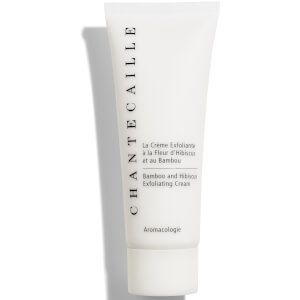
Chantecaille Hibiscus and Bamboo Exfoliating Cream
Works for
4 of 4 advertised claims delivered
Anti-aging6 ingredients credited for this claimStrong support
“Treat the skin with deep exfoliation using Chantecaille Exfoliating Cream, a botanical-packed cream that promotes the smoothing and polishing of tired, dull skin.This rich exfoliating cream hydrates deep within the skin layers, helping create a smoother, more even skin tone.Fine-textured, natural bamboo beads help the skin to shed dead cells, while plant and flower extracts promote skin radiance and a younger-looking complexion.”
This product can help reduce and prevent fine lines and wrinkles, improve skin elasticity and firmness because it contains glycolic acid.
These ingredients in the product can also be helpful, even though there is less evidence for their effectiveness: hexanoyl dipeptide-3 norleucine acetate.
Keep in mind that it typically takes at least 6 weeks to notice any results because the changes that are needed to improve fine lines and elasticity happen in the deeper layers of the skin. No topical anti-aging product can “erase” wrinkles or fully reverse signs of aging.
Exfoliation3 ingredients credited for this claimStrong support
“Hibiscus and Bamboo Exfoliating Cream”
This product can help exfoliate the skin. In other words, it helps break down the bonds between dead cells on the surface of the skin and speed up the skin turnover. Skin often appears softer and brighter after exfoliation, but overdoing it can result in disrupted skin barrier. The following ingredient is doing the exfoliating job in this product: glycolic acid.
Moisturizing14 ingredients credited for this claimStrong support
“A luxurious exfoliating cream loaded with botanicals that work to gently polish, refine, and improve the appearance of skin’s texture while delivering major hydration.”
This product can help improve hydration of the skin with the two types of ingredients.
The first type is called “humectants”:
these ingredients help attract water.
When humectants are on the surface of the skin, they “pull in” the moisture from the outside environment, or from
within deeper layers of the skin. The following ingredients in this product do the job:
glycerin, saccharide isomerate.
This product also contains ingredients called “occlusives”. They help reduce the speed with which our skin loses moisture to the outside environment. These ingredients also help soften the upper layer of the skin, so it feels less tight and nicer to the touch. The following ingredients in this product do the job: caprylic/capric triglyceride, dimethicone.
The following ingredients in this product are especially good for supporting the skin barrier and helping with the hydration level: hexanoyl dipeptide-3 norleucine acetate
Evens skin tone2 ingredients credited for this claimStrong support
“Treat the skin with deep exfoliation using Chantecaille Exfoliating Cream, a botanical-packed cream that promotes the smoothing and polishing of tired, dull skin.This rich exfoliating cream hydrates deep within the skin layers, helping create a smoother, more even skin tone.Fine-textured, natural bamboo beads help the skin to shed dead cells, while plant and flower extracts promote skin radiance and a younger-looking complexion.”
This product can help reduce hypepigmentation and even out the skin tone because it contains the following effective ingredients: glycolic acid
Keep in mind that you would need to apply any topical skincare targetted at hypigmentation consistently for a couple of months to get a result. No topical skincare product can help get rid of hyperpigmentation (including post-acne marks and age spots) instantly.
Can it cause trouble?
Irritancy9 strong irritants: Rosa damascena flower water, Hibiscus sabdariffa flower extract + 7 more — patch-test recommendedHigh risk
ComedogenicClean of flagged comedogenic ingredientsNone flagged

User reviews
Be the first — your take helps the next person decide.
Ingredients
Filter by role to see what each ingredient is doing.
Rosa damascena flower water~28–35%
- Irritation risk
- High
Used to add a nice rose smell to the product. Might help attract water to the upper layer of the skin and have some anti-oxidant effect. Can be irritating
More about Rosa damascena flower waterWater~13–16%
Caprylic/capric triglyceride~6.2–7.6%
- Irritation risk
- Medium
A good mix of fatty acids that forms a protective layer on the skin. Improves the shelf life of products. Derived from coconut and glycerin
More about Caprylic/capric triglycerideC12-20 acid peg-8 ester~3.5–4.3%
- Irritation risk
- Medium
Helps oil and water mix together
More about C12-20 acid peg-8 esterPolylactic acid~2.9–3.6%
- Irritation risk
- Medium
Used as an abrasive ingredient for physical (mechanical) exfoliation
More about Polylactic acidPropanediol~2.2–2.7%
- Irritation risk
- Low
Acts as a solvent for other ingredients. Speeds up the absorption of other ingredients into the skin
More about PropanediolDimethicone~2–2.4%
- Irritation risk
- Low
A silicone that helps to reduce water loss from the surface of the skin. Can temporarily "fill in" lines and wrinkles, absorb oil, and create a nice product finish
More about DimethiconeGlycolic acid~1.6–1.9%
- Irritation risk
- High
An alpha-hydroxy acid (AHA) that helps to remove the dead skin cells on the surface of the skin reveling a more even, smoother complexation. It is also able to stimulate collagen production with long-term use. Could help to reduce pore congestion. It can be irritating to the skin. Apply sunscreen daily if using products with glycolic acid
More about Glycolic acidGlyceryl stearate~1.4–1.7%
- Irritation risk
- Low
An emollient that softens the skin and forms a protective layer on its surface. Helps water and oil mix together
More about Glyceryl stearateCetyl alcohol~1.3–1.6%
- Irritation risk
- Low
A non-drying alcohol that works to soften the skin and stabilize product formulations helping oil and water mix together
More about Cetyl alcoholMagnesium aluminum silicate~1.1–1.3%
- Irritation risk
- Low
Might be helpful in restoring skin barrier function and, when combined with zinc carbonate and malonic acid, reducing fine lines and wrinkles by stimulating elastin production. Also helps stabilize the product formulation
More about Magnesium aluminum silicateSodium hydroxide~0.75–1.1%
Glycerin~0.7–1.1%
- Irritation risk
- Low
One of the best moisturizing ingredients. Naturally present in skin. It attracts water to the upper layer of the skin working as a humectant
More about GlycerinPhenoxyethanol~0.65–0.95%
- Irritation risk
- Low
A preservative. It helps prevent bacterial growth in cosmetic products
More about PhenoxyethanolXanthan gum~0.6–0.95%
- Irritation risk
- Low
Used to create a thicker product consistency
More about Xanthan gumPotassium cetyl phosphate~0.65–0.95%
- Irritation risk
- Medium
Helps oil and water mix together
More about Potassium cetyl phosphateSaccharide isomerate~0.6–0.9%
- Irritation risk
- Low
Helps attract water to the upper layer of the skin
More about Saccharide isomerateCi 77891~0.6–0.9%
- Irritation risk
- Low
Titanium dioxide~0.6–0.95%
- Irritation risk
- Low
Works as a UV filter when used in high concentrations. It is photostable and is effective mostly against the UVB light, with some protection in the UVA range. In small concentrations, used for its ability to improve the color of cosmetic products. Is usually well tolerated by the skin
More about Titanium dioxidePolyacrylamide~0.65–1%
- Irritation risk
- Medium
Used to improve product texture and help oil and water mix together
More about PolyacrylamideEthylhexylglycerin~0.5–0.75%
C13-14 isoparaffin~0.55–0.8%
- Irritation risk
- Low
Helps soften the upper layer of the skin, dissolve other ingredients and create a thicker product consistency
More about C13-14 isoparaffinDisodium edta~0.45–0.7%
Hibiscus sabdariffa flower extract~0.45–0.7%
- Irritation risk
- High
A plant extract that can be irritating. It might contain a compound anthocyanin that could be helpful in neutralizing free radicals
More about Hibiscus sabdariffa flower extractCitrus nobilis peel oil~0.45–0.65%
- Irritation risk
- High
A plant oil with high content of volatile compounds that, especially when exposed to air, can cause allergic reactions and irritate the skin
More about Citrus nobilis peel oilCitrus grandis fruit extract~0.4–0.6%
- Irritation risk
- High
Laureth-7~0.5–0.7%
Rosa damascena flower oil~0.45–0.65%
- Irritation risk
- High
Used as a fragrance. Can be irritating
More about Rosa damascena flower oilPeg-8~0.45–0.65%
- Irritation risk
- Medium
Used to create a nice product consistency
More about Peg-8Acacia decurrens flower wax~0.4–0.65%
Jasminum grandiflorum flower wax~0.35–0.65%
- Irritation risk
- Low
Narcissus poeticus flower wax~0.35–0.65%
- Irritation risk
- Low
Sodium hyaluronate~0.35–0.6%
- Irritation risk
- Low
One of the best moisturizing ingredients. Attracts water into the upper layer of the skin
More about Sodium hyaluronateLecithin~0.4–0.65%
- Irritation risk
- Low
Used mostly for creating emulsions - helping oil and water mix together. Helps soften the upper layer of the skin
More about LecithinCitric acid~0.3–0.6%
- Irritation risk
- Medium
Can work as an exfoliant but is typically used to adjust the product pH
More about Citric acidPapain~0.3–0.6%
- Irritation risk
- High
An enzyme extracted from papaya fruit. Can have an exfoliating effect on the skin. Can be irritating
More about PapainSodium citrate~0.3–0.55%
- Irritation risk
- Medium
Helps to control the skin's pH level. Maintains the skin's natural film of amino-lactic acids and oils. Helps to preserve products
More about Sodium citrateTocopherol~0.3–0.55%
- Irritation risk
- Low
Pure form of vitamin E. Can help moisturise and protect the skin from free radicals. Often used to help stabilise other ingredients or the formula itself
More about TocopherolAscorbyl palmitate~0.25–0.5%
- Irritation risk
- Medium
Being a lipid soluble form of vitamin C, it is more stable and can penetrate the skin better than L-Ascorbic acid. It is effective in protecting the skin from free radicals, as well as evening the skin tone, but is less effective in stimulating collagen production compared to L-Ascorbic acid.
More about Ascorbyl palmitateBambusa arundinacea stem extract~0.25–0.45%
- Irritation risk
- Low
Ascorbic acid~0.2–0.35%
- Irritation risk
- High
The most well-researched antioxidant that works in skin. Helps neutralize free radicals supporting collagen production, helping to even out the skin tone and preventing early signs of aging
More about Ascorbic acidHexanoyl dipeptide-3 norleucine acetate~0.15–0.3%
- Irritation risk
- Low
A type of peptide. Peptides are excellent moisturizers and might be able support collagen production reducing fine lines and wrinkles
More about Hexanoyl dipeptide-3 norleucine acetateLimonene~0.15–0.3%
- Irritation risk
- High
A common frangrance that can easily irritate skin, especially if exposed to air, light or heat
More about LimoneneCitronellol~0.15–0.25%
Geraniol~0.1–0.15%
Linalool~0.1–0.15%
Ingredient list view
Rosa damascena flower water, Water, Caprylic/capric triglyceride, C12-20 acid peg-8 ester, Polylactic acid, Propanediol, Dimethicone, Glycolic acid, Glyceryl stearate, Cetyl alcohol, Magnesium aluminum silicate, Sodium hydroxide, Glycerin, Phenoxyethanol, Xanthan gum, Potassium cetyl phosphate, Saccharide isomerate, Ci 77891, Titanium dioxide, Polyacrylamide, Ethylhexylglycerin, C13-14 isoparaffin, Disodium edta, Hibiscus sabdariffa flower extract, Citrus nobilis peel oil, Citrus grandis fruit extract, Laureth-7, Rosa damascena flower oil, Peg-8, Acacia decurrens flower wax, Jasminum grandiflorum flower wax, Narcissus poeticus flower wax, Sodium hyaluronate, Lecithin, Citric acid, Papain, Sodium citrate, Tocopherol, Ascorbyl palmitate, Bambusa arundinacea stem extract, Ascorbic acid, Hexanoyl dipeptide-3 norleucine acetate, Limonene, Citronellol, Geraniol, Linalool
Compare prices
Retailers ranked by price — lowest first.


Worth comparing, line by line.
Match % combines shared ingredients, the first five ingredients, shared actives and hero ingredients, irritancy (lower counts in the alternative's favour), texture and body area. Only products in the same routine step are compared.
| ChantecailleHibiscus and Bamboo Exfoliating CreamYOUR PRODUCT | Alpha-HLiquid Gold 24 Hour Moisture Repair Cream | |
|---|---|---|
| Match | — | 50% |
| Price | $85.00 | $51.00−$34.00 |
| Shared key ingredients | — | 5 of 9 |
| Key difference | — | Lactic Acid |
| Irritancy | High | Medium |
| Drying alcohol | — | — |
| View product | Shop |
Product summary
"Chantecaille - Hibiscus and Bamboo Exfoliating Cream" is effective for: Anti-aging, Exfoliation, Moisturizing and Evens skin tone
Ingredient callouts
- This product contains acids (glycolic acid 1.60% - 1.90%). Their concentration is low, and they will not have a strong exfoliating effect. Instead, they work to support the skin natural acid mantle and to attract water (as humectants).
- This product also contains Vitamin C (Ascorbic Acid). It can be an effective active for anti-aging and evening out the skin tone, but in this moisturizer it is used for stabilizing other ingredients in the formulation. In this concentration (0.20% - 0.35%) it cannot have a noticeable benefit for the skin.
- We like that this moisturizer contains peptides (hexanoyl dipeptide-3 norleucine acetate 0.15% - 0.30%). There are many different kind of Peptides and they are naturally present in our skin. They all are a combination of aminoacids. Some of them work as natural antibiotics, promote wound-healing and production of collagen. The science is still not settled on how effective Peptides are in skincare, but it is very likely that they have a benefit. Peptides might help restore the skin barrier and fight the signs of aging. At the very least, Peptides work as humectants: they attract water to the upper layer of the skin and improve its hydration.
About the brand
According to Cruelty-Free Kitty "Chantecaille" is cruelty free, but its parent company is not.
Price
The product retails from 75.65$ up to 117.00$ in the United States, from 110.50CA$ up to 138.84CA$ in Canada, for 170.35A$ in Australia and from 73.00£ up to 112.00£ in the United Kingdom.
For a detailed price comparison: click here.
Sources cited in this review
Every concentration estimate and effectiveness label is anchored to one of these 21 studies and safety reviews.
- 1
- 2
- 3Final Report on the Safety Assessment of Dimethicone Copolyoljournals.sagepub.com
- 4
- 5Glycolic acid peel therapy – a current reviewncbi.nlm.nih.gov
- 6

Affiliate links · As an Amazon Associate, WIMJ earns from qualifying purchases.