Works for
CleansingCapryl/capramidopropyl betaine, Sodium c14-16 olefin sulfonate + 8 moreCleanses gently
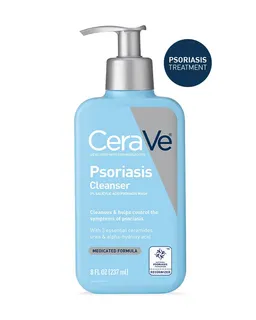
“With 2% salicylic acid to help relieve irritated skin, lactic acid for mild exfoliation, three essential ceramides to promote skin-barrier function, moisturizing glycerin and urea, plus soothing niacinamide, CeraVe Psoriasis Cleanser gently cleanses psoriasis-prone skin, removes scales and helps the skin retain moisture.”
This product works by removing dirt and oil from the surface of the skin. It uses a combination of mild cleansing agents (capryl/capramidopropyl betaine, carbomer, cholesterol, hexylene glycol, laureth-9, peg-150 pentaerythrityl tetrastearate, shea butteramidopropyl betaine, sodium c14-16 olefin sulfonate, sodium lauroyl lactylate, xanthan gum) and should be able to cleanse the skin gently. Still keep in mind that any cleansing can disrupt the skin barrier, and most people do not need to cleanse their skin more than once per day.
Even though this formulation is mild, the following cleansing agents could trigger an irritation or allergy for some people: sodium c14-16 olefin sulfonate
ExfoliationUrea, Salicylic acid + 3 moreWorks well
“With 2% salicylic acid to help relieve irritated skin, lactic acid for mild exfoliation, three essential ceramides to promote skin-barrier function, moisturizing glycerin and urea, plus soothing niacinamide, CeraVe Psoriasis Cleanser gently cleanses psoriasis-prone skin, removes scales and helps the skin retain moisture.”
This product can help exfoliate the skin. In other words, it helps break down the bonds between dead cells on the surface of the skin and speed up the skin turnover. Skin often appears softer and brighter after exfoliation, but overdoing it can result in disrupted skin barrier. The following ingredient is doing the exfoliating job in this product: glycolic acid, salicylic acid.
Anti-blemishNot advertised by the brand · Salicylic acid, Niacinamide + 3 moreWorks well
This product can help reduce breakouts and clogged pores because it contains the following ingredient: niacinamide, salicylic acid. These ingredients is used for treating acne and can have a noticeable effect.
The following ingredient (ingredients) in this product might be helpful, but there is no evidence to confirm that it actually works: glycolic acid
Can it cause trouble?
Irritancy16 flagged ingredientsMedium risk
ComedogenicClean of flagged comedogenic ingredientsNone flagged

User reviews
Be the first — your take helps the next person decide.
Ingredients
Filter by role to see what each ingredient is doing.
Salicylic acid2%
- Irritation risk
- High
Used for skin exfoliation. It has an anti-inflammatory and anti-bacterial effect, helps to unclog pores, prevent blemishes and speed up healing of the existing ones. Sometimes referred to as a BHA (beta-hydroxy acid)
More about Salicylic acidWater~45–55%
Glycerin~7.6–9.3%
- Irritation risk
- Low
One of the best moisturizing ingredients. Naturally present in skin. It attracts water to the upper layer of the skin working as a humectant
More about GlycerinCapryl/capramidopropyl betaine~6.5–7.9%
Urea~3.2–4%
- Irritation risk
- Low
Naturally present in skin (urea makes up about 7% of natural moisturizing factors in skin). Attracts water to the upper layer of the skin. Also has a positive effect on the skin barrier beyond the humectant action. Can enhance penetration of other ingredients. Is an exfoliating ingredient when used in high concentrations
More about UreaSodium c14-16 olefin sulfonate~2.8–3.4%
- Irritation risk
- High
Helps oil and water mix together and used as a cleansing agent. Can be irritating and is better avoided for sensitive skin
More about Sodium c14-16 olefin sulfonateShea butteramidopropyl betaine~2.2–2.7%
Peg-150 pentaerythrityl tetrastearate~1.8–2.1%
- Irritation risk
- Medium
Helps oil and water mix together
More about Peg-150 pentaerythrityl tetrastearateLaureth-9~1.6–1.9%
Sodium lactate~1.3–1.6%
- Irritation risk
- Medium
Helps attract water to the upper layer of the skin. Is often used to adjust the pH level of the product
More about Sodium lactateNiacinamide~1.1–1.3%
- Irritation risk
- Low
Is proven to be effective in reducing blemishes, evening out skin tone and helping to improve lines and wrinkles. It helps the skin to repair sun damage, calm down inflammation and keep maintain good levels of moisture. The concentration of about 2% is effective for supporting the skin barrier and evening out the skin tone. Concentration of 4-6% is better for helping with acne and balancing the sebum production
More about NiacinamideEthoxydiglycol~0.75–1.1%
Sodium chloride~0.7–1.1%
- Irritation risk
- Low
Used to stabilize mixtures of oil and water, and create thicker, gel-like product textures
More about Sodium chlorideGluconolactone~0.6–0.9%
- Irritation risk
- Medium
A polyhydroxy acid (PHA) that helps shed the dead cells from the skin surface revealing smoother skin. Is believed to be genter than AHAs. It helps attract water to the upper layer of the skin and can stimulate production of skin's own hyaluronic acid resulting in improved hydration levels. It has been shown to be helpful against acne and clogged pores if used consistently (e.g over a period of 12 weeks) in high enough concentration. It can help reduce fine lines and wrinkles and improve skin tone with long-term application. Can help neutralize free radicals
More about GluconolactoneC12-13 alkyl lactate~0.6–0.9%
- Irritation risk
- Low
Ceramide np~0.55–0.85%
- Irritation risk
- Low
A type of lipid similar to ceramides naturally present in skin. Helps to soften the upper layer of the skin and supports the skin barrier function to keep it hydrated. Can help to prevent inflammation in skin
More about Ceramide npCeramide ap~0.55–0.85%
- Irritation risk
- Low
A type of lipid similar to ceramides naturally present in skin. Helps to soften the upper layer of the skin and supports the skin barrier function to keep it hydrated. Can help to prevent inflammation in skin
More about Ceramide apCeramide eop~0.55–0.8%
- Irritation risk
- Low
A type of lipid similar to ceramides naturally present in skin. Helps to soften the upper layer of the skin and supports the skin barrier function to keep it hydrated. Can help to prevent inflammation in skin
More about Ceramide eopCarbomer~0.45–0.7%
- Irritation risk
- Low
Helps create a thicker or gel-like product texture. It is not a surfactant but can be used in gentle cleansing formulations
More about CarbomerSaccharide isomerate~0.35–0.65%
- Irritation risk
- Low
Helps attract water to the upper layer of the skin
More about Saccharide isomerateGlycolic acid~0.35–0.6%
- Irritation risk
- High
An alpha-hydroxy acid (AHA) that helps to remove the dead skin cells on the surface of the skin reveling a more even, smoother complexation. It is also able to stimulate collagen production with long-term use. Could help to reduce pore congestion. It can be irritating to the skin. Apply sunscreen daily if using products with glycolic acid
More about Glycolic acidCalcium gluconate~0.3–0.6%
- Irritation risk
- Low
Helps attract water to the upper layer of the skin and helps to improve appearance of the product
More about Calcium gluconateSodium benzoate~0.25–0.5%
Sodium citrate~0.3–0.55%
- Irritation risk
- Medium
Helps to control the skin's pH level. Maintains the skin's natural film of amino-lactic acids and oils. Helps to preserve products
More about Sodium citrateSodium lauroyl lactylate~0.3–0.55%
- Irritation risk
- Medium
Helps water and oil mix together
More about Sodium lauroyl lactylateCholesterol~0.35–0.6%
- Irritation risk
- Low
An emollient that is naturally found in skin
More about CholesterolPhenoxyethanol~0.3–0.55%
- Irritation risk
- Low
A preservative. It helps prevent bacterial growth in cosmetic products
More about PhenoxyethanolDisodium edta~0.25–0.5%
Tetrasodium edta~0.25–0.45%
Citric acid~0.25–0.45%
- Irritation risk
- Medium
Can work as an exfoliant but is typically used to adjust the product pH
More about Citric acidHydrolyzed hyaluronic acid~0.2–0.4%
- Irritation risk
- Low
One of the best moisturizing ingredients. Attracts water into the upper layer of the skin. A version of it is naturally present in skin
More about Hydrolyzed hyaluronic acidLactic acid~0.15–0.3%
- Irritation risk
- Medium
An exfoliating and moisturizing alpha-hydroxy acid (AHA). Typically causes less irritation than other AHAs, for example, glycolic acid. At high concentrations (about 15%), lactic acid can help reduce lines and wrinkles. Recent studies show that lactic acid can support the "good" bacteria living on skin's surface (healthy skin microbiome)
More about Lactic acidPhytosphingosine~0.2–0.35%
- Irritation risk
- Low
A type of lipid that is naturally present in skin. It might help in repairing skin barrier function and has anti-bacterial effect
More about PhytosphingosineXanthan gum~0.1–0.25%
- Irritation risk
- Low
Used to create a thicker product consistency
More about Xanthan gumHexylene glycol~0.1–0.15%
- Irritation risk
- Medium
Helps create a more spreadable product texture
More about Hexylene glycolEthylhexylglycerin~0.05–0.1%
Benzoic acid~0.05–0.15%
Ingredient list view
Salicylic acid, Water, Glycerin, Capryl/capramidopropyl betaine, Urea, Sodium c14-16 olefin sulfonate, Shea butteramidopropyl betaine, Peg-150 pentaerythrityl tetrastearate, Laureth-9, Sodium lactate, Niacinamide, Ethoxydiglycol, Sodium chloride, Gluconolactone, C12-13 alkyl lactate, Ceramide np, Ceramide ap, Ceramide eop, Carbomer, Saccharide isomerate, Glycolic acid, Calcium gluconate, Sodium benzoate, Sodium citrate, Sodium lauroyl lactylate, Cholesterol, Phenoxyethanol, Disodium edta, Tetrasodium edta, Citric acid, Hydrolyzed hyaluronic acid, Lactic acid, Phytosphingosine, Xanthan gum, Hexylene glycol, Ethylhexylglycerin, Benzoic acid
Compare prices
Retailers ranked by price — lowest first.

Worth comparing, line by line.
Match % combines shared ingredients, the first five ingredients, shared actives and hero ingredients, irritancy (lower counts in the alternative's favour), texture and body area. Only products in the same routine step are compared.
| CeraVePsoriasis CleanserYOUR PRODUCT | Peach SlicesBreakout Banisher Body Wash | SkinfixAcne+ 2% BHA Cleanser | Community Sixty-SixDetoxifying AHA/BHA Gel Cleanser | |
|---|---|---|---|---|
| Match | — | 67% | 64% | 64% |
| Price | $16.99 | $17.99+$1.00 | $10.00−$6.99 | $15.82−$1.17 |
| Shared key ingredients | — | 5 of 23 | 5 of 23 | 5 of 23 |
| Key difference | — | 3-O-Ethyl Ascorbic Acid | Azelaic Acid | Panthenol |
| Irritancy | Medium | Medium | Low | Low |
| Drying alcohol | — | — | — | — |
| View product | Shop | Shop | Shop |


More alternatives: Face facts Ceramide Blemish Foaming CleanserMixa Anti-Imperfection Comfort Cleanser
Sources cited in this review
Every concentration estimate and effectiveness label is anchored to one of these 30 studies and safety reviews.
- 1Salicylic acid as a peeling agent: a comprehensive reviewncbi.nlm.nih.gov
- 2Beta Hydroxy Acidsfda.gov
- 3A review of toxicity from topical salicylic acid preparationssciencedirect.com
- 4
- 5
- 6Topical urea in skincare: A reviewpubmed.ncbi.nlm.nih.gov

Affiliate links · As an Amazon Associate, WIMJ earns from qualifying purchases.