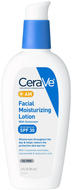
CeraVe AM Facial Moisturizing Lotion SPF 30
Works for
2 of 2 advertised claims delivered
Sun protectionSPF 30 · 4 UV filtersBroad spectrum
This product offers a good level of protection against both UVB and UVA rays.
This sunscreen uses organic (so-called "chemical") sunscreen filters. Organic, or "chemical" filters usually provide reliable sun protection and rarely leave a white cast. Sunscreens with organic filters can sting eyes.
Moisturizing10 ingredients credited for this claimStrong support
“AM Facial Moisturizing Lotion SPF 30”
This product can help improve hydration of the skin with the two types of ingredients.
The first type is called “humectants”:
these ingredients help attract water.
When humectants are on the surface of the skin, they “pull in” the moisture from the outside environment, or from
within deeper layers of the skin. The following ingredients in this product do the job:
glycerin, hyaluronic acid.
This product also contains ingredients called “occlusives”. They help reduce the speed with which our skin loses moisture to the outside environment. These ingredients also help soften the upper layer of the skin, so it feels less tight and nicer to the touch. The following ingredients in this product do the job: dimethicone, cholesterol.
The following ingredients in this product are especially good for supporting the skin barrier and helping with the hydration level: ceramide 1, ceramide 3, ceramide 6 ii, niacinamide, phytosphingosine
Anti-blemishNot advertised by the brand · 2 ingredients credited for this claimStrong support
This product can help reduce breakouts and clogged pores because it contains the following ingredient: niacinamide. This ingredient is used for treating acne and can have a noticeable effect.
Evens skin toneNot advertised by the brand · 1 ingredient credited for this claimStrong support
This product offers broad spectrum sun protection. It means that it can prevent hyperpigmentation and help keep the skin tone even (sun damage is the main factor causing age spots, darkening of post-acne marks and other discolorations).
Can it cause trouble?
Irritancy7 flagged ingredientsLow risk
Comedogenic1 ingredient rated 2 or more on the 0–5 pore-clogging scale1 flagged


User reviews
Ingredients
Filter by role to see what each ingredient is doing.
Homosalate12%
- Irritation risk
- Medium
A weak sunscreen that offers some protection against the sun rays that cause sunburn (UVB), but does not offer meaningful protection against protect against the most aging sun rays (UVA). It loses its effectiveness quickly when exposed to sunlight. It is an organic, or so called "chemical" sunscreen. When used in low concentrations, helps to stabilize the product formulation
More about HomosalateEthylhexyl methoxycinnamate7.5%
- Irritation risk
- High
Octinoxate. When used in higher concentrations, works as a sunscreen protecting the skin from UVB rays. When used in lower concentration, helps to preserve the product formulation. Is shown to be harmful to coral reefs - consider avoiding bathing in coral reef areas when wearing a product with this ingredient. It can be irritating
More about Ethylhexyl methoxycinnamateOctocrylene2%
- Irritation risk
- Medium
A weak sunscreen that protects against the sun rays that cause sunburn (UVB) and is somewhat effective against the UVA rays. It is quite stable and can help stabilize other, more vulnerable, sunscreen ingredients like Avobenzone. It is an organic, or so called "chemical" sunscreen
More about OctocryleneZinc oxide3.5%
- Irritation risk
- Low
A broad spectrum sunblock (protects from both UVA and UVB rays). Is suitable for most sensitive skins. In small concentrations, can be used as a colorant
More about Zinc oxideWater~45–55%
Niacinamide~7.8–9.5%
- Irritation risk
- Low
Is proven to be effective in reducing blemishes, evening out skin tone and helping to improve lines and wrinkles. It helps the skin to repair sun damage, calm down inflammation and keep maintain good levels of moisture. The concentration of about 2% is effective for supporting the skin barrier and evening out the skin tone. Concentration of 4-6% is better for helping with acne and balancing the sebum production
More about NiacinamideBehentrimonium methosulfate~6.2–7.6%
- Irritation risk
- Medium
Helps oil and water mix together
More about Behentrimonium methosulfateCetearyl alcohol~4.8–5.9%
- Irritation risk
- Low
- Comedogenicity
- 2/5
A non-drying alcohol. Works as an emollient. Helps water and oil mix together and creates a nice product texture
More about Cetearyl alcoholGlycerin~3.6–4.4%
- Irritation risk
- Low
One of the best moisturizing ingredients. Naturally present in skin. It attracts water to the upper layer of the skin working as a humectant
More about GlycerinAluminum starch octenylsuccinate~2.7–3.3%
- Irritation risk
- Medium
Used to thicken the product's consistency
More about Aluminum starch octenylsuccinateBoron nitride~2.2–2.7%
- Irritation risk
- Low
Helps to absord oil and evenly disperse other ingredients (for example, pigment) in product formulation
More about Boron nitrideDimethicone~2.1–2.5%
- Irritation risk
- Low
A silicone that helps to reduce water loss from the surface of the skin. Can temporarily "fill in" lines and wrinkles, absorb oil, and create a nice product finish
More about DimethiconeCeramide 3~1.6–2%
- Irritation risk
- Low
A type of lipid similar to ceramides naturally present in skin. Helps to soften the upper layer of the skin and supports the skin barrier function to keep it hydrated. Can help to prevent inflammation in skin
More about Ceramide 3Ceramide 6 ii~1.3–1.5%
- Irritation risk
- Low
A type of lipid similar to ceramides naturally present in skin. Helps to soften the upper layer of the skin and supports the skin barrier function to keep it hydrated. Can help to prevent inflammation in skin
More about Ceramide 6 iiCeramide 1~1.1–1.3%
- Irritation risk
- Low
A type of lipid similar to ceramides naturally present in skin. Helps to soften the upper layer of the skin and supports the skin barrier function to keep it hydrated. Can help to prevent inflammation in skin
More about Ceramide 1Cholesterol~1–1.2%
- Irritation risk
- Low
An emollient that is naturally found in skin
More about CholesterolHyaluronic acid~0.65–0.95%
- Irritation risk
- Low
One of the best moisturizing ingredients. Attracts water into the upper layer of the skin. Naturally present in skin. Typically has large molecule size unless advertised otherwise on the product label. Helps support skin's barrier function and may help to reduce inflammation
More about Hyaluronic acidPhytosphingosine~0.7–1.05%
- Irritation risk
- Low
A type of lipid that is naturally present in skin. It might help in repairing skin barrier function and has anti-bacterial effect
More about PhytosphingosineHydroxyethylcellulose~0.55–0.85%
- Irritation risk
- Low
Used to thicken product formulations and create gel-like textures
More about HydroxyethylcelluloseDisodium edta~0.45–0.65%
Sodium lauroyl lactylate~0.4–0.65%
- Irritation risk
- Medium
Helps water and oil mix together
More about Sodium lauroyl lactylateMethylparaben~0.15–0.3%
Propylparaben~0.2–0.4%
Carbomer~0.15–0.3%
- Irritation risk
- Low
Helps create a thicker or gel-like product texture. It is not a surfactant but can be used in gentle cleansing formulations
More about CarbomerXanthan gum~0.15–0.3%
- Irritation risk
- Low
Used to create a thicker product consistency
More about Xanthan gumIngredient list view
Homosalate, Ethylhexyl methoxycinnamate, Octocrylene, Zinc oxide, Water, Niacinamide, Behentrimonium methosulfate, Cetearyl alcohol, Glycerin, Aluminum starch octenylsuccinate, Boron nitride, Dimethicone, Ceramide 3, Ceramide 6 ii, Ceramide 1, Cholesterol, Hyaluronic acid, Phytosphingosine, Hydroxyethylcellulose, Disodium edta, Sodium lauroyl lactylate, Methylparaben, Propylparaben, Carbomer, Xanthan gum
Compare prices
Retailers ranked by price — lowest first.


Worth comparing, line by line.
Match % combines shared ingredients, the first five ingredients, shared actives and hero ingredients, irritancy (lower counts in the alternative's favour), texture and body area. Only products in the same routine step are compared.
| CeraVeAM Facial Moisturizing Lotion SPF 30YOUR PRODUCT | Up&UpMorning Facial Moisturizing Lotion with Sunscreen SPF 30 | SOBEL SKIN RxMineral-Based SPF 50 Sunscreen | OlayComplete+ Moisturizer with SPF 40 Sensitive | |
|---|---|---|---|---|
| Match | — | 86% | 69% | 69% |
| Price | $9.69 | $10.49+$0.80 | — | $19.94+$10.25 |
| Shared key ingredients | — | 9 of 13 | 5 of 13 | 5 of 13 |
| Key difference | — | Ceramide Np | Lactic Acid | Panthenol |
| Irritancy | Low | Low | Low | Low |
| SPF | SPF 30 | SPF 30 | SPF 50 | SPF 40 |
| Drying alcohol | — | — | — | — |
| View product | Shop | Shop | Shop |


Product summary
Based on the ingredients included, we believe that "CeraVe - AM Facial Moisturizing Lotion SPF 30" can offer reliable sun protection. It can protect from both UVA and UVB rays. This is great news because not all sunscreens with SPF ratings give UVA protection. (UVA rays do not cause sunburn, but still damage our skin and lead to early aging).
It also works as a moisturizer, so you do not have to use an additional hydrating product.
Sunscreen filters
This sunscreen uses a mixture of both mineral and organic (so-called "chemical") UV filters. Here are the organic filters this product uses: octinoxate, homosalate and octocrylene. As for the mineral filters, this sunscreen uses zinc oxide.
Irritation risk
This moisturizer contains actives that can be irritating. We assess the overall irritancy of this moisturizer to be low. For a detailed overview of all potential irritants: click here
You can see the detailed formula review with the breakdown of all actives in the product and the full ingredient list with estimated concentrations in the tables below.
What our users say
Based on 6 reviews 100% recommend this product- When it comes to comedogenicity, all of the reviewers (4) say that it does not clog pores.
- As for using this sunscreen in the eye area, the vast majority of the reviewers (100%) find that it stings eyes.
- When it comes to using this sunscreen under makeup, all of the reviewers (6) say that it does not pill under makeup.
- As for the white cast, the majority of the reviewers (1 %) find that it leaves a noticeable white cast.
Price
The product retails for 19.19CA$ in Canada, for 135.74A$ in Australia and from 9.69$ up to 89.99$ in the United States.
For a detailed price comparison: click here.
Sources cited in this review
Every concentration estimate and effectiveness label is anchored to one of these 15 studies and safety reviews.
- 1
- 2A review of inorganic UV filters zinc oxide and titanium dioxideonlinelibrary.wiley.com
- 3
- 4
- 5
- 6

Affiliate links · As an Amazon Associate, WIMJ earns from qualifying purchases.