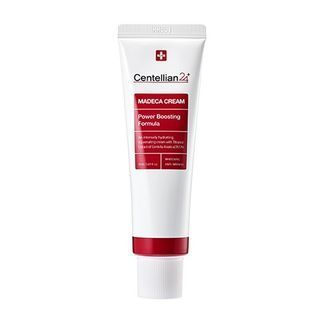
Centellian24 Madeca Cream Power Boosting Formula
Works for
2 of 3 advertised claims delivered
Moisturizing50 ingredients credited for this claimStrong support
“Centellian 24 Madeca Cream Power Boosting Formula is an intensely hydrating rejuvenating cream.”
This product can help improve hydration of the skin with the two types of ingredients.
The first type is called “humectants”:
these ingredients help attract water.
When humectants are on the surface of the skin, they “pull in” the moisture from the outside environment, or from
within deeper layers of the skin. The following ingredients in this product do the job:
glycerin, hyaluronic acid.
This product also contains ingredients called “occlusives”. They help reduce the speed with which our skin loses moisture to the outside environment. These ingredients also help soften the upper layer of the skin, so it feels less tight and nicer to the touch. The following ingredients in this product do the job: borago officinalis seed oil, jojoba esters.
The following ingredients in this product are especially good for supporting the skin barrier and helping with the hydration level: acetyl hexapeptide-8, palmitoyl tetrapeptide-7
Anti-aging12 ingredients credited for this claimStrong support
“Additional ingredients of collagen, elastin and hyaluronic acid gives sagging skin an extra rejuvenating boost, while the patented Skin Analogue Capsule formulation enables swift delivery of ingredients deep inside skin, producing a youthful-looking finish.”
This product can help reduce and prevent fine lines and wrinkles, improve skin elasticity and firmness because it contains adenosine.
These ingredients in the product can also be helpful, even though there is less evidence for their effectiveness: acetyl hexapeptide-8, asiaticoside, centella asiatica extract, palmitoyl tetrapeptide-7.
Keep in mind that it typically takes at least 6 weeks to notice any results because the changes that are needed to improve fine lines and elasticity happen in the deeper layers of the skin. No topical anti-aging product can “erase” wrinkles or fully reverse signs of aging.
Anti-blemish6 ingredients credited for this claimWeak support
“Gently repairs dry, sensitive skin and help soothes irritations Nourishes, hydrates, and supports skin renewal to leave skin feeling calm, comfortable and revitalized Can be used as a spot treatment for breakouts”
Effective ingredients missing or their concentration is too low.
Anti-oxidationNot advertised by the brand · 22 ingredients credited for this claimStrong support
This product contains antioxidants (asiaticoside) that can help neutralize free radicals in skin. By doing so, they can lessen the damage the skin gets from the UV light (sun).
The following ingredients - centella asiatica extract also can have an antioxidant effect, but there is less evidence to confirm their effectiveness in skin.
Can it cause trouble?
Irritancy12 strong irritants: Citrus aurantium bergamia fruit oil, Citrus aurantium dulcis oil + 10 more — patch-test recommendedHigh risk
Comedogenic2 ingredients rated 2 or more on the 0–5 pore-clogging scale2 flagged


User reviews
Be the first — your take helps the next person decide.
Ingredients
Filter by role to see what each ingredient is doing.
Water~40–60%
Glycerin~4.3–6.4%
- Irritation risk
- Low
One of the best moisturizing ingredients. Naturally present in skin. It attracts water to the upper layer of the skin working as a humectant
More about GlycerinPentylene glycol~3.4–5%
- Irritation risk
- Medium
Used to preserve products, dissolve other ingredients and create a nice product texture
More about Pentylene glycol1,2-hexanediol~1.8–2.7%
Butylene glycol~1.8–2.7%
- Irritation risk
- Low
Used to create a nice product texture and help delivery of other ingredients. Might be somewhat helpful in attracting water to the upper layer of the skin
More about Butylene glycolOctanediol~1.4–2.1%
- Irritation risk
- Low
Ethylhexylglycerin~1.2–1.7%
Centella asiatica extract~0.95–1.4%
- Irritation risk
- Medium
A plant extract that has been shown to be able to reduce inflammation in skin, support restoration of skin barrier function, as well as support collagen production. Contains active compounds called centelloids: asiaticoside, madecasosside, asiatic acid and madecassic acid. Might be helpful in preventing stretch marks. It can be itself be irritating though.
More about Centella asiatica extractDipropylene glycol~0.6–1.35%
- Irritation risk
- Low
Helps to dissolve other ingredients in a formulation. Slows down the rate of product drying
More about Dipropylene glycolHydrogenated polydecene~0.45–1.1%
- Irritation risk
- Low
Helps to soften the upper layer of the skin and create a nice product texture
More about Hydrogenated polydeceneCaprylic/capric triglyceride~0.4–0.9%
- Irritation risk
- Medium
A good mix of fatty acids that forms a protective layer on the skin. Improves the shelf life of products. Derived from coconut and glycerin
More about Caprylic/capric triglycerideCyclohexasiloxane~0.2–0.75%
- Irritation risk
- Low
A silicone that serves as an emollient. Helps create a nice non-greasy feels
More about CyclohexasiloxaneGlyceryl stearate~0.15–0.65%
- Irritation risk
- Low
An emollient that softens the skin and forms a protective layer on its surface. Helps water and oil mix together
More about Glyceryl stearatePentaerythrityl tetraethylhexanoate~0.15–0.55%
- Irritation risk
- Low
Used to create a nice product consistency while softening the upper layer of the skin
More about Pentaerythrityl tetraethylhexanoateSoluble collagen~0.1–0.4%
- Irritation risk
- Low
A typically plant-derived compound that is supposed mimic human collagen. Cannot penetrate the skin barrier so is not particularly useful in skincare products beyond attracting water to the upper layer of the skin
More about Soluble collagenHyaluronic acid~0.1–0.4%
- Irritation risk
- Low
One of the best moisturizing ingredients. Attracts water into the upper layer of the skin. Naturally present in skin. Typically has large molecule size unless advertised otherwise on the product label. Helps support skin's barrier function and may help to reduce inflammation
More about Hyaluronic acidElastin~0.1–0.35%
- Irritation risk
- Low
Polyglyceryl-6 distearate~0.1–0.35%
- Irritation risk
- Medium
Helps oil and water mix together while softening the upper layer of the skin
More about Polyglyceryl-6 distearateJojoba esters~0.1–0.3%
- Irritation risk
- Medium
An emollient made of jojoba oil. Helps soften the skin and support its barrier function
More about Jojoba estersCetyl alcohol~0.05–0.25%
- Irritation risk
- Low
A non-drying alcohol that works to soften the skin and stabilize product formulations helping oil and water mix together
More about Cetyl alcoholPolyglyceryl-3 beeswax~0.05–0.2%
- Irritation risk
- Medium
Helps water and oil mix together. Could be an allergen (beeswax)
More about Polyglyceryl-3 beeswaxNiacinamide~0.05–0.1%
- Irritation risk
- Low
Is proven to be effective in reducing blemishes, evening out skin tone and helping to improve lines and wrinkles. It helps the skin to repair sun damage, calm down inflammation and keep maintain good levels of moisture. The concentration of about 2% is effective for supporting the skin barrier and evening out the skin tone. Concentration of 4-6% is better for helping with acne and balancing the sebum production
More about NiacinamideCetearyl alcohol~0.05–0.15%
- Irritation risk
- Low
- Comedogenicity
- 2/5
A non-drying alcohol. Works as an emollient. Helps water and oil mix together and creates a nice product texture
More about Cetearyl alcoholMadecassic acid~0.01–0.05%
- Irritation risk
- Medium
An active compound of Centella Asiatica plant extract. In combination with other active compounds of Centella Asiatica extract (asiaticoside, madecasosside and asiatic acid), madecassic acid has been shown to be helpful in wound-healing, restoring skin barrier function and supporting collagen production in skin. It can, however, itself be irritating
More about Madecassic acidAsiaticoside~0.01–0.05%
- Irritation risk
- Medium
An active compound of Centella Asiatica plant extract. In combination with other active compounds of Centella Asiatica extract (madecasosside, asiatic acid and madecassic acid), asiaticoside has been shown to be helpful in wound-healing, restoring skin barrier function and supporting collagen production in skin. It can, however, itself be irritating
More about AsiaticosideAsiatic acid~0.01–0.05%
- Irritation risk
- Medium
An active compound of Centella Asiatica plant extract. In combination with other active compounds of Centella Asiatica extract (asiaticoside, madecasosside and madecassic acid) asiatic acid has been shown to be helpful in wound-healing, restoring skin barrier function and supporting collagen production in skin. It can, however, itself be irritating
More about Asiatic acidDicaprylyl ether~0.01–0.1%
- Irritation risk
- Low
Helps soften the upper layer of the skin while creating a non-greasy feel on the skin. Helps to dissolve other ingredients
More about Dicaprylyl etherPolyglyceryl-10 laurate~0.01–0.1%
- Irritation risk
- Medium
Helps water and oil mix together
More about Polyglyceryl-10 lauratePanthenol~0.01–0.05%
- Irritation risk
- Low
Helps attract water to the upper layer of the skin and can help improve skin barrier function
More about PanthenolHydroxyethyl acrylate/sodium acryloyldimethyl taurate copolymer~0.01–0.05%
- Irritation risk
- Medium
A gelling agent that thickens the product consistency and leaves the skin with a velvety finish
More about Hydroxyethyl acrylate/sodium acryloyldimethyl taurate copolymerPolysorbate 60~0.05–0.1%
Sorbitan isostearate~0.01–0.1%
- Irritation risk
- Low
Helps oil and water mix together
More about Sorbitan isostearateCitrus aurantium bergamia fruit oil~0.01–0.05%
- Irritation risk
- High
A plant oil with a high content of volatile compounds that can irritate the skin and lead to allergic reactions. Can lead to photosensitivity
More about Citrus aurantium bergamia fruit oilOlea europaea fruit oil~0.01–0.1%
- Irritation risk
- Medium
An emollient that helps soften the skin but is not effective for restoring its barrier function. Might be helpful to calm down inflammation
More about Olea europaea fruit oilCitrus aurantium dulcis oil~0.01–0.05%
- Irritation risk
- High
Used as a fragrance. It can be irritating and cause photosensitivity
More about Citrus aurantium dulcis oilCitrus grandis peel oil~0.01–0.05%
- Irritation risk
- High
A plant oil with high content of volatile compounds that, especially when exposed to air, can cause allergic reactions and irritate the skin
More about Citrus grandis peel oilLavandula angustifolia oil~0.01–0.05%
- Irritation risk
- High
An essential oil. Potential allergen and can be irritating. It has some anti-bacterial properties
More about Lavandula angustifolia oilCedrus atlantica bark oil~0.01–0.05%
- Irritation risk
- Low
Pelargonium graveolens flower oil~0.01–0.1%
- Irritation risk
- High
An essential oil. Can be irritating. Can become an allergen with oxidation
More about Pelargonium graveolens flower oilJasminum officinale oil~0.01–0.05%
- Irritation risk
- Low
Artemisia absinthium extract~0.01–0.05%
- Irritation risk
- Low
Myrtus communis oil~0.01–0.05%
- Irritation risk
- Low
Rose flower oil~0.01–0.05%
- Irritation risk
- High
Flower oil that is used as a fragrance
More about Rose flower oilVanilla planifolia fruit extract~0.01–0.05%
- Irritation risk
- High
A plant extract used as a fragrance. Can be irritating
More about Vanilla planifolia fruit extractFerula galbaniflua resin oil~0.01–0.05%
- Irritation risk
- Low
Hydroxyacetophenone~0.01–0.05%
Xanthan gum~0.01–0.1%
- Irritation risk
- Low
Used to create a thicker product consistency
More about Xanthan gumDisodium edta~0.01–0.05%
Adenosine~0.01–0.05%
- Irritation risk
- Low
Might help improve cell turnover and reduce inflammation in skin. One study shows that the ingredients might be able to help reduce dynamic wrinkles (for example, in the corners of the eyes or on the forehead)
More about AdenosineDicaprylyl carbonate~0.01–0.1%
- Irritation risk
- Low
Helps products spread more easily and works as an emollient to soften skin
More about Dicaprylyl carbonateAlkanna tinctoria root extract~0.01–0.05%
- Irritation risk
- Low
Beeswax~0.05–0.15%
- Irritation risk
- Low
Forms a protective barrier that holds water and keeps dry skin hydrated. Keeps an emulsion from separating into its oil and liquid components, and increases the thickness of a product. Can be an allergen
More about BeeswaxSodium stearoyl glutamate~0.05–0.2%
- Irritation risk
- Medium
Helps oil and water mix together
More about Sodium stearoyl glutamateHydrogenated phosphatidylcholine~0.01–0.05%
- Irritation risk
- Medium
Helps oil and water mix together
More about Hydrogenated phosphatidylcholineCeramide np~0.05–0.15%
- Irritation risk
- Low
A type of lipid similar to ceramides naturally present in skin. Helps to soften the upper layer of the skin and supports the skin barrier function to keep it hydrated. Can help to prevent inflammation in skin
More about Ceramide npBorago officinalis seed oil~0.01–0.1%
- Irritation risk
- Low
A plant oil that is effective in reducing irritation in skin, restore the barrier function and support its hydration
More about Borago officinalis seed oilOenothera biennis oil~0.05–0.15%
- Irritation risk
- Medium
Helps soften the upper layer of the skin and can support skin barrier function
More about Oenothera biennis oilArgania spinosa kernel oil~0.01–0.1%
- Irritation risk
- Medium
An emollient that helps soften the upper layer of the skin. Might have some weak anti-oxidant properties
More about Argania spinosa kernel oilCaprylyl glycol~0.05–0.1%
- Irritation risk
- Medium
Helps preserve products and creates a nice product texture
More about Caprylyl glycolAcetyl hexapeptide-8~0.01–0.05%
- Irritation risk
- Low
A type of peptide. Peptides are excellent moisturizers and might be able support collagen production reducing fine lines and wrinkles
More about Acetyl hexapeptide-8Potassium pca~0.05–0.15%
- Irritation risk
- Low
Opuntia ficus-indica stem extract~0.05–0.1%
- Irritation risk
- Low
Phenoxyethanol~0.05–0.15%
- Irritation risk
- Low
A preservative. It helps prevent bacterial growth in cosmetic products
More about PhenoxyethanolPotassium sorbate~0.05–0.15%
Xylitylglucoside~0.05–0.1%
- Irritation risk
- Low
Helps attract water to the upper layer of the skin and repair the skin barrier function
More about XylitylglucosideAnhydroxylitol~0.05–0.15%
- Irritation risk
- Low
Helps attract water to the upper layer of the skin and repair the skin barrir function
More about AnhydroxylitolXylitol~0.01–0.1%
- Irritation risk
- Low
Helps attract water to the upper layer of the skin and repair the skin barrier function
More about XylitolGlucose~0.05–0.15%
- Irritation risk
- Low
Helps attract water to the upper layer of the skin. Could be helpful in restoring the skin barrier function
More about GlucoseBellis perennis flower extract~0.05–0.1%
- Irritation risk
- High
A plant extract. Used as a fragrance. Can be irritating
More about Bellis perennis flower extractPhenethyl alcohol~0.05–0.15%
Sodium chloride~0.05–0.15%
- Irritation risk
- Low
Used to stabilize mixtures of oil and water, and create thicker, gel-like product textures
More about Sodium chlorideDisodium phosphate~0.05–0.15%
- Irritation risk
- Low
Helps adjust the product pH and stabilize the formulation
More about Disodium phosphatePotassium phosphate~0.05–0.15%
Potassium chloride~0.05–0.15%
- Irritation risk
- Low
Cholesterol~0.05–0.25%
- Irritation risk
- Low
An emollient that is naturally found in skin
More about CholesterolHelianthus annuus seed oil~0.05–0.2%
- Irritation risk
- Low
A great emollient due to its high linoleic acid content. One of the most effective plant oils in helping skin hydration and repairing skin barrier function
More about Helianthus annuus seed oilLupinus albus seed extract~0.05–0.1%
- Irritation risk
- Medium
A plant extract that helps soften the upper layer of the skin
More about Lupinus albus seed extractTocopherol~0.05–0.15%
- Irritation risk
- Low
Pure form of vitamin E. Can help moisturise and protect the skin from free radicals. Often used to help stabilise other ingredients or the formula itself
More about TocopherolChlorella vulgaris extract~0.05–0.15%
- Irritation risk
- Medium
- Comedogenicity
- 3/5
A plant extract that can help to attract water to the upper layer of the skin and might have some anti-oxidant and anti-inflammatory properties
More about Chlorella vulgaris extractSorbitan laurate~0.05–0.2%
Hydroxyethylcellulose~0.05–0.25%
- Irritation risk
- Low
Used to thicken product formulations and create gel-like textures
More about HydroxyethylcelluloseAcetyl dipeptide-1 cetyl ester~0.05–0.2%
- Irritation risk
- Low
A type of peptide. Peptides are excellent moisturizers and might be able support collagen production reducing fine lines and wrinkles
More about Acetyl dipeptide-1 cetyl esterScutellaria baicalensis root extract~0.05–0.1%
- Irritation risk
- High
A plant extract that might contain a compound baicalin that could be helpful in neutralizing free radicals and reducing inflammation in skin. The baicalin concentration in skincare products is often too low for an effective action. Can be used for its fragrant properties
More about Scutellaria baicalensis root extractPolygonum cuspidatum root extract~0.05–0.2%
- Irritation risk
- Medium
A plant extract that can contain resveratrol, an antioxidant that can help neutralize free radicals in skin. The effectiveness depends on the extract quality and concentration in the product
More about Polygonum cuspidatum root extractGlycyrrhiza glabra root extract~0.05–0.1%
- Irritation risk
- Medium
A plant extract that can help lighten the skin and calm down inflammation. Might be helpful in neutralizing free radicals
More about Glycyrrhiza glabra root extractCamellia sinensis leaf extract~0.05–0.2%
- Irritation risk
- Low
Can contain potent anti-oxidant compounds (abbreviated ECG, GCG, EGC, and EGCG) that might help protect the skin from free radicals. Can help calm down inflammation and has some anti-bacterial properties. Unfortunately, these antioxidants are unstable and lose their effectiveness very quickly in products. The concentration of the antioxidant compounds in the extract also tends to be low to be effective in topical formulation
More about Camellia sinensis leaf extractRosmarinus officinalis leaf extract~0.05–0.15%
- Irritation risk
- High
Can be helpful in reducing inflammation in skin, including inflamed acne. It can be irritating
More about Rosmarinus officinalis leaf extractChamomilla recutita flower extract~0.05–0.15%
- Irritation risk
- High
Plant extract that can have healing and anti-inflammatory properties. It is a potential allergen and can be irritating
More about Chamomilla recutita flower extractChamaecyparis obtusa leaf extract~0.05–0.15%
Salix alba bark extract~0.05–0.1%
- Irritation risk
- High
A plant extract that can help neutralize free radicals in skin. It contains a compound salicin that can theoretically be converted into salicylic acid that, in turn, helps reduce inflammation in skin, but the evidence of effectiveness in skin is lacking and the extract is usually not used in a concentration that would enable an exfoliating effect
More about Salix alba bark extractOriganum vulgare leaf extract~0.05–0.15%
- Irritation risk
- High
A plant extract. Can have an anti-oxidant effect, but can also contain irritants
More about Origanum vulgare leaf extractPortulaca oleracea extract~0.05–0.15%
- Irritation risk
- Medium
A plant extract that has some anti-oxidant activity, but solid research is lacking. Can help attract water to the upper layer of the skin
More about Portulaca oleracea extractCinnamomum cassia bark extract~0.05–0.25%
Lactobacillus/soybean ferment extract~0.05–0.15%
- Irritation risk
- Low
A fermentation product created by bacteria Lactobacillus out of soybean. The fermented product helps to attract water to the upper layer of the skin and has anti-bacterial properties. It might be helpful in calming down inflammation and could be helpful in evening out skin tone, but studies are lacking
More about Lactobacillus/soybean ferment extractAloe barbadensis leaf extract~0.05–0.25%
- Irritation risk
- Medium
Traditionally used to treat sunburns, dermatitis and inflammation, but evidence for its effectiveness is lacking. The extract can contain humectants that help attract water into the skin
More about Aloe barbadensis leaf extractAlthaea rosea flower extract~0.05–0.15%
- Irritation risk
- Low
Lactic acid~0.05–0.15%
- Irritation risk
- Medium
An exfoliating and moisturizing alpha-hydroxy acid (AHA). Typically causes less irritation than other AHAs, for example, glycolic acid. At high concentrations (about 15%), lactic acid can help reduce lines and wrinkles. Recent studies show that lactic acid can support the "good" bacteria living on skin's surface (healthy skin microbiome)
More about Lactic acidCetyl hydroxyethylcellulose~0.05–0.2%
- Irritation risk
- Low
Used to create a thicker product consistency and stabilize formulations
More about Cetyl hydroxyethylcelluloseRutin~0.05–0.15%
- Irritation risk
- Low
An antioxidant that might help neutralize free radicals in skin
More about RutinDipotassium phosphate~0.05–0.15%
Palmitoyl tripeptide-1~0.05–0.25%
- Irritation risk
- Low
A type of peptide. Peptides are excellent moisturizers and might be able support collagen production reducing fine lines and wrinkles
More about Palmitoyl tripeptide-1Palmitoyl tetrapeptide-7~0.05–0.25%
- Irritation risk
- Low
A type of peptide. Peptides are excellent moisturizers and might be able support collagen production reducing fine lines and wrinkles
More about Palmitoyl tetrapeptide-7Phaseolus lunatus seed extract~0.05–0.3%
- Irritation risk
- Low
Bean seed extract. It might have some anti-oxidant properties
More about Phaseolus lunatus seed extractSodium palmitoyl proline~0.05–0.15%
- Irritation risk
- Low
Nymphaea alba flower extract~0.05–0.15%
- Irritation risk
- Low
Vanilla tahitensis fruit extract~0.05–0.1%
- Irritation risk
- Low
Stearyl alcohol~0.05–0.25%
- Irritation risk
- Low
An emollient that helps soften the skin
More about Stearyl alcoholTocopheryl acetate~0.05–0.25%
- Irritation risk
- Medium
A more stable but less bio-available form of vitamin E compared to Tocopherol. Might help moisturize and protect the skin from free radicals, but mostly used in low concentrations to stabilize other ingredients.
More about Tocopheryl acetateHydrolyzed vegetable protein~0.05–0.2%
Maltodextrin~0.05–0.1%
- Irritation risk
- Low
Used to stabilize the product formulation and can help absorb oil
More about MaltodextrinCrithmum maritimum callus culture filtrate~0.01–0.1%
- Irritation risk
- Low
A plant cell extract that helps attract water to the upper layer of the skin and might have some anti-oxidant properties
More about Crithmum maritimum callus culture filtrateIngredient list view
Water, Glycerin, Pentylene glycol, 1,2-hexanediol, Butylene glycol, Octanediol, Ethylhexylglycerin, Centella asiatica extract, Dipropylene glycol, Hydrogenated polydecene, Caprylic/capric triglyceride, Cyclohexasiloxane, Glyceryl stearate, Pentaerythrityl tetraethylhexanoate, Soluble collagen, Hyaluronic acid, Elastin, Polyglyceryl-6 distearate, Jojoba esters, Cetyl alcohol, Polyglyceryl-3 beeswax, Niacinamide, Cetearyl alcohol, Madecassic acid, Asiaticoside, Asiatic acid, Dicaprylyl ether, Polyglyceryl-10 laurate, Panthenol, Hydroxyethyl acrylate/sodium acryloyldimethyl taurate copolymer, Polysorbate 60, Sorbitan isostearate, Citrus aurantium bergamia fruit oil, Olea europaea fruit oil, Citrus aurantium dulcis oil, Citrus grandis peel oil, Lavandula angustifolia oil, Cedrus atlantica bark oil, Pelargonium graveolens flower oil, Unknown, Jasminum officinale oil, Artemisia absinthium extract, Myrtus communis oil, Rose flower oil, Vanilla planifolia fruit extract, Ferula galbaniflua resin oil, Hydroxyacetophenone, Xanthan gum, Disodium edta, Adenosine, Dicaprylyl carbonate, Alkanna tinctoria root extract, Beeswax, Sodium stearoyl glutamate, Hydrogenated phosphatidylcholine, Ceramide np, Borago officinalis seed oil, Oenothera biennis oil, Argania spinosa kernel oil, Caprylyl glycol, Acetyl hexapeptide-8, Potassium pca, Opuntia ficus-indica stem extract, Phenoxyethanol, Potassium sorbate, Xylitylglucoside, Anhydroxylitol, Xylitol, Glucose, Bellis perennis flower extract, Phenethyl alcohol, Sodium chloride, Disodium phosphate, Potassium phosphate, Potassium chloride, Cholesterol, Helianthus annuus seed oil, Lupinus albus seed extract, Tocopherol, Chlorella vulgaris extract, Sorbitan laurate, Hydroxyethylcellulose, Acetyl dipeptide-1 cetyl ester, Scutellaria baicalensis root extract, Polygonum cuspidatum root extract, Glycyrrhiza glabra root extract, Camellia sinensis leaf extract, Rosmarinus officinalis leaf extract, Chamomilla recutita flower extract, Chamaecyparis obtusa leaf extract, Salix alba bark extract, Origanum vulgare leaf extract, Portulaca oleracea extract, Cinnamomum cassia bark extract, Lactobacillus/soybean ferment extract, Aloe barbadensis leaf extract, Althaea rosea flower extract, Lactic acid, Cetyl hydroxyethylcellulose, Rutin, Dipotassium phosphate, Palmitoyl tripeptide-1, Palmitoyl tetrapeptide-7, Phaseolus lunatus seed extract, Sodium palmitoyl proline, Nymphaea alba flower extract, Vanilla tahitensis fruit extract, Stearyl alcohol, Tocopheryl acetate, Hydrolyzed vegetable protein, Maltodextrin, Crithmum maritimum callus culture filtrate
Compare prices
Retailers ranked by price — lowest first.

Affiliate links · prices updated regularly
Worth comparing, line by line.
Match % combines shared ingredients, the first five ingredients, shared actives and hero ingredients, irritancy (lower counts in the alternative's favour), texture and body area. Only products in the same routine step are compared.
| Centellian24Madeca Cream Power Boosting FormulaYOUR PRODUCT | Madeca DermaRevitalizing Cream | KLAVUURejuve Pearlsation Multi Pearl Peptide Cream | NEOGEN X SUR.MEDICSurmedic 24K Gold Caviar Repair Vital Cream | |
|---|---|---|---|---|
| Match | — | 59% | 58% | 54% |
| Price | $21.92 | $27.90+$5.98 | $29.10+$7.18 | $39.59+$17.67 |
| Shared key ingredients | — | 23 of 23 | 11 of 23 | 12 of 23 |
| Key difference | — | — | Niacinamide | Copper Tripeptide-1 |
| Irritancy | High | High | Medium | Medium |
| Drying alcohol | — | — | — | — |
| View product | Shop | Shop | Shop |


Product summary
Based on the ingredient list, "Centellian24 - Madeca Cream Power Boosting Formula" can work well for skin moisturization. The formulation is based on a combination of good humectants and emollients. Both are needed to increase the skin hydration level. Humectants in this product (acetyl hexapeptide-8, glycerin, hyaluronic acid, soluble collagen and glucose) help to increase the water content in the upper layer of the skin. (These ingredients do so by "capturing" water molecules from the outside air or from within the deeper layers of the skin). Palmitoyl tetrapeptide-7, borago officinalis seed oil, jojoba esters, oenothera biennis oil and cetearyl alcohol in this product help decrease the water evoporation from the skin, so that it stays hydrated for longer. These ingredients also soften the skin and take away the feeling of tightness and dryness.
Ingredient callouts
- As a plus, this moisturizer also contains Ceramides (ceramide np 0.05% - 0.15%). Ceramides are a type of lipids that our skin produces itself. They are a building block of the skin's barrier. Ceramides used in skincare are synthetic or extracted from plants. They work well for softening the skin surface and "patch holes" in the skin's barrier.
- We like that this moisturizer contains peptides (palmitoyl tetrapeptide-7 0.05% - 0.25%, palmitoyl tripeptide-1 0.05% - 0.25%, acetyl dipeptide-1 cetyl ester 0.05% - 0.20% and acetyl hexapeptide-8 0.01% - 0.05%). There are many different kind of Peptides and they are naturally present in our skin. They all are a combination of aminoacids. Some of them work as natural antibiotics, promote wound-healing and production of collagen. The science is still not settled on how effective Peptides are in skincare, but it is very likely that they have a benefit. Peptides might help restore the skin barrier and fight the signs of aging. At the very least, Peptides work as humectants: they attract water to the upper layer of the skin and improve its hydration.
- Adenosine 0.01% - 0.05%. It is a compound that in involved in many biological processes inside the skin cells. According one high-quality clinical trial, topical Adenosine in low concentrations can somewhat help improve "deep wrinkles" - the wrinkles that appear with age in places where our faces are most dynamic (for example, on the forehead or in the corners of the eyes).
- Actives derived from an extract of the Centella Asiatica plant (also known as Gotu Kola) - asiatic acid 0.01% - 0.05%, asiaticoside 0.01% - 0.05% and madecassic acid 0.01% - 0.05% The Centella Asiatica Actives, even in low concentration, can help reduce inflammation in skin, strengthen the skin barrier and reduce photodamage. They can also help to decrease scarring.
Irritation risk
This moisturizer contains a bunch of common irritants, including ingredients that do not provide any known benefit for the skin. It might not be the best choice if your skin is sensitive. We assess the overall irritancy of this moisturizer to be high. For a detailed overview of all potential irritants: click here
You can see the detailed formula review with the breakdown of all actives in the product and the full ingredient list with estimated concentrations in the tables below.
Price
The product retails for 28.00A$ in Australia and for 21.92$ in the United States.
For a detailed price comparison: click here.
Sources cited in this review
Every concentration estimate and effectiveness label is anchored to one of these 56 studies and safety reviews.
- 1
- 2
- 3
- 4Centella asiatica in cosmetologyncbi.nlm.nih.gov
- 5
- 6

Affiliate links · As an Amazon Associate, WIMJ earns from qualifying purchases.