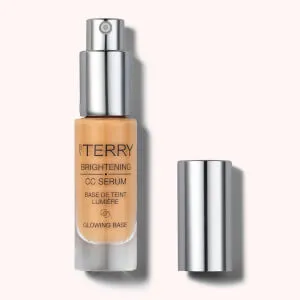
BY TERRY Brightening CC Serum Mini-To-Go - Exclusive
Works for
MoisturizingDimethicone, Glycerin + 13 moreWorks
“The lightweight serum texture moisturises skin, helping to keep makeup in place for longer.”
This product can help improve hydration of the skin with the two types of ingredients.
The first type is called “humectants”:
these ingredients help attract water.
When humectants are on the surface of the skin, they “pull in” the moisture from the outside environment, or from
within deeper layers of the skin. The following ingredients in this product do the job:
glycerin, bis-peg-18 methyl ether dimethyl silane.
This product also contains ingredients called “occlusives”. They help reduce the speed with which our skin loses moisture to the outside environment. These ingredients also help soften the upper layer of the skin, so it feels less tight and nicer to the touch. The following ingredients in this product do the job: dimethicone, helianthus annuus seed oil.
Can it cause trouble?
Irritancy6 strong irritants: Parfum, Benzophenone-4 + 4 more — patch-test recommendedHigh risk
Comedogenic4 ingredients rated 2 or more on the 0–5 pore-clogging scale4 flagged
User reviews
Be the first — your take helps the next person decide.
Ingredients
Filter by role to see what each ingredient is doing.
Water~45–55%
Glycereth-7~4.8–5.9%
- Irritation risk
- Low
Bis-peg-18 methyl ether dimethyl silane~3.9–4.8%
- Irritation risk
- Low
A type of silicone that helps soften the upper layer of the skin and create a nice product texture
More about Bis-peg-18 methyl ether dimethyl silaneDimethicone~3.1–3.8%
- Irritation risk
- Low
A silicone that helps to reduce water loss from the surface of the skin. Can temporarily "fill in" lines and wrinkles, absorb oil, and create a nice product finish
More about DimethiconeMica~2.3–2.8%
- Irritation risk
- Low
Creates an illusion of smoother and more radiant skin tone. Adds shimmer to the skin by reflecting light
More about MicaButylene glycol~1.8–2.2%
- Irritation risk
- Low
Used to create a nice product texture and help delivery of other ingredients. Might be somewhat helpful in attracting water to the upper layer of the skin
More about Butylene glycolPeg-6 methyl ether~1.6–1.9%
- Irritation risk
- Low
Peg-32~1.4–1.7%
- Irritation risk
- Low
Helps dissolve other ingredients and attract water to the upper layer of the skin
More about Peg-32Titanium dioxide~1.5–1.8%
- Irritation risk
- Low
Works as a UV filter when used in high concentrations. It is photostable and is effective mostly against the UVB light, with some protection in the UVA range. In small concentrations, used for its ability to improve the color of cosmetic products. Is usually well tolerated by the skin
More about Titanium dioxideNylon-12~1–1.3%
Boron nitride~0.7–1.05%
- Irritation risk
- Low
Helps to absord oil and evenly disperse other ingredients (for example, pigment) in product formulation
More about Boron nitridePolysilicone-11~0.6–0.85%
- Irritation risk
- Low
A silicone that forms a light film on the skin surface helping to bind water and temporarily absorb oils creating a matt and powdery feel
More about Polysilicone-11Acrylates/palmeth-25 acrylate copolymer~0.45–0.7%
- Irritation risk
- Low
Phenoxyethanol~0.4–0.6%
- Irritation risk
- Low
A preservative. It helps prevent bacterial growth in cosmetic products
More about PhenoxyethanolTocopherol~0.35–0.65%
- Irritation risk
- Low
Pure form of vitamin E. Can help moisturise and protect the skin from free radicals. Often used to help stabilise other ingredients or the formula itself
More about TocopherolCi 77163~0.35–0.6%
Chlorphenesin~0.16–0.32%
Methylparaben~0.15–0.3%
Parfum~0.25–0.45%
- Irritation risk
- High
An aromatic blend of unspecified and possibly irritating ingredients
More about ParfumIron oxides~0.3–0.55%
- Irritation risk
- Low
An umbrella term for the following three colorants: CI 77491, CI 77492, CI 77499. They might be able to offer some protection against visible light, but the degree of the protection is not clear
More about Iron oxidesGlycine soja oil~0.25–0.45%
- Irritation risk
- Medium
- Comedogenicity
- 2/5
A good emollient that helps soften the skin and helps repair its barrier function. It can clog pores if used in high concentrations.
More about Glycine soja oilEthylparaben~0.2–0.4%
Polymethylsilsesquioxane~0.25–0.4%
- Irritation risk
- Low
A silicone that improves product texture and helps dissolve other ingredients. Can form a non-greasy film on the skin to prevent moisture loss
More about PolymethylsilsesquioxanePotassium hydroxide~0.2–0.4%
Benzophenone-4~0.4–0.6%
- Irritation risk
- High
Sulisobenzone. A UV filter. Is typically used to improve the product stability under exposure to UV light. It is effective against both UVA and UVB rays. It can be used is larger concentrations as a sun protection ingredient for the skin, but can be irritating
More about Benzophenone-4Iron oxides~0.2–0.35%
- Irritation risk
- Low
An umbrella term for the following three colorants: CI 77491, CI 77492, CI 77499. They might be able to offer some protection against visible light, but the degree of the protection is not clear
More about Iron oxidesGlycerin~0.25–0.45%
- Irritation risk
- Low
One of the best moisturizing ingredients. Naturally present in skin. It attracts water to the upper layer of the skin working as a humectant
More about GlycerinSodium acrylates copolymer~0.2–0.35%
- Irritation risk
- Medium
Used to create a thicker product consistency
More about Sodium acrylates copolymerGeraniol~0.2–0.35%
Caprylyl glycol~0.25–0.4%
- Irritation risk
- Medium
Helps preserve products and creates a nice product texture
More about Caprylyl glycolPapain~0.2–0.35%
- Irritation risk
- High
An enzyme extracted from papaya fruit. Can have an exfoliating effect on the skin. Can be irritating
More about PapainHydrogenated polydecene~0.2–0.4%
- Irritation risk
- Low
Helps to soften the upper layer of the skin and create a nice product texture
More about Hydrogenated polydeceneDecyl glucoside~0.4–0.6%
- Irritation risk
- High
Helps oil and water mix together. Can be irritating
More about Decyl glucosideCitronellol~0.2–0.35%
Bht~0.2–0.35%
Rosa alba leaf cell extract~0.2–0.4%
- Irritation risk
- High
1,2-hexanediol~0.2–0.35%
Carbomer~0.2–0.4%
- Irritation risk
- Low
Helps create a thicker or gel-like product texture. It is not a surfactant but can be used in gentle cleansing formulations
More about CarbomerHelianthus annuus seed oil~0.25–0.45%
- Irritation risk
- Low
A great emollient due to its high linoleic acid content. One of the most effective plant oils in helping skin hydration and repairing skin barrier function
More about Helianthus annuus seed oilPhospholipids~0.25–0.45%
- Irritation risk
- Low
Emollients that are naturaly present in skin. In addition, they help water and oil mix together in the product
More about PhospholipidsPolyglyceryl-10 stearate~0.25–0.45%
- Irritation risk
- Medium
Helps water and oil mix together and softens the upper layer of the skin
More about Polyglyceryl-10 stearateEugenol~0.2–0.4%
Algin~0.25–0.45%
- Irritation risk
- Low
- Comedogenicity
- 3/5
Used to thicken product formulation. Can help attract water to the upper layer of the skin
More about AlginCitric acid~0.25–0.45%
- Irritation risk
- Medium
Can work as an exfoliant but is typically used to adjust the product pH
More about Citric acidWater~0.25–0.45%
Glycereth-7~0.25–0.45%
- Irritation risk
- Low
Bis-peg-18 methyl ether dimethyl silane~0.25–0.45%
- Irritation risk
- Low
A type of silicone that helps soften the upper layer of the skin and create a nice product texture
More about Bis-peg-18 methyl ether dimethyl silaneDimethicone~0.3–0.55%
- Irritation risk
- Low
A silicone that helps to reduce water loss from the surface of the skin. Can temporarily "fill in" lines and wrinkles, absorb oil, and create a nice product finish
More about DimethiconeButylene glycol~0.25–0.45%
- Irritation risk
- Low
Used to create a nice product texture and help delivery of other ingredients. Might be somewhat helpful in attracting water to the upper layer of the skin
More about Butylene glycolMica~0.3–0.5%
- Irritation risk
- Low
Creates an illusion of smoother and more radiant skin tone. Adds shimmer to the skin by reflecting light
More about MicaPeg-6 methyl ether~0.25–0.45%
- Irritation risk
- Low
Peg-32~0.25–0.45%
- Irritation risk
- Low
Helps dissolve other ingredients and attract water to the upper layer of the skin
More about Peg-32Nylon-12~0.3–0.5%
Boron nitride~0.25–0.45%
- Irritation risk
- Low
Helps to absord oil and evenly disperse other ingredients (for example, pigment) in product formulation
More about Boron nitrideTitanium dioxide~0.3–0.6%
- Irritation risk
- Low
Works as a UV filter when used in high concentrations. It is photostable and is effective mostly against the UVB light, with some protection in the UVA range. In small concentrations, used for its ability to improve the color of cosmetic products. Is usually well tolerated by the skin
More about Titanium dioxidePolysilicone-11~0.25–0.5%
- Irritation risk
- Low
A silicone that forms a light film on the skin surface helping to bind water and temporarily absorb oils creating a matt and powdery feel
More about Polysilicone-11Iron oxides~0.25–0.4%
- Irritation risk
- Low
An umbrella term for the following three colorants: CI 77491, CI 77492, CI 77499. They might be able to offer some protection against visible light, but the degree of the protection is not clear
More about Iron oxidesCi 77163~0.25–0.45%
Acrylates/palmeth-25 acrylate copolymer~0.25–0.45%
- Irritation risk
- Low
Phenoxyethanol~0.25–0.45%
- Irritation risk
- Low
A preservative. It helps prevent bacterial growth in cosmetic products
More about PhenoxyethanolTocopherol~0.25–0.45%
- Irritation risk
- Low
Pure form of vitamin E. Can help moisturise and protect the skin from free radicals. Often used to help stabilise other ingredients or the formula itself
More about TocopherolChlorphenesin~0.16–0.32%
Methylparaben~0.15–0.3%
Parfum~0.2–0.4%
- Irritation risk
- High
An aromatic blend of unspecified and possibly irritating ingredients
More about ParfumGlycine soja oil~0.25–0.45%
- Irritation risk
- Medium
- Comedogenicity
- 2/5
A good emollient that helps soften the skin and helps repair its barrier function. It can clog pores if used in high concentrations.
More about Glycine soja oilEthylparaben~0.2–0.4%
Polymethylsilsesquioxane~0.25–0.5%
- Irritation risk
- Low
A silicone that improves product texture and helps dissolve other ingredients. Can form a non-greasy film on the skin to prevent moisture loss
More about PolymethylsilsesquioxanePotassium hydroxide~0.25–0.45%
Iron oxides~0.25–0.4%
- Irritation risk
- Low
An umbrella term for the following three colorants: CI 77491, CI 77492, CI 77499. They might be able to offer some protection against visible light, but the degree of the protection is not clear
More about Iron oxidesBenzophenone-4~0.45–0.65%
- Irritation risk
- High
Sulisobenzone. A UV filter. Is typically used to improve the product stability under exposure to UV light. It is effective against both UVA and UVB rays. It can be used is larger concentrations as a sun protection ingredient for the skin, but can be irritating
More about Benzophenone-4Iron oxides~0.25–0.4%
- Irritation risk
- Low
An umbrella term for the following three colorants: CI 77491, CI 77492, CI 77499. They might be able to offer some protection against visible light, but the degree of the protection is not clear
More about Iron oxidesGlycerin~0.25–0.5%
- Irritation risk
- Low
One of the best moisturizing ingredients. Naturally present in skin. It attracts water to the upper layer of the skin working as a humectant
More about GlycerinSodium acrylates copolymer~0.2–0.4%
- Irritation risk
- Medium
Used to create a thicker product consistency
More about Sodium acrylates copolymerGeraniol~0.2–0.4%
Caprylyl glycol~0.25–0.5%
- Irritation risk
- Medium
Helps preserve products and creates a nice product texture
More about Caprylyl glycolPapain~0.25–0.45%
- Irritation risk
- High
An enzyme extracted from papaya fruit. Can have an exfoliating effect on the skin. Can be irritating
More about PapainHydrogenated polydecene~0.25–0.45%
- Irritation risk
- Low
Helps to soften the upper layer of the skin and create a nice product texture
More about Hydrogenated polydeceneDecyl glucoside~0.45–0.65%
- Irritation risk
- High
Helps oil and water mix together. Can be irritating
More about Decyl glucosideCitronellol~0.2–0.4%
Bht~0.2–0.4%
Rosa alba leaf cell extract~0.25–0.4%
- Irritation risk
- High
1,2-hexanediol~0.2–0.35%
Carbomer~0.2–0.35%
- Irritation risk
- Low
Helps create a thicker or gel-like product texture. It is not a surfactant but can be used in gentle cleansing formulations
More about CarbomerHelianthus annuus seed oil~0.2–0.35%
- Irritation risk
- Low
A great emollient due to its high linoleic acid content. One of the most effective plant oils in helping skin hydration and repairing skin barrier function
More about Helianthus annuus seed oilPhospholipids~0.15–0.3%
- Irritation risk
- Low
Emollients that are naturaly present in skin. In addition, they help water and oil mix together in the product
More about PhospholipidsPolyglyceryl-10 stearate~0.15–0.3%
- Irritation risk
- Medium
Helps water and oil mix together and softens the upper layer of the skin
More about Polyglyceryl-10 stearateEugenol~0.15–0.25%
Algin~0.1–0.15%
- Irritation risk
- Low
- Comedogenicity
- 3/5
Used to thicken product formulation. Can help attract water to the upper layer of the skin
More about AlginCitric acid~0.05–0.1%
- Irritation risk
- Medium
Can work as an exfoliant but is typically used to adjust the product pH
More about Citric acidIngredient list view
Water, Glycereth-7, Bis-peg-18 methyl ether dimethyl silane, Dimethicone, Mica, Butylene glycol, Peg-6 methyl ether, Peg-32, Titanium dioxide, Nylon-12, Boron nitride, Polysilicone-11, Acrylates/palmeth-25 acrylate copolymer, Phenoxyethanol, Tocopherol, Ci 77163, Chlorphenesin, Methylparaben, Parfum, Iron oxides, Glycine soja oil, Ethylparaben, Polymethylsilsesquioxane, Potassium hydroxide, Benzophenone-4, Iron oxides, Glycerin, Sodium acrylates copolymer, Geraniol, Caprylyl glycol, Papain, Hydrogenated polydecene, Decyl glucoside, Citronellol, Bht, Rosa alba leaf cell extract, 1,2-hexanediol, Carbomer, Helianthus annuus seed oil, Phospholipids, Polyglyceryl-10 stearate, Eugenol, Algin, Citric acid, Water, Glycereth-7, Bis-peg-18 methyl ether dimethyl silane, Dimethicone, Butylene glycol, Mica, Peg-6 methyl ether, Peg-32, Nylon-12, Boron nitride, Titanium dioxide, Polysilicone-11, Iron oxides, Ci 77163, Acrylates/palmeth-25 acrylate copolymer, Phenoxyethanol, Tocopherol, Chlorphenesin, Methylparaben, Parfum, Glycine soja oil, Ethylparaben, Polymethylsilsesquioxane, Potassium hydroxide, Iron oxides, Benzophenone-4, Iron oxides, Glycerin, Sodium acrylates copolymer, Geraniol, Caprylyl glycol, Papain, Hydrogenated polydecene, Decyl glucoside, Citronellol, Bht, Rosa alba leaf cell extract, 1,2-hexanediol, Carbomer, Helianthus annuus seed oil, Phospholipids, Polyglyceryl-10 stearate, Eugenol, Algin, Citric acid
Compare prices
Retailers ranked by price — lowest first.
Worth comparing, line by line.
Match % combines shared ingredients, the first five ingredients, shared actives and hero ingredients, irritancy (lower counts in the alternative's favour), texture and body area. Only products in the same routine step are compared.
| BY TERRYBrightening CC Serum Mini-To-Go - ExclusiveYOUR PRODUCT | IOPERetinol Expert 0.1% | Elizabeth GrantCaviar Cellular Recharge Super Serum | Beauty PieSuper Healthy Skin™ Daily Vitamin C Defense Serum | |
|---|---|---|---|---|
| Match | — | 40% | 39% | 38% |
| Price | — | $80.00 | — | $20.72 |
| Shared key ingredients | — | 6 of 9 | 5 of 9 | 5 of 9 |
| Key difference | — | Acetyl Tetrapeptide-11 | Lactic Acid | Acetyl Tetrapeptide-2 |
| Irritancy | High | Medium | Medium | Medium |
| Drying alcohol | — | — | — | Contains drying alcohol |
| View product | Shop | Shop | Shop |


More alternatives: Super Healthy Skin™ Daily Vitamin C Defense SerumLaboratoire ACM Duolys.CE Intensive Antioxidant Serum
Sources cited in this review
Every concentration estimate and effectiveness label is anchored to one of these 18 studies and safety reviews.
- 1
- 2Final Report on the Safety Assessment of Dimethicone Copolyoljournals.sagepub.com
- 3
- 4Safety Assessment of Boron Nitride as Used in Cosmetics cir-safety.org
- 5Vitamin E in dermatologyncbi.nlm.nih.gov
- 6Vitamin E and Skin Healthlpi.oregonstate.edu

Affiliate links · As an Amazon Associate, WIMJ earns from qualifying purchases.