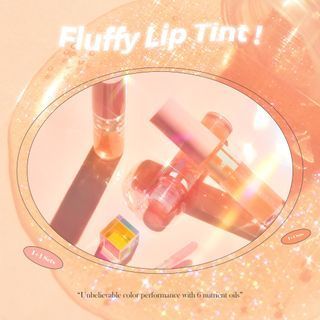
BLESSED MOON Fluffy Lip Tint - 5 Colors
Works for
1 of 1 advertised claim delivered
Moisturizing27 ingredients credited for this claimGood support
“Highly moisturizing lip tint boasts a smooth formula that glides effortlessly on lips, delivering a lightweight texture and vivid pigmentation.”
This product can help improve hydration of the skin with the two types of ingredients.
The first type is called “humectants”:
these ingredients help attract water.
When humectants are on the surface of the skin, they “pull in” the moisture from the outside environment, or from
within deeper layers of the skin. The following ingredients in this product do the job:
glycerin, butylene glycol.
This product also contains ingredients called “occlusives”. They help reduce the speed with which our skin loses moisture to the outside environment. These ingredients also help soften the upper layer of the skin, so it feels less tight and nicer to the touch. The following ingredients in this product do the job: butyrospermum parkii butter, dimethicone.
Can it cause trouble?
Irritancy2 strong irritants: Parfum, Alcohol — patch-test recommendedHigh risk
Comedogenic5 ingredients rated 2 or more on the 0–5 pore-clogging scale5 flagged
User reviews
Be the first — your take helps the next person decide.
Ingredients
Filter by role to see what each ingredient is doing.
Tocopheryl acetate~29–36%
- Irritation risk
- Medium
A more stable but less bio-available form of vitamin E compared to Tocopherol. Might help moisturize and protect the skin from free radicals, but mostly used in low concentrations to stabilize other ingredients.
More about Tocopheryl acetateParfum~4–4.9%
- Irritation risk
- High
An aromatic blend of unspecified and possibly irritating ingredients
More about ParfumCamellia japonica seed oil~5–6.2%
- Irritation risk
- Low
A plant oil that helps to soften the upper layer of the skin and can help restore skin's barrier function. Might have an anti-oxidant effect
More about Camellia japonica seed oilGossypium herbaceum seed oil~3.6–4.5%
- Irritation risk
- Low
- Comedogenicity
- 3/5
Cottonseed oil. It is used as an emollient and occlusive in products. It is rich palmitic, oleic acid, and linoleic fatty acids.
More about Gossypium herbaceum seed oilMangifera indica seed oil~2.7–3.3%
- Irritation risk
- Low
Persea gratissima oil~2.3–2.8%
- Irritation risk
- Medium
An emollient that helps soften the skin and could be helpful in repairing its barrier function
More about Persea gratissima oilPrunus amygdalus dulcis seed~1.7–2.1%
- Irritation risk
- Low
Helps soften the upper layer of the skin
More about Prunus amygdalus dulcis seedPrunus armeniaca kernel oil~1.6–1.9%
- Irritation risk
- Medium
An emollient that helps soften the skin
More about Prunus armeniaca kernel oilSimmondsia chinensis seed oil~1.5–1.8%
- Irritation risk
- Medium
Softens the upper layer of skin and helps restore the healthy skin barrier. Has shown to help calm down inflammation in skin. It is a stable oil, meaning that it retains its properties even when exposed to air.
More about Simmondsia chinensis seed oilButyrospermum parkii butter~1.1–1.3%
- Irritation risk
- Low
- Comedogenicity
- 3/5
A great moisturising ingredient that softens the skin and reduces water loss from its upper layer. It also can be helpful in protecting skin from free radicals
More about Butyrospermum parkii butterArgania spinosa kernel oil~0.8–1.2%
- Irritation risk
- Medium
An emollient that helps soften the upper layer of the skin. Might have some weak anti-oxidant properties
More about Argania spinosa kernel oilOenothera biennis oil~0.7–1%
- Irritation risk
- Medium
Helps soften the upper layer of the skin and can support skin barrier function
More about Oenothera biennis oilCaprylic/capric triglyceride~0.65–1%
- Irritation risk
- Medium
A good mix of fatty acids that forms a protective layer on the skin. Improves the shelf life of products. Derived from coconut and glycerin
More about Caprylic/capric triglycerideOlea europaea fruit oil~0.55–0.85%
- Irritation risk
- Medium
An emollient that helps soften the skin but is not effective for restoring its barrier function. Might be helpful to calm down inflammation
More about Olea europaea fruit oilRosa canina fruit extract~0.45–0.7%
- Irritation risk
- Medium
A plant extract that might have some anti-oxidant properties, but evidence is lacking
More about Rosa canina fruit extractMangifera indica fruit extract~0.45–0.7%
- Irritation risk
- Medium
A fruit extract that might help attract water to the upper layer of the skin. There is no evidence of other benefits in skin
More about Mangifera indica fruit extractTocopherol~0.45–0.7%
- Irritation risk
- Low
Pure form of vitamin E. Can help moisturise and protect the skin from free radicals. Often used to help stabilise other ingredients or the formula itself
More about TocopherolWater~0.45–0.65%
Ci 17200~0.4–0.6%
Disteardimonium hectorite~0.35–0.6%
- Irritation risk
- Low
A type of clay that is used to thicken the product consistency
More about Disteardimonium hectoritePentylene glycol~0.45–0.65%
- Irritation risk
- Medium
Used to preserve products, dissolve other ingredients and create a nice product texture
More about Pentylene glycolAlcohol~0.3–0.6%
- Irritation risk
- High
Can be drying and contribute to skin irritation. Used in formulars to dissolve other ingredients, create a thinner product consistency or for its antibacterial properties
More about AlcoholHydrogenated polyisobutene~0.45–0.65%
- Irritation risk
- Low
Used to improve the product consistency and soften the upper layer of the skin
More about Hydrogenated polyisobuteneTitanium dioxide~0.5–0.7%
- Irritation risk
- Low
Works as a UV filter when used in high concentrations. It is photostable and is effective mostly against the UVB light, with some protection in the UVA range. In small concentrations, used for its ability to improve the color of cosmetic products. Is usually well tolerated by the skin
More about Titanium dioxideCi 77891~0.3–0.55%
- Irritation risk
- Low
Polyglyceryl-2 triisostearate~0.4–0.6%
- Irritation risk
- Low
Helps to soften the upper layer of the skin and create a nice product texture
More about Polyglyceryl-2 triisostearatePeg-60 hydrogenated castor oil~0.4–0.6%
- Irritation risk
- Medium
Helps oil and water mix together
More about Peg-60 hydrogenated castor oilTris(tetramethylhydroxypiperidinol) citrate~0.35–0.6%
- Irritation risk
- Low
Peg-10 dimethicone~0.45–0.7%
- Irritation risk
- Low
A silicone that works to soften the upper layer of the skin and reduce its water loss
More about Peg-10 dimethiconeAcrylates copolymer~0.4–0.6%
- Irritation risk
- Medium
Used to stabilize product formulation, help create an even product layer over skin (for example, in sunscreen) and create a thicker product consistency
More about Acrylates copolymerCi 17200~0.35–0.6%
Cyclopentasiloxane~0.45–0.65%
- Irritation risk
- Low
A silicone that helps improve the product texture and spreadability. Can absorb oil creating a short-term mattifying effect on the skin
More about CyclopentasiloxaneIron oxides~0.3–0.55%
- Irritation risk
- Low
An umbrella term for the following three colorants: CI 77491, CI 77492, CI 77499. They might be able to offer some protection against visible light, but the degree of the protection is not clear
More about Iron oxidesCi 77491~0.35–0.6%
- Irritation risk
- Low
A red colorant made of iron oxide. Typically is not irritating
More about Ci 77491Ci 45410~0.35–0.6%
Dibutyl lauroyl glutamide~0.35–0.65%
- Irritation risk
- Medium
Helps improve the product texture and soften the upper layer of the skin
More about Dibutyl lauroyl glutamidePropylene carbonate~0.4–0.6%
- Irritation risk
- Low
Is used to dissolve other ingredients and create nice product texture
More about Propylene carbonateIron oxides~0.3–0.55%
- Irritation risk
- Low
An umbrella term for the following three colorants: CI 77491, CI 77492, CI 77499. They might be able to offer some protection against visible light, but the degree of the protection is not clear
More about Iron oxidesCi 77499~0.35–0.6%
Ethylhexylglycerin~0.35–0.6%
Sorbitan stearate~0.35–0.65%
Calcium sodium borosilicate~0.4–0.6%
Ci 15985~0.35–0.6%
Hydrogenated didecene~0.3–0.6%
- Irritation risk
- Low
Cyclohexasiloxane~0.45–0.65%
- Irritation risk
- Low
A silicone that serves as an emollient. Helps create a nice non-greasy feels
More about CyclohexasiloxaneCi 45410~0.35–0.6%
Ethylhexyl hydroxystearate~0.45–0.7%
- Irritation risk
- Low
Helps soften the upper layer of the skin and reduce water loss from it
More about Ethylhexyl hydroxystearateTriethoxycaprylylsilane~0.35–0.6%
- Irritation risk
- Low
A type of silicone that helps oil and water mix well together. Helps to disperse other ingredients, e.g. pigments, evenly in a formulation
More about TriethoxycaprylylsilaneDipropylene glycol~0.3–0.55%
- Irritation risk
- Low
Helps to dissolve other ingredients in a formulation. Slows down the rate of product drying
More about Dipropylene glycolDimethicone/vinyl dimethicone crosspolymer~0.35–0.6%
- Irritation risk
- Low
Used to stabilize product formulations and create a nice product texture
More about Dimethicone/vinyl dimethicone crosspolymerAluminum hydroxide~0.45–0.7%
- Irritation risk
- Low
Is used to add opaque (non-transparent) appearance to formulations. Can be used to coat other ingredients for even dispersion. This is a different ingredient compared to the ones used in antipersperants (aluminium chloride and aluminium chlorohydrate)
More about Aluminum hydroxideIsododecane~0.4–0.6%
- Irritation risk
- Low
An emollient that helps soften the skin and can decrease moisture loss. Helps create a nice product texture
More about IsododecaneGlycerin~0.4–0.6%
- Irritation risk
- Low
One of the best moisturizing ingredients. Naturally present in skin. It attracts water to the upper layer of the skin working as a humectant
More about GlycerinDibutyl ethylhexanoyl glutamide~0.3–0.6%
- Irritation risk
- Medium
Helps improve the product texture and soften the upper layer of the skin
More about Dibutyl ethylhexanoyl glutamidePhenoxyethanol~0.3–0.6%
- Irritation risk
- Low
A preservative. It helps prevent bacterial growth in cosmetic products
More about PhenoxyethanolOctyldodecanol~0.4–0.65%
- Irritation risk
- Low
An emollient that helps to soften the skin and create a pleasant product texture and stabilize the formulation
More about OctyldodecanolCi 19140~0.35–0.6%
Ci 15985~0.3–0.6%
Ethylcellulose~0.35–0.65%
- Irritation risk
- Low
Dimethicone~0.45–0.7%
- Irritation risk
- Low
A silicone that helps to reduce water loss from the surface of the skin. Can temporarily "fill in" lines and wrinkles, absorb oil, and create a nice product finish
More about DimethiconeEthylene/va copolymer~0.35–0.6%
- Irritation risk
- Low
Sodium acrylate/sodium acryloyldimethyl taurate copolymer~0.3–0.6%
- Irritation risk
- Low
Used to create a thicker product consistency
More about Sodium acrylate/sodium acryloyldimethyl taurate copolymerDextrin palmitate~0.3–0.6%
- Irritation risk
- Medium
Helps water and oil mix together
More about Dextrin palmitateHydroxyacetophenone~0.3–0.55%
Silica dimethyl silylate~0.35–0.65%
Polybutylene terephthalate~0.3–0.55%
- Irritation risk
- Low
Tin oxide~0.45–0.65%
- Irritation risk
- Low
A colorant that can add a pearl-like appearance to the formulation
More about Tin oxideButylene glycol~0.2–0.35%
- Irritation risk
- Low
Used to create a nice product texture and help delivery of other ingredients. Might be somewhat helpful in attracting water to the upper layer of the skin
More about Butylene glycol1,2-hexanediol~0.15–0.25%
Laureth-8~0.2–0.4%
Disodium edta~0.15–0.3%
Cetearyl alcohol~0.25–0.5%
- Irritation risk
- Low
- Comedogenicity
- 2/5
A non-drying alcohol. Works as an emollient. Helps water and oil mix together and creates a nice product texture
More about Cetearyl alcoholDiisostearyl malate~0.25–0.45%
- Irritation risk
- Medium
Helps to soften the upper layer of the skin
More about Diisostearyl malateIngredient list view
Tocopheryl acetate, Parfum, Camellia japonica seed oil, Gossypium herbaceum seed oil, Mangifera indica seed oil, Persea gratissima oil, Prunus amygdalus dulcis seed, Prunus armeniaca kernel oil, Simmondsia chinensis seed oil, Butyrospermum parkii butter, Argania spinosa kernel oil, Oenothera biennis oil, Caprylic/capric triglyceride, Olea europaea fruit oil, Rosa canina fruit extract, Mangifera indica fruit extract, Tocopherol, Water, Ci 17200, Disteardimonium hectorite, Pentylene glycol, Alcohol, Hydrogenated polyisobutene, Titanium dioxide, Ci 77891, Polyglyceryl-2 triisostearate, Peg-60 hydrogenated castor oil, Tris(tetramethylhydroxypiperidinol) citrate, Peg-10 dimethicone, Acrylates copolymer, Ci 17200, Cyclopentasiloxane, Iron oxides, Ci 77491, Ci 45410, Dibutyl lauroyl glutamide, Propylene carbonate, Iron oxides, Ci 77499, Ethylhexylglycerin, Sorbitan stearate, Calcium sodium borosilicate, Ci 15985, Hydrogenated didecene, Cyclohexasiloxane, Ci 45410, Ethylhexyl hydroxystearate, Triethoxycaprylylsilane, Dipropylene glycol, Dimethicone/vinyl dimethicone crosspolymer, Aluminum hydroxide, Isododecane, Glycerin, Dibutyl ethylhexanoyl glutamide, Phenoxyethanol, Octyldodecanol, Ci 19140, Ci 15985, Ethylcellulose, Dimethicone, Ethylene/va copolymer, Sodium acrylate/sodium acryloyldimethyl taurate copolymer, Dextrin palmitate, Hydroxyacetophenone, Silica dimethyl silylate, Polybutylene terephthalate, Tin oxide, Butylene glycol, 1,2-hexanediol, Laureth-8, Disodium edta, Cetearyl alcohol, Diisostearyl malate
Compare prices
Retailers ranked by price — lowest first.

Affiliate links · prices updated regularly
Sources cited in this review
Every concentration estimate and effectiveness label is anchored to one of these 18 studies and safety reviews.
- 1
- 2Use of “natural” oils for moisturization: Review of olive, coconut, and sunflower seed oilonlinelibrary.wiley.com
- 3Vitamin E in dermatologyncbi.nlm.nih.gov
- 4Vitamin E and Skin Healthlpi.oregonstate.edu
- 5
- 6

Affiliate links · As an Amazon Associate, WIMJ earns from qualifying purchases.