Works for:
based on ingredients and %- Anti-aging
- Moisturizing
- Evens skin tone
- Exfoliation
Can it cause trouble?
- Irritation risk: high
- Comedogenic risk ingredients: 7
Key actives

Product Summary
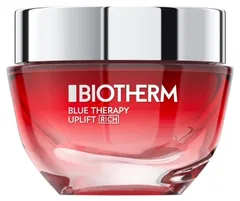
"BIOTHERM - Blue Therapy Red Algae Uplift Rich Rich Firming Dew Cream" is effective for: Moisturizing, Exfoliation and Anti-aging
This product could be helpful for: Evens skin tone, but its actives are not the most effective or are not well-studied.
Ingredient callouts
- Peptides (palmitoyl tripeptide-1 0.20% - 0.40% and palmitoyl tetrapeptide-7 0.20% - 0.35%). Peptides are a very big group of ingredients. They all consist of a different combination of aminoacids. Our skin produces Peptides naturally. Some of them work as natural antibiotics, promote wound-healing and production of collagen. The scientists are still studying how effective the topical application of Peptides is, but it is very likely that theynare helpful. Peptides might be able to support skin barrier restoration and even have an anti-aging benefit. At the very least, they certainly help attract water to the skin and support the hydration in this way.
- Adenosine 0.15% - 0.30%. It is a compound that in involved in many biological processes inside the skin cells. According one high-quality clinical trial, topical Adenosine in low concentrations can somewhat help improve "deep wrinkles" - the wrinkles that appear with age in places where our faces are most dynamic (for example, on the forehead or in the corners of the eyes).
- Humectants (sodium lactate 0.15% - 0.30%, glyceryl acrylate/acrylic acid copolymer 0.15% - 0.30% and glycerin 5.20% - 6.40%). These ingredients help attract water to the upper layer of the skin and improve the skin hydration.
Price
The product retails for 51.25£ in the United Kingdom.
For a detailed price comparison: click here.
Anti-aging
What does the product description say?
It's enriched with a combination of collagen peptide fractions and Life Plankton to help boost firmness, offering a targeted solution for firming skin and fighting the signs of skin aging.
Source: Cocoon Center
This product can help reduce and prevent fine lines and wrinkles, improve skin elasticity and firmness because it contains adenosine.
These ingredients in the product can also be helpful, even though there is less evidence for their effectiveness: palmitoyl tetrapeptide-7, palmitoyl tripeptide-1.
Keep in mind that it typically takes at least 6 weeks to notice any results because the changes that are needed to improve fine lines and elasticity happen in the deeper layers of the skin. No topical anti-aging product can “erase” wrinkles or fully reverse signs of aging.
Might help improve cell turnover and reduce inflammation in skin. One study shows that the ingredients might be able to help reduce dynamic wrinkles (for example, in the corners of the eyes or on the forehead)
A type of peptide. Peptides are excellent moisturizers and might be able support collagen production reducing fine lines and wrinkles
A type of peptide. Peptides are excellent moisturizers and might be able support collagen production reducing fine lines and wrinkles
Pure form of vitamin E. Can help moisturise and protect the skin from free radicals. Often used to help stabilise other ingredients or the formula itself
A great moisturising ingredient that softens the skin and reduces water loss from its upper layer. It also can be helpful in protecting skin from free radicals
Works as a humectant helping to attract water to the upper layer of the skin and might be effective as an anti-oxidant.
Being a lipid soluble form of vitamin C, it is more stable and can penetrate the skin better than L-Ascorbic acid. It is effective in protecting the skin from free radicals, as well as evening the skin tone, but is less effective in stimulating collagen production compared to L-Ascorbic acid.
Exfoliation
This product can help exfoliate the skin. In other words, it helps break down the bonds between dead cells on the surface of the skin and speed up the skin turnover. Skin often appears softer and brighter after exfoliation, but overdoing it can result in disrupted skin barrier. The following ingredient is doing the exfoliating job in this product: capryloyl salicylic acid.
Moisturizing
What does the product description say?
This moisturizing cream, ideal for dry skin, leaves an ultra-comfortable finish.
Source: Cocoon Center
This product can help improve hydration of the skin with the two types of ingredients.
The first type is called “humectants”:
these ingredients help attract water.
When humectants are on the surface of the skin, they “pull in” the moisture from the outside environment, or from
within deeper layers of the skin. The following ingredients in this product do the job:
glycerin, glyceryl acrylate/acrylic acid copolymer.
This product also contains ingredients called “occlusives”. They help reduce the speed with which our skin loses moisture to the outside environment. These ingredients also help soften the upper layer of the skin, so it feels less tight and nicer to the touch. The following ingredients in this product do the job: cera alba, squalane.
The following ingredients in this product are especially good for supporting the skin barrier and helping with the hydration level: palmitoyl tetrapeptide-7, palmitoyl tripeptide-1
Helps attract water to the upper layer of the skin. Is often used to adjust the pH level of the product
An oil naturally present in skin. Works as an emollient to soften the skin and form a protective layer on its surface without a greasy feeling.
Helps soften the upper layer of the skin and slow down the water loss over time
Forms a protective barrier that holds water and keeps dry skin hydrated. Keeps an emulsion from separating into its oil and liquid components, and increases the thickness of a product. Can be an allergen
One of the best moisturizing ingredients. Naturally present in skin. It attracts water to the upper layer of the skin working as a humectant
Helps attract water to the upper layer of the skin and provide a longer-lasting hydration. Can create a thicker product consistency
A sugar-derived compound that helps to attract water to the upper layer of the skin and might be able to stimulate synthesis of skin's own moisturizing factors, but solid research is lacking. It could be irritating
Helps soften the upper layer of the skin and might have some anti-oxidant properties
A type of peptide. Peptides are excellent moisturizers and might be able support collagen production reducing fine lines and wrinkles
A type of peptide. Peptides are excellent moisturizers and might be able support collagen production reducing fine lines and wrinkles
A good emollient helping to soften the skin. Might have some anti-oxidant properties. Adds a fragrance to the product
A good moisturizing plant oil. Due to the high linoleic acid content, it helps soften the upper layer of the skin, reduce water loss and support skin barrier function
Helps attract water to the upper layer of the skin. Might have some anti-aging, anti-oxidant, and skin lightening properties, but solid evidence is missing
A non-drying alcohol that works to soften the skin and stabilize product formulations helping oil and water mix together
A plant extract that helps attract water to the upper layer of the skin and can help neutralize free radicals
Might help improve cell turnover and reduce inflammation in skin. One study shows that the ingredients might be able to help reduce dynamic wrinkles (for example, in the corners of the eyes or on the forehead)
Improves the texture of the product and helps soften the skin. Helps oil and water mix together and can be used as a cleansing agent
An emollient that helps to soften the skin and create a pleasant product texture and stabilize the formulation
Used to preserve products, dissolve other ingredients and create a nice product texture
An emollient that softens the skin and forms a protective layer on its surface. Helps water and oil mix together
Helps oil and water mix together and can enhance the penetration of other ingredients into the skin. It can be irritating
Used to create a nice product texture and help delivery of other ingredients. Might be somewhat helpful in attracting water to the upper layer of the skin
Helps soften the upper layer of the skin and create a nice product texture
A great moisturising ingredient that softens the skin and reduces water loss from its upper layer. It also can be helpful in protecting skin from free radicals
An emollient that helps soften the upper layer of the skin. Might have some weak anti-oxidant properties
A good mix of fatty acids that forms a protective layer on the skin. Improves the shelf life of products. Derived from coconut and glycerin
An emollient that helps soften the skin
An emollient. Is not recommended for acne-prone skin as it can be comedogenic
Works as a humectant helping to attract water to the upper layer of the skin and might be effective as an anti-oxidant.
Pure form of vitamin E. Can help moisturise and protect the skin from free radicals. Often used to help stabilise other ingredients or the formula itself
Anti-oxidation
This product contains antioxidants (castanea sativa seed extract) that might be able to help neutralize free radicals in skin to lessen the damage it gets from the UV light (sun). There is not enough evidence to confirm their effectiveness in skin though.
A plant extract that helps attract water to the upper layer of the skin and can help neutralize free radicals
Might help improve cell turnover and reduce inflammation in skin. One study shows that the ingredients might be able to help reduce dynamic wrinkles (for example, in the corners of the eyes or on the forehead)
Helps attract water to the upper layer of the skin. Might have some anti-aging, anti-oxidant, and skin lightening properties, but solid evidence is missing
Pure form of vitamin E. Can help moisturise and protect the skin from free radicals. Often used to help stabilise other ingredients or the formula itself
Works as a humectant helping to attract water to the upper layer of the skin and might be effective as an anti-oxidant.
A great moisturising ingredient that softens the skin and reduces water loss from its upper layer. It also can be helpful in protecting skin from free radicals
An emollient that helps soften the skin
An emollient that helps soften the upper layer of the skin. Might have some weak anti-oxidant properties
Being a lipid soluble form of vitamin C, it is more stable and can penetrate the skin better than L-Ascorbic acid. It is effective in protecting the skin from free radicals, as well as evening the skin tone, but is less effective in stimulating collagen production compared to L-Ascorbic acid.
Evens skin tone
What does the product description say?
Biotherm Blue Peptides Uplift Rich Firming Cream 50 ml is a cream that can be used daily to restore elasticity, radiance and tone to your skin.
Source: Cocoon Center
The following ingredient (ingredients) in this product might be helpful, but there is no evidence to confirm that it actually works: capryloyl salicylic acid.
Helps attract water to the upper layer of the skin. Might have some anti-aging, anti-oxidant, and skin lightening properties, but solid evidence is missing
How honest is this product?
| Promise | Can it deliver? |
|---|---|
| Anti-aging | |
| Moisturizing | |
| Evens skin tone |
Total Promises Fulfilled score: 91/100.
We receive a small commission for purchases made through these links at no cost for you. Thank you for your support! Learn more
Affiliate link · supports WIMJ at no cost to you
Potential irritants
Comedogenic ingredients
User reviews (0)
Averages from community submissions.
No reviews yet for this product.
Be the first to share your experience!
Tried this product?
Help capture what the ingredient list can't—texture, finish, pilling, scent, and more. Answer what you can, skip the rest.
Takes ~30 seconds.
Reviews are shown in aggregate. No personal details.
| Product | Similarity | Price | Irritancy |
|---|---|---|---|
 BIOTHERM Blue Therapy Red Algae Uplift Rich Rich Firming Dew Cream | Current | ≈ $71.88 | |
Paula's choice Resist Intensive Repair Cream | 53% | ≈ $34.10 | |
 Institut Esthederm Excellage Re-Densifying Face Cream | 53% | ≈ $82.87 | |
 Dr Dennis Gross DermInfusions Blur + Repair Cream with Hyaluronic Acid and Peptides | 52% | - | |
Abib YesStyle Exclusive PDRN Volume Fill-it Booster Crème 2.5 Tube Mini 5pcs Bundle Set | 52% | $37.53 | |
 L'Oréal Group Collagen Expert Night Moisturizer for Maturing, Dry Skin | 51% | $19.99 |
Key Actives
Pure form of vitamin E. Can help moisturise and protect the skin from free radicals. Often used to help stabilise other ingredients or the formula itself
A great moisturising ingredient that softens the skin and reduces water loss from its upper layer. It also can be helpful in protecting skin from free radicals
Might help improve cell turnover and reduce inflammation in skin. One study shows that the ingredients might be able to help reduce dynamic wrinkles (for example, in the corners of the eyes or on the forehead)
An emollient that helps soften the upper layer of the skin. Might have some weak anti-oxidant properties
Forms a protective barrier that holds water and keeps dry skin hydrated. Keeps an emulsion from separating into its oil and liquid components, and increases the thickness of a product. Can be an allergen
A good moisturizing plant oil. Due to the high linoleic acid content, it helps soften the upper layer of the skin, reduce water loss and support skin barrier function
An emollient that helps soften the skin
A plant extract that helps attract water to the upper layer of the skin and can help neutralize free radicals
A type of peptide. Peptides are excellent moisturizers and might be able support collagen production reducing fine lines and wrinkles
A type of peptide. Peptides are excellent moisturizers and might be able support collagen production reducing fine lines and wrinkles
One of the best moisturizing ingredients. Naturally present in skin. It attracts water to the upper layer of the skin working as a humectant
A sugar-derived compound that helps to attract water to the upper layer of the skin and might be able to stimulate synthesis of skin's own moisturizing factors, but solid research is lacking. It could be irritating
An oil naturally present in skin. Works as an emollient to soften the skin and form a protective layer on its surface without a greasy feeling.
An emollient. Is not recommended for acne-prone skin as it can be comedogenic
A good emollient helping to soften the skin. Might have some anti-oxidant properties. Adds a fragrance to the product
Helps soften the upper layer of the skin and might have some anti-oxidant properties
Helps attract water to the upper layer of the skin and provide a longer-lasting hydration. Can create a thicker product consistency
Helps attract water to the upper layer of the skin. Is often used to adjust the pH level of the product
Helps soften the upper layer of the skin and slow down the water loss over time
A good mix of fatty acids that forms a protective layer on the skin. Improves the shelf life of products. Derived from coconut and glycerin
Works as a UV filter when used in high concentrations. It is photostable and is effective mostly against the UVB light, with some protection in the UVA range. In small concentrations, used for its ability to improve the color of cosmetic products. Is usually well tolerated by the skin
Potential irritants
A sugar-derived compound that helps to attract water to the upper layer of the skin and might be able to stimulate synthesis of skin's own moisturizing factors, but solid research is lacking. It could be irritating
Produces temporary toning effect. Can help dissolve other ingredients or preserve products
Helps oil and water mix together and can enhance the penetration of other ingredients into the skin. It can be irritating
A good emollient helping to soften the skin. Might have some anti-oxidant properties. Adds a fragrance to the product
A common frangrance that can easily irritate skin, especially if exposed to air, light or heat
An aromatic blend of unspecified and possibly irritating ingredients
An emollient that helps soften the upper layer of the skin. Might have some weak anti-oxidant properties
Forms a protective barrier that holds water and keeps dry skin hydrated. Keeps an emulsion from separating into its oil and liquid components, and increases the thickness of a product. Can be an allergen
An emollient. Is not recommended for acne-prone skin as it can be comedogenic
Helps thicken the product formula and create a nice product formulation
A plant extract that helps attract water to the upper layer of the skin and can help neutralize free radicals
Helps attract water to the upper layer of the skin and provide a longer-lasting hydration. Can create a thicker product consistency
Helps attract water to the upper layer of the skin. Is often used to adjust the pH level of the product
A good mix of fatty acids that forms a protective layer on the skin. Improves the shelf life of products. Derived from coconut and glycerin
Can work as an exfoliant but is typically used to adjust the product pH
Used to improve stability of the formulation
Used to preserve products, dissolve other ingredients and create a nice product texture
Being a lipid soluble form of vitamin C, it is more stable and can penetrate the skin better than L-Ascorbic acid. It is effective in protecting the skin from free radicals, as well as evening the skin tone, but is less effective in stimulating collagen production compared to L-Ascorbic acid.
Comedogenic ingredients
A great moisturising ingredient that softens the skin and reduces water loss from its upper layer. It also can be helpful in protecting skin from free radicals
An emollient. Is not recommended for acne-prone skin as it can be comedogenic
A good moisturizing plant oil. Due to the high linoleic acid content, it helps soften the upper layer of the skin, reduce water loss and support skin barrier function
Helps thicken the product formula and create a nice product formulation
All ingredients
One of the best moisturizing ingredients. Naturally present in skin. It attracts water to the upper layer of the skin working as a humectant
An emollient that helps to soften the skin and create a pleasant product texture and stabilize the formulation
Helps soften the upper layer of the skin and create a nice product texture
Used to create a nice product texture and help delivery of other ingredients. Might be somewhat helpful in attracting water to the upper layer of the skin
A sugar-derived compound that helps to attract water to the upper layer of the skin and might be able to stimulate synthesis of skin's own moisturizing factors, but solid research is lacking. It could be irritating
Produces temporary toning effect. Can help dissolve other ingredients or preserve products
A non-drying alcohol that works to soften the skin and stabilize product formulations helping oil and water mix together
An emollient that softens the skin and forms a protective layer on its surface. Helps water and oil mix together
An emollient that helps soften the upper layer of the skin. Might have some weak anti-oxidant properties
Helps oil and water mix together and can enhance the penetration of other ingredients into the skin. It can be irritating
Helps oil and water mix togehter and creates a nice product texture
Forms a protective barrier that holds water and keeps dry skin hydrated. Keeps an emulsion from separating into its oil and liquid components, and increases the thickness of a product. Can be an allergen
An oil naturally present in skin. Works as an emollient to soften the skin and form a protective layer on its surface without a greasy feeling.
A great moisturising ingredient that softens the skin and reduces water loss from its upper layer. It also can be helpful in protecting skin from free radicals
An emollient. Is not recommended for acne-prone skin as it can be comedogenic
A good moisturizing plant oil. Due to the high linoleic acid content, it helps soften the upper layer of the skin, reduce water loss and support skin barrier function
Works as a humectant helping to attract water to the upper layer of the skin and might be effective as an anti-oxidant.
Helps thicken the product formula and create a nice product formulation
A good emollient helping to soften the skin. Might have some anti-oxidant properties. Adds a fragrance to the product
A plant extract that helps attract water to the upper layer of the skin and can help neutralize free radicals
Helps soften the upper layer of the skin and might have some anti-oxidant properties
A colorant that can add a pearl-like appearance to the formulation
Helps create a thicker or gel-like product texture. It is not a surfactant but can be used in gentle cleansing formulations
Helps attract water to the upper layer of the skin and provide a longer-lasting hydration. Can create a thicker product consistency
Used to dissolve other ingredients in a product and can enhance their ability to penetrate the skin
Improves the texture of the product and helps soften the skin. Helps oil and water mix together and can be used as a cleansing agent
Used to stabilize mixtures of oil and water, and create thicker, gel-like product textures
Helps attract water to the upper layer of the skin. Is often used to adjust the pH level of the product
Helps soften the upper layer of the skin and slow down the water loss over time
A type of peptide. Peptides are excellent moisturizers and might be able support collagen production reducing fine lines and wrinkles
A type of peptide. Peptides are excellent moisturizers and might be able support collagen production reducing fine lines and wrinkles
Might help improve cell turnover and reduce inflammation in skin. One study shows that the ingredients might be able to help reduce dynamic wrinkles (for example, in the corners of the eyes or on the forehead)
Helps attract water to the upper layer of the skin. Might have some anti-aging, anti-oxidant, and skin lightening properties, but solid evidence is missing
A good mix of fatty acids that forms a protective layer on the skin. Improves the shelf life of products. Derived from coconut and glycerin
Can work as an exfoliant but is typically used to adjust the product pH
Used to improve stability of the formulation
A mineral that is used as an optical filter (makes the skin looks nicer through light reflection) and to improve the texture of cosmetic products
Used to preserve products, dissolve other ingredients and create a nice product texture
Helps water and oil mix together and create gel-like textures
Pure form of vitamin E. Can help moisturise and protect the skin from free radicals. Often used to help stabilise other ingredients or the formula itself
Being a lipid soluble form of vitamin C, it is more stable and can penetrate the skin better than L-Ascorbic acid. It is effective in protecting the skin from free radicals, as well as evening the skin tone, but is less effective in stimulating collagen production compared to L-Ascorbic acid.
Used to increase stability of product formulations
A preservative. It helps prevent bacterial growth in cosmetic products
An umbrella term for the following three colorants: CI 77491, CI 77492, CI 77499. They might be able to offer some protection against visible light, but the degree of the protection is not clear
Works as a UV filter when used in high concentrations. It is photostable and is effective mostly against the UVB light, with some protection in the UVA range. In small concentrations, used for its ability to improve the color of cosmetic products. Is usually well tolerated by the skin
Creates an illusion of smoother and more radiant skin tone. Adds shimmer to the skin by reflecting light
A common frangrance that can easily irritate skin, especially if exposed to air, light or heat
An aromatic blend of unspecified and possibly irritating ingredients
Ingredient list view
Water, Glycerin, Octyldodecanol, C15-19 alkane, Butylene glycol, Hydroxypropyl tetrahydropyrantriol, Alcohol denat., Cetyl alcohol, Glyceryl stearate, Zea mays germ oil, Argania spinosa kernel oil, Propylene glycol, Peg-100 stearate, Cera alba, Squalane, Butyrospermum parkii butter, Myristyl myristate, Zea mays oil, Prunus armeniaca kernel oil, Alaria esculenta extract, Carrageenan, Passiflora edulis seed oil, Castanea sativa seed extract, Oryza sativa bran oil, Tin oxide, Sorbitan oleate, Sorbitan tristearate, Carbomer, Talc, Glyceryl acrylate/acrylic acid copolymer, Dimethyl isosorbide, Isohexadecane, Sodium chloride, Sodium hydroxide, Sodium lactate, 2-oleamido-1,3-octadecanediol, Palmitoyl tetrapeptide-7, Palmitoyl tripeptide-1, Adenosine, Hydrolyzed rhodophyceae extract, Hydrolyzed soy protein, Caprylic/capric triglyceride, Capryloyl salicylic acid, Vitreoscilla ferment, Citric acid, Trisodium ethylenediamine disuccinate, Xanthan gum, Synthetic fluorphlogopite, Pentylene glycol, Ethylhexylglycerin, Polysorbate 20, Polysorbate 80, Acrylamide/sodium acryloyldimethyltaurate copolymer, Tocopherol, Ascorbyl palmitate, Pentaerythrityl tetra-di-t-butyl hydroxyhydrocinnamate, Phenoxyethanol, Chlorphenesin, Ci 77163, Iron oxides, Titanium dioxide, Mica, Linalool, Geraniol, Limonene, Citronellol, Parfum
- Glycerol and the skin: holistic approach to its origin and functions
- A Compensating Skin Care Complex Containing Pro-xylane in Menopausal Women: Results from a Multicentre, Evaluator-blinded, Randomized Study
- Synthesis of Pro-XylaneTM: A new biologically active C-glycoside in aqueous media
- First case of contact dermatitis caused by hydroxypropyl tetrahydropyrantriol used in an anti-ageing cream
- Natural vegetable fats in the prevention of irritant contact dermatitis
- Surfactants and experimental irritant contact dermatitis
- Propylene Glycol
- Skin-sensitizing and irritant properties of propylene glycol
- Efficacy of barrier creams in comparison to skin care products in dental laboratory technicians--a controlled trial
- Content of fatty acids in corn (Zea mays L.) oil from Ecuador
- Chestnut extract
- Study on the Composition of Rice Bran Oil and Its Higher Free Fatty Acids Value
- Safety Assessment of Tin(IV) Oxide as Used in Cosmetics
- Final report on the safety assessment of sorbitan caprylate, sorbitan cocoate, sorbitan diisostearate, sorbitan dioleate, sorbitan distearate, sorbitan isostearate, sorbitan olivate, sorbitan sesquiisostearate, sorbitan sesquistearate, and sorbitan triisostearate
- Activity enhancement of ferulic acid with dimethyl isosorbride in cosmetic compositions
- Safety Assessment of Ceramides as Used in Cosmetics
- Evaluation of anti-wrinkle efficacy of adenosine-containing products using the FOITS technique
- Extracts from Glycine max (soybean) induce elastin synthesis and inhibit elastase activity
- Dermatological and cosmeceutical benefits of Glycine max (soybean) and its active components
- Safety Assessment of Soy Peptides as Used in Cosmetics
- Vitamin E in dermatology
- Vitamin E and Skin Health
- Safety Assessment of Pentaerythrityl Tetra-Di-t-Butyl Hydroxyhydrocinnamate as Used in Cosmetics
- Annex I: Clinical evidence regarding sensitisation to individual fragrance chemicals and to natural extracts