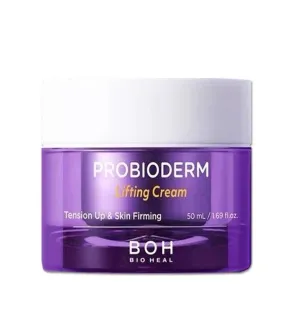
BIOHEAL BOH Probioderm Lifting Cream

BIOHEAL BOH Probioderm Lifting Cream

Efficacy100/100IrritancyHigh

Works for

Anti-aging
Niacinamide, Palmitoyl tripeptide-1 + 11 more
Works well
What the product description says
“Probioderm Lifting Cream”
Source: K-Beauty Makeup

This product can help reduce and prevent fine lines and wrinkles, improve skin elasticity and firmness because it contains adenosine, lactobionic acid, niacinamide.

These ingredients in the product can also be helpful, even though there is less evidence for their effectiveness: acetyl hexapeptide-8, carnosine, copper tripeptide-1, palmitoyl pentapeptide-4, palmitoyl tetrapeptide-7, palmitoyl tripeptide-1, palmitoyl tripeptide-5.

Keep in mind that it typically takes at least 6 weeks to notice any results because the changes that are needed to improve fine lines and elasticity happen in the deeper layers of the skin. No topical anti-aging product can “erase” wrinkles or fully reverse signs of aging.

NiacinamideKey activeEffect: HighIs proven to be effective in reducing blemishes, evening out skin tone and helping to improve lines and wrinkles. It helps the skin to repair sun damage, calm down inflammation and keep maintain good levels of moisture. The concentration of about 2% is effective for supporting the skin barrier and evening out the skin tone. Concentration of 4-6% is better for helping with acne and balancing the sebum production~0.9–1.1%
Palmitoyl tripeptide-1Key activeEffect: MediumA type of peptide. Peptides are excellent moisturizers and might be able support collagen production reducing fine lines and wrinkles~0.25–0.45%
Palmitoyl tetrapeptide-7Key activeEffect: MediumA type of peptide. Peptides are excellent moisturizers and might be able support collagen production reducing fine lines and wrinkles~0.25–0.45%
AdenosineKey activeEffect: HighMight help improve cell turnover and reduce inflammation in skin. One study shows that the ingredients might be able to help reduce dynamic wrinkles (for example, in the corners of the eyes or on the forehead)~0.2–0.35%
Lactobionic acidKey activeEffect: HighA polyhydroxy acid (PHA) that helps shed dead cells from the surface of the skin revealing a smoother, more even skin. PHAs tend to be gentler on the skin compared to AHAs (for example, glycolic acid). It also has hydrating properties and helps attract water to the upper layer of the skin. It can help calm down inflammation in skin and support restoration of the barrier function. It has an anti-oxidant effect as well. It can help reduce fine line, wrinkles and improve skin elasticity~0.2–0.4%
Palmitoyl tripeptide-5Key activeEffect: MediumA type of peptide. Peptides are excellent moisturizers and might be able support collagen production reducing fine lines and wrinkles~0.2–0.35%
CarnosineKey activeEffect: MediumA type of peptide. It attracts water to the upper layer of the skin. It can help neutralize free radicals in skin combatting the sun damage~0.2–0.35%
Palmitoyl pentapeptide-4Key activeEffect: MediumA type of peptide. Peptides are excellent moisturizers and might be able support collagen production reducing fine lines and wrinkles~0.2–0.4%
Acetyl hexapeptide-8Key activeEffect: MediumA type of peptide. Peptides are excellent moisturizers and might be able support collagen production reducing fine lines and wrinkles~0.2–0.35%
Copper tripeptide-1Key activeEffect: MediumA naturally occurring peptide. One of the most studied peptides in dermatology. It is sometimes abbreviated GHK-Cu. Belongs to the class of carrier peptides. It stimulates both synthesis and breakdown of collagen in skin. It is released in skin wounds and inflammation to support healing. It accelerates wound-healing of the skin and can stimulate hair growth. There are preliminary studies that confirm that copper tripeptide can help support collagen production reducing fine lines and wrinkles and decrease inflammation in skin.~0.2–0.4%
Limnanthes alba seed oilEffect: LowThis oil's cmposition is closest to rapeseed oil. It is a very stable oil and serves as an emoillient~1.2–1.4%
Butyrospermum parkii butterEffect: Low, below effective doseA great moisturising ingredient that softens the skin and reduces water loss from its upper layer. It also can be helpful in protecting skin from free radicals~0.35–0.6%
TocopherolEffect: Low, below effective dosePure form of vitamin E. Can help moisturise and protect the skin from free radicals. Often used to help stabilise other ingredients or the formula itself~0.2–0.4%
Moisturizing
Niacinamide, Ceramide np + 41 more
Works well
What the product description says
“Probioderm Lifting Cream”
From product name

This product can help improve hydration of the skin with the two types of ingredients.

The first type is called “humectants”:
these ingredients help attract water. When humectants are on the surface of the skin, they “pull in” the moisture from the outside environment, or from within deeper layers of the skin. The following ingredients in this product do the job: carnosine, fructooligosaccharides.

This product also contains ingredients called “occlusives”. They help reduce the speed with which our skin loses moisture to the outside environment. These ingredients also help soften the upper layer of the skin, so it feels less tight and nicer to the touch. The following ingredients in this product do the job: caprylic/capric triglyceride, dimethicone.

The following ingredients in this product are especially good for supporting the skin barrier and helping with the hydration level: acetyl hexapeptide-8, ceramide np, copper tripeptide-1, lactobionic acid, niacinamide, palmitoyl pentapeptide-4, palmitoyl tetrapeptide-7, palmitoyl tripeptide-1, palmitoyl tripeptide-5

NiacinamideHeroEffect: HighIs proven to be effective in reducing blemishes, evening out skin tone and helping to improve lines and wrinkles. It helps the skin to repair sun damage, calm down inflammation and keep maintain good levels of moisture. The concentration of about 2% is effective for supporting the skin barrier and evening out the skin tone. Concentration of 4-6% is better for helping with acne and balancing the sebum production~0.9–1.1%
Ceramide npHero· EmollientEffect: HighA type of lipid similar to ceramides naturally present in skin. Helps to soften the upper layer of the skin and supports the skin barrier function to keep it hydrated. Can help to prevent inflammation in skin~0.25–0.45%
Palmitoyl tetrapeptide-7Hero· EmollientEffect: HighA type of peptide. Peptides are excellent moisturizers and might be able support collagen production reducing fine lines and wrinkles~0.25–0.45%
Palmitoyl tripeptide-1Hero· EmollientEffect: HighA type of peptide. Peptides are excellent moisturizers and might be able support collagen production reducing fine lines and wrinkles~0.25–0.45%
Copper tripeptide-1HeroEffect: HighA naturally occurring peptide. One of the most studied peptides in dermatology. It is sometimes abbreviated GHK-Cu. Belongs to the class of carrier peptides. It stimulates both synthesis and breakdown of collagen in skin. It is released in skin wounds and inflammation to support healing. It accelerates wound-healing of the skin and can stimulate hair growth. There are preliminary studies that confirm that copper tripeptide can help support collagen production reducing fine lines and wrinkles and decrease inflammation in skin.~0.2–0.4%
Palmitoyl pentapeptide-4HeroEffect: HighA type of peptide. Peptides are excellent moisturizers and might be able support collagen production reducing fine lines and wrinkles~0.2–0.4%
Palmitoyl tripeptide-5HeroEffect: HighA type of peptide. Peptides are excellent moisturizers and might be able support collagen production reducing fine lines and wrinkles~0.2–0.35%
Lactobionic acidHeroEffect: HighA polyhydroxy acid (PHA) that helps shed dead cells from the surface of the skin revealing a smoother, more even skin. PHAs tend to be gentler on the skin compared to AHAs (for example, glycolic acid). It also has hydrating properties and helps attract water to the upper layer of the skin. It can help calm down inflammation in skin and support restoration of the barrier function. It has an anti-oxidant effect as well. It can help reduce fine line, wrinkles and improve skin elasticity~0.2–0.4%
Acetyl hexapeptide-8Hero· HumectantEffect: HighA type of peptide. Peptides are excellent moisturizers and might be able support collagen production reducing fine lines and wrinkles~0.2–0.35%
Lactobacillus fermentKey active· HumectantEffect: HighA fermentation product created by bacteria Lactobacillus. The fermented product has anti-bacterial properties and might be helpful in calming down inflammation, but studies are lacking. Helps attract water to the upper layer of the skin. Can be used as a preservative~4.5–5.5%
GlycerinKey active· HumectantEffect: HighOne of the best moisturizing ingredients. Naturally present in skin. It attracts water to the upper layer of the skin working as a humectant~3–3.7%
Caprylic/capric triglycerideKey active· Emollient, OcclusiveEffect: HighA good mix of fatty acids that forms a protective layer on the skin. Improves the shelf life of products. Derived from coconut and glycerin~2.4–2.9%
Hydrogenated poly(c6-14 olefin)Key active· EmollientEffect: MediumHelps soften the upper layer of the skin and create a nice product texture~1.9–2.4%
Limnanthes alba seed oilKey active· EmollientEffect: HighThis oil's cmposition is closest to rapeseed oil. It is a very stable oil and serves as an emoillient~1.2–1.4%
Hydrogenated vegetable oilKey active· EmollientEffect: MediumAn oil from a mixture of different vegetables. Helps soften the upper layer of the skin~0.5–0.75%
Cetearyl alcoholKey active· EmollientEffect: MediumA non-drying alcohol. Works as an emollient. Helps water and oil mix together and creates a nice product texture~0.5–0.75%
Jojoba estersKey active· EmollientEffect: HighAn emollient made of jojoba oil. Helps soften the skin and support its barrier function~0.4–0.6%
SucroseKey active· HumectantEffect: HighCan help attract water to the upper layer of the skin. In crystal form, it can work as a gentle exfoliant, gentler than the salt scrub. Helps stabilize the emulsion~0.3–0.55%
DimethiconeKey active· Emollient, OcclusiveEffect: HighA silicone that helps to reduce water loss from the surface of the skin. Can temporarily "fill in" lines and wrinkles, absorb oil, and create a nice product finish~0.25–0.5%
CholesterolKey active· EmollientEffect: HighAn emollient that is naturally found in skin~0.25–0.5%
PolymethylsilsesquioxaneKey activeEffect: HighA silicone that improves product texture and helps dissolve other ingredients. Can form a non-greasy film on the skin to prevent moisture loss~0.25–0.45%
Micrococcus lysateKey activeEffect: HighConsists of remains of dead bacteria cells. Is likely helpful in attracting water to the upper layer of the skin. Might be helpful in reducing inflammation and neutralizing free radicals in skin. It is claimed to be a "DNA repair enzyme"~0.2–0.35%
CarnosineKey active· HumectantEffect: HighA type of peptide. It attracts water to the upper layer of the skin. It can help neutralize free radicals in skin combatting the sun damage~0.2–0.35%
FructooligosaccharidesKey active· HumectantEffect: HighHelp attract water to the upper layer of the skin~0.2–0.35%
Olea europaea fruit oilKey active· EmollientEffect: MediumAn emollient that helps soften the skin but is not effective for restoring its barrier function. Might be helpful to calm down inflammation~0.2–0.4%
AdenosineKey activeEffect: MediumMight help improve cell turnover and reduce inflammation in skin. One study shows that the ingredients might be able to help reduce dynamic wrinkles (for example, in the corners of the eyes or on the forehead)~0.2–0.35%
Corallina officinalis extractKey activeEffect: HighRed algae extract that helps attract water to the upper layer of the skin and might contain antioxidants~0.15–0.3%
Sodium hyaluronateKey active· HumectantEffect: HighOne of the best moisturizing ingredients. Attracts water into the upper layer of the skin~0.15–0.3%
Chlorella vulgaris extractKey activeEffect: MediumA plant extract that can help to attract water to the upper layer of the skin and might have some anti-oxidant and anti-inflammatory properties~0.15–0.3%
Hydrogenated polydecene· EmollientEffect: LowHelps to soften the upper layer of the skin and create a nice product texture~1.5–1.9%
Glyceryl stearate· EmollientEffect: LowAn emollient that softens the skin and forms a protective layer on its surface. Helps water and oil mix together~0.6–0.85%
Pentylene glycol· EmollientEffect: LowUsed to preserve products, dissolve other ingredients and create a nice product texture~0.45–0.65%
Oleic acid· EmollientEffect: LowHelps soften the upper layer of the skin. At the same time, it can weaken the skin's barrier enhancing penetration of other ingredients and increasing the risk of skin dryness~0.25–0.5%
Behenyl alcohol· Emollient, OcclusiveEffect: LowNon-drying alcohol that helps water and oil mix together. Also serves as an emollient~0.25–0.5%
Caprylyl glycol· Humectant, EmollientEffect: LowHelps preserve products and creates a nice product texture~0.25–0.45%
Dextrin· HumectantEffect: LowA sugar that is used to stabilize the product formulation. Can help attract water to the upper layer of the skin~0.25–0.45%
Moringa oleifera seed oil· EmollientEffect: LowA plant oil that helps soften the upper layer of the skin. Is unlikely to be helpful in restoring skin barrier function due to the low content of linoleic acid~0.2–0.35%
Butylene glycol· HumectantEffect: LowUsed to create a nice product texture and help delivery of other ingredients. Might be somewhat helpful in attracting water to the upper layer of the skin~0.2–0.4%
LecithinEffect: Low, below effective doseUsed mostly for creating emulsions - helping oil and water mix together. Helps soften the upper layer of the skin~0.25–0.45%
TocopherolEffect: Low, below effective dosePure form of vitamin E. Can help moisturise and protect the skin from free radicals. Often used to help stabilise other ingredients or the formula itself~0.2–0.4%
Butyrospermum parkii butterUnder-dosedA great moisturising ingredient that softens the skin and reduces water loss from its upper layer. It also can be helpful in protecting skin from free radicals~0.35–0.6%
Dipotassium glycyrrhizateUnder-dosedA salt derived from licorice. Works as an emollient to soften the upper layer of the skin and can help calm down inflammation. Might be helpful for skin lightening~0.2–0.35%
Bifida ferment lysateUnder-dosedConsists of remains of dead yeast bacteria cells. Helps to hydrate the skin and reduce irritation. Might has some anti-oxidant effect~0.2–0.35%
Anti-oxidation
Side benefit · Lactobionic acid, Carnosine + 13 more
Works well

This product contains antioxidants (carnosine, lactobionic acid) that can help neutralize free radicals in skin. By doing so, they can lessen the damage the skin gets from the UV light (sun).

Lactobionic acidKey activeEffect: HighA polyhydroxy acid (PHA) that helps shed dead cells from the surface of the skin revealing a smoother, more even skin. PHAs tend to be gentler on the skin compared to AHAs (for example, glycolic acid). It also has hydrating properties and helps attract water to the upper layer of the skin. It can help calm down inflammation in skin and support restoration of the barrier function. It has an anti-oxidant effect as well. It can help reduce fine line, wrinkles and improve skin elasticity~0.2–0.4%
CarnosineKey activeEffect: HighA type of peptide. It attracts water to the upper layer of the skin. It can help neutralize free radicals in skin combatting the sun damage~0.2–0.35%
Lactobacillus fermentEffect: LowA fermentation product created by bacteria Lactobacillus. The fermented product has anti-bacterial properties and might be helpful in calming down inflammation, but studies are lacking. Helps attract water to the upper layer of the skin. Can be used as a preservative~4.5–5.5%
Limnanthes alba seed oilEffect: LowThis oil's cmposition is closest to rapeseed oil. It is a very stable oil and serves as an emoillient~1.2–1.4%
Eclipta prostrata extractEffect: LowA plant extract that might help neutralize free radicals in skin. It can be irritating~0.25–0.45%
AdenosineEffect: LowMight help improve cell turnover and reduce inflammation in skin. One study shows that the ingredients might be able to help reduce dynamic wrinkles (for example, in the corners of the eyes or on the forehead)~0.2–0.35%
Melia azadirachta flower extractEffect: LowA plant extract that might be helpful to neutralize free radicals in skin~0.2–0.4%
Micrococcus lysateEffect: LowConsists of remains of dead bacteria cells. Is likely helpful in attracting water to the upper layer of the skin. Might be helpful in reducing inflammation and neutralizing free radicals in skin. It is claimed to be a "DNA repair enzyme"~0.2–0.35%
Corallina officinalis extractEffect: LowRed algae extract that helps attract water to the upper layer of the skin and might contain antioxidants~0.15–0.3%
Chlorella vulgaris extractEffect: LowA plant extract that can help to attract water to the upper layer of the skin and might have some anti-oxidant and anti-inflammatory properties~0.15–0.3%
Ocimum sanctum leaf extractEffect: LowA plant extract that is rich in a fragrance compound eugenol that is a frequent allergen and can be irritating. It might also contain anti-oxidants to help neutralize free radicals~0.15–0.3%
Butyrospermum parkii butterEffect: Low, below effective doseA great moisturising ingredient that softens the skin and reduces water loss from its upper layer. It also can be helpful in protecting skin from free radicals~0.35–0.6%
Tocopheryl acetateEffect: Low, below effective doseA more stable but less bio-available form of vitamin E compared to Tocopherol. Might help moisturize and protect the skin from free radicals, but mostly used in low concentrations to stabilize other ingredients.~0.2–0.4%
TocopherolUnder-dosedPure form of vitamin E. Can help moisturise and protect the skin from free radicals. Often used to help stabilise other ingredients or the formula itself~0.2–0.4%
Bifida ferment lysateUnder-dosedConsists of remains of dead yeast bacteria cells. Helps to hydrate the skin and reduce irritation. Might has some anti-oxidant effect~0.2–0.35%
Evens skin tone
Side benefit · Niacinamide, Lactobionic acid + 2 more
Works well

This product can help reduce hypepigmentation and even out the skin tone because it contains the following effective ingredients: lactobionic acid, niacinamide

Keep in mind that you would need to apply any topical skincare targetted at hypigmentation consistently for a couple of months to get a result. No topical skincare product can help get rid of hyperpigmentation (including post-acne marks and age spots) instantly.

NiacinamideKey activeEffect: HighIs proven to be effective in reducing blemishes, evening out skin tone and helping to improve lines and wrinkles. It helps the skin to repair sun damage, calm down inflammation and keep maintain good levels of moisture. The concentration of about 2% is effective for supporting the skin barrier and evening out the skin tone. Concentration of 4-6% is better for helping with acne and balancing the sebum production~0.9–1.1%
Lactobionic acidKey activeEffect: HighA polyhydroxy acid (PHA) that helps shed dead cells from the surface of the skin revealing a smoother, more even skin. PHAs tend to be gentler on the skin compared to AHAs (for example, glycolic acid). It also has hydrating properties and helps attract water to the upper layer of the skin. It can help calm down inflammation in skin and support restoration of the barrier function. It has an anti-oxidant effect as well. It can help reduce fine line, wrinkles and improve skin elasticity~0.2–0.4%
Bifida ferment lysateEffect: Low, below effective doseConsists of remains of dead yeast bacteria cells. Helps to hydrate the skin and reduce irritation. Might has some anti-oxidant effect~0.2–0.35%
Dipotassium glycyrrhizateEffect: Low, below effective doseA salt derived from licorice. Works as an emollient to soften the upper layer of the skin and can help calm down inflammation. Might be helpful for skin lightening~0.2–0.35%
Anti-blemish
Side benefit · Niacinamide, Lactobionic acid + 1 more
Works well

This product can help reduce breakouts and clogged pores because it contains the following ingredient: niacinamide. This ingredient is used for treating acne and can have a noticeable effect.

The following ingredient (ingredients) in this product might be helpful, but there is no evidence to confirm that it actually works: lactobionic acid

NiacinamideHeroEffect: HighIs proven to be effective in reducing blemishes, evening out skin tone and helping to improve lines and wrinkles. It helps the skin to repair sun damage, calm down inflammation and keep maintain good levels of moisture. The concentration of about 2% is effective for supporting the skin barrier and evening out the skin tone. Concentration of 4-6% is better for helping with acne and balancing the sebum production~0.9–1.1%
Lactobionic acidKey activeEffect: MediumA polyhydroxy acid (PHA) that helps shed dead cells from the surface of the skin revealing a smoother, more even skin. PHAs tend to be gentler on the skin compared to AHAs (for example, glycolic acid). It also has hydrating properties and helps attract water to the upper layer of the skin. It can help calm down inflammation in skin and support restoration of the barrier function. It has an anti-oxidant effect as well. It can help reduce fine line, wrinkles and improve skin elasticity~0.2–0.4%
Melia azadirachta leaf extractEffect: LowA plant extract that has anti-bacterial properties. Can be used to preserve the product. Can be irritating~0.2–0.4%
Exfoliation
Side benefit · Lactobionic acid
Works well

This product can help exfoliate the skin. In other words, it helps break down the bonds between dead cells on the surface of the skin and speed up the skin turnover. Skin often appears softer and brighter after exfoliation, but overdoing it can result in disrupted skin barrier. The following ingredient is doing the exfoliating job in this product: lactobionic acid.

Lactobionic acidKey activeEffect: HighA polyhydroxy acid (PHA) that helps shed dead cells from the surface of the skin revealing a smoother, more even skin. PHAs tend to be gentler on the skin compared to AHAs (for example, glycolic acid). It also has hydrating properties and helps attract water to the upper layer of the skin. It can help calm down inflammation in skin and support restoration of the barrier function. It has an anti-oxidant effect as well. It can help reduce fine line, wrinkles and improve skin elasticity~0.2–0.4%

Can it cause trouble?

Irritancy
9 strong irritants: Ocimum sanctum leaf extract, Parfum + 7 more — patch-test recommended
High risk
We flagged 32 ingredients with irritancy potential. Severity depends on your sensitivity threshold; the table lists the worst offenders first.
IngredientFunctionIrritationEst. amount
Eclipta prostrata extractA plant extract that might help neutralize free radicals in skin. It can be irritatingHigh~0.25–0.45%est.
Melia azadirachta leaf extractA plant extract that has anti-bacterial properties. Can be used to preserve the product. Can be irritatingHigh~0.2–0.4%est.
Curcuma longa root extractA plant extract that can contain an active compound curcumin, that may have some anti-inflammatory properties when applied to the skin, but solid research is lacking and the typical concentration used in skincare products is too low. Can be an irritantHigh~0.15–0.3%est.
Ocimum sanctum leaf extractA plant extract that is rich in a fragrance compound eugenol that is a frequent allergen and can be irritating. It might also contain anti-oxidants to help neutralize free radicalsHigh~0.15–0.3%est.
ParfumAn aromatic blend of unspecified and possibly irritating ingredientsHigh~0.15–0.3%est.
Alpha-isomethyl iononeA fragrance. Potential allergen and can be irritatingHigh~0.15–0.3%est.
LinaloolA fragrance. Can be irritatingHigh~0.15–0.25%est.
CitronellolA fragrance. Can be irritatingHigh~0.15–0.25%est.
Butylphenyl methylpropionalA fragrance. Can trigger allergic reactions and be irritatingHigh~0.15–0.25%est.
LimoneneA common frangrance that can easily irritate skin, especially if exposed to air, light or heatHigh~0.15–0.25%est.
HydroxycitronellalA fragrance. A likely allergen and can be irritatingHigh~0.1–0.15%est.
Hexyl cinnamalA fragrance with jasmine smell. A likely irritantHigh~0.1–0.15%est.
Caprylic/capric triglycerideA good mix of fatty acids that forms a protective layer on the skin. Improves the shelf life of products. Derived from coconut and glycerinMedium~2.4–2.9%est.
1,2-hexanediolA preservativeMedium~0.65–1%est.
Polyglyceryl-3 methylglucose distearateHelps water and oil mix togetherMedium~0.65–1%est.
Pentylene glycolUsed to preserve products, dissolve other ingredients and create a nice product textureMedium~0.45–0.65%est.
Jojoba estersAn emollient made of jojoba oil. Helps soften the skin and support its barrier functionMedium~0.4–0.6%est.
Melia azadirachta flower extractA plant extract that might be helpful to neutralize free radicals in skinMedium~0.2–0.4%est.
Moringa oleifera seed oilA plant oil that helps soften the upper layer of the skin. Is unlikely to be helpful in restoring skin barrier function due to the low content of linoleic acidMedium~0.2–0.35%est.
Chlorella vulgaris extractA plant extract that can help to attract water to the upper layer of the skin and might have some anti-oxidant and anti-inflammatory propertiesMedium~0.15–0.3%est.
Olea europaea fruit oilAn emollient that helps soften the skin but is not effective for restoring its barrier function. Might be helpful to calm down inflammationMedium~0.2–0.4%est.
Polysorbate 60Helps oil and water mix togetherMedium~0.25–0.45%est.
Caprylyl glycolHelps preserve products and creates a nice product textureMedium~0.25–0.45%est.
Tocopheryl acetateA more stable but less bio-available form of vitamin E compared to Tocopherol. Might help moisturize and protect the skin from free radicals, but mostly used in low concentrations to stabilize other ingredients.Medium~0.2–0.4%est.
EthylhexylglycerinA preservativeMedium~0.2–0.4%est.
Lactobionic acidA polyhydroxy acid (PHA) that helps shed dead cells from the surface of the skin revealing a smoother, more even skin. PHAs tend to be gentler on the skin compared to AHAs (for example, glycolic acid). It also has hydrating properties and helps attract water to the upper layer of the skin. It can help calm down inflammation in skin and support restoration of the barrier function. It has an anti-oxidant effect as well. It can help reduce fine line, wrinkles and improve skin elasticityMedium~0.2–0.4%est.
MethylpropanediolHelps dissolve other ingredients in a formulationMedium~0.2–0.4%est.
Ceteareth-20Helps oil and water mix together. Has some emollient propertiesMedium~0.3–0.55%est.
Oleic acidHelps soften the upper layer of the skin. At the same time, it can weaken the skin's barrier enhancing penetration of other ingredients and increasing the risk of skin drynessMedium~0.25–0.5%est.
Peg-40 hydrogenated castor oilHelps oil and water mix togetherMedium~0.25–0.45%est.
Potassium hydroxideUsed to adjust the pH level of productsMedium~0.2–0.4%est.
Disodium edtaStabilizes the product formulationMedium~0.2–0.35%est.
Comedogenic
7 ingredients rated 2 or more on the 0–5 pore-clogging scale
7 flagged
These ingredients have a comedogenic rating of 2 or more on a 0–5 scale; the table shows each one's rating. In leave-on products they can clog pores in acne-prone skin.
IngredientFunctionRatingEst. amount
Butyrospermum parkii butterA great moisturising ingredient that softens the skin and reduces water loss from its upper layer. It also can be helpful in protecting skin from free radicals3/5~0.35–0.6%est.
Theobroma cacao seed extract—3/5~0.2–0.4%est.
Corallina officinalis extractRed algae extract that helps attract water to the upper layer of the skin and might contain antioxidants3/5~0.15–0.3%est.
Chlorella vulgaris extractA plant extract that can help to attract water to the upper layer of the skin and might have some anti-oxidant and anti-inflammatory properties3/5~0.15–0.3%est.
Hydrogenated vegetable oilAn oil from a mixture of different vegetables. Helps soften the upper layer of the skin2/5~0.5–0.75%est.
Cetearyl alcoholA non-drying alcohol. Works as an emollient. Helps water and oil mix together and creates a nice product texture2/5~0.5–0.75%est.
Ceteareth-20Helps oil and water mix together. Has some emollient properties2/5~0.3–0.55%est.

User reviews

Would you recommend?
No community reviews yet.

Be the first — your take helps the next person decide.

Ingredients

Filter by role to see what each ingredient is doing.

Water~45–55%
Formula
Irritation risk
Low

Plain old water

More about Water
Lactobacillus ferment~4.5–5.5%
Key active
Irritation risk
Low
Works for
MoisturizingAnti-oxidationAnti-inflammatoryReduces irritation

A fermentation product created by bacteria Lactobacillus. The fermented product has anti-bacterial properties and might be helpful in calming down inflammation, but studies are lacking. Helps attract water to the upper layer of the skin. Can be used as a preservative

More about Lactobacillus ferment
Dipropylene glycol~4–4.9%
Formula
Irritation risk
Low

Helps to dissolve other ingredients in a formulation. Slows down the rate of product drying

More about Dipropylene glycol
Glycerin~3–3.7%
Key active
Irritation risk
Low
Works for
Moisturizing

One of the best moisturizing ingredients. Naturally present in skin. It attracts water to the upper layer of the skin working as a humectant

More about Glycerin
Caprylic/capric triglyceride~2.4–2.9%
Key activeIrritant · medium
Irritation risk
Medium
Works for
Moisturizing

A good mix of fatty acids that forms a protective layer on the skin. Improves the shelf life of products. Derived from coconut and glycerin

More about Caprylic/capric triglyceride
Hydrogenated poly(c6-14 olefin)~1.9–2.4%
Key active
Irritation risk
Low
Works for
Moisturizing

Helps soften the upper layer of the skin and create a nice product texture

More about Hydrogenated poly(c6-14 olefin)
Hydrogenated polydecene~1.5–1.9%
Formula
Irritation risk
Low
Works for
Moisturizing

Helps to soften the upper layer of the skin and create a nice product texture

More about Hydrogenated polydecene
1,2-hexanediol~0.65–1%
Irritant · medium
Irritation risk
Medium

A preservative

More about 1,2-hexanediol
Limnanthes alba seed oil~1.2–1.4%
Key active
Irritation risk
Low
Works for
MoisturizingAnti-oxidationAnti-aging

This oil's cmposition is closest to rapeseed oil. It is a very stable oil and serves as an emoillient

More about Limnanthes alba seed oil
Niacinamide~0.9–1.1%
Hero · Moisturizing, Anti-blemish
Irritation risk
Low
Works for
Anti-agingEvens skin toneMoisturizingAnti-blemishReduces irritationAntibacterialReduces rednessAnti-inflammatory

Is proven to be effective in reducing blemishes, evening out skin tone and helping to improve lines and wrinkles. It helps the skin to repair sun damage, calm down inflammation and keep maintain good levels of moisture. The concentration of about 2% is effective for supporting the skin barrier and evening out the skin tone. Concentration of 4-6% is better for helping with acne and balancing the sebum production

More about Niacinamide
Polyglyceryl-3 methylglucose distearate~0.65–1%
Irritant · medium
Irritation risk
Medium
Works for
Cleansing

Helps water and oil mix together

More about Polyglyceryl-3 methylglucose distearate
Glyceryl stearate~0.6–0.85%
Formula
Irritation risk
Low
Works for
CleansingMoisturizing

An emollient that softens the skin and forms a protective layer on its surface. Helps water and oil mix together

More about Glyceryl stearate
Hydrogenated vegetable oil~0.5–0.75%
Key activeComedogenic 2/5
Irritation risk
Low
Comedogenicity
2/5
Works for
Moisturizing

An oil from a mixture of different vegetables. Helps soften the upper layer of the skin

More about Hydrogenated vegetable oil
Cetearyl alcohol~0.5–0.75%
Key activeComedogenic 2/5
Irritation risk
Low
Comedogenicity
2/5
Works for
CleansingMoisturizing

A non-drying alcohol. Works as an emollient. Helps water and oil mix together and creates a nice product texture

More about Cetearyl alcohol
Pentylene glycol~0.45–0.65%
Irritant · medium
Irritation risk
Medium
Works for
Moisturizing

Used to preserve products, dissolve other ingredients and create a nice product texture

More about Pentylene glycol
Jojoba esters~0.4–0.6%
Key activeIrritant · medium
Irritation risk
Medium
Works for
Moisturizing

An emollient made of jojoba oil. Helps soften the skin and support its barrier function

More about Jojoba esters
Sucrose~0.3–0.55%
Key active
Irritation risk
Low
Works for
Moisturizing

Can help attract water to the upper layer of the skin. In crystal form, it can work as a gentle exfoliant, gentler than the salt scrub. Helps stabilize the emulsion

More about Sucrose
Butyrospermum parkii butter~0.35–0.6%
Under-dosedComedogenic 3/5
Irritation risk
Low
Comedogenicity
3/5
Works for
MoisturizingAnti-oxidationAnti-aging

A great moisturising ingredient that softens the skin and reduces water loss from its upper layer. It also can be helpful in protecting skin from free radicals

More about Butyrospermum parkii butter
Eclipta prostrata extract~0.25–0.45%
Irritant · high
Irritation risk
High
Works for
Anti-inflammatoryAnti-oxidation

A plant extract that might help neutralize free radicals in skin. It can be irritating

More about Eclipta prostrata extract
Melia azadirachta flower extract~0.2–0.4%
Irritant · medium
Irritation risk
Medium
Works for
Anti-oxidation

A plant extract that might be helpful to neutralize free radicals in skin

More about Melia azadirachta flower extract
Melia azadirachta leaf extract~0.2–0.4%
Irritant · high
Irritation risk
High
Works for
AntibacterialAnti-blemish

A plant extract that has anti-bacterial properties. Can be used to preserve the product. Can be irritating

More about Melia azadirachta leaf extract
Theobroma cacao seed extract~0.2–0.4%
Comedogenic 3/5
Irritation risk
Low
Comedogenicity
3/5
More about Theobroma cacao seed extract
Curcuma longa root extract~0.15–0.3%
Irritant · high
Irritation risk
High
Works for
Anti-inflammatory

A plant extract that can contain an active compound curcumin, that may have some anti-inflammatory properties when applied to the skin, but solid research is lacking and the typical concentration used in skincare products is too low. Can be an irritant

More about Curcuma longa root extract
Ocimum sanctum leaf extract~0.15–0.3%
Irritant · high
Irritation risk
High
Works for
Anti-oxidation

A plant extract that is rich in a fragrance compound eugenol that is a frequent allergen and can be irritating. It might also contain anti-oxidants to help neutralize free radicals

More about Ocimum sanctum leaf extract
Corallina officinalis extract~0.15–0.3%
Key activeComedogenic 3/5
Irritation risk
Low
Comedogenicity
3/5
Works for
MoisturizingAnti-oxidation

Red algae extract that helps attract water to the upper layer of the skin and might contain antioxidants

More about Corallina officinalis extract
Moringa oleifera seed oil~0.2–0.35%
Irritant · medium
Irritation risk
Medium
Works for
Moisturizing

A plant oil that helps soften the upper layer of the skin. Is unlikely to be helpful in restoring skin barrier function due to the low content of linoleic acid

More about Moringa oleifera seed oil
Sodium hyaluronate~0.15–0.3%
Key active
Irritation risk
Low
Works for
Moisturizing

One of the best moisturizing ingredients. Attracts water into the upper layer of the skin

More about Sodium hyaluronate
Chlorella vulgaris extract~0.15–0.3%
Key activeComedogenic 3/5Irritant · medium
Irritation risk
Medium
Comedogenicity
3/5
Works for
MoisturizingAnti-oxidationAnti-inflammatory

A plant extract that can help to attract water to the upper layer of the skin and might have some anti-oxidant and anti-inflammatory properties

More about Chlorella vulgaris extract
Candida bombicola/glucose/methyl rapeseedate ferment~0.3–0.5%
Formula
Irritation risk
Low
Works for
Cleansing

Helps water and oil mix together and preserve the product formulation

More about Candida bombicola/glucose/methyl rapeseedate ferment
Olea europaea fruit oil~0.2–0.4%
Key activeIrritant · medium
Irritation risk
Medium
Works for
Moisturizing

An emollient that helps soften the skin but is not effective for restoring its barrier function. Might be helpful to calm down inflammation

More about Olea europaea fruit oil
Bifida ferment lysate~0.2–0.35%
Under-dosed
Irritation risk
Low
Works for
MoisturizingAnti-oxidationEvens skin tone

Consists of remains of dead yeast bacteria cells. Helps to hydrate the skin and reduce irritation. Might has some anti-oxidant effect

More about Bifida ferment lysate
Dipentaerythrityl hexahydroxystearate/hexastearate/hexarosinate~0.2–0.35%
Formula
Polymethylsilsesquioxane~0.25–0.45%
Key active
Irritation risk
Low
Works for
Moisturizing

A silicone that improves product texture and helps dissolve other ingredients. Can form a non-greasy film on the skin to prevent moisture loss

More about Polymethylsilsesquioxane
Cetearyl olivate~0.25–0.4%
Formula
Irritation risk
Low
Works for
Cleansing

Helps oil and water mix together

More about Cetearyl olivate
Sorbitan olivate~0.2–0.4%
Formula
Irritation risk
Low
Works for
Cleansing

Helps oil and water mix together

More about Sorbitan olivate
Peg-100 stearate~0.3–0.55%
Formula
Irritation risk
Low
Works for
Cleansing

Helps oil and water mix togehter and creates a nice product texture

More about Peg-100 stearate
Dimethicone~0.25–0.5%
Key active
Irritation risk
Low
Works for
MoisturizingMattifying

A silicone that helps to reduce water loss from the surface of the skin. Can temporarily "fill in" lines and wrinkles, absorb oil, and create a nice product finish

More about Dimethicone
Polysorbate 60~0.25–0.45%
Irritant · medium
Irritation risk
Medium
Works for
Cleansing

Helps oil and water mix together

More about Polysorbate 60
Caprylyl glycol~0.25–0.45%
Irritant · medium
Irritation risk
Medium
Works for
Moisturizing

Helps preserve products and creates a nice product texture

More about Caprylyl glycol
Tromethamine~0.2–0.4%
Formula
Irritation risk
Low

Helps adjust pH in products

More about Tromethamine
Tocopheryl acetate~0.2–0.4%
Irritant · medium
Irritation risk
Medium
Works for
Anti-oxidation

A more stable but less bio-available form of vitamin E compared to Tocopherol. Might help moisturize and protect the skin from free radicals, but mostly used in low concentrations to stabilize other ingredients.

More about Tocopheryl acetate
Ethylhexylglycerin~0.2–0.4%
Irritant · medium
Irritation risk
Medium

A preservative

More about Ethylhexylglycerin
Adenosine~0.2–0.35%
Key active
Irritation risk
Low
Works for
Anti-agingMoisturizingAnti-oxidation

Might help improve cell turnover and reduce inflammation in skin. One study shows that the ingredients might be able to help reduce dynamic wrinkles (for example, in the corners of the eyes or on the forehead)

More about Adenosine
Dipotassium glycyrrhizate~0.2–0.35%
Under-dosed
Irritation risk
Low
Works for
MoisturizingAnti-inflammatoryEvens skin tone

A salt derived from licorice. Works as an emollient to soften the upper layer of the skin and can help calm down inflammation. Might be helpful for skin lightening

More about Dipotassium glycyrrhizate
Micrococcus lysate~0.2–0.35%
Key active
Irritation risk
Low
Works for
MoisturizingAnti-oxidationAnti-inflammatory

Consists of remains of dead bacteria cells. Is likely helpful in attracting water to the upper layer of the skin. Might be helpful in reducing inflammation and neutralizing free radicals in skin. It is claimed to be a "DNA repair enzyme"

More about Micrococcus lysate
Butylene glycol~0.2–0.4%
Formula
Irritation risk
Low
Works for
Moisturizing

Used to create a nice product texture and help delivery of other ingredients. Might be somewhat helpful in attracting water to the upper layer of the skin

More about Butylene glycol
Dextrin~0.25–0.45%
Formula
Irritation risk
Low
Works for
Moisturizing

A sugar that is used to stabilize the product formulation. Can help attract water to the upper layer of the skin

More about Dextrin
Carnosine~0.2–0.35%
Key active
Irritation risk
Low
Works for
Anti-oxidationMoisturizingAnti-aging

A type of peptide. It attracts water to the upper layer of the skin. It can help neutralize free radicals in skin combatting the sun damage

More about Carnosine
Tocopherol~0.2–0.4%
Under-dosed
Irritation risk
Low
Works for
Anti-oxidationAnti-agingAnti-inflammatoryMoisturizing

Pure form of vitamin E. Can help moisturise and protect the skin from free radicals. Often used to help stabilise other ingredients or the formula itself

More about Tocopherol
Lactobionic acid~0.2–0.4%
Hero · MoisturizingIrritant · medium
Irritation risk
Medium
Works for
MoisturizingAnti-oxidationAnti-agingExfoliationEvens skin toneAnti-blemishAnti-inflammatory

A polyhydroxy acid (PHA) that helps shed dead cells from the surface of the skin revealing a smoother, more even skin. PHAs tend to be gentler on the skin compared to AHAs (for example, glycolic acid). It also has hydrating properties and helps attract water to the upper layer of the skin. It can help calm down inflammation in skin and support restoration of the barrier function. It has an anti-oxidant effect as well. It can help reduce fine line, wrinkles and improve skin elasticity

More about Lactobionic acid
Methylpropanediol~0.2–0.4%
Irritant · medium
Irritation risk
Medium

Helps dissolve other ingredients in a formulation

More about Methylpropanediol
Fructooligosaccharides~0.2–0.35%
Key active
Irritation risk
Low
Works for
Moisturizing

Help attract water to the upper layer of the skin

More about Fructooligosaccharides
Palmitoyl tripeptide-5~0.2–0.35%
Hero · Moisturizing
Irritation risk
Low
Works for
MoisturizingAnti-aging

A type of peptide. Peptides are excellent moisturizers and might be able support collagen production reducing fine lines and wrinkles

More about Palmitoyl tripeptide-5
Polysorbate 20~0.25–0.45%
Formula
Irritation risk
Low
Works for
Cleansing

Helps oil and water mix together

More about Polysorbate 20
Ceteareth-20~0.3–0.55%
Comedogenic 2/5Irritant · medium
Irritation risk
Medium
Comedogenicity
2/5
Works for
Cleansing

Helps oil and water mix together. Has some emollient properties

More about Ceteareth-20
Cholesterol~0.25–0.5%
Key active
Irritation risk
Low
Works for
MoisturizingCleansing

An emollient that is naturally found in skin

More about Cholesterol
Glycolipids~0.2–0.35%
Formula
Irritation risk
Low
More about Glycolipids
Lecithin~0.25–0.45%
Formula
Irritation risk
Low
Works for
CleansingMoisturizing

Used mostly for creating emulsions - helping oil and water mix together. Helps soften the upper layer of the skin

More about Lecithin
Oleic acid~0.25–0.5%
Irritant · medium
Irritation risk
Medium
Works for
CleansingMoisturizingAnti-inflammatory

Helps soften the upper layer of the skin. At the same time, it can weaken the skin's barrier enhancing penetration of other ingredients and increasing the risk of skin dryness

More about Oleic acid
Peg-40 hydrogenated castor oil~0.25–0.45%
Irritant · medium
Irritation risk
Medium
Works for
Cleansing

Helps oil and water mix together

More about Peg-40 hydrogenated castor oil
Potassium hydroxide~0.2–0.4%
Irritant · medium
Irritation risk
Medium

Used to adjust the pH level of products

More about Potassium hydroxide
Ceramide np~0.25–0.45%
Hero · Moisturizing
Irritation risk
Low
Works for
MoisturizingReduces irritationAnti-inflammatory

A type of lipid similar to ceramides naturally present in skin. Helps to soften the upper layer of the skin and supports the skin barrier function to keep it hydrated. Can help to prevent inflammation in skin

More about Ceramide np
Palmitoyl tripeptide-1~0.25–0.45%
Hero · Moisturizing
Irritation risk
Low
Works for
MoisturizingAnti-aging

A type of peptide. Peptides are excellent moisturizers and might be able support collagen production reducing fine lines and wrinkles

More about Palmitoyl tripeptide-1
Palmitoyl tetrapeptide-7~0.25–0.45%
Hero · Moisturizing
Irritation risk
Low
Works for
MoisturizingAnti-aging

A type of peptide. Peptides are excellent moisturizers and might be able support collagen production reducing fine lines and wrinkles

More about Palmitoyl tetrapeptide-7
Palmitoyl pentapeptide-4~0.2–0.4%
Hero · Moisturizing
Irritation risk
Low
Works for
MoisturizingAnti-aging

A type of peptide. Peptides are excellent moisturizers and might be able support collagen production reducing fine lines and wrinkles

More about Palmitoyl pentapeptide-4
Copper tripeptide-1~0.2–0.4%
Hero · Moisturizing
Irritation risk
Low
Works for
MoisturizingAnti-aging

A naturally occurring peptide. One of the most studied peptides in dermatology. It is sometimes abbreviated GHK-Cu. Belongs to the class of carrier peptides. It stimulates both synthesis and breakdown of collagen in skin. It is released in skin wounds and inflammation to support healing. It accelerates wound-healing of the skin and can stimulate hair growth. There are preliminary studies that confirm that copper tripeptide can help support collagen production reducing fine lines and wrinkles and decrease inflammation in skin.

More about Copper tripeptide-1
Acetyl hexapeptide-8~0.2–0.35%
Hero · Moisturizing
Irritation risk
Low
Works for
MoisturizingAnti-aging

A type of peptide. Peptides are excellent moisturizers and might be able support collagen production reducing fine lines and wrinkles

More about Acetyl hexapeptide-8
Behenyl alcohol~0.25–0.5%
Formula
Irritation risk
Low
Works for
Moisturizing

Non-drying alcohol that helps water and oil mix together. Also serves as an emollient

More about Behenyl alcohol
Carbomer~0.2–0.35%
Formula
Irritation risk
Low
Works for
Cleansing

Helps create a thicker or gel-like product texture. It is not a surfactant but can be used in gentle cleansing formulations

More about Carbomer
Xanthan gum~0.2–0.35%
Formula
Irritation risk
Low
Works for
Cleansing

Used to create a thicker product consistency

More about Xanthan gum
Disodium edta~0.2–0.35%
Irritant · medium
Irritation risk
Medium

Stabilizes the product formulation

More about Disodium edta
Parfum~0.15–0.3%
Irritant · high
Irritation risk
High

An aromatic blend of unspecified and possibly irritating ingredients

More about Parfum
Alpha-isomethyl ionone~0.15–0.3%
Irritant · high
Irritation risk
High

A fragrance. Potential allergen and can be irritating

More about Alpha-isomethyl ionone
Linalool~0.15–0.25%
Irritant · high
Irritation risk
High

A fragrance. Can be irritating

More about Linalool
Citronellol~0.15–0.25%
Irritant · high
Irritation risk
High

A fragrance. Can be irritating

More about Citronellol
Butylphenyl methylpropional~0.15–0.25%
Irritant · high
Irritation risk
High

A fragrance. Can trigger allergic reactions and be irritating

More about Butylphenyl methylpropional
Limonene~0.15–0.25%
Irritant · high
Irritation risk
High

A common frangrance that can easily irritate skin, especially if exposed to air, light or heat

More about Limonene
Hydroxycitronellal~0.1–0.15%
Irritant · high
Irritation risk
High

A fragrance. A likely allergen and can be irritating

More about Hydroxycitronellal
Hexyl cinnamal~0.1–0.15%
Irritant · high
Irritation risk
High

A fragrance with jasmine smell. A likely irritant

More about Hexyl cinnamal
Ingredient list view

Water, Lactobacillus ferment, Dipropylene glycol, Glycerin, Caprylic/capric triglyceride, Hydrogenated poly(c6-14 olefin), Hydrogenated polydecene, 1,2-hexanediol, Limnanthes alba seed oil, Niacinamide, Polyglyceryl-3 methylglucose distearate, Glyceryl stearate, Hydrogenated vegetable oil, Cetearyl alcohol, Pentylene glycol, Jojoba esters, Sucrose, Butyrospermum parkii butter, Eclipta prostrata extract, Melia azadirachta flower extract, Melia azadirachta leaf extract, Theobroma cacao seed extract, Curcuma longa root extract, Ocimum sanctum leaf extract, Corallina officinalis extract, Moringa oleifera seed oil, Sodium hyaluronate, Chlorella vulgaris extract, Candida bombicola/glucose/methyl rapeseedate ferment, Olea europaea fruit oil, Bifida ferment lysate, Dipentaerythrityl hexahydroxystearate/hexastearate/hexarosinate, Polymethylsilsesquioxane, Cetearyl olivate, Sorbitan olivate, Peg-100 stearate, Dimethicone, Polysorbate 60, Caprylyl glycol, Tromethamine, Tocopheryl acetate, Ethylhexylglycerin, Adenosine, Dipotassium glycyrrhizate, Micrococcus lysate, Butylene glycol, Dextrin, Carnosine, Tocopherol, Lactobionic acid, Methylpropanediol, Fructooligosaccharides, Palmitoyl tripeptide-5, Polysorbate 20, Ceteareth-20, Cholesterol, Glycolipids, Lecithin, Oleic acid, Peg-40 hydrogenated castor oil, Potassium hydroxide, Ceramide np, Palmitoyl tripeptide-1, Palmitoyl tetrapeptide-7, Palmitoyl pentapeptide-4, Copper tripeptide-1, Acetyl hexapeptide-8, Behenyl alcohol, Carbomer, Xanthan gum, Disodium edta, Parfum, Alpha-isomethyl ionone, Linalool, Citronellol, Butylphenyl methylpropional, Limonene, Hydroxycitronellal, Hexyl cinnamal

Compare prices

Retailers ranked by price — lowest first.

Amazon US
Price unavailable Out of stock
Check
K-Beauty Makeup50 ml
Price unavailable Out of stock
Check

Affiliate links · As an Amazon Associate, WIMJ earns from qualifying purchases.

Worth comparing, line by line.

Match % combines shared ingredients, the first five ingredients, shared actives and hero ingredients, irritancy (lower counts in the alternative's favour), texture and body area. Only products in the same routine step are compared.

Side-by-side comparison of this product against its closest alternatives
BIOHEAL BOHProbioderm Lifting CreamYOUR PRODUCTMEDI-PEELCica Antio CreamAbibYesStyle Exclusive PDRN Volume Fill-it Booster Crème 2.5 Tube Mini 5pcs Bundle SetNEOGEN X SUR.MEDICSurmedic 24K Gold Caviar Repair Vital Cream
Match—89%89%89%
Price—$15.43$37.53$60.00
Shared key ingredients—17 of 2814 of 2812 of 28
Key difference—Oligopeptide-32RetinalHexapeptide-11
Irritancy High High Medium Medium
Drying alcohol————
View product Shop Shop Shop

More alternatives: Thank You Farmer Rice Pure Barrier Capsule Creamnumbuzin No.9 NAD+ Gold 3D Firming Cream

Cheaper alternatives? See how this stacks up against similar formulas.
We compare ingredient profiles across our catalog — pick the closest match for your budget.
Open dupe finder

Product summary

"BIO HEAL BOH - Probioderm Lifting Cream" has a good moisturizing formula. To work well, any moisturizer needs to include a combination of water-binding and emollient ingredients. BIO HEAL BOH - Probioderm Lifting Cream ticks this box. Acetyl hexapeptide-8, carnosine, fructooligosaccharides, glycerin and lactobacillus ferment in this product (humectants) attract water molecules to the upper layer of the skin (the water comes from the outside air or from the deeper layers of the skin if the air is dry). Ceramide np, palmitoyl tetrapeptide-7, palmitoyl tripeptide-1, cholesterol and jojoba esters in this product help decrease the water evoporation from the skin, so that it stays hydrated for longer. These ingredients also soften the skin and take away the feeling of tightness and dryness.

Ingredient callouts

  • As a plus, this moisturizer also contains Ceramides (ceramide np 0.25% - 0.45%). Ceramides are a type of lipids that our skin produces itself. They are a building block of the skin's barrier. Ceramides used in skincare are synthetic or extracted from plants. They work well for softening the skin surface and "patch holes" in the skin's barrier.
  • We like that this moisturizer contains peptides (acetyl hexapeptide-8 0.20% - 0.35%, copper tripeptide-1 0.20% - 0.40%, palmitoyl pentapeptide-4 0.20% - 0.40%, palmitoyl tetrapeptide-7 0.25% - 0.45%, palmitoyl tripeptide-1 0.25% - 0.45% and palmitoyl tripeptide-5 0.20% - 0.35%). There are many different kind of Peptides and they are naturally present in our skin. They all are a combination of aminoacids. Some of them work as natural antibiotics, promote wound-healing and production of collagen. The science is still not settled on how effective Peptides are in skincare, but it is very likely that they have a benefit. Peptides might help restore the skin barrier and fight the signs of aging. At the very least, Peptides work as humectants: they attract water to the upper layer of the skin and improve its hydration.
  • Adenosine 0.20% - 0.35%. It is a chemical present inside our skin cells. A clinical trial confirmed that topical application of Adenosine in a low concentration can reduce dynamic wrinkles (these are the wrinkles that appear with age in a places where our mimic is the most active, for example, in the corners of the eyes or on the forehead).
This product contains ingredients that could be beneficial, but their concentrations are too low in this formulation: lecithin, vitamin e, dipotassium glycyrrhizate, bifida ferment lysate and butyrospermum parkii butter

Irritation risk

This moisturizer contains a bunch of common irritants, including ingredients that do not provide any known benefit for the skin. It might not be the best choice if your skin is sensitive. We assess the overall irritancy of this moisturizer to be high. For a detailed overview of all potential irritants: click here

You can see the detailed formula review with the breakdown of all actives in the product and the full ingredient list with estimated concentrations in the tables below.

Sources cited in this review

Every concentration estimate and effectiveness label is anchored to one of these 40 studies and safety reviews.

  1. 1
  2. 2
  3. 3
  4. 4
  5. 5
  6. 6
BIOHEAL BOH Probioderm Lifting Cream
BIOHEAL BOHProbioderm Lifting Cream

Affiliate links · As an Amazon Associate, WIMJ earns from qualifying purchases.

As an Amazon Associate, WIMJ earns from qualifying purchases.