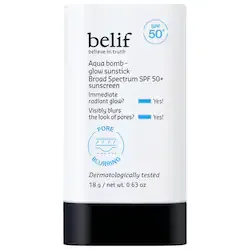
belif Aqua Bomb Korean Glow Sunstick SPF 50+
Works for
Sun protectionSPF 50 · 4 UV filtersBroad spectrum
This product offers a good level of protection against both UVB and UVA rays.
This sunscreen uses organic (so-called "chemical") sunscreen filters. Organic, or "chemical" filters usually provide reliable sun protection and rarely leave a white cast. Sunscreens with organic filters can sting eyes.
This product can be considered "reef safe" because it does not contain the UV filters (oxybenzone and octinoxate) that can be harmful to coral reefs when present in the water in high concentrations.
Evens skin toneNiacinamideWorks well
“Niacinamide: Known to visibly brighten and smooth texture.”
This product offers broad spectrum sun protection. It means that it can prevent hyperpigmentation and help keep the skin tone even (sun damage is the main factor causing age spots, darkening of post-acne marks and other discolorations).
Anti-agingSide benefit · Hyaluronic acid, Tocopherol + 1 moreWorks well
This product can help prevent early signs of skin aging because it offers a good level of broad spectrum sun protection. Sun damage is the main cause of premature skin aging, and protecting your skin from the sun is the best anti-aging strategy.
MoisturizingSide benefit the brand mentions · C12-15 alkyl benzoate, Caprylic/capric triglyceride + 16 moreWorks
“Multi-7 Hyaluronic Acid: Hydrates, locks in moisture, and visibly firms.”
This product can help improve hydration of the skin with the two types of ingredients.
The first type is called “humectants”:
these ingredients help attract water.
When humectants are on the surface of the skin, they “pull in” the moisture from the outside environment, or from
within deeper layers of the skin. The following ingredients in this product do the job:
hyaluronic acid, hydrolyzed hyaluronic acid.
This product also contains ingredients called “occlusives”. They help reduce the speed with which our skin loses moisture to the outside environment. These ingredients also help soften the upper layer of the skin, so it feels less tight and nicer to the touch. The following ingredients in this product do the job: caprylic/capric triglyceride, c12-15 alkyl benzoate.
Can it cause trouble?
Irritancy11 strong irritants: Pelargonium graveolens flower oil, Citrus aurantium dulcis peel oil + 9 more — patch-test recommendedHigh risk
Comedogenic2 ingredients rated 2 or more on the 0–5 pore-clogging scale2 flagged


User reviews
Be the first — your take helps the next person decide.
Ingredients
Filter by role to see what each ingredient is doing.
Octyldodecanol~22–33%
- Irritation risk
- Low
An emollient that helps to soften the skin and create a pleasant product texture and stabilize the formulation
More about OctyldodecanolC12-15 alkyl benzoate~4.4–6.6%
- Irritation risk
- Low
Enhances the product texture and makes it more spreadable. Helps reduce water loss from the outer layer of skin. Extands the shelf life by preventing bacteria growth
More about C12-15 alkyl benzoateHomosalate~4.8–7.3%
- Irritation risk
- Medium
A weak sunscreen that offers some protection against the sun rays that cause sunburn (UVB), but does not offer meaningful protection against protect against the most aging sun rays (UVA). It loses its effectiveness quickly when exposed to sunlight. It is an organic, or so called "chemical" sunscreen. When used in low concentrations, helps to stabilize the product formulation
More about HomosalateCaprylic/capric triglyceride~3.9–5.9%
- Irritation risk
- Medium
A good mix of fatty acids that forms a protective layer on the skin. Improves the shelf life of products. Derived from coconut and glycerin
More about Caprylic/capric triglycerideDicaprylyl carbonate~2.9–4.3%
- Irritation risk
- Low
Helps products spread more easily and works as an emollient to soften skin
More about Dicaprylyl carbonatePropylheptyl caprylate~2.1–3.1%
- Irritation risk
- Low
Helps soften the upper layer of the skin
More about Propylheptyl caprylateOctocrylene~2–2.9%
- Irritation risk
- Medium
A weak sunscreen that protects against the sun rays that cause sunburn (UVB) and is somewhat effective against the UVA rays. It is quite stable and can help stabilize other, more vulnerable, sunscreen ingredients like Avobenzone. It is an organic, or so called "chemical" sunscreen
More about OctocryleneDibutyl lauroyl glutamide~1.5–2.3%
- Irritation risk
- Medium
Helps improve the product texture and soften the upper layer of the skin
More about Dibutyl lauroyl glutamideEthylhexyl salicylate~1.5–2.3%
- Irritation risk
- Low
Octisalate. A UV filter. It offers some protection against the sun rays that cause sunburn (UVB), but does not protect against the most aging sun rays (UVA). It loses its effectiveness quickly when exposed to sunlight. It is an organic, or so called "chemical" sunscreen
More about Ethylhexyl salicylateButyloctyl salicylate~0.9–1.35%
- Irritation risk
- Medium
A synthetic ester of salicylic acid that is used to help disperse pigments and boost effectiveness of sunscreen ingredients. It is able to absorb UV light (working as an organic, or chemical filter), but is not approved as a sunscreen ingredient on its own
More about Butyloctyl salicylateDibutyl ethylhexanoyl glutamide~0.55–1.3%
- Irritation risk
- Medium
Helps improve the product texture and soften the upper layer of the skin
More about Dibutyl ethylhexanoyl glutamideButyl methoxydibenzoylmethane~0.85–1.25%
- Irritation risk
- Medium
Avobenzone. An organic, or so-called "chemical" UV filter. Protects against both UVA and UVB rays. Needs to be combined with other filters in a formulation to be stable.
More about Butyl methoxydibenzoylmethanePelargonium graveolens flower oil~0.45–1%
- Irritation risk
- High
An essential oil. Can be irritating. Can become an allergen with oxidation
More about Pelargonium graveolens flower oilCitrus aurantium dulcis peel oil~0.4–0.9%
- Irritation risk
- High
An essentil oil from orange peel. Potential allergen and can be irritating
More about Citrus aurantium dulcis peel oilHyaluronic acid~0.35–0.85%
- Irritation risk
- Low
One of the best moisturizing ingredients. Attracts water into the upper layer of the skin. Naturally present in skin. Typically has large molecule size unless advertised otherwise on the product label. Helps support skin's barrier function and may help to reduce inflammation
More about Hyaluronic acidHydrolyzed hyaluronic acid~0.35–0.8%
- Irritation risk
- Low
One of the best moisturizing ingredients. Attracts water into the upper layer of the skin. A version of it is naturally present in skin
More about Hydrolyzed hyaluronic acidSodium hyaluronate~0.35–0.8%
- Irritation risk
- Low
One of the best moisturizing ingredients. Attracts water into the upper layer of the skin
More about Sodium hyaluronateMelissa officinalis flower/leaf/stem water~0.3–0.75%
- Irritation risk
- High
Rosmarinus officinalis leaf water~0.3–0.7%
- Irritation risk
- Low
Eucalyptus globulus leaf extract~0.15–0.7%
- Irritation risk
- High
Used as a fragrance. Can be irritating
More about Eucalyptus globulus leaf extractLaminaria japonica extract~0.2–0.75%
- Irritation risk
- Low
- Comedogenicity
- 3/5
Seaweed extract that might help to attract water to the upper layer of the skin and have some anti-oxidant properties
More about Laminaria japonica extractEcklonia cava extract~0.15–0.7%
- Irritation risk
- Low
- Comedogenicity
- 3/5
Hizikia fusiforme extract~0.15–0.65%
- Irritation risk
- Low
Mentha rotundifolia leaf extract~0.15–0.65%
- Irritation risk
- High
Used as a fragrance and can be irritating
More about Mentha rotundifolia leaf extractRosa canina fruit extract~0.15–0.65%
- Irritation risk
- Medium
A plant extract that might have some anti-oxidant properties, but evidence is lacking
More about Rosa canina fruit extractThymus vulgaris leaf extract~0.15–0.65%
- Irritation risk
- High
Plant extract that has some anti-bacterial properties. Can be used as a fragrance. Can be irritating
More about Thymus vulgaris leaf extractDextrin palmitate~0.15–0.7%
- Irritation risk
- Medium
Helps water and oil mix together
More about Dextrin palmitatePolyhydroxystearic acid~0.2–0.7%
- Irritation risk
- Medium
Used to create a thicker product consistency and stabilize the formulation
More about Polyhydroxystearic acidStearalkonium hectorite~0.15–0.65%
Propylene carbonate~0.2–0.75%
- Irritation risk
- Low
Is used to dissolve other ingredients and create nice product texture
More about Propylene carbonateSynthetic fluorphlogopite~0.2–0.7%
- Irritation risk
- Low
A mineral that is used as an optical filter (makes the skin looks nicer through light reflection) and to improve the texture of cosmetic products
More about Synthetic fluorphlogopiteTocopherol~0.15–0.65%
- Irritation risk
- Low
Pure form of vitamin E. Can help moisturise and protect the skin from free radicals. Often used to help stabilise other ingredients or the formula itself
More about TocopherolWater~0.15–0.65%
Hydrolyzed sodium hyaluronate~0.15–0.65%
- Irritation risk
- Low
Attracts water into the upper layer of the skin
More about Hydrolyzed sodium hyaluronateHydroxypropyltrimonium hyaluronate~0.35–0.8%
- Irritation risk
- Low
Niacinamide~0.15–0.65%
- Irritation risk
- Low
Is proven to be effective in reducing blemishes, evening out skin tone and helping to improve lines and wrinkles. It helps the skin to repair sun damage, calm down inflammation and keep maintain good levels of moisture. The concentration of about 2% is effective for supporting the skin barrier and evening out the skin tone. Concentration of 4-6% is better for helping with acne and balancing the sebum production
More about NiacinamideSodium acetylated hyaluronate~0.15–0.65%
- Irritation risk
- Low
A type of hyaluronic acid that works as an excellent moisturizer by attracting water into the upper layer of the skin. Is typically feels less sticky on the skin compared to the usual hyaluronic acid
More about Sodium acetylated hyaluronateButylene glycol~0.15–0.65%
- Irritation risk
- Low
Used to create a nice product texture and help delivery of other ingredients. Might be somewhat helpful in attracting water to the upper layer of the skin
More about Butylene glycol1,2-hexanediol~0.15–0.65%
Pentylene glycol~0.3–0.75%
- Irritation risk
- Medium
Used to preserve products, dissolve other ingredients and create a nice product texture
More about Pentylene glycolEthylhexylglycerin~0.15–0.6%
Sodium hyaluronate crosspolymer~0.15–0.6%
- Irritation risk
- Medium
Attracts water into the upper layer of the skin
More about Sodium hyaluronate crosspolymerLimonene~0.1–0.5%
- Irritation risk
- High
A common frangrance that can easily irritate skin, especially if exposed to air, light or heat
More about LimoneneCitronellol~0.1–0.4%
Geraniol~0.1–0.45%
Linalool~0.1–0.45%
Citral~0.1–0.3%
Iron oxides~0.1–0.35%
- Irritation risk
- Low
An umbrella term for the following three colorants: CI 77491, CI 77492, CI 77499. They might be able to offer some protection against visible light, but the degree of the protection is not clear
More about Iron oxidesIngredient list view
Octyldodecanol, C12-15 alkyl benzoate, Homosalate, Caprylic/capric triglyceride, Dicaprylyl carbonate, Propylheptyl caprylate, Octocrylene, Dibutyl lauroyl glutamide, Ethylhexyl salicylate, Butyloctyl salicylate, Dibutyl ethylhexanoyl glutamide, Butyl methoxydibenzoylmethane, Pelargonium graveolens flower oil, Citrus aurantium dulcis peel oil, Hyaluronic acid, Hydrolyzed hyaluronic acid, Sodium hyaluronate, Melissa officinalis flower/leaf/stem water, Rosmarinus officinalis leaf water, Eucalyptus globulus leaf extract, Laminaria japonica extract, Ecklonia cava extract, Hizikia fusiforme extract, Mentha rotundifolia leaf extract, Rosa canina fruit extract, Thymus vulgaris leaf extract, Dextrin palmitate, Polyhydroxystearic acid, Stearalkonium hectorite, Propylene carbonate, Synthetic fluorphlogopite, Tocopherol, Water, Hydrolyzed sodium hyaluronate, Hydroxypropyltrimonium hyaluronate, Niacinamide, Sodium acetylated hyaluronate, Butylene glycol, 1,2-hexanediol, Pentylene glycol, Ethylhexylglycerin, Sodium hyaluronate crosspolymer, Limonene, Citronellol, Geraniol, Linalool, Citral, Iron oxides
Compare prices
Retailers ranked by price — lowest first.

Worth comparing, line by line.
Match % combines shared ingredients, the first five ingredients, shared actives and hero ingredients, irritancy (lower counts in the alternative's favour), texture and body area. Only products in the same routine step are compared.
| belifAqua Bomb Korean Glow Sunstick SPF 50+YOUR PRODUCT | ISNTREEHyaluronic Acid Watery Sun Gel SPF50+ PA++++ | OttieWater Barrier Sunscreen | fromrierEGF Cica Mineral Sunscreen | |
|---|---|---|---|---|
| Match | — | 85% | 85% | 83% |
| Price | $28.00 | $11.67−$16.33 | $14.89−$13.11 | $21.00−$7.00 |
| Shared key ingredients | — | 8 of 12 | 8 of 12 | 7 of 12 |
| Key difference | — | Adenosine | Madecassoside | Sh-Polypeptide-22 |
| Irritancy | High | Low | Medium | Low |
| SPF | SPF 50 | SPF 50 | SPF 50 | SPF 50 |
| Drying alcohol | — | — | — | — |
| View product | Shop | Shop | Shop |
More alternatives: Manyo Galactomy Sérum Solaire SPF50+ PA++++Isispharma Neotone Radiance SPF 50+
Sources cited in this review
Every concentration estimate and effectiveness label is anchored to one of these 15 studies and safety reviews.
- 1
- 2
- 3
- 4Efficacy of a New Topical Nano-hyaluronic Acid in Humansncbi.nlm.nih.gov
- 5Physiochemical properties and application of hyaluronic acid: a systematic reviewonlinelibrary.wiley.com
- 6Hyaluronic acid: A key molecule in skin agingncbi.nlm.nih.gov

Affiliate links · As an Amazon Associate, WIMJ earns from qualifying purchases.