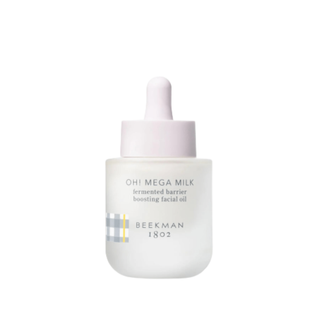
Beekman 1802 Mega Milk Facial Oil
Works for
1 of 2 advertised claims delivered
Moisturizing8 ingredients credited for this claimGood support
“Goat milk is rich in omega fatty acids and the fermented plant oils increase omega fatty acid content by 90x, for superior skin nourishment and hydration all while having a silky after-feel that's never sticky or greasy.”
This product can help soften the skin and reduce its moisture loss with emollients and occlusives: caprylic/capric triglyceride, cocos nucifera oil.
Keep in mind that this product does not contain effective ingredients to attract water to the upper layer of the skin. This is why an additional product with humectants like glycerin or hyaluronic acid can be helpful (apply it before this product for the best results).
Evens skin tone3 ingredients credited for this claimLimited support
“Vitamin C Helps to brighten skin, fade darks spots and hyperpigmentation, and protect against sun damage.”
This product contains ingredients (glycyrrhiza uralensis root extract) that could help reduce hyperpigmentation (for example, post-acne marks or age spots) in theory, but there is not enough evidence that they actually work.
Anti-oxidationNot advertised by the brand · 6 ingredients credited for this claimStrong support
This product contains antioxidants (acetyl zingerone) that can help neutralize free radicals in skin. By doing so, they can lessen the damage the skin gets from the UV light (sun).
Anti-agingNot advertised by the brand · 4 ingredients credited for this claimModerate support
This product contains acetyl zingerone. This ingredient might be able to help reduce and prevent fine lines and wrinkles, improve skin elasticity and firmness, but there is not enough evidence that it actually works.
Can it cause trouble?
Irritancy1 strong irritant: Rosmarinus officinalis leaf extractMedium risk
Comedogenic1 ingredient rated 2 or more on the 0–5 pore-clogging scale1 flagged


User reviews
Ingredients
Filter by role to see what each ingredient is doing.
Water~40–60%
Caprylic/capric triglyceride~5.6–8.5%
- Irritation risk
- Medium
A good mix of fatty acids that forms a protective layer on the skin. Improves the shelf life of products. Derived from coconut and glycerin
More about Caprylic/capric triglycerideCocos nucifera oil~4–6%
- Irritation risk
- Low
- Comedogenicity
- 3/5
An emollient. Found to be as effective as a moisturizer for dry skin as mineral oil. Could be comedogenic
More about Cocos nucifera oilHelianthus annuus seed oil~2.9–4.4%
- Irritation risk
- Low
A great emollient due to its high linoleic acid content. One of the most effective plant oils in helping skin hydration and repairing skin barrier function
More about Helianthus annuus seed oilPolyglyceryl-3 polyricinoleate~2.1–3.1%
- Irritation risk
- Medium
Helps oil and water mix together
More about Polyglyceryl-3 polyricinoleateSimmondsia chinensis seed oil~1.9–2.8%
- Irritation risk
- Medium
Softens the upper layer of skin and helps restore the healthy skin barrier. Has shown to help calm down inflammation in skin. It is a stable oil, meaning that it retains its properties even when exposed to air.
More about Simmondsia chinensis seed oilOlea europaea fruit oil~1.4–2.1%
- Irritation risk
- Medium
An emollient that helps soften the skin but is not effective for restoring its barrier function. Might be helpful to calm down inflammation
More about Olea europaea fruit oilArgania spinosa kernel oil~1.3–2%
- Irritation risk
- Medium
An emollient that helps soften the upper layer of the skin. Might have some weak anti-oxidant properties
More about Argania spinosa kernel oilAngelica gigas root extract~1–1.6%
- Irritation risk
- Low
Lithospermum erythrorhizon root extract~0.85–1.25%
- Irritation risk
- High
A plant extract that might help neutralize free radicals in skin. Can be used for its fragrance
More about Lithospermum erythrorhizon root extractGlycyrrhiza uralensis root extract~0.5–1.15%
- Irritation risk
- Medium
Licorice root extract. Might be helpful in reducing hyperpigmentation
More about Glycyrrhiza uralensis root extractTetrahexyldecyl ascorbate~0.4–1%
- Irritation risk
- Medium
Being a lipid soluble form of vitamin C, it is more stable than ascorbic acid, but still degrades quickly and needs to be stabilized in a formulation with another ingredient. It is claimed to penetrate skin better than pure vitamin C and have the the similar benefits, but solid studies of its effectiveness are lacking. Is likely to require a higher concentration in a product than pure vitamin C to be effective. It might be able to help reduce pore clogging.
More about Tetrahexyldecyl ascorbateNiacinamide~0.35–0.85%
- Irritation risk
- Low
Is proven to be effective in reducing blemishes, evening out skin tone and helping to improve lines and wrinkles. It helps the skin to repair sun damage, calm down inflammation and keep maintain good levels of moisture. The concentration of about 2% is effective for supporting the skin barrier and evening out the skin tone. Concentration of 4-6% is better for helping with acne and balancing the sebum production
More about NiacinamideCaprae lac~0.35–0.8%
- Irritation risk
- Low
Goat milk~0.3–0.75%
- Irritation risk
- Low
Tocopherol~0.2–0.7%
- Irritation risk
- Low
Pure form of vitamin E. Can help moisturise and protect the skin from free radicals. Often used to help stabilise other ingredients or the formula itself
More about TocopherolRosmarinus officinalis leaf extract~0.15–0.55%
- Irritation risk
- High
Can be helpful in reducing inflammation in skin, including inflamed acne. It can be irritating
More about Rosmarinus officinalis leaf extractAcetyl zingerone~0.15–0.5%
- Irritation risk
- Medium
An active compound sourced from ginger root. It can help neutralize free radicals in skin. It might be able to help reduce fine lines and wrinkles and improve the skin tone. In small concentrations, used as a chelating agent and helps preserve stability of product formulations.
More about Acetyl zingeroneDiisostearoyl polyglyceryl-3 dimer dilinoleate~0.15–0.6%
- Irritation risk
- Low
Magnesium sulfate~0.1–0.45%
Phenylpropanol~0.1–0.35%
- Irritation risk
- High
Helps mask the smell of other ingredients and helps preserve the product formulation
More about PhenylpropanolEthylhexylglycerin~0.1–0.3%
Olea europaea fruit oil~0.05–0.25%
- Irritation risk
- Medium
An emollient that helps soften the skin but is not effective for restoring its barrier function. Might be helpful to calm down inflammation
More about Olea europaea fruit oilIngredient list view
Water, Caprylic/capric triglyceride, Cocos nucifera oil, Helianthus annuus seed oil, Polyglyceryl-3 polyricinoleate, Simmondsia chinensis seed oil, Unknown, Olea europaea fruit oil, Argania spinosa kernel oil, Angelica gigas root extract, Lithospermum erythrorhizon root extract, Glycyrrhiza uralensis root extract, Tetrahexyldecyl ascorbate, Niacinamide, Caprae lac, Goat milk, Tocopherol, Rosmarinus officinalis leaf extract, Acetyl zingerone, Diisostearoyl polyglyceryl-3 dimer dilinoleate, Magnesium sulfate, Phenylpropanol, Ethylhexylglycerin, Olea europaea fruit oil
Compare prices
Retailers ranked by price — lowest first.
.png)
Worth comparing, line by line.
Match % combines shared ingredients, the first five ingredients, shared actives and hero ingredients, irritancy (lower counts in the alternative's favour), texture and body area. Only products in the same routine step are compared.
| Beekman 1802Mega Milk Facial OilYOUR PRODUCT | N1Rosacea cream | NorevaEczeane Palpebral Anti-Itch Lipid Replenishing Cream 48H | SVRTopialyse Intensively Nourishing Face + Body Balm for Extremely, Sensitive, Inflamed + Eczema-Prone Skin of All Ages | |
|---|---|---|---|---|
| Match | — | 88% | 83% | 83% |
| Price | $54.00 | — | $19.02−$34.98 | $26.67−$27.33 |
| Shared key ingredients | — | 6 of 9 | 4 of 9 | 3 of 9 |
| Key difference | — | 3-O-Ethyl Ascorbic Acid | Chondrus Crispus Extract | Alpha-Glucan Oligosaccharide |
| Irritancy | Medium | Low | Low | Low |
| Drying alcohol | — | — | — | — |
| View product | Shop | Shop | Shop |


Sources cited in this review
Every concentration estimate and effectiveness label is anchored to one of these 17 studies and safety reviews.
- 1
- 2
- 3Effect of topically applied lipids on surfactant-irritated skinonlinelibrary.wiley.com
- 4
- 5Use of “natural” oils for moisturization: Review of olive, coconut, and sunflower seed oilonlinelibrary.wiley.com
- 6

Affiliate links · As an Amazon Associate, WIMJ earns from qualifying purchases.