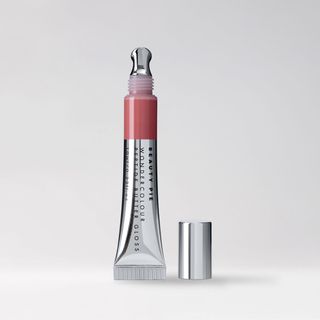
Beauty Pie Wondercolour Glossy Peptide Lip Butter - Ripple | BEAUTY PIE
Works for
1 of 1 advertised claim delivered
Moisturizing16 ingredients credited for this claimStrong support
“nourishment of a lip oil to give softer, glossier and more moisturised lips”
This product can help improve hydration of the skin with the two types of ingredients.
The first type is called “humectants”:
these ingredients help attract water.
When humectants are on the surface of the skin, they “pull in” the moisture from the outside environment, or from
within deeper layers of the skin. The following ingredients in this product do the job:
glycerin, hyaluronic acid.
This product also contains ingredients called “occlusives”. They help reduce the speed with which our skin loses moisture to the outside environment. These ingredients also help soften the upper layer of the skin, so it feels less tight and nicer to the touch. The following ingredients in this product do the job: caprylic/capric triglyceride, simmondsia chinensis seed oil.
The following ingredients in this product are especially good for supporting the skin barrier and helping with the hydration level: acetyl hexapeptide-8, ceramide np, copper tripeptide-1, palmitoyl tripeptide-1, phytosphingosine
Anti-agingNot advertised by the brand · 5 ingredients credited for this claimModerate support
This product contains acetyl hexapeptide-8, copper tripeptide-1, palmitoyl tripeptide-1. These ingredients might be able to help reduce and prevent fine lines and wrinkles, improve skin elasticity and firmness, but there is not enough evidence that it actually works.
Can it cause trouble?
Irritancy1 strong irritant: ParfumMedium risk
Comedogenic2 ingredients rated 2 or more on the 0–5 pore-clogging scale2 flagged
User reviews
Be the first — your take helps the next person decide.
Ingredients
Filter by role to see what each ingredient is doing.
Polyglyceryl-2 isostearate/dimer dilinoleate copolymer~22–33%
- Irritation risk
- Low
Camellia japonica seed oil~5.2–7.8%
- Irritation risk
- Low
A plant oil that helps to soften the upper layer of the skin and can help restore skin's barrier function. Might have an anti-oxidant effect
More about Camellia japonica seed oilCaprylic/capric triglyceride~4.8–7.3%
- Irritation risk
- Medium
A good mix of fatty acids that forms a protective layer on the skin. Improves the shelf life of products. Derived from coconut and glycerin
More about Caprylic/capric triglycerideSimmondsia chinensis seed oil~3.7–5.5%
- Irritation risk
- Medium
Softens the upper layer of skin and helps restore the healthy skin barrier. Has shown to help calm down inflammation in skin. It is a stable oil, meaning that it retains its properties even when exposed to air.
More about Simmondsia chinensis seed oilDilinoleic acid/butanediol copolymer~2.7–4%
- Irritation risk
- Low
Tribehenin~2.1–3.1%
- Irritation risk
- Low
Used to create a thicker product consistency and soften the upper layer of the skin
More about TribeheninDextrin palmitate~1.5–2.3%
- Irritation risk
- Medium
Helps water and oil mix together
More about Dextrin palmitateHydrogenated castor oil dimer dilinoleate~1.3–1.9%
- Irritation risk
- Low
Sorbitan isostearate~1–1.6%
- Irritation risk
- Low
Helps oil and water mix together
More about Sorbitan isostearateSilica silylate~1–1.5%
Diisostearyl malate~0.55–1.3%
- Irritation risk
- Medium
Helps to soften the upper layer of the skin
More about Diisostearyl malatePolyglyceryl-2 triisostearate~0.45–1.05%
- Irritation risk
- Low
Helps to soften the upper layer of the skin and create a nice product texture
More about Polyglyceryl-2 triisostearateParfum~0.35–0.85%
- Irritation risk
- High
An aromatic blend of unspecified and possibly irritating ingredients
More about ParfumPolyglyceryl-2 diisostearate~0.35–0.85%
Dehydroacetic acid~0.3–0.6%
Water~0.35–0.75%
Hyaluronic acid~0.3–0.7%
- Irritation risk
- Low
One of the best moisturizing ingredients. Attracts water into the upper layer of the skin. Naturally present in skin. Typically has large molecule size unless advertised otherwise on the product label. Helps support skin's barrier function and may help to reduce inflammation
More about Hyaluronic acidGlycerin~0.3–0.75%
- Irritation risk
- Low
One of the best moisturizing ingredients. Naturally present in skin. It attracts water to the upper layer of the skin working as a humectant
More about GlycerinEthylhexyl palmitate~0.35–0.75%
- Irritation risk
- Low
- Comedogenicity
- 3/5
An emollient that helps soften the skin and create a nice product texture
More about Ethylhexyl palmitateMacadamia integrifolia seed oil~0.3–0.75%
- Irritation risk
- Low
A plant oil that helps soften the upper layer of the skin
More about Macadamia integrifolia seed oilButylene glycol~0.15–0.65%
- Irritation risk
- Low
Used to create a nice product texture and help delivery of other ingredients. Might be somewhat helpful in attracting water to the upper layer of the skin
More about Butylene glycol1,2-hexanediol~0.15–0.65%
Ceramide np~0.2–0.75%
- Irritation risk
- Low
A type of lipid similar to ceramides naturally present in skin. Helps to soften the upper layer of the skin and supports the skin barrier function to keep it hydrated. Can help to prevent inflammation in skin
More about Ceramide npPhytosphingosine~0.3–0.7%
- Irritation risk
- Low
A type of lipid that is naturally present in skin. It might help in repairing skin barrier function and has anti-bacterial effect
More about PhytosphingosineLactic acid~0.15–0.6%
- Irritation risk
- Medium
An exfoliating and moisturizing alpha-hydroxy acid (AHA). Typically causes less irritation than other AHAs, for example, glycolic acid. At high concentrations (about 15%), lactic acid can help reduce lines and wrinkles. Recent studies show that lactic acid can support the "good" bacteria living on skin's surface (healthy skin microbiome)
More about Lactic acidPalmitoyl tripeptide-1~0.2–0.75%
- Irritation risk
- Low
A type of peptide. Peptides are excellent moisturizers and might be able support collagen production reducing fine lines and wrinkles
More about Palmitoyl tripeptide-1Ethylhexylglycerin~0.15–0.6%
Acetyl hexapeptide-8~0.15–0.6%
- Irritation risk
- Low
A type of peptide. Peptides are excellent moisturizers and might be able support collagen production reducing fine lines and wrinkles
More about Acetyl hexapeptide-8Copper tripeptide-1~0.15–0.6%
- Irritation risk
- Low
A naturally occurring peptide. One of the most studied peptides in dermatology. It is sometimes abbreviated GHK-Cu. Belongs to the class of carrier peptides. It stimulates both synthesis and breakdown of collagen in skin. It is released in skin wounds and inflammation to support healing. It accelerates wound-healing of the skin and can stimulate hair growth. There are preliminary studies that confirm that copper tripeptide can help support collagen production reducing fine lines and wrinkles and decrease inflammation in skin.
More about Copper tripeptide-1Vanillin~0.15–0.55%
- Irritation risk
- Low
Titanium dioxide~0.3–0.7%
- Irritation risk
- Low
Works as a UV filter when used in high concentrations. It is photostable and is effective mostly against the UVB light, with some protection in the UVA range. In small concentrations, used for its ability to improve the color of cosmetic products. Is usually well tolerated by the skin
More about Titanium dioxideCi 19140~0.1–0.45%
Ci 19140~0.1–0.4%
Ci 15850~0.1–0.35%
Iron oxides~0.05–0.25%
- Irritation risk
- Low
An umbrella term for the following three colorants: CI 77491, CI 77492, CI 77499. They might be able to offer some protection against visible light, but the degree of the protection is not clear
More about Iron oxidesCi 45410~0.05–0.2%
Blue 1 lake~0.05–0.2%
Ingredient list view
Polyglyceryl-2 isostearate/dimer dilinoleate copolymer, Camellia japonica seed oil, Caprylic/capric triglyceride, Simmondsia chinensis seed oil, Dilinoleic acid/butanediol copolymer, Tribehenin, Dextrin palmitate, Hydrogenated castor oil dimer dilinoleate, Sorbitan isostearate, Silica silylate, Diisostearyl malate, Polyglyceryl-2 triisostearate, Parfum, Polyglyceryl-2 diisostearate, Dehydroacetic acid, Water, Hyaluronic acid, Glycerin, Ethylhexyl palmitate, Macadamia integrifolia seed oil, Butylene glycol, 1,2-hexanediol, Ceramide np, Phytosphingosine, Lactic acid, Palmitoyl tripeptide-1, Ethylhexylglycerin, Acetyl hexapeptide-8, Copper tripeptide-1, Vanillin, Titanium dioxide, Ci 19140, Ci 19140, Ci 15850, Iron oxides, Ci 45410, Blue 1 lake
Compare prices
Retailers ranked by price — lowest first.
Affiliate links · prices updated regularly · As an Amazon Associate, WIMJ earns from qualifying purchases.
Sources cited in this review
Every concentration estimate and effectiveness label is anchored to one of these 18 studies and safety reviews.
- 1
- 2
- 3
- 4Efficacy of a New Topical Nano-hyaluronic Acid in Humansncbi.nlm.nih.gov
- 5Physiochemical properties and application of hyaluronic acid: a systematic reviewonlinelibrary.wiley.com
- 6

Affiliate links · As an Amazon Associate, WIMJ earns from qualifying purchases.