Works for
1 of 2 advertised claims delivered
MoisturizingZea mays oil, Pca + 5 moreGood evidence
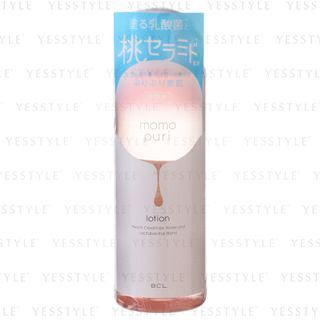
“Momo Puri Peach Lotion”
This product can help improve hydration of the skin with the two types of ingredients.
The first type is called “humectants”:
these ingredients help attract water.
When humectants are on the surface of the skin, they “pull in” the moisture from the outside environment, or from
within deeper layers of the skin. The following ingredients in this product do the job:
arginine, glycerin.
This product also contains ingredients called “occlusives”. They help reduce the speed with which our skin loses moisture to the outside environment. These ingredients also help soften the upper layer of the skin, so it feels less tight and nicer to the touch. The following ingredients in this product do the job: arginine.
Anti-agingPrunus persica leaf extract, Tocopherol + 1 moreWeak evidence
“Also formulated with lactic acid to fight signs of aging, improve skin’s collagen levels and create firmer skin.”
Effective ingredients missing or their concentration is too low.
Can it cause trouble?
Irritancy3 strong irritants: Retinyl palmitate, Citrus aurantium bergamia fruit extract + 1 more — patch-test recommendedHigh risk
Comedogenic1 ingredient rated 2 or more on the 0–5 pore-clogging scale1 flagged
User reviews
Be the first — your take helps the next person decide.
Ingredients
Filter by role to see what each ingredient is doing.
Water~40–60%
Dipropylene glycol~6.5–9.7%
- Irritation risk
- Low
Helps to dissolve other ingredients in a formulation. Slows down the rate of product drying
More about Dipropylene glycolGlycerin~3.7–5.6%
- Irritation risk
- Low
One of the best moisturizing ingredients. Naturally present in skin. It attracts water to the upper layer of the skin working as a humectant
More about GlycerinPropylene glycol~2.7–4.1%
- Irritation risk
- High
Helps oil and water mix together and can enhance the penetration of other ingredients into the skin. It can be irritating
More about Propylene glycolPolybutene~2.1–3.1%
Glycol~1.7–2.5%
- Irritation risk
- Low
Glycerin~1.5–2.3%
- Irritation risk
- Low
One of the best moisturizing ingredients. Naturally present in skin. It attracts water to the upper layer of the skin working as a humectant
More about GlycerinArginine~1.2–1.9%
- Irritation risk
- Low
An amino acid that is naturally present in skin and helps keep it hydrated. When used together with AHAs, it can reduce their irritating effect on the skin
More about ArginineEnterococcus faecalis~1–1.5%
- Irritation risk
- Low
Zea mays oil~0.6–1.35%
- Irritation risk
- Low
- Comedogenicity
- 3/5
A good moisturizing plant oil. Due to the high linoleic acid content, it helps soften the upper layer of the skin, reduce water loss and support skin barrier function
More about Zea mays oilAvena sativa kernel extract~0.5–1.2%
- Irritation risk
- Low
An effective moisturizing and skin barrier repair ingredient. Helps calm down inflammation and has some anti-oxidant properties
More about Avena sativa kernel extractTocopherol~0.4–0.95%
- Irritation risk
- Low
Pure form of vitamin E. Can help moisturise and protect the skin from free radicals. Often used to help stabilise other ingredients or the formula itself
More about TocopherolRetinyl palmitate~0.35–0.8%
- Irritation risk
- High
Three steps removed from the active form of vitamin A - retinoic acid. To have an effect in the skin, it first needs to be converted twice to become the retinoic acid. This means it is less potent than retinol, but could also be less irritating. Once converted to the retinoic acid in the skin, it helps against all signs of aging, improves skin cell turnover and helps fight blemishes and clogged pores. However, in many cosmetic formulations, it is used in a concentration that is too low to have the full effect
More about Retinyl palmitatePhytosteryl glucoside/glucosylceramide~0.35–0.75%
- Irritation risk
- Low
Citrus aurantium bergamia fruit extract~0.2–0.8%
- Irritation risk
- High
Prunus persica leaf extract~0.35–0.8%
- Irritation risk
- High
Might be helpful in supporting collagen and ellastin production but solid research is lacking. Could be irritating
More about Prunus persica leaf extractSilver oxide~0.2–0.75%
- Irritation risk
- Low
Butylene glycol~0.15–0.7%
- Irritation risk
- Low
Used to create a nice product texture and help delivery of other ingredients. Might be somewhat helpful in attracting water to the upper layer of the skin
More about Butylene glycolPca~0.15–0.6%
- Irritation risk
- Low
Naturally present in skin and helps to attract water to its upper layer
More about PcaGlyceryl isostearate~0.15–0.65%
Xanthan gum~0.1–0.5%
- Irritation risk
- Low
Used to create a thicker product consistency
More about Xanthan gumXylitol~0.1–0.45%
- Irritation risk
- Low
Helps attract water to the upper layer of the skin and repair the skin barrier function
More about XylitolCitric acid~0.1–0.35%
- Irritation risk
- Medium
Can work as an exfoliant but is typically used to adjust the product pH
More about Citric acidPhytic acid~0.05–0.3%
- Irritation risk
- Medium
An alpha-hydroxy acid (AHA), but is mostly used to stabilize product formulations in cosmetics
More about Phytic acidGlyceryl laurate~0.05–0.25%
- Irritation risk
- Medium
Helps water and oil mix together and has an anti-microbial effect helping to preserve product formulations
More about Glyceryl laurateParfum~0.01–0.05%
- Irritation risk
- High
An aromatic blend of unspecified and possibly irritating ingredients
More about ParfumIngredient list view
Water, Dipropylene glycol, Glycerin, Unknown, Propylene glycol, Polybutene, Glycol, Glycerin, Arginine, Enterococcus faecalis, Zea mays oil, Avena sativa kernel extract, Tocopherol, Retinyl palmitate, Unknown, Phytosteryl glucoside/glucosylceramide, Citrus aurantium bergamia fruit extract, Prunus persica leaf extract, Silver oxide, Butylene glycol, Pca, Glyceryl isostearate, Unknown, Xanthan gum, Xylitol, Citric acid, Unknown, Phytic acid, Unknown, Glyceryl laurate, Parfum
Compare prices
Retailers ranked by price — lowest first.

Affiliate links · prices updated regularly
Sources cited in this review
Every concentration estimate and effectiveness label is anchored to one of these 10 studies and safety reviews.
- 1
- 2Surfactants and experimental irritant contact dermatitisncbi.nlm.nih.gov
- 3Propylene Glycolpubmed.ncbi.nlm.nih.gov
- 4Skin-sensitizing and irritant properties of propylene glycolonlinelibrary.wiley.com
- 5
- 6Content of fatty acids in corn (Zea mays L.) oil from Ecuadorresearchgate.net

Affiliate links · As an Amazon Associate, WIMJ earns from qualifying purchases.