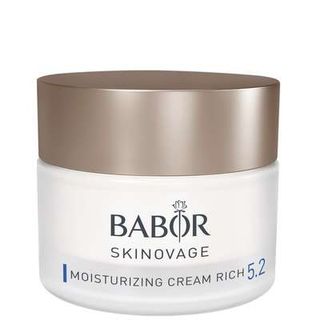
BABOR Skinovage Moisturizing Cream Rich 5.2
Works for
1 of 1 advertised claim delivered
Moisturizing12 ingredients credited for this claimStrong support
“Skinovage Moisturizing Cream Rich 5.”
This product can help improve hydration of the skin with the two types of ingredients.
The first type is called “humectants”:
these ingredients help attract water.
When humectants are on the surface of the skin, they “pull in” the moisture from the outside environment, or from
within deeper layers of the skin. The following ingredients in this product do the job:
pantolactone, hydrolyzed corn starch.
This product also contains ingredients called “occlusives”. They help reduce the speed with which our skin loses moisture to the outside environment. These ingredients also help soften the upper layer of the skin, so it feels less tight and nicer to the touch. The following ingredients in this product do the job: butyrospermum parkii butter, cera alba.
The following ingredients in this product are especially good for supporting the skin barrier and helping with the hydration level: panthenol
Can it cause trouble?
Irritancy5 strong irritants: Limonene, Parfum + 3 more — patch-test recommendedHigh risk
Comedogenic2 ingredients rated 2 or more on the 0–5 pore-clogging scale2 flagged

User reviews
Be the first — your take helps the next person decide.
Ingredients
Filter by role to see what each ingredient is doing.
Water~45–55%
Isohexadecane~8.4–10.3%
- Irritation risk
- Low
Improves the texture of the product and helps soften the skin. Helps oil and water mix together and can be used as a cleansing agent
More about IsohexadecanePolyglyceryl-3 polyricinoleate~3.8–4.7%
- Irritation risk
- Medium
Helps oil and water mix together
More about Polyglyceryl-3 polyricinoleateSimmondsia chinensis seed oil~3.2–3.9%
- Irritation risk
- Medium
Softens the upper layer of skin and helps restore the healthy skin barrier. Has shown to help calm down inflammation in skin. It is a stable oil, meaning that it retains its properties even when exposed to air.
More about Simmondsia chinensis seed oilCera microcristallina~2.4–2.9%
- Irritation risk
- Low
Helps to soften the upper layer of the skin, reduce water loss from its surface and create a thicker product consistency
More about Cera microcristallinaDecyl oleate~1.9–2.3%
- Irritation risk
- Low
- Comedogenicity
- 2/5
Helps soften the upper layer of the skin
More about Decyl oleateButyrospermum parkii butter~1.6–2%
- Irritation risk
- Low
- Comedogenicity
- 3/5
A great moisturising ingredient that softens the skin and reduces water loss from its upper layer. It also can be helpful in protecting skin from free radicals
More about Butyrospermum parkii butterCetyl palmitate~1.4–1.7%
- Irritation risk
- Low
An emollient that helps soften the skin and is used to improve product texture and stability
More about Cetyl palmitateSilica dimethyl silylate~1.2–1.4%
Panthenol~0.9–1.1%
- Irritation risk
- Low
Helps attract water to the upper layer of the skin and can help improve skin barrier function
More about PanthenolHydrolyzed corn starch~0.65–0.95%
- Irritation risk
- Low
Helps improve the product texture
More about Hydrolyzed corn starchPhenoxyethanol~0.55–0.8%
- Irritation risk
- Low
A preservative. It helps prevent bacterial growth in cosmetic products
More about PhenoxyethanolBeta vulgaris root extract~0.5–0.7%
- Irritation risk
- Medium
A plant extract that might have some antioxidant properties, but mostly used in cosmetics for its color
More about Beta vulgaris root extractCera alba~0.55–0.85%
- Irritation risk
- Medium
Forms a protective barrier that holds water and keeps dry skin hydrated. Keeps an emulsion from separating into its oil and liquid components, and increases the thickness of a product. Can be an allergen
More about Cera albaMagnesium sulfate~0.45–0.65%
Tocopheryl acetate~0.4–0.65%
- Irritation risk
- Medium
A more stable but less bio-available form of vitamin E compared to Tocopherol. Might help moisturize and protect the skin from free radicals, but mostly used in low concentrations to stabilize other ingredients.
More about Tocopheryl acetateLimonene~0.35–0.6%
- Irritation risk
- High
A common frangrance that can easily irritate skin, especially if exposed to air, light or heat
More about LimoneneParfum~0.3–0.55%
- Irritation risk
- High
An aromatic blend of unspecified and possibly irritating ingredients
More about ParfumMaltodextrin~0.3–0.55%
- Irritation risk
- Low
Used to stabilize the product formulation and can help absorb oil
More about MaltodextrinEthylhexylglycerin~0.25–0.5%
Lactic acid~0.25–0.45%
- Irritation risk
- Medium
An exfoliating and moisturizing alpha-hydroxy acid (AHA). Typically causes less irritation than other AHAs, for example, glycolic acid. At high concentrations (about 15%), lactic acid can help reduce lines and wrinkles. Recent studies show that lactic acid can support the "good" bacteria living on skin's surface (healthy skin microbiome)
More about Lactic acidAlcohol~0.25–0.45%
- Irritation risk
- High
Can be drying and contribute to skin irritation. Used in formulars to dissolve other ingredients, create a thinner product consistency or for its antibacterial properties
More about AlcoholCaprylic/capric triglyceride~0.25–0.5%
- Irritation risk
- Medium
A good mix of fatty acids that forms a protective layer on the skin. Improves the shelf life of products. Derived from coconut and glycerin
More about Caprylic/capric triglycerideLinalool~0.15–0.3%
Pantolactone~0.2–0.35%
- Irritation risk
- Low
Helps attract water to the upper layer of the skin
More about PantolactoneAscorbyl palmitate~0.15–0.3%
- Irritation risk
- Medium
Being a lipid soluble form of vitamin C, it is more stable and can penetrate the skin better than L-Ascorbic acid. It is effective in protecting the skin from free radicals, as well as evening the skin tone, but is less effective in stimulating collagen production compared to L-Ascorbic acid.
More about Ascorbyl palmitateCitral~0.1–0.2%
P-anisic acid~0.1–0.2%
- Irritation risk
- High
Helps preserve products. Can mask unpleasant smell. Could be irritating
More about P-anisic acidCitric acid~0.1–0.15%
- Irritation risk
- Medium
Can work as an exfoliant but is typically used to adjust the product pH
More about Citric acidAscorbic acid~0.05–0.1%
- Irritation risk
- High
The most well-researched antioxidant that works in skin. Helps neutralize free radicals supporting collagen production, helping to even out the skin tone and preventing early signs of aging
More about Ascorbic acidHydrolyzed royal jelly protein~0.05–0.1%
- Irritation risk
- High
Ingredient list view
Water, Isohexadecane, Polyglyceryl-3 polyricinoleate, Simmondsia chinensis seed oil, Cera microcristallina, Decyl oleate, Butyrospermum parkii butter, Cetyl palmitate, Silica dimethyl silylate, Panthenol, Hydrolyzed corn starch, Phenoxyethanol, Beta vulgaris root extract, Cera alba, Magnesium sulfate, Tocopheryl acetate, Limonene, Parfum, Maltodextrin, Ethylhexylglycerin, Lactic acid, Alcohol, Caprylic/capric triglyceride, Linalool, Pantolactone, Ascorbyl palmitate, Citral, P-anisic acid, Citric acid, Ascorbic acid, Hydrolyzed royal jelly protein
Compare prices
Retailers ranked by price — lowest first.
Affiliate links · prices updated regularly · As an Amazon Associate, WIMJ earns from qualifying purchases.
Worth comparing, line by line.
Match % combines shared ingredients, the first five ingredients, shared actives and hero ingredients, irritancy (lower counts in the alternative's favour), texture and body area. Only products in the same routine step are compared.
| BABORSkinovage Moisturizing Cream Rich 5.2YOUR PRODUCT | Dr. Barbara SturmSki Cream | January LabsRetexturizing Night Cream | |
|---|---|---|---|
| Match | — | 57% | 55% |
| Price | $78.86 | $57.50−$21.36 | $86.00+$7.14 |
| Shared key ingredients | — | 7 of 8 | 4 of 8 |
| Key difference | — | Glycerin | Niacinamide |
| Irritancy | High | Medium | Medium |
| Drying alcohol | Contains drying alcohol | Contains drying alcohol | — |
| View product | Shop | Shop |


Product summary
"BABOR - Skinovage Moisturizing Cream Rich 5.2" has a good moisturizing formula. To work well, any moisturizer needs to include a combination of water-binding and emollient ingredients. BABOR - Skinovage Moisturizing Cream Rich 5.2 ticks this box. Panthenol, pantolactone and hydrolyzed corn starch in this product (humectants) attract water molecules to the upper layer of the skin (the water comes from the outside air or from the deeper layers of the skin if the air is dry). Emollients in this formulation (butyrospermum parkii butter, cera alba, cera microcristallina, simmondsia chinensis seed oil and cetyl palmitate) help to reduce the moisture loss from the skin. They also soften the skin surface and relieve the feeling of dryness and tightness.
Ingredient callouts
- This product also contains vitamin C (Ascorbic Acid). It can be an effective active for anti-aging and evening out the skin tone, but in this moisturizer it is used for stabilizing other ingredients in the formulation. In this concentration (0.05% - 0.10%) it cannot have a noticeable benefit for the skin.
- This formulation also uses an effective concentration of panthenol (pro-vitamin B5) - about 0.90% - 1.10%. Panthenol helps strengthen the skin barrier, improve hydration and reduce inflammation in skin.
Irritation risk
There are quite a few common irritants in this product, including ingredients without particular skin benefits. We would not recommend it for sensitive skin. We assess the overall irritancy of this moisturizer to be high. For a detailed overview of all potential irritants: click here
You can see the detailed formula review with the breakdown of all actives in the product and the full ingredient list with estimated concentrations in the tables below.
Price
The product retails for 131.60A$ in Australia.
For a detailed price comparison: click here.
Sources cited in this review
Every concentration estimate and effectiveness label is anchored to one of these 8 studies and safety reviews.
- 1Skin moisturizing effects of panthenol-based formulationspdfs.semanticscholar.org
- 2
- 3
- 4Safety Assessment of Magnesium Sulfate as Used in Cosmeticsncbi.nlm.nih.gov
- 5Epidermal and dermal effects of topical lactic acidncbi.nlm.nih.gov
- 6Dual Effects of Alpha-Hydroxy Acids on the Skinpdfs.semanticscholar.org

Affiliate links · As an Amazon Associate, WIMJ earns from qualifying purchases.