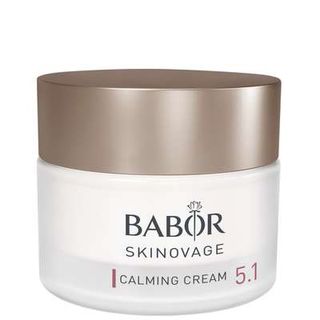
Works for
1 of 2 advertised claims delivered
MoisturizingPanthenol, Sesamum indicum seed oil + 14 moreStrong evidence
“As the perfect complimentary treatment, Babor recommends the MOISTURIZING CREAM RICH 5.”
This product can help improve hydration of the skin with the two types of ingredients.
The first type is called “humectants”:
these ingredients help attract water.
When humectants are on the surface of the skin, they “pull in” the moisture from the outside environment, or from
within deeper layers of the skin. The following ingredients in this product do the job:
biosaccharide gum-1, glycerin.
This product also contains ingredients called “occlusives”. They help reduce the speed with which our skin loses moisture to the outside environment. These ingredients also help soften the upper layer of the skin, so it feels less tight and nicer to the touch. The following ingredients in this product do the job: butyrospermum parkii butter, dimethicone.
The following ingredients in this product are especially good for supporting the skin barrier and helping with the hydration level: panthenol
Evens skin toneAscorbic acidWeak evidence
“The skin is left looking softer, more even and restored.”
Effective ingredients missing or their concentration is too low
Can it cause trouble?
Irritancy1 strong irritant: AlcoholMedium risk
Comedogenic3 ingredients rated 2 or more on the 0–5 pore-clogging scale3 flagged

User reviews
Be the first — your take helps the next person decide.
Ingredients
Filter by role to see what each ingredient is doing.
Water~45–55%
Sesamum indicum seed oil~6–7.3%
- Irritation risk
- Low
A good moisturizing plant oil. Due to the high linoleic acid content, it helps soften the upper layer of the skin, reduce water loss and support skin barrier function
More about Sesamum indicum seed oilCetearyl ethylhexanoate~4.3–5.2%
- Irritation risk
- Low
An emollient that helps soften the skin
More about Cetearyl ethylhexanoateButyrospermum parkii butter~3.1–3.8%
- Irritation risk
- Low
- Comedogenicity
- 3/5
A great moisturising ingredient that softens the skin and reduces water loss from its upper layer. It also can be helpful in protecting skin from free radicals
More about Butyrospermum parkii butterPolyglyceryl-3 methylglucose distearate~2.3–2.8%
- Irritation risk
- Medium
Helps water and oil mix together
More about Polyglyceryl-3 methylglucose distearateButylene glycol~1.9–2.3%
- Irritation risk
- Low
Used to create a nice product texture and help delivery of other ingredients. Might be somewhat helpful in attracting water to the upper layer of the skin
More about Butylene glycolMacadamia integrifolia seed oil~1.6–2%
- Irritation risk
- Low
A plant oil that helps soften the upper layer of the skin
More about Macadamia integrifolia seed oilPropanediol~1.4–1.7%
- Irritation risk
- Low
Acts as a solvent for other ingredients. Speeds up the absorption of other ingredients into the skin
More about PropanediolGlycerin~1.2–1.5%
- Irritation risk
- Low
One of the best moisturizing ingredients. Naturally present in skin. It attracts water to the upper layer of the skin working as a humectant
More about GlycerinHydrogenated vegetable glycerides~0.95–1.15%
- Irritation risk
- Low
Help soften the upper layer of the skin
More about Hydrogenated vegetable glyceridesCetearyl alcohol~0.75–1.15%
- Irritation risk
- Low
- Comedogenicity
- 2/5
A non-drying alcohol. Works as an emollient. Helps water and oil mix together and creates a nice product texture
More about Cetearyl alcoholBrassica campestris sterols~0.6–0.9%
- Irritation risk
- Low
Help soften the upper layer of the skin
More about Brassica campestris sterolsTocopheryl acetate~0.55–0.8%
- Irritation risk
- Medium
A more stable but less bio-available form of vitamin E compared to Tocopherol. Might help moisturize and protect the skin from free radicals, but mostly used in low concentrations to stabilize other ingredients.
More about Tocopheryl acetatePanthenol~0.5–0.7%
- Irritation risk
- Low
Helps attract water to the upper layer of the skin and can help improve skin barrier function
More about PanthenolPhenoxyethanol~0.45–0.7%
- Irritation risk
- Low
A preservative. It helps prevent bacterial growth in cosmetic products
More about PhenoxyethanolDimethicone~0.5–0.75%
- Irritation risk
- Low
A silicone that helps to reduce water loss from the surface of the skin. Can temporarily "fill in" lines and wrinkles, absorb oil, and create a nice product finish
More about DimethiconeIsopropyl myristate~0.45–0.7%
- Irritation risk
- Low
- Comedogenicity
- 3/5
An emollient that helps soften the skin. Could be comedogenic
More about Isopropyl myristateCarbomer~0.35–0.65%
- Irritation risk
- Low
Helps create a thicker or gel-like product texture. It is not a surfactant but can be used in gentle cleansing formulations
More about CarbomerXanthan gum~0.35–0.6%
- Irritation risk
- Low
Used to create a thicker product consistency
More about Xanthan gumAllantoin~0.3–0.55%
- Irritation risk
- Low
Helps calm down inflammation in skin and can help reduce itching. Helps to repair the skin barrier and keep skin hydrated
More about AllantoinSodium cetearyl sulfate~0.45–0.65%
- Irritation risk
- Medium
Helps water and oil mix together and works as a cleansing agent
More about Sodium cetearyl sulfateEthylhexylglycerin~0.25–0.5%
Albatrellus confluens extract~0.25–0.45%
- Irritation risk
- Low
Alcohol~0.25–0.45%
- Irritation risk
- High
Can be drying and contribute to skin irritation. Used in formulars to dissolve other ingredients, create a thinner product consistency or for its antibacterial properties
More about AlcoholSodium hydroxide~0.25–0.45%
Hydrogenated lecithin~0.25–0.45%
- Irritation risk
- Low
Helps to retain moisture by creating a protective barrier on the skin. Rich in fatty acids. Improves product texture and helps with the penetration of other ingredients.
More about Hydrogenated lecithinCaprylic/capric triglyceride~0.25–0.5%
- Irritation risk
- Medium
A good mix of fatty acids that forms a protective layer on the skin. Improves the shelf life of products. Derived from coconut and glycerin
More about Caprylic/capric triglycerideBiosaccharide gum-1~0.2–0.35%
- Irritation risk
- Low
Helps attract water to the upper layer of the skin and is claimed to provide a longer-lasting hydration because of its ability to create a water-binding film on the surface of the skin
More about Biosaccharide gum-1Citric acid~0.15–0.3%
- Irritation risk
- Medium
Can work as an exfoliant but is typically used to adjust the product pH
More about Citric acidPhenethyl alcohol~0.15–0.3%
Pantolactone~0.1–0.25%
- Irritation risk
- Low
Helps attract water to the upper layer of the skin
More about PantolactoneAscorbyl palmitate~0.1–0.15%
- Irritation risk
- Medium
Being a lipid soluble form of vitamin C, it is more stable and can penetrate the skin better than L-Ascorbic acid. It is effective in protecting the skin from free radicals, as well as evening the skin tone, but is less effective in stimulating collagen production compared to L-Ascorbic acid.
More about Ascorbyl palmitateAscorbic acid~0.05–0.15%
- Irritation risk
- High
The most well-researched antioxidant that works in skin. Helps neutralize free radicals supporting collagen production, helping to even out the skin tone and preventing early signs of aging
More about Ascorbic acidMaltodextrin~0.05–0.15%
- Irritation risk
- Low
Used to stabilize the product formulation and can help absorb oil
More about MaltodextrinHydrolyzed royal jelly protein~0.05–0.1%
- Irritation risk
- High
Ingredient list view
Water, Sesamum indicum seed oil, Cetearyl ethylhexanoate, Butyrospermum parkii butter, Polyglyceryl-3 methylglucose distearate, Butylene glycol, Macadamia integrifolia seed oil, Propanediol, Glycerin, Hydrogenated vegetable glycerides, Cetearyl alcohol, Brassica campestris sterols, Tocopheryl acetate, Panthenol, Phenoxyethanol, Dimethicone, Isopropyl myristate, Carbomer, Xanthan gum, Allantoin, Sodium cetearyl sulfate, Ethylhexylglycerin, Albatrellus confluens extract, Alcohol, Sodium hydroxide, Hydrogenated lecithin, Caprylic/capric triglyceride, Biosaccharide gum-1, Citric acid, Phenethyl alcohol, Pantolactone, Ascorbyl palmitate, Ascorbic acid, Maltodextrin, Hydrolyzed royal jelly protein
Compare prices
Retailers ranked by price — lowest first.

Worth comparing, line by line.
Match % combines shared ingredients, the first five ingredients, shared actives and hero ingredients, irritancy (lower counts in the alternative's favour), texture and body area. Only products in the same routine step are compared.
| BABORSkinovage Calming Cream 5.1YOUR PRODUCT | MarudermHyaluronic Acid Moisturizer Face & Body Cream | ObagiHydrate Facial Moisturizer | Ply SkinCare Cream | |
|---|---|---|---|---|
| Match | — | 61% | 60% | 60% |
| Price | $69.52 | $21.99−$47.53 | $70.00 | — |
| Shared key ingredients | — | 6 of 10 | 6 of 10 | 5 of 10 |
| Key difference | — | Niacinamide | Bisabolol | Niacinamide |
| Irritancy | Medium | Low | Low | Low |
| Drying alcohol | Contains drying alcohol | — | — | — |
| View product | Shop | Shop | Shop |


Product summary
Based on the ingredient list, "BABOR - Skinovage Calming Cream 5.1" can work well for skin moisturization. To work well, any moisturizer needs to include a combination of water-binding and emollient ingredients. BABOR - Skinovage Calming Cream 5.1 ticks this box. Humectants in this product (panthenol, biosaccharide gum-1, glycerin, pantolactone and butylene glycol) help to increase the water content in the upper layer of the skin. (These ingredients do so by "capturing" water molecules from the outside air or from within the deeper layers of the skin). Emollients in this formulation (isopropyl myristate, sesamum indicum seed oil, butyrospermum parkii butter, dimethicone and brassica campestris sterols) help to reduce the moisture loss from the skin. They also soften the skin surface and relieve the feeling of dryness and tightness.
Ingredient callouts
- This product also contains vitamin C (Ascorbic Acid). It can be an effective active for anti-aging and evening out the skin tone, but in this moisturizer it is used for stabilizing other ingredients in the formulation. In this concentration (0.05% - 0.15%) it cannot have a noticeable benefit for the skin.
Irritation risk
This moisturizer contains some common irritants, including those without a benefit for the skin. We assess the overall irritancy of this moisturizer to be medium. For a detailed overview of all potential irritants: click here
You can see the detailed formula review with the breakdown of all actives in the product and the full ingredient list with estimated concentrations in the tables below.
Price
The product retails for 52.00£ in the United Kingdom and for 109.99A$ in Australia.
For a detailed price comparison: click here.
Sources cited in this review
Every concentration estimate and effectiveness label is anchored to one of these 13 studies and safety reviews.
- 1
- 2Triglyceride composition of Sesamum indicum seed oilonlinelibrary.wiley.com
- 3
- 4
- 5
- 6Skin moisturizing effects of panthenol-based formulationspdfs.semanticscholar.org

Affiliate links · As an Amazon Associate, WIMJ earns from qualifying purchases.