Works for
1 of 3 advertised claims delivered
MoisturizingUrea, Panthenol + 20 moreStrong evidence
“Powered by a unique Re-YOUTH Complex that combines Telovitin, Agicyl, Epocyl and Lumicol, the lightweight formula is absorbed quickly and deeply to combat uneven skin tone and minimise the appearance of wrinkles, whilst delivering long-lasting moisture and hydration to restore softness and suppleness.”
This product can help improve hydration of the skin with the two types of ingredients.
The first type is called “humectants”:
these ingredients help attract water.
When humectants are on the surface of the skin, they “pull in” the moisture from the outside environment, or from
within deeper layers of the skin. The following ingredients in this product do the job:
fructose, glycerin.
This product also contains ingredients called “occlusives”. They help reduce the speed with which our skin loses moisture to the outside environment. These ingredients also help soften the upper layer of the skin, so it feels less tight and nicer to the touch. The following ingredients in this product do the job: caprylic/capric triglyceride, simmondsia chinensis seed oil.
The following ingredients in this product are especially good for supporting the skin barrier and helping with the hydration level: panthenol, urea
Anti-agingAscorbyl palmitate, Ascorbic acid + 2 moreLimited evidence
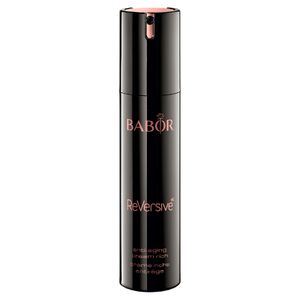
“Fight signs of ageing with the BABOR ReVersive Anti-Aging Cream Rich ; an intensive cream that utilises high-performance active ingredients to help maintain youthful radiance.”
This product does not contain ingredients that are able to reduce fine lines and wrinkles or help with skin elasticity, but it can improve the look of the skin temporarily through moisturization. Well-moisturized skin might also be able to repair the sun damage better.
Evens skin toneAscorbic acid, Lactic acid + 1 moreWeak evidence
“Powered by a unique Re-YOUTH Complex that combines Telovitin, Agicyl, Epocyl and Lumicol, the lightweight formula is absorbed quickly and deeply to combat uneven skin tone and minimise the appearance of wrinkles, whilst delivering long-lasting moisture and hydration to restore softness and suppleness.”
Effective ingredients missing or their concentration is too low
Can it cause trouble?
Irritancy4 strong irritants: Parfum, Alcohol + 2 more — patch-test recommendedHigh risk
Comedogenic4 ingredients rated 2 or more on the 0–5 pore-clogging scale4 flagged

User reviews
Be the first — your take helps the next person decide.
Ingredients
Filter by role to see what each ingredient is doing.
Water~45–55%
Glycerin~4.6–5.6%
- Irritation risk
- Low
One of the best moisturizing ingredients. Naturally present in skin. It attracts water to the upper layer of the skin working as a humectant
More about GlycerinC12-15 alkyl benzoate~4.1–5%
- Irritation risk
- Low
Enhances the product texture and makes it more spreadable. Helps reduce water loss from the outer layer of skin. Extands the shelf life by preventing bacteria growth
More about C12-15 alkyl benzoateCocoglycerides~2.8–3.4%
- Irritation risk
- High
Help soften the upper layer of the skin and make it easier for oil and water mix together. Recently, a rising number of allergic reactions to cocoglycerides and other coconut-derived surfactants has been reported. As there is a significant overlap between frequent irritants and allergens, we flag this ingredient for attention of those with very sensitive, reactive skin
More about CocoglyceridesCaprylic/capric triglyceride~2.4–3%
- Irritation risk
- Medium
A good mix of fatty acids that forms a protective layer on the skin. Improves the shelf life of products. Derived from coconut and glycerin
More about Caprylic/capric triglycerideCetearyl alcohol~2–2.4%
- Irritation risk
- Low
- Comedogenicity
- 2/5
A non-drying alcohol. Works as an emollient. Helps water and oil mix together and creates a nice product texture
More about Cetearyl alcoholGlycine soja oil~1.6–1.9%
- Irritation risk
- Medium
- Comedogenicity
- 2/5
A good emollient that helps soften the skin and helps repair its barrier function. It can clog pores if used in high concentrations.
More about Glycine soja oilPersea gratissima oil~1.5–1.9%
- Irritation risk
- Medium
An emollient that helps soften the skin and could be helpful in repairing its barrier function
More about Persea gratissima oilSimmondsia chinensis seed oil~1.3–1.6%
- Irritation risk
- Medium
Softens the upper layer of skin and helps restore the healthy skin barrier. Has shown to help calm down inflammation in skin. It is a stable oil, meaning that it retains its properties even when exposed to air.
More about Simmondsia chinensis seed oilTocopheryl acetate~1–1.2%
- Irritation risk
- Medium
A more stable but less bio-available form of vitamin E compared to Tocopherol. Might help moisturize and protect the skin from free radicals, but mostly used in low concentrations to stabilize other ingredients.
More about Tocopheryl acetateMaris aqua~0.7–1.05%
Phenoxyethanol~0.6–0.85%
- Irritation risk
- Low
A preservative. It helps prevent bacterial growth in cosmetic products
More about PhenoxyethanolPanthenol~0.5–0.8%
- Irritation risk
- Low
Helps attract water to the upper layer of the skin and can help improve skin barrier function
More about PanthenolHydrogenated vegetable glycerides~0.5–0.75%
- Irritation risk
- Low
Help soften the upper layer of the skin
More about Hydrogenated vegetable glyceridesPotassium cetyl phosphate~0.45–0.7%
- Irritation risk
- Medium
Helps oil and water mix together
More about Potassium cetyl phosphateSodium acrylate/sodium acryloyldimethyl taurate copolymer~0.45–0.65%
- Irritation risk
- Low
Used to create a thicker product consistency
More about Sodium acrylate/sodium acryloyldimethyl taurate copolymerGlobularia cordifolia callus culture extract~0.4–0.6%
- Irritation risk
- Low
An extract from plant stem cells that might help calm down inflammation in skin
More about Globularia cordifolia callus culture extractXanthan gum~0.4–0.6%
- Irritation risk
- Low
Used to create a thicker product consistency
More about Xanthan gumPolyisobutene~0.35–0.65%
Hydrogenated palm glycerides~0.35–0.65%
- Irritation risk
- Low
An emollient that softens the skin
More about Hydrogenated palm glyceridesSodium lactate~0.25–0.5%
- Irritation risk
- Medium
Helps attract water to the upper layer of the skin. Is often used to adjust the pH level of the product
More about Sodium lactateSodium pca~0.25–0.5%
- Irritation risk
- Low
Naturally present in skin and helps to attract water to its upper layer
More about Sodium pcaParfum~0.2–0.4%
- Irritation risk
- High
An aromatic blend of unspecified and possibly irritating ingredients
More about ParfumPotassium sorbate~0.25–0.45%
Ethylhexylglycerin~0.25–0.45%
Teprenone~0.2–0.4%
- Irritation risk
- Low
Disodium edta~0.25–0.4%
Sodium hyaluronate~0.25–0.4%
- Irritation risk
- Low
One of the best moisturizing ingredients. Attracts water into the upper layer of the skin
More about Sodium hyaluronateSorbitan oleate~0.25–0.45%
- Irritation risk
- Medium
- Comedogenicity
- 2/5
Helps oil and water mix together
More about Sorbitan oleateCitric acid~0.25–0.4%
- Irritation risk
- Medium
Can work as an exfoliant but is typically used to adjust the product pH
More about Citric acidCaprylyl/capryl glucoside~0.3–0.5%
- Irritation risk
- Medium
Helps oil and water mix together. Can be used as a cleansing agent
More about Caprylyl/capryl glucosideAlcohol~0.25–0.4%
- Irritation risk
- High
Can be drying and contribute to skin irritation. Used in formulars to dissolve other ingredients, create a thinner product consistency or for its antibacterial properties
More about AlcoholPhormidium persicinum extract~0.25–0.45%
- Irritation risk
- Low
Plankton extract~0.2–0.4%
- Irritation risk
- Medium
- Comedogenicity
- 3/5
Can help attract water to the upper layer of the skin
More about Plankton extractButylphenyl methylpropional~0.2–0.35%
- Irritation risk
- High
A fragrance. Can trigger allergic reactions and be irritating
More about Butylphenyl methylpropionalHydroxyisohexyl 3-cyclohexene carboxaldehyde~0.2–0.35%
- Irritation risk
- High
A fragrance. Can be irritating
More about Hydroxyisohexyl 3-cyclohexene carboxaldehydePantolactone~0.2–0.4%
- Irritation risk
- Low
Helps attract water to the upper layer of the skin
More about PantolactoneSodium benzoate~0.2–0.35%
Fructose~0.15–0.3%
- Irritation risk
- Low
Helps attract water to the upper layer of the skin
More about FructoseGlycine~0.15–0.3%
- Irritation risk
- Low
Helps to attract water to the upper layer of the skin and can help restore the skin barrier function
More about GlycineAscorbyl palmitate~0.15–0.25%
- Irritation risk
- Medium
Being a lipid soluble form of vitamin C, it is more stable and can penetrate the skin better than L-Ascorbic acid. It is effective in protecting the skin from free radicals, as well as evening the skin tone, but is less effective in stimulating collagen production compared to L-Ascorbic acid.
More about Ascorbyl palmitateInositol~0.15–0.3%
Lactic acid~0.15–0.3%
- Irritation risk
- Medium
An exfoliating and moisturizing alpha-hydroxy acid (AHA). Typically causes less irritation than other AHAs, for example, glycolic acid. At high concentrations (about 15%), lactic acid can help reduce lines and wrinkles. Recent studies show that lactic acid can support the "good" bacteria living on skin's surface (healthy skin microbiome)
More about Lactic acidNiacinamide~0.15–0.25%
- Irritation risk
- Low
Is proven to be effective in reducing blemishes, evening out skin tone and helping to improve lines and wrinkles. It helps the skin to repair sun damage, calm down inflammation and keep maintain good levels of moisture. The concentration of about 2% is effective for supporting the skin barrier and evening out the skin tone. Concentration of 4-6% is better for helping with acne and balancing the sebum production
More about NiacinamideUrea~0.1–0.2%
- Irritation risk
- Low
Naturally present in skin (urea makes up about 7% of natural moisturizing factors in skin). Attracts water to the upper layer of the skin. Also has a positive effect on the skin barrier beyond the humectant action. Can enhance penetration of other ingredients. Is an exfoliating ingredient when used in high concentrations
More about UreaAscorbic acid~0.1–0.15%
- Irritation risk
- High
The most well-researched antioxidant that works in skin. Helps neutralize free radicals supporting collagen production, helping to even out the skin tone and preventing early signs of aging
More about Ascorbic acidIngredient list view
Water, Glycerin, C12-15 alkyl benzoate, Cocoglycerides, Caprylic/capric triglyceride, Cetearyl alcohol, Glycine soja oil, Persea gratissima oil, Simmondsia chinensis seed oil, Tocopheryl acetate, Maris aqua, Phenoxyethanol, Panthenol, Hydrogenated vegetable glycerides, Potassium cetyl phosphate, Sodium acrylate/sodium acryloyldimethyl taurate copolymer, Globularia cordifolia callus culture extract, Xanthan gum, Polyisobutene, Hydrogenated palm glycerides, Sodium lactate, Sodium pca, Parfum, Potassium sorbate, Ethylhexylglycerin, Teprenone, Disodium edta, Sodium hyaluronate, Sorbitan oleate, Citric acid, Caprylyl/capryl glucoside, Alcohol, Phormidium persicinum extract, Plankton extract, Butylphenyl methylpropional, Hydroxyisohexyl 3-cyclohexene carboxaldehyde, Pantolactone, Sodium benzoate, Fructose, Glycine, Ascorbyl palmitate, Inositol, Lactic acid, Niacinamide, Urea, Ascorbic acid
Compare prices
Retailers ranked by price — lowest first.
Affiliate links · prices updated regularly · As an Amazon Associate, WIMJ earns from qualifying purchases.
Worth comparing, line by line.
Match % combines shared ingredients, the first five ingredients, shared actives and hero ingredients, irritancy (lower counts in the alternative's favour), texture and body area. Only products in the same routine step are compared.
| BABORReVersive Anti-Aging Cream RichYOUR PRODUCT | MarudermHyaluronic Acid Moisturizer Face & Body Cream | ISDINIsdinceutics Prevent Hyaluronic Moisture Sensitive Skin | IsdinceuticsHyaluronic Moisture Sensitive Skin | |
|---|---|---|---|---|
| Match | — | 94% | 89% | 89% |
| Price | — | $21.99 | $38.93 | — |
| Shared key ingredients | — | 11 of 15 | 6 of 15 | 6 of 15 |
| Key difference | — | Dimethicone | Hydrolyzed Hyaluronic Acid | Hydrolyzed Hyaluronic Acid |
| Irritancy | High | Low | Medium | Medium |
| Drying alcohol | Contains drying alcohol | — | — | — |
| View product | Shop | Shop | Shop |


Product summary
Judging from the ingredient list, "BABOR - ReVersive Anti-Aging Cream Rich" works well for improving skin hydration To work well, any moisturizer needs to include a combination of water-binding and emollient ingredients. BABOR - ReVersive Anti-Aging Cream Rich ticks this box. Panthenol, urea, fructose, glycerin and glycine in this product (humectants) attract water molecules to the upper layer of the skin (the water comes from the outside air or from the deeper layers of the skin if the air is dry). Emollients in this formulation (glycine soja oil, persea gratissima oil, caprylic/capric triglyceride, simmondsia chinensis seed oil and c12-15 alkyl benzoate) help to reduce the moisture loss from the skin. They also soften the skin surface and relieve the feeling of dryness and tightness.
Ingredient callouts
- This product also contains vitamin C (Ascorbic Acid). It can be an effective active for anti-aging and evening out the skin tone, but in this moisturizer it is used for stabilizing other ingredients in the formulation. In this concentration (0.10% - 0.15%) it cannot have a noticeable benefit for the skin.
Irritation risk
We assess the overall irritancy of this moisturizer to be high. For a detailed overview of all potential irritants: click here
You can see the detailed formula review with the breakdown of all actives in the product and the full ingredient list with estimated concentrations in the tables below.
Price
The product retails from 125.00$ up to 185.00$ in the United States and for 159.10CA$ in Canada.
For a detailed price comparison: click here.
Sources cited in this review
Every concentration estimate and effectiveness label is anchored to one of these 15 studies and safety reviews.
- 1
- 2Skin moisturizing effects of panthenol-based formulationspdfs.semanticscholar.org
- 3
- 4
- 5Hyaluronic acid: A key molecule in skin agingncbi.nlm.nih.gov
- 6

Affiliate links · As an Amazon Associate, WIMJ earns from qualifying purchases.