Works for
1 of 3 advertised claims delivered
Moisturizing13 ingredients credited for this claimGood support
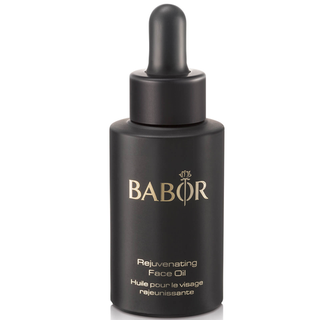
“Rejuvenating Face Oil”
This product can help soften the skin and reduce its moisture loss with emollients and occlusives: helianthus annuus seed oil, glycine soja oil.
Keep in mind that this product does not contain effective ingredients to attract water to the upper layer of the skin. This is why an additional product with humectants like glycerin or hyaluronic acid can be helpful (apply it before this product for the best results).
Evens skin tone1 ingredient credited for this claimWeak support
“Rejuvenating Face Oil lends the complexion a more even appearance and imparts a youthful glow.”
Effective ingredients missing or their concentration is too low
Anti-aging4 ingredients credited for this claimWeak support
“Rejuvenating Face Oil lends the complexion a more even appearance and imparts a youthful glow.”
Effective ingredients missing or their concentration is too low.
Can it cause trouble?
Irritancy9 strong irritants: Parfum, Alcohol + 7 more — patch-test recommendedHigh risk
Comedogenic1 ingredient rated 2 or more on the 0–5 pore-clogging scale1 flagged
User reviews
Be the first — your take helps the next person decide.
Ingredients
Filter by role to see what each ingredient is doing.
Prunus amygdalus dulcis oil~25–37%
- Irritation risk
- Low
An emollient that softens the skin
More about Prunus amygdalus dulcis oilCoco-caprylate~5.2–7.8%
- Irritation risk
- Medium
An emollient that softens skin and creates a nice product texture
More about Coco-caprylateVitis vinifera seed oil~4.8–7.3%
- Irritation risk
- Medium
A great emollient that can also have anti-oxidant properties
More about Vitis vinifera seed oilMacadamia integrifolia seed oil~3.9–5.8%
- Irritation risk
- Low
A plant oil that helps soften the upper layer of the skin
More about Macadamia integrifolia seed oilPrunus armeniaca kernel oil~3–4.4%
- Irritation risk
- Medium
An emollient that helps soften the skin
More about Prunus armeniaca kernel oilPistacia vera seed oil~2.2–3.3%
- Irritation risk
- Low
Helps soften the upper layer of the skin
More about Pistacia vera seed oilRosa canina fruit oil~1.7–2.6%
- Irritation risk
- Medium
A great emollient. Contains vitamin E (tocopherol) which may give it some anti-oxidant properties. Can contain volatile compounds and can be irritating
More about Rosa canina fruit oilGlycine soja oil~1.3–2%
- Irritation risk
- Medium
- Comedogenicity
- 2/5
A good emollient that helps soften the skin and helps repair its barrier function. It can clog pores if used in high concentrations.
More about Glycine soja oilUndecane~1.2–1.8%
- Irritation risk
- Medium
Helps create a non-greasy finish on the skin
More about UndecaneTridecane~0.9–1.35%
Tocopheryl acetate~0.6–1.35%
- Irritation risk
- Medium
A more stable but less bio-available form of vitamin E compared to Tocopherol. Might help moisturize and protect the skin from free radicals, but mostly used in low concentrations to stabilize other ingredients.
More about Tocopheryl acetateParfum~0.5–1.15%
- Irritation risk
- High
An aromatic blend of unspecified and possibly irritating ingredients
More about ParfumHelianthus annuus seed oil~0.55–1.25%
- Irritation risk
- Low
A great emollient due to its high linoleic acid content. One of the most effective plant oils in helping skin hydration and repairing skin barrier function
More about Helianthus annuus seed oilAlcohol~0.4–0.9%
- Irritation risk
- High
Can be drying and contribute to skin irritation. Used in formulars to dissolve other ingredients, create a thinner product consistency or for its antibacterial properties
More about AlcoholRosa alba leaf cell extract~0.4–0.9%
- Irritation risk
- High
Caprylic/capric triglyceride~0.45–1.05%
- Irritation risk
- Medium
A good mix of fatty acids that forms a protective layer on the skin. Improves the shelf life of products. Derived from coconut and glycerin
More about Caprylic/capric triglycerideDicaprylyl ether~0.4–0.95%
- Irritation risk
- Low
Helps soften the upper layer of the skin while creating a non-greasy feel on the skin. Helps to dissolve other ingredients
More about Dicaprylyl etherCitronellol~0.3–0.7%
Alpha-isomethyl ionone~0.15–0.7%
- Irritation risk
- High
A fragrance. Potential allergen and can be irritating
More about Alpha-isomethyl iononeBenzyl salicylate~0.15–0.5%
Lauryl alcohol~0.2–0.75%
Limonene~0.1–0.45%
- Irritation risk
- High
A common frangrance that can easily irritate skin, especially if exposed to air, light or heat
More about LimoneneLinalool~0.1–0.4%
Ascorbyl palmitate~0.1–0.35%
- Irritation risk
- Medium
Being a lipid soluble form of vitamin C, it is more stable and can penetrate the skin better than L-Ascorbic acid. It is effective in protecting the skin from free radicals, as well as evening the skin tone, but is less effective in stimulating collagen production compared to L-Ascorbic acid.
More about Ascorbyl palmitateMagnolia grandiflora bark extract~0.1–0.4%
- Irritation risk
- Low
Citric acid~0.05–0.3%
- Irritation risk
- Medium
Can work as an exfoliant but is typically used to adjust the product pH
More about Citric acidAscorbic acid~0.05–0.2%
- Irritation risk
- High
The most well-researched antioxidant that works in skin. Helps neutralize free radicals supporting collagen production, helping to even out the skin tone and preventing early signs of aging
More about Ascorbic acidTocopherol~0.05–0.2%
- Irritation risk
- Low
Pure form of vitamin E. Can help moisturise and protect the skin from free radicals. Often used to help stabilise other ingredients or the formula itself
More about TocopherolRosmarinus officinalis leaf extract~0.01–0.1%
- Irritation risk
- High
Can be helpful in reducing inflammation in skin, including inflamed acne. It can be irritating
More about Rosmarinus officinalis leaf extractIngredient list view
Prunus amygdalus dulcis oil, Coco-caprylate, Vitis vinifera seed oil, Macadamia integrifolia seed oil, Prunus armeniaca kernel oil, Pistacia vera seed oil, Rosa canina fruit oil, Glycine soja oil, Undecane, Tridecane, Tocopheryl acetate, Parfum, Helianthus annuus seed oil, Alcohol, Rosa alba leaf cell extract, Caprylic/capric triglyceride, Dicaprylyl ether, Citronellol, Alpha-isomethyl ionone, Benzyl salicylate, Lauryl alcohol, Limonene, Linalool, Ascorbyl palmitate, Magnolia grandiflora bark extract, Citric acid, Ascorbic acid, Tocopherol, Rosmarinus officinalis leaf extract
Compare prices
Retailers ranked by price — lowest first.

Sources cited in this review
Every concentration estimate and effectiveness label is anchored to one of these 12 studies and safety reviews.
- 1
- 2
- 3
- 4
- 5
- 6Effect of topically applied lipids on surfactant-irritated skinonlinelibrary.wiley.com

Affiliate links · As an Amazon Associate, WIMJ earns from qualifying purchases.