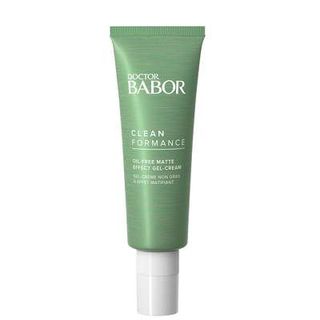
BABOR Doctor Babor Cleanformance: Oil-Free Matte Effect Cream
Works for
1 of 1 advertised claim delivered
Moisturizing10 ingredients credited for this claimStrong support
“Benefit The oil-free, extra-light cream-gel formula intensively moisturizes the skin, giving it a matte, healthy-looking glow.”
This product contains good ingredients to attract water to the upper layer of the skin. These ingredients are called "humectants": biosaccharide gum-1, glycerin.
When humectants are on the surface of the skin, they “pull in” the moisture from the outside environment, or from within deeper layers of the skin. If the air is dry, humectants can speed up the moisture loss from the skin. This is why it is a good idea to use another product on top of this one to help "seal in" the moisture (look for ingredients like dimethicone, squalane, oils and butters).
The following ingredients in this product are especially good for supporting the skin barrier and helping with the hydration level: niacinamide
Evens skin toneNot advertised by the brand · 2 ingredients credited for this claimStrong support
This product can help reduce hypepigmentation and even out the skin tone because it contains the following effective ingredients: niacinamide
Keep in mind that you would need to apply any topical skincare targetted at hypigmentation consistently for a couple of months to get a result. No topical skincare product can help get rid of hyperpigmentation (including post-acne marks and age spots) instantly.
Anti-blemishNot advertised by the brand · 2 ingredients credited for this claimStrong support
This product can help reduce breakouts and clogged pores because it contains the following ingredient: niacinamide. This ingredient is used for treating acne and can have a noticeable effect.
Anti-agingNot advertised by the brand · 4 ingredients credited for this claimStrong support
This product can help reduce and prevent fine lines and wrinkles, improve skin elasticity and firmness because it contains niacinamide.
Keep in mind that it typically takes at least 6 weeks to notice any results because the changes that are needed to improve fine lines and elasticity happen in the deeper layers of the skin. No topical anti-aging product can “erase” wrinkles or fully reverse signs of aging.
Can it cause trouble?
Irritancy6 strong irritants: Alcohol, Parfum + 4 more — patch-test recommendedHigh risk
ComedogenicClean of flagged comedogenic ingredientsNone flagged


User reviews
Be the first — your take helps the next person decide.
Ingredients
Filter by role to see what each ingredient is doing.
Water~45–55%
Alcohol~8.2–10%
- Irritation risk
- High
Can be drying and contribute to skin irritation. Used in formulars to dissolve other ingredients, create a thinner product consistency or for its antibacterial properties
More about AlcoholLactococcus ferment lysate~4.3–5.3%
- Irritation risk
- Low
Consists of remains of dead bacteria cells. Is likely helpful in attracting water to the upper layer of the skin. Might be helpful in reducing inflammation and neutralizing free radicals in skin
More about Lactococcus ferment lysateGlycerin~3–3.7%
- Irritation risk
- Low
One of the best moisturizing ingredients. Naturally present in skin. It attracts water to the upper layer of the skin working as a humectant
More about GlycerinNiacinamide~2.3–2.8%
- Irritation risk
- Low
Is proven to be effective in reducing blemishes, evening out skin tone and helping to improve lines and wrinkles. It helps the skin to repair sun damage, calm down inflammation and keep maintain good levels of moisture. The concentration of about 2% is effective for supporting the skin barrier and evening out the skin tone. Concentration of 4-6% is better for helping with acne and balancing the sebum production
More about NiacinamideGlyceryl oleate citrate~1.9–2.3%
- Irritation risk
- Medium
Helps oil and water mix together
More about Glyceryl oleate citrateTocopheryl acetate~1.6–1.9%
- Irritation risk
- Medium
A more stable but less bio-available form of vitamin E compared to Tocopherol. Might help moisturize and protect the skin from free radicals, but mostly used in low concentrations to stabilize other ingredients.
More about Tocopheryl acetateHydrolyzed yeast protein~1.4–1.7%
- Irritation risk
- Low
Distarch phosphate~1.1–1.4%
- Irritation risk
- Low
Aloe barbadensis leaf juice~0.95–1.15%
- Irritation risk
- Medium
Traditionally used to treat sunburns, dermatitis and inflammation, but evidence for its effectiveness is lacking. The extract can contain humectants that help attract water into the skin
More about Aloe barbadensis leaf juicePhenoxyethanol~0.65–0.95%
- Irritation risk
- Low
A preservative. It helps prevent bacterial growth in cosmetic products
More about PhenoxyethanolDehydroxanthan gum~0.6–0.9%
- Irritation risk
- Low
Helps create thicker product formulations and stabilize emulsions
More about Dehydroxanthan gumButylene glycol~0.5–0.75%
- Irritation risk
- Low
Used to create a nice product texture and help delivery of other ingredients. Might be somewhat helpful in attracting water to the upper layer of the skin
More about Butylene glycolCaprylic/capric triglyceride~0.5–0.8%
- Irritation risk
- Medium
A good mix of fatty acids that forms a protective layer on the skin. Improves the shelf life of products. Derived from coconut and glycerin
More about Caprylic/capric triglycerideParfum~0.35–0.65%
- Irritation risk
- High
An aromatic blend of unspecified and possibly irritating ingredients
More about ParfumLevulinic acid~0.35–0.6%
Pentylene glycol~0.45–0.7%
- Irritation risk
- Medium
Used to preserve products, dissolve other ingredients and create a nice product texture
More about Pentylene glycolEthylhexylglycerin~0.35–0.6%
Cassia angustifolia seed polysaccharide~0.3–0.55%
- Irritation risk
- Medium
Helps attract water to the upper layer of the skin. Is sometimes referred to as "natural" hyaluronic acid (even though hyaluronic acid is not unnatural and is present in human skin)
More about Cassia angustifolia seed polysaccharideSodium levulinate~0.25–0.5%
Limonene~0.25–0.45%
- Irritation risk
- High
A common frangrance that can easily irritate skin, especially if exposed to air, light or heat
More about LimoneneMica~0.3–0.5%
- Irritation risk
- Low
Creates an illusion of smoother and more radiant skin tone. Adds shimmer to the skin by reflecting light
More about MicaBiosaccharide gum-1~0.25–0.45%
- Irritation risk
- Low
Helps attract water to the upper layer of the skin and is claimed to provide a longer-lasting hydration because of its ability to create a water-binding film on the surface of the skin
More about Biosaccharide gum-1Linalool~0.2–0.4%
Backhousia citriodora leaf extract~0.25–0.45%
- Irritation risk
- High
A plant extract used mostly as a fragrance. Can have some anti-microbial and anti-oxidant properties
More about Backhousia citriodora leaf extractLactic acid~0.25–0.45%
- Irritation risk
- Medium
An exfoliating and moisturizing alpha-hydroxy acid (AHA). Typically causes less irritation than other AHAs, for example, glycolic acid. At high concentrations (about 15%), lactic acid can help reduce lines and wrinkles. Recent studies show that lactic acid can support the "good" bacteria living on skin's surface (healthy skin microbiome)
More about Lactic acidSodium hydroxide~0.25–0.45%
Sodium chloride~0.25–0.5%
- Irritation risk
- Low
Used to stabilize mixtures of oil and water, and create thicker, gel-like product textures
More about Sodium chlorideSodium benzoate~0.2–0.4%
Acer rubrum bark extract~0.2–0.4%
- Irritation risk
- Low
Citric acid~0.15–0.3%
- Irritation risk
- Medium
Can work as an exfoliant but is typically used to adjust the product pH
More about Citric acidTin oxide~0.3–0.5%
- Irritation risk
- Low
A colorant that can add a pearl-like appearance to the formulation
More about Tin oxideCitral~0.15–0.25%
Ci 77891~0.1–0.2%
- Irritation risk
- Low
Ci 77288~0.1–0.15%
- Irritation risk
- Low
Ci 42090~0.1–0.15%
Ingredient list view
Water, Alcohol, Lactococcus ferment lysate, Glycerin, Niacinamide, Glyceryl oleate citrate, Tocopheryl acetate, Hydrolyzed yeast protein, Distarch phosphate, Aloe barbadensis leaf juice, Phenoxyethanol, Dehydroxanthan gum, Butylene glycol, Caprylic/capric triglyceride, Parfum, Levulinic acid, Pentylene glycol, Ethylhexylglycerin, Cassia angustifolia seed polysaccharide, Sodium levulinate, Limonene, Mica, Biosaccharide gum-1, Linalool, Backhousia citriodora leaf extract, Lactic acid, Sodium hydroxide, Sodium chloride, Sodium benzoate, Acer rubrum bark extract, Citric acid, Tin oxide, Citral, Ci 77891, Ci 77288, Ci 42090
Compare prices
Retailers ranked by price — lowest first.
Worth comparing, line by line.
Match % combines shared ingredients, the first five ingredients, shared actives and hero ingredients, irritancy (lower counts in the alternative's favour), texture and body area. Only products in the same routine step are compared.
| BABORDoctor Babor Cleanformance: Oil-Free Matte Effect CreamYOUR PRODUCT | January LabsRetexturizing Night Cream | Biologique RechercheLotion P50 Original "1970" | FaceGymSupreme Restructure Cream | |
|---|---|---|---|---|
| Match | — | 87% | 84% | 83% |
| Price | $36.36 | $86.00+$49.64 | $155.00+$118.64 | $120.00+$83.64 |
| Shared key ingredients | — | 4 of 7 | 3 of 7 | 4 of 7 |
| Key difference | — | Palmitoyl Tripeptide-5 | Salicylic Acid | Hexapeptide-9 |
| Irritancy | High | Medium | High | Medium |
| Drying alcohol | Contains drying alcohol | — | — | — |
| View product | Shop | Shop | Shop |


Product summary
"BABOR - Doctor Babor Cleanformance: Oil-Free Matte Effect Cream" has a good moisturizing formula. As we expect from a proper moisturizer, the formula includes a combo of effective humectants and emollients. These are the two different types of ingredients that are essential for improving the skin hydration and supporting a healthy skin barrier. Biosaccharide gum-1, glycerin and butylene glycol in this product (humectants) attract water molecules to the upper layer of the skin (the water comes from the outside air or from the deeper layers of the skin if the air is dry). Emollients in this formulation (pentylene glycol) help to reduce the moisture loss from the skin. They also soften the skin surface and relieve the feeling of dryness and tightness.
Ingredient callouts
- We particularly like that there is a good concentration of Niacinamide (2.30% - 2.80%) in this moisturizer. Niacinamide is a well-studied multi-tasking active. It is a great ingredient to have in a moisturizer. It is stable, and can work well in almost any hydrating formulation. There is solid evidence that Niacinamide can help support skin barrier, regulate oil production and reduce acne and clogged pores. It also helps to fight photodamage and help improve the skin tone, reducing pigmentation marks.
Irritation risk
There are quite a few common irritants in this product, including ingredients without particular skin benefits. We would not recommend it for sensitive skin. We assess the overall irritancy of this moisturizer to be high. For a detailed overview of all potential irritants: click here
You can see the detailed formula review with the breakdown of all actives in the product and the full ingredient list with estimated concentrations in the tables below.
Sources cited in this review
Every concentration estimate and effectiveness label is anchored to one of these 10 studies and safety reviews.
- 1
- 2
- 3
- 4
- 5
- 6Contact Burn with Blister Formation in Children Treated with Sennosidesonlinelibrary.wiley.com

Affiliate links · As an Amazon Associate, WIMJ earns from qualifying purchases.