Works for
1 of 2 advertised claims delivered
MoisturizingUrea, Peg/ppg-18/18 dimethicone + 15 moreStrong evidence
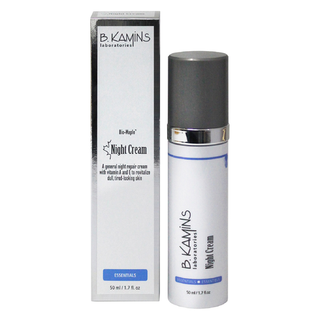
“Night Cream”
This product can help improve hydration of the skin with the two types of ingredients.
The first type is called “humectants”:
these ingredients help attract water.
When humectants are on the surface of the skin, they “pull in” the moisture from the outside environment, or from
within deeper layers of the skin. The following ingredients in this product do the job:
glycerin, sodium hyaluronate.
This product also contains ingredients called “occlusives”. They help reduce the speed with which our skin loses moisture to the outside environment. These ingredients also help soften the upper layer of the skin, so it feels less tight and nicer to the touch. The following ingredients in this product do the job: dimethicone, glycine soja oil.
The following ingredients in this product are especially good for supporting the skin barrier and helping with the hydration level: urea
Anti-agingTocopherol, Retinyl palmitateLimited evidence
“Antioxidants, vitamins, essential nutrients and powerful humectants help restore and protect the skin's moisture balance, while helping to visibly diminish the appearance of fine lines and wrinkles.”
This product does not contain ingredients that are able to reduce fine lines and wrinkles or help with skin elasticity, but it can improve the look of the skin temporarily through moisturization. Well-moisturized skin might also be able to repair the sun damage better.
Can it cause trouble?
Irritancy8 strong irritants: Retinyl palmitate, Parfum + 6 more — patch-test recommendedHigh risk
Comedogenic3 ingredients rated 2 or more on the 0–5 pore-clogging scale3 flagged


User reviews
Be the first — your take helps the next person decide.
Ingredients
Filter by role to see what each ingredient is doing.
Water~45–55%
Glyceryl stearate se~4.1–5%
- Irritation risk
- Low
- Comedogenicity
- 2/5
Used to stabilize the product formulations and works as an emollient
More about Glyceryl stearate seUrea~4–4.9%
- Irritation risk
- Low
Naturally present in skin (urea makes up about 7% of natural moisturizing factors in skin). Attracts water to the upper layer of the skin. Also has a positive effect on the skin barrier beyond the humectant action. Can enhance penetration of other ingredients. Is an exfoliating ingredient when used in high concentrations
More about UreaSoluble collagen~3.3–4%
- Irritation risk
- Low
A typically plant-derived compound that is supposed mimic human collagen. Cannot penetrate the skin barrier so is not particularly useful in skincare products beyond attracting water to the upper layer of the skin
More about Soluble collagenAcer saccharum extract~2.7–3.3%
- Irritation risk
- Medium
A plant extract that contains small percentage of AHAs. Is unlikely to have any skin benefit due the small concentration of the active compounds
More about Acer saccharum extractCetyl alcohol~2.3–2.8%
- Irritation risk
- Low
A non-drying alcohol that works to soften the skin and stabilize product formulations helping oil and water mix together
More about Cetyl alcoholCoco-caprylate/caprate~1.9–2.3%
- Irritation risk
- Low
Helps to soften the upper layer of the skin without creating a greasy texture
More about Coco-caprylate/capratePeg-8~1.6–2%
- Irritation risk
- Medium
Used to create a nice product consistency
More about Peg-8Ceteareth-12~1.3–1.6%
Cyclotetrasiloxane~1.1–1.3%
- Irritation risk
- Low
Cyclopentasiloxane~0.9–1.1%
- Irritation risk
- Low
A silicone that helps improve the product texture and spreadability. Can absorb oil creating a short-term mattifying effect on the skin
More about CyclopentasiloxanePeg/ppg-18/18 dimethicone~0.7–1%
- Irritation risk
- Low
A silicone that mixes with water creating nice light-weight product texture
More about Peg/ppg-18/18 dimethiconeGlycerin~0.6–0.9%
- Irritation risk
- Low
One of the best moisturizing ingredients. Naturally present in skin. It attracts water to the upper layer of the skin working as a humectant
More about GlycerinPrunus armeniaca kernel oil~0.55–0.85%
- Irritation risk
- Medium
An emollient that helps soften the skin
More about Prunus armeniaca kernel oilDimethicone~0.6–0.9%
- Irritation risk
- Low
A silicone that helps to reduce water loss from the surface of the skin. Can temporarily "fill in" lines and wrinkles, absorb oil, and create a nice product finish
More about DimethiconeTocopheryl acetate~0.55–0.8%
- Irritation risk
- Medium
A more stable but less bio-available form of vitamin E compared to Tocopherol. Might help moisturize and protect the skin from free radicals, but mostly used in low concentrations to stabilize other ingredients.
More about Tocopheryl acetateTriticum vulgare germ oil~0.55–0.8%
- Irritation risk
- Low
- Comedogenicity
- 3/5
A good emoillient. Contains vitamin E which can help neutralise free radicals, however the oil is unstable. Avoid if you have gluten or wheat sensitivity (including food allergies).
More about Triticum vulgare germ oilPolysorbate 80~0.55–0.8%
Lecithin~0.55–0.8%
- Irritation risk
- Low
Used mostly for creating emulsions - helping oil and water mix together. Helps soften the upper layer of the skin
More about LecithinPotassium phosphate~0.5–0.7%
Retinyl palmitate~0.4–0.6%
- Irritation risk
- High
Three steps removed from the active form of vitamin A - retinoic acid. To have an effect in the skin, it first needs to be converted twice to become the retinoic acid. This means it is less potent than retinol, but could also be less irritating. Once converted to the retinoic acid in the skin, it helps against all signs of aging, improves skin cell turnover and helps fight blemishes and clogged pores. However, in many cosmetic formulations, it is used in a concentration that is too low to have the full effect
More about Retinyl palmitateXanthan gum~0.45–0.7%
- Irritation risk
- Low
Used to create a thicker product consistency
More about Xanthan gumDisodium phosphate~0.4–0.65%
- Irritation risk
- Low
Helps adjust the product pH and stabilize the formulation
More about Disodium phosphateSodium hyaluronate~0.4–0.65%
- Irritation risk
- Low
One of the best moisturizing ingredients. Attracts water into the upper layer of the skin
More about Sodium hyaluronateCarbomer~0.4–0.65%
- Irritation risk
- Low
Helps create a thicker or gel-like product texture. It is not a surfactant but can be used in gentle cleansing formulations
More about CarbomerPolysorbate 20~0.45–0.7%
Ceratonia siliqua gum~0.45–0.7%
- Irritation risk
- Medium
Used to stabilize product formulations and create thicker consistency
More about Ceratonia siliqua gumSodium bicarbonate~0.5–0.75%
Tocopherol~0.35–0.65%
- Irritation risk
- Low
Pure form of vitamin E. Can help moisturise and protect the skin from free radicals. Often used to help stabilise other ingredients or the formula itself
More about TocopherolGlycine soja oil~0.4–0.6%
- Irritation risk
- Medium
- Comedogenicity
- 2/5
A good emollient that helps soften the skin and helps repair its barrier function. It can clog pores if used in high concentrations.
More about Glycine soja oilSodium hydroxide~0.3–0.6%
Phenoxyethanol~0.25–0.5%
- Irritation risk
- Low
A preservative. It helps prevent bacterial growth in cosmetic products
More about PhenoxyethanolCaprylyl glycol~0.3–0.5%
- Irritation risk
- Medium
Helps preserve products and creates a nice product texture
More about Caprylyl glycolSorbic acid~0.25–0.5%
Parfum~0.2–0.4%
- Irritation risk
- High
An aromatic blend of unspecified and possibly irritating ingredients
More about ParfumMica~0.25–0.45%
- Irritation risk
- Low
Creates an illusion of smoother and more radiant skin tone. Adds shimmer to the skin by reflecting light
More about MicaTitanium dioxide~0.3–0.6%
- Irritation risk
- Low
Works as a UV filter when used in high concentrations. It is photostable and is effective mostly against the UVB light, with some protection in the UVA range. In small concentrations, used for its ability to improve the color of cosmetic products. Is usually well tolerated by the skin
More about Titanium dioxideCi 77891~0.2–0.4%
- Irritation risk
- Low
Ultramarines~0.25–0.45%
- Irritation risk
- Low
Ci 77007~0.2–0.4%
Amyl cinnamal~0.15–0.3%
- Irritation risk
- High
Benzyl salicylate~0.15–0.3%
Butylphenyl methylpropional~0.15–0.3%
- Irritation risk
- High
A fragrance. Can trigger allergic reactions and be irritating
More about Butylphenyl methylpropionalLimonene~0.15–0.3%
- Irritation risk
- High
A common frangrance that can easily irritate skin, especially if exposed to air, light or heat
More about LimoneneLinalool~0.05–0.1%
Alpha-isomethyl ionone~0.05–0.1%
- Irritation risk
- High
A fragrance. Potential allergen and can be irritating
More about Alpha-isomethyl iononeIngredient list view
Water, Glyceryl stearate se, Urea, Soluble collagen, Acer saccharum extract, Cetyl alcohol, Coco-caprylate/caprate, Peg-8, Ceteareth-12, Cyclotetrasiloxane, Cyclopentasiloxane, Peg/ppg-18/18 dimethicone, Glycerin, Prunus armeniaca kernel oil, Dimethicone, Tocopheryl acetate, Triticum vulgare germ oil, Polysorbate 80, Lecithin, Potassium phosphate, Retinyl palmitate, Xanthan gum, Disodium phosphate, Sodium hyaluronate, Carbomer, Polysorbate 20, Ceratonia siliqua gum, Sodium bicarbonate, Tocopherol, Glycine soja oil, Sodium hydroxide, Phenoxyethanol, Caprylyl glycol, Sorbic acid, Parfum, Mica, Titanium dioxide, Ci 77891, Ultramarines, Ci 77007, Amyl cinnamal, Benzyl salicylate, Butylphenyl methylpropional, Limonene, Linalool, Alpha-isomethyl ionone
Compare prices
Retailers ranked by price — lowest first.
Affiliate links · prices updated regularly · As an Amazon Associate, WIMJ earns from qualifying purchases.
Worth comparing, line by line.
Match % combines shared ingredients, the first five ingredients, shared actives and hero ingredients, irritancy (lower counts in the alternative's favour), texture and body area. Only products in the same routine step are compared.
| B. KaminsNight CreamYOUR PRODUCT | Dr. Eve_RyouthSnake Venom + Collagen Wrinkle Filler Night Moisturiser | DermagorMy Essentials Moisturisation Face Cream 24H Rich | TransformulasMarine Miracle Creme | |
|---|---|---|---|---|
| Match | — | 57% | 56% | 56% |
| Price | — | $33.41 | $18.45 | $129.66 |
| Shared key ingredients | — | 6 of 13 | 6 of 13 | 4 of 13 |
| Key difference | — | Dipeptide Diaminobutyroyl Benzylamide Diacetate | Lactic Acid | Centella Asiatica Extract |
| Irritancy | High | Medium | Medium | Medium |
| Drying alcohol | — | — | — | — |
| View product | Shop | Shop | Shop |


Product summary
Based on the ingredients included, "B. Kamins - Night Cream" works well for moisturizing the skin. To work well, any moisturizer needs to include a combination of water-binding and emollient ingredients. B. Kamins - Night Cream ticks this box. Urea, glycerin, sodium hyaluronate, soluble collagen and caprylyl glycol in this product (humectants) attract water molecules to the upper layer of the skin (the water comes from the outside air or from the deeper layers of the skin if the air is dry). Emollients in this formulation (glycine soja oil, triticum vulgare germ oil, dimethicone, cetyl alcohol and coco-caprylate/caprate) help to reduce the moisture loss from the skin. They also soften the skin surface and relieve the feeling of dryness and tightness.
Ingredient callouts
- this moisturizer includes a form of retinoids (vitamin A) - retinyl palmitate 0.40% - 0.60%, but this type of vitamin A is not very effective. It could in theory help with fine lines and wrinkles, but the effect is most likely minimal.
Irritation risk
This moisturizer contains a bunch of common irritants, including ingredients that do not provide any known benefit for the skin. It might not be the best choice if your skin is sensitive. We assess the overall irritancy of this moisturizer to be high. For a detailed overview of all potential irritants: click here
You can see the detailed formula review with the breakdown of all actives in the product and the full ingredient list with estimated concentrations in the tables below.
Price
The product retails for 133.90CA$ in Canada and from 76.86$ up to 81.90$ in the United States.
For a detailed price comparison: click here.
Sources cited in this review
Every concentration estimate and effectiveness label is anchored to one of these 10 studies and safety reviews.
- 1Topical urea in skincare: A reviewpubmed.ncbi.nlm.nih.gov
- 2Safety Assessment of Alkyl Esters as Used in Cosmeticscir-safety.org
- 3
- 4
- 5Final Report on the Safety Assessment of Dimethicone Copolyoljournals.sagepub.com
- 6Hyaluronic acid: A key molecule in skin agingncbi.nlm.nih.gov

Affiliate links · As an Amazon Associate, WIMJ earns from qualifying purchases.