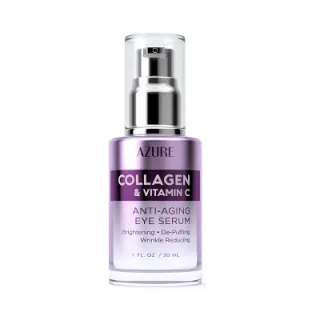
Azure Skincare Collagen and Vitamin C Eye Serum
Works for
MoisturizingCopper tripeptide-1, Palmitoyl pentapeptide-4 + 15 moreWorks well
“Anti-aging formula infused with Vitamin C which protects, brightens, and moisturizes under-eye skin.”
This product can help improve hydration of the skin with the two types of ingredients.
The first type is called “humectants”:
these ingredients help attract water.
When humectants are on the surface of the skin, they “pull in” the moisture from the outside environment, or from
within deeper layers of the skin. The following ingredients in this product do the job:
betaine, glycerin.
This product also contains ingredients called “occlusives”. They help reduce the speed with which our skin loses moisture to the outside environment. These ingredients also help soften the upper layer of the skin, so it feels less tight and nicer to the touch. The following ingredients in this product do the job: caprylic/capric triglyceride, hydrolyzed collagen.
The following ingredients in this product are especially good for supporting the skin barrier and helping with the hydration level: acetyl hexapeptide-8, copper tripeptide-1, palmitoyl pentapeptide-4, panthenol
Anti-agingCopper tripeptide-1, Acetyl hexapeptide-8 + 4 moreMay help
“Collagen and Vitamin C Eye Serum”
This product contains acetyl hexapeptide-8, copper tripeptide-1, palmitoyl pentapeptide-4. There is some human evidence that these ingredients help reduce and prevent fine lines and wrinkles and improve skin elasticity and firmness, though it is smaller or less consistent than the evidence for the best anti-aging ingredients.
Can it cause trouble?
Irritancy1 strong irritant: ParfumMedium risk
ComedogenicClean of flagged comedogenic ingredientsNone flagged

User reviews
Be the first — your take helps the next person decide.
Ingredients
Filter by role to see what each ingredient is doing.
Water~40–60%
Glycerin~4.1–6.2%
- Irritation risk
- Low
One of the best moisturizing ingredients. Naturally present in skin. It attracts water to the upper layer of the skin working as a humectant
More about GlycerinPropylene glycol~3.5–5.2%
- Irritation risk
- High
Helps oil and water mix together and can enhance the penetration of other ingredients into the skin. It can be irritating
More about Propylene glycolBetaine~2.7–4%
- Irritation risk
- Low
Helps attract water to the upper layer of the skin and improves the product texture
More about BetaineHydrolyzed collagen~2.1–3.2%
- Irritation risk
- Low
A typically plant-derived compound that is supposed mimic human collagen. Cannot penetrate the skin barrier so is not particularly useful in skincare products beyond attracting water to the upper layer of the skin
More about Hydrolyzed collagenAscorbic acid~1.7–2.5%
- Irritation risk
- High
The most well-researched antioxidant that works in skin. Helps neutralize free radicals supporting collagen production, helping to even out the skin tone and preventing early signs of aging
More about Ascorbic acidButylene glycol~1.4–2.1%
- Irritation risk
- Low
Used to create a nice product texture and help delivery of other ingredients. Might be somewhat helpful in attracting water to the upper layer of the skin
More about Butylene glycolLecithin~1.3–1.9%
- Irritation risk
- Low
Used mostly for creating emulsions - helping oil and water mix together. Helps soften the upper layer of the skin
More about LecithinPolysorbate 20~1–1.6%
Caprylic/capric triglyceride~0.9–1.35%
- Irritation risk
- Medium
A good mix of fatty acids that forms a protective layer on the skin. Improves the shelf life of products. Derived from coconut and glycerin
More about Caprylic/capric triglycerideCopper tripeptide-1~0.5–1.2%
- Irritation risk
- Low
A naturally occurring peptide. One of the most studied peptides in dermatology. It is sometimes abbreviated GHK-Cu. Belongs to the class of carrier peptides. It stimulates both synthesis and breakdown of collagen in skin. It is released in skin wounds and inflammation to support healing. It accelerates wound-healing of the skin and can stimulate hair growth. There are preliminary studies that confirm that copper tripeptide can help support collagen production reducing fine lines and wrinkles and decrease inflammation in skin.
More about Copper tripeptide-1Acetyl hexapeptide-8~0.4–1%
- Irritation risk
- Low
A type of peptide. Peptides are excellent moisturizers and might be able support collagen production reducing fine lines and wrinkles
More about Acetyl hexapeptide-8Palmitoyl pentapeptide-4~0.4–0.9%
- Irritation risk
- Low
A type of peptide. Peptides are excellent moisturizers and might be able support collagen production reducing fine lines and wrinkles
More about Palmitoyl pentapeptide-4Sodium ascorbyl phosphate~0.35–0.8%
- Irritation risk
- Medium
A stable derivative of vitamin C. It is oil-soluble which means it is more likely to penetrate the skin compared to the pure form of vitamin C (which is water-soluble), but it is less bio-available and is way less effective in stimulating collagen and reducing wrinkles compared to the pure form of vitamin C (L-ascorbic acid) and its other derivatives (for example, magnesium ascorbyl phosphate). At the same time, this vitamin C derivative has been shown in studies to be effective in reducing acne, blemishes and clogged pores. It is less irritating then the pure form of vitamin C
More about Sodium ascorbyl phosphateBeta-glucan~0.3–0.75%
- Irritation risk
- Low
Helps attract water to the upper layer of the skin, calm down inflammation and irritation, restore the barrier function and support wound healing. It can be helpful in reducing fine lines and wrinkles
More about Beta-glucanHydroxyethyl urea~0.3–0.75%
- Irritation risk
- Low
A synthetic humectant made from urea. It pulls water into the upper layer of the skin about as well as glycerin, but without glycerin's stickiness. Unlike urea, it has not been shown to exfoliate. Lab and animal tests suggest a low risk of irritation at the levels used in products.
More about Hydroxyethyl ureaAloe barbadensis leaf extract~0.35–0.8%
- Irritation risk
- Medium
Traditionally used to treat sunburns, dermatitis and inflammation, but evidence for its effectiveness is lacking. The extract can contain humectants that help attract water into the skin
More about Aloe barbadensis leaf extractPortulaca oleracea extract~0.2–0.7%
- Irritation risk
- Medium
A plant extract that has some anti-oxidant activity, but solid research is lacking. Can help attract water to the upper layer of the skin
More about Portulaca oleracea extractPeg-60 hydrogenated castor oil~0.15–0.6%
- Irritation risk
- Medium
Helps oil and water mix together
More about Peg-60 hydrogenated castor oilSodium hyaluronate~0.1–0.5%
- Irritation risk
- Low
One of the best moisturizing ingredients. Attracts water into the upper layer of the skin
More about Sodium hyaluronateGlyceryl acrylate/acrylic acid copolymer~0.1–0.45%
- Irritation risk
- Medium
Helps attract water to the upper layer of the skin and provide a longer-lasting hydration. Can create a thicker product consistency
More about Glyceryl acrylate/acrylic acid copolymerPanthenol~0.1–0.45%
- Irritation risk
- Low
Helps attract water to the upper layer of the skin and can help improve skin barrier function
More about PanthenolXanthan gum~0.1–0.4%
- Irritation risk
- Low
Used to create a thicker product consistency
More about Xanthan gumEthylhexylglycerin~0.1–0.35%
1,2-hexanediol~0.05–0.25%
Phenoxyethanol~0.05–0.25%
- Irritation risk
- Low
A preservative. It helps prevent bacterial growth in cosmetic products
More about PhenoxyethanolDisodium edta~0.05–0.1%
Parfum~0.01–0.1%
- Irritation risk
- High
An aromatic blend of unspecified and possibly irritating ingredients
More about ParfumIngredient list view
Water, Glycerin, Propylene glycol, Betaine, Hydrolyzed collagen, Ascorbic acid, Butylene glycol, Lecithin, Polysorbate 20, Caprylic/capric triglyceride, Copper tripeptide-1, Acetyl hexapeptide-8, Palmitoyl pentapeptide-4, Sodium ascorbyl phosphate, Beta-glucan, Hydroxyethyl urea, Aloe barbadensis leaf extract, Portulaca oleracea extract, Peg-60 hydrogenated castor oil, Sodium hyaluronate, Glyceryl acrylate/acrylic acid copolymer, Panthenol, Xanthan gum, Ethylhexylglycerin, 1,2-hexanediol, Phenoxyethanol, Disodium edta, Parfum
Compare prices
Retailers ranked by price — lowest first.

Worth comparing, line by line.
Match % combines shared ingredients, the first five ingredients, shared actives and hero ingredients, irritancy (lower counts in the alternative's favour), texture and body area. Only products in the same routine step are compared.
| Azure SkincareCollagen and Vitamin C Eye SerumYOUR PRODUCT | Biovène BarcelonaVITAMIN C +20% Skin Brightening Facial Serum Treatment | BioveneVITAMIN C 27% SERUM | NourishMaxVITAMIN C + B + E + FERULIC & RETINOL SERUM | |
|---|---|---|---|---|
| Match | — | 68% | 68% | 66% |
| Price | $9.99 | $6.58−$3.41 | $19.66+$9.67 | $59.00+$49.01 |
| Shared key ingredients | — | 5 of 13 | 5 of 13 | 4 of 13 |
| Key difference | — | Ferulic Acid | Ferulic Acid | Ferulic Acid |
| Irritancy | Medium | Low | Low | Medium |
| Drying alcohol | — | — | — | — |
| View product | Shop | Shop | Shop |

More alternatives: Formulyst Active Serum – Vitamin B, C, E, Ferulic + NiacinamideSkinCeuticals Serum 20 AOX
Sources cited in this review
Every concentration estimate and effectiveness label is anchored to one of these 34 studies and safety reviews.
- 1
- 2Surfactants and experimental irritant contact dermatitisncbi.nlm.nih.gov
- 3Propylene Glycolpubmed.ncbi.nlm.nih.gov
- 4Skin-sensitizing and irritant properties of propylene glycolonlinelibrary.wiley.com
- 5
- 6

Affiliate links · As an Amazon Associate, WIMJ earns from qualifying purchases.