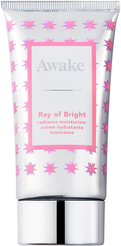
Awake Beauty Ray Of Bright Radiance Moisturizer
Works for
1 of 2 advertised claims delivered
Moisturizing11 ingredients credited for this claimGood support
“Ray Of Bright Radiance Moisturizer”
This product can help improve hydration of the skin with the two types of ingredients.
The first type is called “humectants”:
these ingredients help attract water.
When humectants are on the surface of the skin, they “pull in” the moisture from the outside environment, or from
within deeper layers of the skin. The following ingredients in this product do the job:
glycerin, sodium pca.
This product also contains ingredients called “occlusives”. They help reduce the speed with which our skin loses moisture to the outside environment. These ingredients also help soften the upper layer of the skin, so it feels less tight and nicer to the touch. The following ingredients in this product do the job: dimethicone, simmondsia chinensis seed oil.
Evens skin tone3 ingredients credited for this claimLimited support
“Jojoba seed oil and aloe leaf extracts nourish your skin while licorice root extract helps brighten and even out your skin tone.”
This product contains ingredients (glycyrrhiza glabra root extract, hexylresorcinol) that could help reduce hyperpigmentation (for example, post-acne marks or age spots) in theory, but there is not enough evidence that they actually work.
Anti-oxidationNot advertised by the brand · 3 ingredients credited for this claimModerate support
This product contains antioxidants (hexylresorcinol) that might be able to help neutralize free radicals in skin to lessen the damage it gets from the UV light (sun). There is not enough evidence to confirm their effectiveness in skin though.
Can it cause trouble?
Irritancy3 strong irritants: Citrus aurantium dulcis peel oil, Limonene + 1 more — patch-test recommendedHigh risk
Comedogenic1 ingredient rated 2 or more on the 0–5 pore-clogging scale1 flagged
User reviews
Be the first — your take helps the next person decide.
Ingredients
Filter by role to see what each ingredient is doing.
Water~45–55%
Dimethicone~6.4–7.8%
- Irritation risk
- Low
A silicone that helps to reduce water loss from the surface of the skin. Can temporarily "fill in" lines and wrinkles, absorb oil, and create a nice product finish
More about DimethiconeCetyl ricinoleate~4.4–5.4%
- Irritation risk
- Low
An emollient that helps soften the upper layer of the skin
More about Cetyl ricinoleateButylene glycol~3.1–3.8%
- Irritation risk
- Low
Used to create a nice product texture and help delivery of other ingredients. Might be somewhat helpful in attracting water to the upper layer of the skin
More about Butylene glycolGlycol stearate~2.4–2.9%
Glyceryl stearate~2–2.5%
- Irritation risk
- Low
An emollient that softens the skin and forms a protective layer on its surface. Helps water and oil mix together
More about Glyceryl stearateMica~1.7–2.1%
- Irritation risk
- Low
Creates an illusion of smoother and more radiant skin tone. Adds shimmer to the skin by reflecting light
More about MicaSimmondsia chinensis seed oil~1.6–1.9%
- Irritation risk
- Medium
Softens the upper layer of skin and helps restore the healthy skin barrier. Has shown to help calm down inflammation in skin. It is a stable oil, meaning that it retains its properties even when exposed to air.
More about Simmondsia chinensis seed oilCitrus aurantium dulcis peel oil~1.2–1.4%
- Irritation risk
- High
An essentil oil from orange peel. Potential allergen and can be irritating
More about Citrus aurantium dulcis peel oilGlycyrrhiza glabra root extract~0.75–1.1%
- Irritation risk
- Medium
A plant extract that can help lighten the skin and calm down inflammation. Might be helpful in neutralizing free radicals
More about Glycyrrhiza glabra root extractAloe barbadensis leaf extract~0.75–1.1%
- Irritation risk
- Medium
Traditionally used to treat sunburns, dermatitis and inflammation, but evidence for its effectiveness is lacking. The extract can contain humectants that help attract water into the skin
More about Aloe barbadensis leaf extractTetrahexyldecyl ascorbate~0.55–0.85%
- Irritation risk
- Medium
Being a lipid soluble form of vitamin C, it is more stable than ascorbic acid, but still degrades quickly and needs to be stabilized in a formulation with another ingredient. It is claimed to penetrate skin better than pure vitamin C and have the the similar benefits, but solid studies of its effectiveness are lacking. Is likely to require a higher concentration in a product than pure vitamin C to be effective. It might be able to help reduce pore clogging.
More about Tetrahexyldecyl ascorbateGlycerin~0.55–0.8%
- Irritation risk
- Low
One of the best moisturizing ingredients. Naturally present in skin. It attracts water to the upper layer of the skin working as a humectant
More about GlycerinEthylhexylglycerin~0.45–0.7%
Sorbitan oleate~0.45–0.65%
- Irritation risk
- Medium
- Comedogenicity
- 2/5
Helps oil and water mix together
More about Sorbitan oleateCetyl esters~0.45–0.65%
- Irritation risk
- Low
Helps soften upper layer of the skin and can enhance penetration of other ingredients into the upper layer of the skin
More about Cetyl estersCetyl alcohol~0.45–0.7%
- Irritation risk
- Low
A non-drying alcohol that works to soften the skin and stabilize product formulations helping oil and water mix together
More about Cetyl alcoholXanthan gum~0.35–0.65%
- Irritation risk
- Low
Used to create a thicker product consistency
More about Xanthan gumAcrylamide/sodium acryloyldimethyltaurate copolymer~0.3–0.55%
- Irritation risk
- Low
Helps water and oil mix together and create gel-like textures
More about Acrylamide/sodium acryloyldimethyltaurate copolymerSodium pca~0.25–0.5%
- Irritation risk
- Low
Naturally present in skin and helps to attract water to its upper layer
More about Sodium pcaStearyl alcohol~0.3–0.55%
- Irritation risk
- Low
An emollient that helps soften the skin
More about Stearyl alcoholPotassium stearate~0.3–0.6%
Isohexadecane~0.3–0.6%
- Irritation risk
- Low
Improves the texture of the product and helps soften the skin. Helps oil and water mix together and can be used as a cleansing agent
More about IsohexadecanePolysorbate 80~0.25–0.5%
Citric acid~0.2–0.4%
- Irritation risk
- Medium
Can work as an exfoliant but is typically used to adjust the product pH
More about Citric acidDisodium edta~0.2–0.4%
Hexylresorcinol~0.2–0.4%
- Irritation risk
- Medium
Might be helpful in reducing hyperpigmentation and neutralizing free radicals in skin
More about HexylresorcinolPhenoxyethanol~0.2–0.35%
- Irritation risk
- Low
A preservative. It helps prevent bacterial growth in cosmetic products
More about PhenoxyethanolLimonene~0.15–0.3%
- Irritation risk
- High
A common frangrance that can easily irritate skin, especially if exposed to air, light or heat
More about LimoneneLinalool~0.15–0.25%
Titanium dioxide~0.25–0.4%
- Irritation risk
- Low
Works as a UV filter when used in high concentrations. It is photostable and is effective mostly against the UVB light, with some protection in the UVA range. In small concentrations, used for its ability to improve the color of cosmetic products. Is usually well tolerated by the skin
More about Titanium dioxideCi 77891~0.1–0.2%
- Irritation risk
- Low
Ci 14700~0.1–0.15%
Ci 17200~0.1–0.15%
Ingredient list view
Water, Dimethicone, Cetyl ricinoleate, Butylene glycol, Glycol stearate, Glyceryl stearate, Mica, Simmondsia chinensis seed oil, Citrus aurantium dulcis peel oil, Glycyrrhiza glabra root extract, Aloe barbadensis leaf extract, Tetrahexyldecyl ascorbate, Glycerin, Ethylhexylglycerin, Sorbitan oleate, Cetyl esters, Cetyl alcohol, Xanthan gum, Acrylamide/sodium acryloyldimethyltaurate copolymer, Sodium pca, Stearyl alcohol, Potassium stearate, Isohexadecane, Polysorbate 80, Citric acid, Disodium edta, Hexylresorcinol, Phenoxyethanol, Limonene, Linalool, Titanium dioxide, Ci 77891, Ci 14700, Ci 17200
Compare prices
Retailers ranked by price — lowest first.
Worth comparing, line by line.
Match % combines shared ingredients, the first five ingredients, shared actives and hero ingredients, irritancy (lower counts in the alternative's favour), texture and body area. Only products in the same routine step are compared.
| Awake BeautyRay Of Bright Radiance MoisturizerYOUR PRODUCT | PillowtalkDermMajor Fade Active Seal Moisturizer | M-61Vitablast C 20% Cream | Colleen Rothschild BeautyVitamin C Nourishing Cream | |
|---|---|---|---|---|
| Match | — | 53% | 52% | 51% |
| Price | $26.00 | — | $96.00+$70.00 | — |
| Shared key ingredients | — | 3 of 7 | 3 of 7 | 3 of 7 |
| Key difference | — | Hexapeptide-2 | Niacinamide | Panthenol |
| Irritancy | High | Low | Medium | Medium |
| Drying alcohol | — | — | — | — |
| View product | Shop | Shop | Shop |


Sources cited in this review
Every concentration estimate and effectiveness label is anchored to one of these 8 studies and safety reviews.
- 1
- 2Final Report on the Safety Assessment of Dimethicone Copolyoljournals.sagepub.com
- 3
- 4
- 5
- 6Surfactants and experimental irritant contact dermatitisncbi.nlm.nih.gov

Affiliate links · As an Amazon Associate, WIMJ earns from qualifying purchases.