Works for
MoisturizingCeramide 3, Caprylic/capric triglyceride + 12 moreWorks well
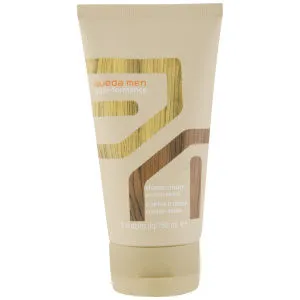
“Prevent razor burn and other irritation with Aveda Men Pure-Formance Shave Cream, a 99% naturally derived, intensely moisturising formula.”
This product can help improve hydration of the skin with the two types of ingredients.
The first type is called “humectants”:
these ingredients help attract water.
When humectants are on the surface of the skin, they “pull in” the moisture from the outside environment, or from
within deeper layers of the skin. The following ingredients in this product do the job:
glycerin, hydrolyzed algin.
This product also contains ingredients called “occlusives”. They help reduce the speed with which our skin loses moisture to the outside environment. These ingredients also help soften the upper layer of the skin, so it feels less tight and nicer to the touch. The following ingredients in this product do the job: caprylic/capric triglyceride, helianthus annuus seed oil.
The following ingredients in this product are especially good for supporting the skin barrier and helping with the hydration level: ceramide 3
Can it cause trouble?
Irritancy4 strong irritants: Parfum, Limonene + 2 more — patch-test recommendedHigh risk
Comedogenic1 ingredient rated 2 or more on the 0–5 pore-clogging scale1 flagged
User reviews
Be the first — your take helps the next person decide.
Ingredients
Filter by role to see what each ingredient is doing.
Water~45–55%
Stearic acid~8.1–9.9%
- Irritation risk
- Low
Helps oil and water mix together and works as an emollient
More about Stearic acidSodium methyl cocoyl taurate~5.8–7.1%
- Irritation risk
- High
Helps oil and water mix together. Can be used as cleansing agent
More about Sodium methyl cocoyl taurateCaprylic/capric triglyceride~3.2–3.9%
- Irritation risk
- Medium
A good mix of fatty acids that forms a protective layer on the skin. Improves the shelf life of products. Derived from coconut and glycerin
More about Caprylic/capric triglycerideSodium cocoyl isethionate~2.5–3%
- Irritation risk
- Medium
Helps water and oil mix together. Can be used as a cleansing agent
More about Sodium cocoyl isethionateCetearyl olivate~1.9–2.3%
Lauramidopropyl betaine~2–2.4%
Decyl glucoside~1.5–1.8%
- Irritation risk
- High
Helps oil and water mix together. Can be irritating
More about Decyl glucosideGlycerin~1.2–1.5%
- Irritation risk
- Low
One of the best moisturizing ingredients. Naturally present in skin. It attracts water to the upper layer of the skin working as a humectant
More about GlycerinArgania spinosa kernel oil~1–1.2%
- Irritation risk
- Medium
An emollient that helps soften the upper layer of the skin. Might have some weak anti-oxidant properties
More about Argania spinosa kernel oilCeramide 3~0.75–1.1%
- Irritation risk
- Low
A type of lipid similar to ceramides naturally present in skin. Helps to soften the upper layer of the skin and supports the skin barrier function to keep it hydrated. Can help to prevent inflammation in skin
More about Ceramide 3Caffeine~0.6–0.85%
- Irritation risk
- Medium
Might be helpful in neutralizing free radicals. Can have a dehydration effect that might somewhat decrease the look of puffy eyes
More about CaffeineAloe barbadensis leaf~0.55–0.8%
- Irritation risk
- Low
Tocopherol~0.5–0.75%
- Irritation risk
- Low
Pure form of vitamin E. Can help moisturise and protect the skin from free radicals. Often used to help stabilise other ingredients or the formula itself
More about TocopherolHelianthus annuus seed oil~0.5–0.75%
- Irritation risk
- Low
A great emollient due to its high linoleic acid content. One of the most effective plant oils in helping skin hydration and repairing skin barrier function
More about Helianthus annuus seed oilCalophyllum inophyllum seed oil~0.5–0.75%
- Irritation risk
- Low
Zingiber cassumunar root oil~0.5–0.75%
- Irritation risk
- Low
Ursolic acid~0.35–0.65%
- Irritation risk
- Low
Glycyrrhiza glabra root extract~0.35–0.6%
- Irritation risk
- Medium
A plant extract that can help lighten the skin and calm down inflammation. Might be helpful in neutralizing free radicals
More about Glycyrrhiza glabra root extractGlycine soja seed extract~0.4–0.65%
- Irritation risk
- Medium
An emollient that helps soften the skin. Might be somewhat helpful in evening the skin tone.
More about Glycine soja seed extractScutellaria baicalensis root extract~0.3–0.55%
- Irritation risk
- High
A plant extract that might contain a compound baicalin that could be helpful in neutralizing free radicals and reducing inflammation in skin. The baicalin concentration in skincare products is often too low for an effective action. Can be used for its fragrant properties
More about Scutellaria baicalensis root extractBoswellia serrata extract~0.35–0.65%
- Irritation risk
- Low
Silybum marianum extract~0.35–0.6%
- Irritation risk
- High
Might be able to help neutralize free radical, calm down inflammation in skin, and even skin tone
More about Silybum marianum extractHydrolyzed algin~0.3–0.6%
- Irritation risk
- Low
- Comedogenicity
- 3/5
Derived from brown algae. Helps attract water to the upper layer of the skin
More about Hydrolyzed alginSorbitan olivate~0.3–0.6%
Oleic acid~0.35–0.65%
- Irritation risk
- Medium
Helps soften the upper layer of the skin. At the same time, it can weaken the skin's barrier enhancing penetration of other ingredients and increasing the risk of skin dryness
More about Oleic acidCapryloyl glycine~0.4–0.6%
- Irritation risk
- Low
Helps oil and water mix together, preserve cosmetic products, and attract water to the upper layer of the skin
More about Capryloyl glycineXanthan gum~0.25–0.5%
- Irritation risk
- Low
Used to create a thicker product consistency
More about Xanthan gumSodium gluconate~0.25–0.45%
Sodium chloride~0.2–0.4%
- Irritation risk
- Low
Used to stabilize mixtures of oil and water, and create thicker, gel-like product textures
More about Sodium chlorideCitric acid~0.15–0.3%
- Irritation risk
- Medium
Can work as an exfoliant but is typically used to adjust the product pH
More about Citric acidParfum~0.1–0.2%
- Irritation risk
- High
An aromatic blend of unspecified and possibly irritating ingredients
More about ParfumLimonene~0.1–0.2%
- Irritation risk
- High
A common frangrance that can easily irritate skin, especially if exposed to air, light or heat
More about LimoneneLinalool~0.1–0.15%
Citronellol~0.05–0.1%
Phenoxyethanol~0.1–0.15%
- Irritation risk
- Low
A preservative. It helps prevent bacterial growth in cosmetic products
More about PhenoxyethanolIngredient list view
Water, Stearic acid, Sodium methyl cocoyl taurate, Caprylic/capric triglyceride, Sodium cocoyl isethionate, Cetearyl olivate, Lauramidopropyl betaine, Decyl glucoside, Glycerin, Argania spinosa kernel oil, Ceramide 3, Caffeine, Aloe barbadensis leaf, Tocopherol, Helianthus annuus seed oil, Calophyllum inophyllum seed oil, Zingiber cassumunar root oil, Ursolic acid, Glycyrrhiza glabra root extract, Glycine soja seed extract, Scutellaria baicalensis root extract, Boswellia serrata extract, Silybum marianum extract, Hydrolyzed algin, Sorbitan olivate, Oleic acid, Capryloyl glycine, Xanthan gum, Sodium gluconate, Sodium chloride, Citric acid, Parfum, Limonene, Linalool, Citronellol, Phenoxyethanol
Compare prices
Retailers ranked by price — lowest first.
Worth comparing, line by line.
Match % combines shared ingredients, the first five ingredients, shared actives and hero ingredients, irritancy (lower counts in the alternative's favour), texture and body area. Only products in the same routine step are compared.
| AvedaMen Pure-Formance Shave CreamYOUR PRODUCT | Baume.BePre Shave Gel | BulldogSensitive After Shave Balm | Bart's BalmBart's Premium Aftershave Balm - BEN VRACKIE | |
|---|---|---|---|---|
| Match | — | 23% | 22% | 22% |
| Price | $26.00 | — | $6.63−$19.37 | — |
| Shared key ingredients | — | 3 of 9 | 2 of 9 | 4 of 9 |
| Key difference | — | Rosemary Extract | Allantoin | Cocos Nucifera Oil |
| Irritancy | High | Medium | Low | Medium |
| Drying alcohol | — | — | — | — |
| View product | Shop | Shop | Shop |


More alternatives: Dsquared2 Green Wood Aftershave BalmSpeick Aftershave Balm - Sensitive
Sources cited in this review
Every concentration estimate and effectiveness label is anchored to one of these 22 studies and safety reviews.
- 1
- 2Final Report on the Safety Assessment of Sodium Cocoyl Isethionatejournals.sagepub.com
- 3
- 4
- 5
- 6

Affiliate links · As an Amazon Associate, WIMJ earns from qualifying purchases.