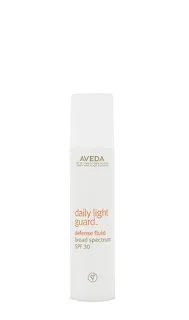
Aveda daily light guard™ defense fluid broad spectrum spf 30
Works for
0 of 1 advertised claim delivered
Sun protectionSPF 30 · 3 UV filters · Partial spectrumWeak protection
This product does not offer good protection against UVA rays.
This product can be considered "reef safe" because it does not contain the UV filters (oxybenzone and octinoxate) that can be harmful to coral reefs when present in the water in high concentrations.
MoisturizingNot advertised by the brand · 9 ingredients credited for this claimGood support
This product can help soften the skin and reduce its moisture loss with emollients and occlusives: dimethicone, helianthus annuus seed oil.
Keep in mind that this product does not contain effective ingredients to attract water to the upper layer of the skin. This is why an additional product with humectants like glycerin or hyaluronic acid can be helpful (apply it before this product for the best results).
Anti-oxidationNot advertised by the brand · 7 ingredients credited for this claimModerate support
This product contains antioxidants (punica granatum extract) that might be able to help neutralize free radicals in skin to lessen the damage it gets from the UV light (sun). There is not enough evidence to confirm their effectiveness in skin though.
Can it cause trouble?
Irritancy3 strong irritants: Rosmarinus officinalis extract, Zingiber officinale root extract + 1 more — patch-test recommendedHigh risk
ComedogenicClean of flagged comedogenic ingredientsNone flagged
User reviews
Be the first — your take helps the next person decide.
Ingredients
Filter by role to see what each ingredient is doing.
Titanium dioxide~29–35%
- Irritation risk
- Low
Works as a UV filter when used in high concentrations. It is photostable and is effective mostly against the UVB light, with some protection in the UVA range. In small concentrations, used for its ability to improve the color of cosmetic products. Is usually well tolerated by the skin
More about Titanium dioxideZinc oxide1%
- Irritation risk
- Low
A broad spectrum sunblock (protects from both UVA and UVB rays). Is suitable for most sensitive skins. In small concentrations, can be used as a colorant
More about Zinc oxideWater~13–16%
Dimethicone~6.7–8.2%
- Irritation risk
- Low
A silicone that helps to reduce water loss from the surface of the skin. Can temporarily "fill in" lines and wrinkles, absorb oil, and create a nice product finish
More about DimethiconeDicaprylyl carbonate~4.7–5.7%
- Irritation risk
- Low
Helps products spread more easily and works as an emollient to soften skin
More about Dicaprylyl carbonateButyloctyl salicylate~3.5–4.3%
- Irritation risk
- Medium
A synthetic ester of salicylic acid that is used to help disperse pigments and boost effectiveness of sunscreen ingredients. It is able to absorb UV light (working as an organic, or chemical filter), but is not approved as a sunscreen ingredient on its own
More about Butyloctyl salicylateCoco-caprylate/caprate~3.2–3.9%
- Irritation risk
- Low
Helps to soften the upper layer of the skin without creating a greasy texture
More about Coco-caprylate/capratePropanediol~2.6–3.2%
- Irritation risk
- Low
Acts as a solvent for other ingredients. Speeds up the absorption of other ingredients into the skin
More about PropanediolDipentaerythrityl tri-polyhydroxystearate~2.2–2.7%
- Irritation risk
- Low
Polyglyceryl-4 diisostearate/polyhydroxystearate/sebacate~1.6–2%
- Irritation risk
- Medium
Helps water and oil mix together
More about Polyglyceryl-4 diisostearate/polyhydroxystearate/sebacateAleurites moluccanus seed oil~1.3–1.5%
- Irritation risk
- Low
Helps soften the upper layer of the skin
More about Aleurites moluccanus seed oilTrimethylsiloxysilicate~1.2–1.4%
- Irritation risk
- Low
A type of silicone that helps create a nice product consistency and support the delivery of other ingredients
More about TrimethylsiloxysilicateSilica~1.2–1.5%
Hydrogenated castor oil/sebacic acid copolymer~1–1.2%
- Irritation risk
- Low
Rosmarinus officinalis extract~0.8–1.15%
- Irritation risk
- High
Helianthus annuus seed oil~0.95–1.15%
- Irritation risk
- Low
A great emollient due to its high linoleic acid content. One of the most effective plant oils in helping skin hydration and repairing skin barrier function
More about Helianthus annuus seed oilTocopherol~0.75–1.1%
- Irritation risk
- Low
Pure form of vitamin E. Can help moisturise and protect the skin from free radicals. Often used to help stabilise other ingredients or the formula itself
More about TocopherolCaffeine~0.65–0.95%
- Irritation risk
- Medium
Might be helpful in neutralizing free radicals. Can have a dehydration effect that might somewhat decrease the look of puffy eyes
More about CaffeinePunica granatum extract~0.65–0.95%
- Irritation risk
- Medium
A plant extract that can help neutralize free radicals in skin and even out the skin tone, but is typically used in products in a concentration that is too low to be effective
More about Punica granatum extractPolygonum cuspidatum root extract~0.6–0.9%
- Irritation risk
- Medium
A plant extract that can contain resveratrol, an antioxidant that can help neutralize free radicals in skin. The effectiveness depends on the extract quality and concentration in the product
More about Polygonum cuspidatum root extractZingiber officinale root extract~0.5–0.8%
- Irritation risk
- High
A plant extract that can contain an irritating essential oil. Might have some anti-oxidant effect, but evidence is lacking
More about Zingiber officinale root extractVanilla planifolia fruit extract~0.55–0.8%
- Irritation risk
- High
A plant extract used as a fragrance. Can be irritating
More about Vanilla planifolia fruit extractOryzanol~0.5–0.75%
- Irritation risk
- Low
An anti-oxidant that helps stabilize product formulations. Might help neutralise free radicals in skin
More about OryzanolAscorbyl palmitate~0.45–0.65%
- Irritation risk
- Medium
Being a lipid soluble form of vitamin C, it is more stable and can penetrate the skin better than L-Ascorbic acid. It is effective in protecting the skin from free radicals, as well as evening the skin tone, but is less effective in stimulating collagen production compared to L-Ascorbic acid.
More about Ascorbyl palmitateHydroxyapatite~0.55–0.8%
- Irritation risk
- Low
Dimethicone silylate~0.35–0.6%
- Irritation risk
- Low
Triethoxycaprylylsilane~0.3–0.6%
- Irritation risk
- Low
A type of silicone that helps oil and water mix well together. Helps to disperse other ingredients, e.g. pigments, evenly in a formulation
More about TriethoxycaprylylsilaneDimethicone crosspolymer-3~0.25–0.45%
- Irritation risk
- Low
Dimethicone/polyglycerin-3 crosspolymer~0.55–0.85%
- Irritation risk
- Medium
Helps oil and water mix together
More about Dimethicone/polyglycerin-3 crosspolymerCetyl peg/ppg-10/1 dimethicone~0.2–0.35%
- Irritation risk
- Low
A type of silicone that helps water and oil mix together. Can help to soften upper layer of the skin
More about Cetyl peg/ppg-10/1 dimethiconeLauryl peg-9 polydimethylsiloxyethyl dimethicone~0.15–0.25%
- Irritation risk
- Low
A type of silicone that helps to soften upper layer of the skin and create a nice product texture
More about Lauryl peg-9 polydimethylsiloxyethyl dimethiconeCaprylyl glycol~0.2–0.35%
- Irritation risk
- Medium
Helps preserve products and creates a nice product texture
More about Caprylyl glycolPhenoxyethanol~0.1–0.2%
- Irritation risk
- Low
A preservative. It helps prevent bacterial growth in cosmetic products
More about PhenoxyethanolIngredient list view
Titanium dioxide, Zinc oxide, Water, Dimethicone, Dicaprylyl carbonate, Butyloctyl salicylate, Coco-caprylate/caprate, Propanediol, Dipentaerythrityl tri-polyhydroxystearate, Polyglyceryl-4 diisostearate/polyhydroxystearate/sebacate, Aleurites moluccanus seed oil, Trimethylsiloxysilicate, Silica, Hydrogenated castor oil/sebacic acid copolymer, Rosmarinus officinalis extract, Helianthus annuus seed oil, Tocopherol, Caffeine, Punica granatum extract, Polygonum cuspidatum root extract, Zingiber officinale root extract, Vanilla planifolia fruit extract, Oryzanol, Ascorbyl palmitate, Hydroxyapatite, Dimethicone silylate, Triethoxycaprylylsilane, Dimethicone crosspolymer-3, Dimethicone/polyglycerin-3 crosspolymer, Cetyl peg/ppg-10/1 dimethicone, Lauryl peg-9 polydimethylsiloxyethyl dimethicone, Caprylyl glycol, Phenoxyethanol
Compare prices
Retailers ranked by price — lowest first.

Product summary
We do not recommend "Aveda - daily light guard™ defense fluid broad spectrum spf 30" because it does not provide good UVA protection. UVA sun rays don't burn the skin, but they still lead to photoaging and hyperpigmentation.
Because it includes good moisturizing ingredients, it can also work as a hydrating day cream.
Sunscreen filters
This sunscreen uses a mixture of both mineral and organic (so-called "chemical") UV filters. The organic filters in the product are: butyloctyl salicylate. As for the mineral filters, this sunscreen uses both titanium dioxide and zinc oxide.
Irritation risk
There are some common irritants in this product, including ingredients that do not have benefits for the skin. We assess the overall irritancy of this product to be high. For a detailed overview of all potential irritants: click here
You can see the detailed formula review with the breakdown of all actives in the product and the full ingredient list with estimated concentrations in the tables below.
About the brand
According to Cruelty-Free Kitty "Aveda" is cruelty free, but its parent company is not.
Price
The product retails from 36.45$ up to 39.99$ in the United States.
For a detailed price comparison: click here.
Sources cited in this review
Every concentration estimate and effectiveness label is anchored to one of these 23 studies and safety reviews.
- 1A review of inorganic UV filters zinc oxide and titanium dioxideonlinelibrary.wiley.com
- 2
- 3
- 4
- 5
- 6

Affiliate links · As an Amazon Associate, WIMJ earns from qualifying purchases.