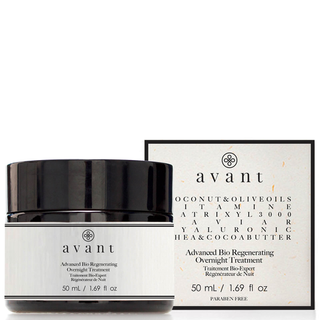
Avant Skincare Advanced Bio Regenerating Overnight Treatment
Works for
1 of 2 advertised claims delivered
Moisturizing13 ingredients credited for this claimGood support
“Treat your skin to the nourishing and anti-ageing benefits of Avant Skincare's Advanced Bio Regenerating Overnight Treatment ; part of the first ever range launched by the brand.”
This product can help improve hydration of the skin with the two types of ingredients.
The first type is called “humectants”:
these ingredients help attract water.
When humectants are on the surface of the skin, they “pull in” the moisture from the outside environment, or from
within deeper layers of the skin. The following ingredients in this product do the job:
diglycerin, glycerin.
This product also contains ingredients called “occlusives”. They help reduce the speed with which our skin loses moisture to the outside environment. These ingredients also help soften the upper layer of the skin, so it feels less tight and nicer to the touch. The following ingredients in this product do the job: caprylic/capric triglyceride, dimethicone.
Anti-aging1 ingredient credited for this claimWeak support
“Treat your skin to the nourishing and anti-ageing benefits of Avant Skincare's Advanced Bio Regenerating Overnight Treatment ; part of the first ever range launched by the brand.”
Effective ingredients missing or their concentration is too low.
Can it cause trouble?
Irritancy11 strong irritants: Hibiscus sabdariffa flower extract, Retinyl palmitate + 9 more — patch-test recommendedHigh risk
Comedogenic2 ingredients rated 2 or more on the 0–5 pore-clogging scale2 flagged
User reviews
Be the first — your take helps the next person decide.
Ingredients
Filter by role to see what each ingredient is doing.
Water~45–55%
Caprylic/capric triglyceride~5.8–7.1%
- Irritation risk
- Medium
A good mix of fatty acids that forms a protective layer on the skin. Improves the shelf life of products. Derived from coconut and glycerin
More about Caprylic/capric triglycerideDiglycerin~4.2–5.2%
- Irritation risk
- Low
Helps attract water to the upper layer of the skin
More about DiglycerinDimethicone~3.3–4%
- Irritation risk
- Low
A silicone that helps to reduce water loss from the surface of the skin. Can temporarily "fill in" lines and wrinkles, absorb oil, and create a nice product finish
More about DimethiconeCyclopentasiloxane~2.4–3%
- Irritation risk
- Low
A silicone that helps improve the product texture and spreadability. Can absorb oil creating a short-term mattifying effect on the skin
More about CyclopentasiloxanePropylheptyl caprylate~2–2.5%
- Irritation risk
- Low
Helps soften the upper layer of the skin
More about Propylheptyl caprylatePolysilicone-11~1.8–2.1%
- Irritation risk
- Low
A silicone that forms a light film on the skin surface helping to bind water and temporarily absorb oils creating a matt and powdery feel
More about Polysilicone-11Myristyl myristate~1.6–1.9%
- Irritation risk
- Medium
- Comedogenicity
- 3/5
An emollient. Is not recommended for acne-prone skin as it can be comedogenic
More about Myristyl myristateCetearyl alcohol~1.3–1.6%
- Irritation risk
- Low
- Comedogenicity
- 2/5
A non-drying alcohol. Works as an emollient. Helps water and oil mix together and creates a nice product texture
More about Cetearyl alcoholGlycerin~1–1.3%
- Irritation risk
- Low
One of the best moisturizing ingredients. Naturally present in skin. It attracts water to the upper layer of the skin working as a humectant
More about GlycerinSodium polyacrylate~0.75–1.15%
- Irritation risk
- Low
Used to create a gel-like product texture, as well as to stabilize emulsions
More about Sodium polyacrylateHdi/trimethylol hexyllactone crosspolymer~0.55–0.85%
- Irritation risk
- Low
Used to create a silky product texture and add volume to products
More about Hdi/trimethylol hexyllactone crosspolymerPolymethylsilsesquioxane~0.6–0.9%
- Irritation risk
- Low
A silicone that improves product texture and helps dissolve other ingredients. Can form a non-greasy film on the skin to prevent moisture loss
More about PolymethylsilsesquioxanePrunus amygdalus dulcis seed~0.45–0.7%
- Irritation risk
- Low
Helps soften the upper layer of the skin
More about Prunus amygdalus dulcis seedBuddleja davidii leaf extract~0.45–0.65%
- Irritation risk
- Low
Hibiscus sabdariffa flower extract~0.4–0.65%
- Irritation risk
- High
A plant extract that can be irritating. It might contain a compound anthocyanin that could be helpful in neutralizing free radicals
More about Hibiscus sabdariffa flower extractAdansonia digitata fruit extract~0.45–0.7%
- Irritation risk
- Low
Vigna aconitifolia seed extract~0.3–0.6%
- Irritation risk
- Low
Allantoin~0.3–0.55%
- Irritation risk
- Low
Helps calm down inflammation in skin and can help reduce itching. Helps to repair the skin barrier and keep skin hydrated
More about AllantoinTocopheryl acetate~0.3–0.55%
- Irritation risk
- Medium
A more stable but less bio-available form of vitamin E compared to Tocopherol. Might help moisturize and protect the skin from free radicals, but mostly used in low concentrations to stabilize other ingredients.
More about Tocopheryl acetateRetinyl palmitate~0.25–0.45%
- Irritation risk
- High
Three steps removed from the active form of vitamin A - retinoic acid. To have an effect in the skin, it first needs to be converted twice to become the retinoic acid. This means it is less potent than retinol, but could also be less irritating. Once converted to the retinoic acid in the skin, it helps against all signs of aging, improves skin cell turnover and helps fight blemishes and clogged pores. However, in many cosmetic formulations, it is used in a concentration that is too low to have the full effect
More about Retinyl palmitateHydroxypropyl guar~0.3–0.55%
- Irritation risk
- Medium
Used to create a thicker product consistency and stabilize emulsions
More about Hydroxypropyl guarDimethiconol~0.3–0.55%
- Irritation risk
- Low
A silicone that makes products more spreadable and keeps skin smooth. Helps to add gloss to skin and may visually fill in fine lines/wrinkles for short time
More about DimethiconolPotassium cetyl phosphate~0.3–0.5%
- Irritation risk
- Medium
Helps oil and water mix together
More about Potassium cetyl phosphateCeteareth-6~0.25–0.5%
Laureth-12~0.25–0.5%
Disodium edta~0.25–0.45%
Maltodextrin~0.25–0.5%
- Irritation risk
- Low
Used to stabilize the product formulation and can help absorb oil
More about MaltodextrinCitric acid~0.25–0.5%
- Irritation risk
- Medium
Can work as an exfoliant but is typically used to adjust the product pH
More about Citric acidAlpha-isomethyl ionone~0.2–0.4%
- Irritation risk
- High
A fragrance. Potential allergen and can be irritating
More about Alpha-isomethyl iononeBenzyl benzoate~0.2–0.4%
- Irritation risk
- High
Fragrance with sweet balsamic smell. Help to preserve products and dissolve other ingredients. Could trigger allergic reactions and be irritating
More about Benzyl benzoateBenzyl salicylate~0.2–0.4%
Citronellol~0.2–0.4%
Hexyl cinnamal~0.2–0.35%
Linalool~0.2–0.35%
Limonene~0.2–0.35%
- Irritation risk
- High
A common frangrance that can easily irritate skin, especially if exposed to air, light or heat
More about LimoneneGeraniol~0.15–0.3%
Parfum~0.15–0.25%
- Irritation risk
- High
An aromatic blend of unspecified and possibly irritating ingredients
More about ParfumSodium benzoate~0.15–0.25%
Potassium sorbate~0.15–0.3%
Ethylhexylglycerin~0.1–0.2%
Phenoxyethanol~0.15–0.3%
- Irritation risk
- Low
A preservative. It helps prevent bacterial growth in cosmetic products
More about PhenoxyethanolIngredient list view
Water, Caprylic/capric triglyceride, Diglycerin, Dimethicone, Cyclopentasiloxane, Propylheptyl caprylate, Polysilicone-11, Myristyl myristate, Cetearyl alcohol, Glycerin, Sodium polyacrylate, Hdi/trimethylol hexyllactone crosspolymer, Polymethylsilsesquioxane, Prunus amygdalus dulcis seed, Buddleja davidii leaf extract, Hibiscus sabdariffa flower extract, Adansonia digitata fruit extract, Vigna aconitifolia seed extract, Allantoin, Tocopheryl acetate, Retinyl palmitate, Hydroxypropyl guar, Dimethiconol, Potassium cetyl phosphate, Ceteareth-6, Laureth-12, Disodium edta, Maltodextrin, Citric acid, Alpha-isomethyl ionone, Benzyl benzoate, Benzyl salicylate, Citronellol, Hexyl cinnamal, Linalool, Limonene, Geraniol, Parfum, Sodium benzoate, Potassium sorbate, Ethylhexylglycerin, Phenoxyethanol
Compare prices
Retailers ranked by price — lowest first.

.png)

Product summary
"Avant Skincare - Advanced Bio Regenerating Overnight Treatment" is effective for: Anti-inflammatory and Moisturizing
This product could be helpful for: Anti-aging, but its actives are not the most effective or are not well-studied.
Ingredient callouts
- Peptides (palmitoyl pentapeptide-4 0.45% - 0.65%). There are many different kind of Peptides and they are naturally present in our skin. They all are a combination of aminoacids. Some of them work as natural antibiotics, promote wound-healing and production of collagen. The science is still not settled on how effective Peptides are in skincare, but it is very likely that they have a benefit. They might help restore the skin barrier and fight the signs of aging. At the very least, Peptides work as humectants: they attract water to the upper layer of the skin and improve its hydration.
- Humectants (sodium hyaluronate 0.20% - 0.40% and glycerin 1.10% - 1.30%). These ingredients help attract water to the upper layer of the skin and improve the skin hydration.
Price
The product retails from 82.00£ up to 85.00£ in the United Kingdom, for 29.75$ in the United States and for 111.00CA$ in Canada.
For a detailed price comparison: click here.
Sources cited in this review
Every concentration estimate and effectiveness label is anchored to one of these 9 studies and safety reviews.
- 1
- 2Final Report on the Safety Assessment of Dimethicone Copolyoljournals.sagepub.com
- 3
- 4
- 5
- 6Hibiscus sabdariffa L. – A phytochemical and pharmacological reviewsciencedirect.com

Affiliate links · As an Amazon Associate, WIMJ earns from qualifying purchases.