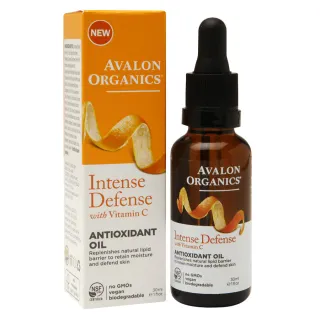
Avalon Organics Intense Defense Antioxidant Oil
Works for
1 of 2 advertised claims delivered
Moisturizing16 ingredients credited for this claimStrong support
“NewWith vitamin C. Helps replenish natural lipid barrier to retain moisture and defend skin.”
This product can help soften the skin and reduce its moisture loss with emollients and occlusives: caprylic/capric triglyceride, helianthus annuus seed oil.
Keep in mind that this product does not contain effective ingredients to attract water to the upper layer of the skin. This is why an additional product with humectants like glycerin or hyaluronic acid can be helpful (apply it before this product for the best results).
The following ingredients in this product are especially good for supporting the skin barrier and helping with the hydration level: linoleic acid
Anti-aging3 ingredients credited for this claimLimited support
“Environmental aggressors such as UV rays and pollution create free radicals that cause premature signs of skin aging.”
This product does not contain ingredients that are able to reduce fine lines and wrinkles or help with skin elasticity, but it can improve the look of the skin temporarily through moisturization. Well-moisturized skin might also be able to repair the sun damage better.This ingredient - camellia sinensis leaf extract - could be helpful for preventing or repairing signs of aging in theory, but there is no evidence that it actually works.
This ingredient camellia sinensis leaf extract might be able to help neutralize free radicals in skin and help it fight off some of the sun damage.
Anti-oxidationNot advertised by the brand · 7 ingredients credited for this claimModerate support
This product contains antioxidants (camellia sinensis leaf extract, rubus idaeus seed oil) that might be able to help neutralize free radicals in skin to lessen the damage it gets from the UV light (sun). There is not enough evidence to confirm their effectiveness in skin though.
Can it cause trouble?
Irritancy7 strong irritants: Citrus aurantium bergamia fruit oil, Citrus aurantium dulcis peel oil + 5 more — patch-test recommendedHigh risk
Comedogenic1 ingredient rated 2 or more on the 0–5 pore-clogging scale1 flagged
User reviews
Be the first — your take helps the next person decide.
Ingredients
Filter by role to see what each ingredient is doing.
Argania spinosa kernel oil~23–34%
- Irritation risk
- Medium
An emollient that helps soften the upper layer of the skin. Might have some weak anti-oxidant properties
More about Argania spinosa kernel oilShea butter ethyl esters~4.5–6.8%
- Irritation risk
- Low
Helps soften the upper layer of the skin
More about Shea butter ethyl estersHelianthus annuus seed oil~4.6–6.8%
- Irritation risk
- Low
A great emollient due to its high linoleic acid content. One of the most effective plant oils in helping skin hydration and repairing skin barrier function
More about Helianthus annuus seed oilPrunus armeniaca kernel oil~3.7–5.6%
- Irritation risk
- Medium
An emollient that helps soften the skin
More about Prunus armeniaca kernel oilCaprylic/capric triglyceride~3–4.5%
- Irritation risk
- Medium
A good mix of fatty acids that forms a protective layer on the skin. Improves the shelf life of products. Derived from coconut and glycerin
More about Caprylic/capric triglycerideRubus idaeus seed oil~2–3%
- Irritation risk
- Medium
A plant oil that might be able to help neutralize free radicals in skin
More about Rubus idaeus seed oilAleurites moluccanus seed oil~1.5–2.2%
- Irritation risk
- Low
Helps soften the upper layer of the skin
More about Aleurites moluccanus seed oilCitrus aurantium bergamia fruit oil~1.2–1.7%
- Irritation risk
- High
A plant oil with a high content of volatile compounds that can irritate the skin and lead to allergic reactions. Can lead to photosensitivity
More about Citrus aurantium bergamia fruit oilCitrus aurantium dulcis peel oil~1.1–1.6%
- Irritation risk
- High
An essentil oil from orange peel. Potential allergen and can be irritating
More about Citrus aurantium dulcis peel oilCitrus limon peel oil~0.85–1.3%
Camellia sinensis leaf extract~0.8–1.2%
- Irritation risk
- Low
Can contain potent anti-oxidant compounds (abbreviated ECG, GCG, EGC, and EGCG) that might help protect the skin from free radicals. Can help calm down inflammation and has some anti-bacterial properties. Unfortunately, these antioxidants are unstable and lose their effectiveness very quickly in products. The concentration of the antioxidant compounds in the extract also tends to be low to be effective in topical formulation
More about Camellia sinensis leaf extractCitrus limon peel extract~0.5–1.15%
Ascorbyl palmitate~0.45–1.05%
- Irritation risk
- Medium
Being a lipid soluble form of vitamin C, it is more stable and can penetrate the skin better than L-Ascorbic acid. It is effective in protecting the skin from free radicals, as well as evening the skin tone, but is less effective in stimulating collagen production compared to L-Ascorbic acid.
More about Ascorbyl palmitateTocopherol~0.45–1%
- Irritation risk
- Low
Pure form of vitamin E. Can help moisturise and protect the skin from free radicals. Often used to help stabilise other ingredients or the formula itself
More about TocopherolTocopheryl acetate~0.4–0.95%
- Irritation risk
- Medium
A more stable but less bio-available form of vitamin E compared to Tocopherol. Might help moisturize and protect the skin from free radicals, but mostly used in low concentrations to stabilize other ingredients.
More about Tocopheryl acetateGlycine soja oil~0.4–1%
- Irritation risk
- Medium
- Comedogenicity
- 2/5
A good emollient that helps soften the skin and helps repair its barrier function. It can clog pores if used in high concentrations.
More about Glycine soja oilLecithin~0.45–1%
- Irritation risk
- Low
Used mostly for creating emulsions - helping oil and water mix together. Helps soften the upper layer of the skin
More about LecithinLinoleic acid~0.4–0.95%
- Irritation risk
- Low
An excellent emollient. Helps soften the skin, restore its barrier function, and can help to calm down inflammation. It can be helpful to prevent blemishes and clogged pores
More about Linoleic acidOleic acid~0.35–0.8%
- Irritation risk
- Medium
Helps soften the upper layer of the skin. At the same time, it can weaken the skin's barrier enhancing penetration of other ingredients and increasing the risk of skin dryness
More about Oleic acidPalmitic acid~0.3–0.75%
- Irritation risk
- Low
An emollient that is naturally present in skin and helps soften it
More about Palmitic acidPhytosteryl canola glycerides~0.15–0.65%
- Irritation risk
- Low
Helps soften the upper layer of the skin
More about Phytosteryl canola glyceridesStearic acid~0.3–0.75%
- Irritation risk
- Low
Helps oil and water mix together and works as an emollient
More about Stearic acidTriolein~0.15–0.55%
Citral~0.1–0.4%
Limonene~0.1–0.4%
- Irritation risk
- High
A common frangrance that can easily irritate skin, especially if exposed to air, light or heat
More about LimoneneLinalool~0.1–0.35%
Ingredient list view
Argania spinosa kernel oil, Shea butter ethyl esters, Helianthus annuus seed oil, Prunus armeniaca kernel oil, Caprylic/capric triglyceride, Rubus idaeus seed oil, Aleurites moluccanus seed oil, Citrus aurantium bergamia fruit oil, Citrus aurantium dulcis peel oil, Citrus limon peel oil, Camellia sinensis leaf extract, Citrus limon peel extract, Ascorbyl palmitate, Tocopherol, Tocopheryl acetate, Glycine soja oil, Lecithin, Linoleic acid, Oleic acid, Palmitic acid, Phytosteryl canola glycerides, Stearic acid, Triolein, Citral, Limonene, Linalool
Compare prices
Retailers ranked by price — lowest first.

Worth comparing, line by line.
Match % combines shared ingredients, the first five ingredients, shared actives and hero ingredients, irritancy (lower counts in the alternative's favour), texture and body area. Only products in the same routine step are compared.
| Avalon OrganicsIntense Defense Antioxidant OilYOUR PRODUCT | PacificaVegan Ceramide Facial Oil | NaturiumRetinol Complex Cream | PipetteBaby Oil | |
|---|---|---|---|---|
| Match | — | 54% | 52% | 52% |
| Price | — | $18.00 | $15.99 | $4.16 |
| Shared key ingredients | — | 3 of 11 | 5 of 11 | 2 of 11 |
| Key difference | — | Phytosphingosine | Retinol | Ceramide Np |
| Irritancy | High | Medium | Medium | Low |
| Drying alcohol | — | — | — | — |
| View product | Shop | Shop | Shop |


Sources cited in this review
Every concentration estimate and effectiveness label is anchored to one of these 14 studies and safety reviews.
- 1
- 2
- 3
- 4Effect of topically applied lipids on surfactant-irritated skinonlinelibrary.wiley.com
- 5
- 6

Affiliate links · As an Amazon Associate, WIMJ earns from qualifying purchases.