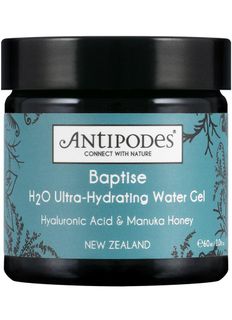
Antipodes Baptise H2O Ultra Hydrating Water Gel
Works for
1 of 3 advertised claims delivered
Moisturizing7 ingredients credited for this claimGood support
“The Antipodes Baptise H20 Ultra-Hydrating Water Gel is a weightless, intensive moisturiser that immerses thirsty skin in natural moisture.”
This product contains good ingredients to attract water to the upper layer of the skin. These ingredients are called "humectants": glycerin, hyaluronic acid.
When humectants are on the surface of the skin, they “pull in” the moisture from the outside environment, or from within deeper layers of the skin. If the air is dry, humectants can speed up the moisture loss from the skin. This is why it is a good idea to use another product on top of this one to help "seal in" the moisture (look for ingredients like dimethicone, squalane, oils and butters).
Anti-aging1 ingredient credited for this claimLimited support
“Manuka Honey Active - Iconic New Zealand native shrub is known for its many skin-enhancing properties: an anti-wrinkle agent, has real antibacterial prowess and it's naturally astringent.”
This product does not contain ingredients that are able to reduce fine lines and wrinkles or help with skin elasticity, but it can improve the look of the skin temporarily through moisturization. Well-moisturized skin might also be able to repair the sun damage better.This ingredient - hyaluronic acid - could be helpful for preventing or repairing signs of aging in theory, but there is no evidence that it actually works.
ExfoliationNo ingredient credited for this claimNo support
“Finally, South Pacific Hibiscus Flower gently exfoliates dead skin cells to reveal a smoother, clearer and brighter complexion.”
This product does not contain effective exfoliating ingredients. It might be able to deliver physical exfoliation, that is scrub off some of the dead cells on the surface of the skin. We do not recommend physical exfoliation, because it is not uniform (some bits of skin can get exfoliated too much while others not at all). It can also traumatize the skin and aggrevate acne and other skin conditions.
Can it cause trouble?
Irritancy8 strong irritants: Hibiscus sabdariffa flower extract, Zingiber officinale root extract + 6 more — patch-test recommendedHigh risk
ComedogenicClean of flagged comedogenic ingredientsNone flagged
User reviews
Be the first — your take helps the next person decide.
Ingredients
Filter by role to see what each ingredient is doing.
Water~40–60%
Glycerin~3.9–5.9%
- Irritation risk
- Low
One of the best moisturizing ingredients. Naturally present in skin. It attracts water to the upper layer of the skin working as a humectant
More about GlycerinSodium acrylates copolymer~3.6–5.4%
- Irritation risk
- Medium
Used to create a thicker product consistency
More about Sodium acrylates copolymerLecithin~2.5–3.7%
- Irritation risk
- Low
Used mostly for creating emulsions - helping oil and water mix together. Helps soften the upper layer of the skin
More about LecithinDehydroacetic acid~0.3–0.6%
Benzyl alcohol~0.4–0.95%
- Irritation risk
- High
A preservative. Can be used to mask unpleasant smell. Can be irritating
More about Benzyl alcoholGlyceryl caprylate~1.4–2.1%
- Irritation risk
- Low
An emollient that can also help water and oil mix together, as well as prevent bacteria growth in products
More about Glyceryl caprylatePolysorbate 20~1.2–1.9%
Hyaluronic acid~1–1.5%
- Irritation risk
- Low
One of the best moisturizing ingredients. Attracts water into the upper layer of the skin. Naturally present in skin. Typically has large molecule size unless advertised otherwise on the product label. Helps support skin's barrier function and may help to reduce inflammation
More about Hyaluronic acidGlycerin~0.9–1.35%
- Irritation risk
- Low
One of the best moisturizing ingredients. Naturally present in skin. It attracts water to the upper layer of the skin working as a humectant
More about GlycerinWater~0.5–1.15%
Terminalia ferdinandiana fruit extract~0.45–1%
- Irritation risk
- Medium
A plant extract that might have some anti-oxidant effect in skin, but evidence is lacking
More about Terminalia ferdinandiana fruit extractSodium citrate~0.35–0.85%
- Irritation risk
- Medium
Helps to control the skin's pH level. Maintains the skin's natural film of amino-lactic acids and oils. Helps to preserve products
More about Sodium citrateLysolecithin~0.35–0.85%
- Irritation risk
- Low
Lecithin derivative. It helps oil and water mix together and can enhance penetration of other ingredients. It helps soften the upper layer of the skin
More about LysolecithinSclerotium gum~0.3–0.75%
- Irritation risk
- Low
Used to create gel-like formulas and stabilize emulsions
More about Sclerotium gumXanthan gum~0.35–0.75%
- Irritation risk
- Low
Used to create a thicker product consistency
More about Xanthan gumPullulan~0.35–0.75%
- Irritation risk
- High
Creates a thin drying film on the skin resulting in a short-term tightening effect
More about PullulanPhormium tenax extract~0.2–0.75%
- Irritation risk
- Low
Hibiscus sabdariffa flower extract~0.15–0.7%
- Irritation risk
- High
A plant extract that can be irritating. It might contain a compound anthocyanin that could be helpful in neutralizing free radicals
More about Hibiscus sabdariffa flower extractCyathea medullaris leaf extract~0.15–0.65%
- Irritation risk
- Low
Zingiber officinale root extract~0.15–0.6%
- Irritation risk
- High
A plant extract that can contain an irritating essential oil. Might have some anti-oxidant effect, but evidence is lacking
More about Zingiber officinale root extractAloe barbadensis leaf extract~0.15–0.7%
- Irritation risk
- Medium
Traditionally used to treat sunburns, dermatitis and inflammation, but evidence for its effectiveness is lacking. The extract can contain humectants that help attract water into the skin
More about Aloe barbadensis leaf extractMica~0.15–0.6%
- Irritation risk
- Low
Creates an illusion of smoother and more radiant skin tone. Adds shimmer to the skin by reflecting light
More about MicaTitanium dioxide~0.15–0.7%
- Irritation risk
- Low
Works as a UV filter when used in high concentrations. It is photostable and is effective mostly against the UVB light, with some protection in the UVA range. In small concentrations, used for its ability to improve the color of cosmetic products. Is usually well tolerated by the skin
More about Titanium dioxideRosa damascena flower oil~0.1–0.45%
- Irritation risk
- High
Used as a fragrance. Can be irritating
More about Rosa damascena flower oilCitral~0.1–0.3%
Citronellol~0.05–0.25%
Eugenol~0.05–0.25%
Geraniol~0.05–0.2%
Linalool~0.05–0.15%
Ingredient list view
Water, Glycerin, Sodium acrylates copolymer, Lecithin, Dehydroacetic acid, Benzyl alcohol, Glyceryl caprylate, Polysorbate 20, Hyaluronic acid, Glycerin, Water, Terminalia ferdinandiana fruit extract, Sodium citrate, Lysolecithin, Sclerotium gum, Xanthan gum, Pullulan, Phormium tenax extract, Hibiscus sabdariffa flower extract, Unknown, Cyathea medullaris leaf extract, Zingiber officinale root extract, Aloe barbadensis leaf extract, Mica, Titanium dioxide, Unknown, Rosa damascena flower oil, Citral, Citronellol, Eugenol, Geraniol, Linalool
Compare prices
Retailers ranked by price — lowest first.
Affiliate links · prices updated regularly · As an Amazon Associate, WIMJ earns from qualifying purchases.
Sources cited in this review
Every concentration estimate and effectiveness label is anchored to one of these 11 studies and safety reviews.
- 1
- 2
- 3
- 4Efficacy of a New Topical Nano-hyaluronic Acid in Humansncbi.nlm.nih.gov
- 5Physiochemical properties and application of hyaluronic acid: a systematic reviewonlinelibrary.wiley.com
- 6

Affiliate links · As an Amazon Associate, WIMJ earns from qualifying purchases.