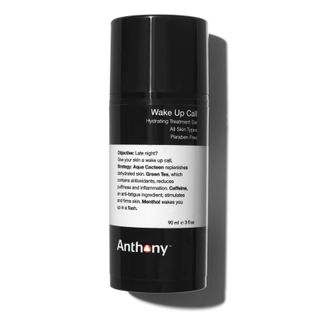
Anthony Wake Up Call Treatment Gel by Anthony

Anthony Wake Up Call Treatment Gel by Anthony

Efficacy37/100IrritancyHigh
Edit

Works for

1 of 2 advertised claims delivered

Moisturizing
11 ingredients credited for this claim
Good support
What the product description says
“It is a powerful formulation that nourishes, moisturises, stimulates and rejuvenates skin within seconds.”
Source: SpaceNK

This product can help soften the skin and reduce its moisture loss with emollients and occlusives: dimethicone.

Keep in mind that this product does not contain effective ingredients to attract water to the upper layer of the skin. This is why an additional product with humectants like glycerin or hyaluronic acid can be helpful (apply it before this product for the best results).

DimethiconeKey active· Emollient, OcclusiveEffect: HighA silicone that helps to reduce water loss from the surface of the skin. Can temporarily "fill in" lines and wrinkles, absorb oil, and create a nice product finish~0.9–1.1%
Corallina officinalis extractKey activeEffect: HighRed algae extract that helps attract water to the upper layer of the skin and might contain antioxidants~1.6–2%
Hydrolyzed soy proteinKey active· HumectantEffect: MediumHelps attract water to the upper layer of the skin. Might have some anti-aging, anti-oxidant, and skin lightening properties, but solid evidence is missing~1.1–1.3%
Chlorella vulgaris extractKey activeEffect: MediumA plant extract that can help to attract water to the upper layer of the skin and might have some anti-oxidant and anti-inflammatory properties~2–2.4%
Propylene glycol· HumectantEffect: LowHelps oil and water mix together and can enhance the penetration of other ingredients into the skin. It can be irritating~2.4–2.9%
Butyrospermum parkii butterUnder-dosedEffect: HighA great moisturising ingredient that softens the skin and reduces water loss from its upper layer. It also can be helpful in protecting skin from free radicals~0.45–0.7%
Caprylic/capric triglycerideUnder-dosedEffect: HighA good mix of fatty acids that forms a protective layer on the skin. Improves the shelf life of products. Derived from coconut and glycerin~0.65–0.95%
Lactic acidUnder-dosedEffect: HighAn exfoliating and moisturizing alpha-hydroxy acid (AHA). Typically causes less irritation than other AHAs, for example, glycolic acid. At high concentrations (about 15%), lactic acid can help reduce lines and wrinkles. Recent studies show that lactic acid can support the "good" bacteria living on skin's surface (healthy skin microbiome)~0.3–0.55%
PanthenolUnder-dosedEffect: HighHelps attract water to the upper layer of the skin and can help improve skin barrier function~0.25–0.5%
TocopherolEffect: Low, below effective dosePure form of vitamin E. Can help moisturise and protect the skin from free radicals. Often used to help stabilise other ingredients or the formula itself~0.25–0.5%
Camellia sinensis leaf extractEffect: Low, below effective doseCan contain potent anti-oxidant compounds (abbreviated ECG, GCG, EGC, and EGCG) that might help protect the skin from free radicals. Can help calm down inflammation and has some anti-bacterial properties. Unfortunately, these antioxidants are unstable and lose their effectiveness very quickly in products. The concentration of the antioxidant compounds in the extract also tends to be low to be effective in topical formulation~0.35–0.65%
Anti-aging
6 ingredients credited for this claim
Weak support
What the product description says
“The gel contains aqua cacteen that hydrates the skin; the caffeine works as a stimulant to rejuvenate the skin and make it feel firm and youthful.Green tea in the gel contains antioxidants to get rid of free radicals that cause inflammation and puffiness while menthol helps to cool and refresh skin in no time.”
Source: SpaceNK

Effective ingredients missing or their concentration is too low.

Ascorbic acidUnder-dosedEffect: HighThe most well-researched antioxidant that works in skin. Helps neutralize free radicals supporting collagen production, helping to even out the skin tone and preventing early signs of aging~0.3–0.5%
Lactic acidUnder-dosedEffect: MediumAn exfoliating and moisturizing alpha-hydroxy acid (AHA). Typically causes less irritation than other AHAs, for example, glycolic acid. At high concentrations (about 15%), lactic acid can help reduce lines and wrinkles. Recent studies show that lactic acid can support the "good" bacteria living on skin's surface (healthy skin microbiome)~0.3–0.55%
Retinyl palmitateUnder-dosedEffect: MediumThree steps removed from the active form of vitamin A - retinoic acid. To have an effect in the skin, it first needs to be converted twice to become the retinoic acid. This means it is less potent than retinol, but could also be less irritating. Once converted to the retinoic acid in the skin, it helps against all signs of aging, improves skin cell turnover and helps fight blemishes and clogged pores. However, in many cosmetic formulations, it is used in a concentration that is too low to have the full effect~0.25–0.4%
Butyrospermum parkii butterEffect: Low, below effective doseA great moisturising ingredient that softens the skin and reduces water loss from its upper layer. It also can be helpful in protecting skin from free radicals~0.45–0.7%
Camellia sinensis leaf extractEffect: Low, below effective doseCan contain potent anti-oxidant compounds (abbreviated ECG, GCG, EGC, and EGCG) that might help protect the skin from free radicals. Can help calm down inflammation and has some anti-bacterial properties. Unfortunately, these antioxidants are unstable and lose their effectiveness very quickly in products. The concentration of the antioxidant compounds in the extract also tends to be low to be effective in topical formulation~0.35–0.65%
TocopherolEffect: Low, below effective dosePure form of vitamin E. Can help moisturise and protect the skin from free radicals. Often used to help stabilise other ingredients or the formula itself~0.25–0.5%

Can it cause trouble?

Irritancy
14 strong irritants: Alcohol, Menthol + 12 more — patch-test recommended
High risk
We flagged 27 ingredients with irritancy potential. Severity depends on your sensitivity threshold; the table lists the worst offenders first.
IngredientFunctionIrritationEst. amount
AlcoholCan be drying and contribute to skin irritation. Used in formulars to dissolve other ingredients, create a thinner product consistency or for its antibacterial propertiesHigh~7.5–9.1%est.
Propylene glycolHelps oil and water mix together and can enhance the penetration of other ingredients into the skin. It can be irritatingHigh~2.4–2.9%est.
Menthol—High~0.5–0.75%est.
Hamamelis virginiana leaf extractA plant extract that can help calm down inflammation in skin. Can, however, itself be irritatingHigh~0.45–0.7%est.
Mentha viridis extractUsed as a fragrance and can be irritatingHigh~0.45–0.65%est.
Sambucus nigra flower extractA plant extract that might help neutralize free radicals in skinHigh~0.25–0.45%est.
Retinyl palmitateThree steps removed from the active form of vitamin A - retinoic acid. To have an effect in the skin, it first needs to be converted twice to become the retinoic acid. This means it is less potent than retinol, but could also be less irritating. Once converted to the retinoic acid in the skin, it helps against all signs of aging, improves skin cell turnover and helps fight blemishes and clogged pores. However, in many cosmetic formulations, it is used in a concentration that is too low to have the full effectHigh~0.25–0.4%est.
Ascorbic acidThe most well-researched antioxidant that works in skin. Helps neutralize free radicals supporting collagen production, helping to even out the skin tone and preventing early signs of agingHigh~0.3–0.5%est.
Citrus limon seed oil—High~0.2–0.4%est.
Citrus nobilis peel oilA plant oil with high content of volatile compounds that, especially when exposed to air, can cause allergic reactions and irritate the skinHigh~0.25–0.45%est.
Citrus aurantium dulcis oilUsed as a fragrance. It can be irritating and cause photosensitivityHigh~0.25–0.5%est.
Mentha piperita oilUsed as a fragrance and can be irritatingHigh~0.2–0.4%est.
LinaloolA fragrance. Can be irritatingHigh~0.15–0.3%est.
LimoneneA common frangrance that can easily irritate skin, especially if exposed to air, light or heatHigh~0.15–0.25%est.
CitralA fragrance with a lemon scent. A likely irritantHigh~0.15–0.25%est.
CitronellolA fragrance. Can be irritatingHigh~0.1–0.2%est.
GeraniolA fragrance. Can be irritatingHigh~0.05–0.15%est.
Chlorella vulgaris extractA plant extract that can help to attract water to the upper layer of the skin and might have some anti-oxidant and anti-inflammatory propertiesMedium~2–2.4%est.
Acrylates/c10-30 alkyl acrylate crosspolymerMaintains the texture of skincare products. Allows the product to spread evenly. Helps oil and water mix togetherMedium~1.4–1.7%est.
Caprylic/capric triglycerideA good mix of fatty acids that forms a protective layer on the skin. Improves the shelf life of products. Derived from coconut and glycerinMedium~0.65–0.95%est.
CaffeineMight be helpful in neutralizing free radicals. Can have a dehydration effect that might somewhat decrease the look of puffy eyesMedium~0.45–0.65%est.
TriethanolamineUsed to adjust pH of the product and can help improve the product's smellMedium~0.45–0.65%est.
Lactic acidAn exfoliating and moisturizing alpha-hydroxy acid (AHA). Typically causes less irritation than other AHAs, for example, glycolic acid. At high concentrations (about 15%), lactic acid can help reduce lines and wrinkles. Recent studies show that lactic acid can support the "good" bacteria living on skin's surface (healthy skin microbiome)Medium~0.3–0.55%est.
Citric acidCan work as an exfoliant but is typically used to adjust the product pHMedium~0.3–0.55%est.
PvpHelps evenly disperse other ingredients in a formulation and create an even layer on the surface of the skinMedium~0.3–0.5%est.
Potassium sorbateA preservativeMedium~0.25–0.45%est.
Ci 42090A colorant (dye)Medium~0.1–0.15%est.
Comedogenic
3 ingredients rated 2 or more on the 0–5 pore-clogging scale
3 flagged
These ingredients have a comedogenic rating of 2 or more on a 0–5 scale; the table shows each one's rating. In leave-on products they can clog pores in acne-prone skin.
IngredientFunctionRatingEst. amount
Chlorella vulgaris extractA plant extract that can help to attract water to the upper layer of the skin and might have some anti-oxidant and anti-inflammatory properties3/5~2–2.4%est.
Corallina officinalis extractRed algae extract that helps attract water to the upper layer of the skin and might contain antioxidants3/5~1.6–2%est.
Butyrospermum parkii butterA great moisturising ingredient that softens the skin and reduces water loss from its upper layer. It also can be helpful in protecting skin from free radicals3/5~0.45–0.7%est.
Edit
Cheaper Alternatives
Similar formulations, better price
No cheaper similar product found.

User reviews

Would you recommend?
No community reviews yet.

Be the first — your take helps the next person decide.

Write a review · ~30s

Ingredients

Filter by role to see what each ingredient is doing.

Water~45–55%
Formula
Irritation risk
Low

Plain old water

More about Water
Alcohol~7.5–9.1%
Irritant · high
Irritation risk
High
Works for
Antibacterial

Can be drying and contribute to skin irritation. Used in formulars to dissolve other ingredients, create a thinner product consistency or for its antibacterial properties

More about Alcohol
Opuntia streptacantha stem extract~4.2–5.1%
Formula
Triticum vulgare protein~3.3–4.1%
Formula
Propylene glycol~2.4–2.9%
Irritant · high
Irritation risk
High
Works for
Moisturizing

Helps oil and water mix together and can enhance the penetration of other ingredients into the skin. It can be irritating

More about Propylene glycol
Chlorella vulgaris extract~2–2.4%
Key activeComedogenic 3/5Irritant · medium
Irritation risk
Medium
Comedogenicity
3/5
Works for
MoisturizingAnti-oxidationAnti-inflammatory

A plant extract that can help to attract water to the upper layer of the skin and might have some anti-oxidant and anti-inflammatory properties

More about Chlorella vulgaris extract
Corallina officinalis extract~1.6–2%
Key activeComedogenic 3/5
Irritation risk
Low
Comedogenicity
3/5
Works for
MoisturizingAnti-oxidation

Red algae extract that helps attract water to the upper layer of the skin and might contain antioxidants

More about Corallina officinalis extract
Acrylates/c10-30 alkyl acrylate crosspolymer~1.4–1.7%
Irritant · medium
Irritation risk
Medium

Maintains the texture of skincare products. Allows the product to spread evenly. Helps oil and water mix together

More about Acrylates/c10-30 alkyl acrylate crosspolymer
Hydrolyzed soy protein~1.1–1.3%
Key active
Irritation risk
Low
Works for
MoisturizingEvens skin toneAnti-inflammatoryAnti-oxidation

Helps attract water to the upper layer of the skin. Might have some anti-aging, anti-oxidant, and skin lightening properties, but solid evidence is missing

More about Hydrolyzed soy protein
Dimethicone~0.9–1.1%
Key active
Irritation risk
Low
Works for
MoisturizingMattifying

A silicone that helps to reduce water loss from the surface of the skin. Can temporarily "fill in" lines and wrinkles, absorb oil, and create a nice product finish

More about Dimethicone
Caprylic/capric triglyceride~0.65–0.95%
Under-dosedIrritant · medium
Irritation risk
Medium
Works for
Moisturizing

A good mix of fatty acids that forms a protective layer on the skin. Improves the shelf life of products. Derived from coconut and glycerin

More about Caprylic/capric triglyceride
Menthol~0.5–0.75%
Irritant · high
Irritation risk
High
More about Menthol
Hamamelis virginiana leaf extract~0.45–0.7%
Irritant · high
Irritation risk
High
Works for
Anti-inflammatory

A plant extract that can help calm down inflammation in skin. Can, however, itself be irritating

More about Hamamelis virginiana leaf extract
Caffeine~0.45–0.65%
Irritant · medium
Irritation risk
Medium
Works for
De-puffingAnti-oxidation

Might be helpful in neutralizing free radicals. Can have a dehydration effect that might somewhat decrease the look of puffy eyes

More about Caffeine
Butyrospermum parkii butter~0.45–0.7%
Under-dosedComedogenic 3/5
Irritation risk
Low
Comedogenicity
3/5
Works for
MoisturizingAnti-oxidationAnti-aging

A great moisturising ingredient that softens the skin and reduces water loss from its upper layer. It also can be helpful in protecting skin from free radicals

More about Butyrospermum parkii butter
Triethanolamine~0.45–0.65%
Irritant · medium
Irritation risk
Medium
Works for
Cleansing

Used to adjust pH of the product and can help improve the product's smell

More about Triethanolamine
Mentha viridis extract~0.45–0.65%
Irritant · high
Irritation risk
High

Used as a fragrance and can be irritating

More about Mentha viridis extract
Camellia sinensis leaf extract~0.35–0.65%
Formula
Irritation risk
Low
Works for
AntibacterialAnti-oxidationAnti-agingAnti-blemishEvens skin toneMoisturizing

Can contain potent anti-oxidant compounds (abbreviated ECG, GCG, EGC, and EGCG) that might help protect the skin from free radicals. Can help calm down inflammation and has some anti-bacterial properties. Unfortunately, these antioxidants are unstable and lose their effectiveness very quickly in products. The concentration of the antioxidant compounds in the extract also tends to be low to be effective in topical formulation

More about Camellia sinensis leaf extract
Lactic acid~0.3–0.55%
Under-dosedIrritant · medium
Irritation risk
Medium
Works for
ExfoliationEvens skin toneMoisturizingAnti-aging

An exfoliating and moisturizing alpha-hydroxy acid (AHA). Typically causes less irritation than other AHAs, for example, glycolic acid. At high concentrations (about 15%), lactic acid can help reduce lines and wrinkles. Recent studies show that lactic acid can support the "good" bacteria living on skin's surface (healthy skin microbiome)

More about Lactic acid
Citric acid~0.3–0.55%
Irritant · medium
Irritation risk
Medium

Can work as an exfoliant but is typically used to adjust the product pH

More about Citric acid
Malic acid~0.3–0.5%
Formula
Irritation risk
Low

Helps adjust the product pH

More about Malic acid
Terminalia catappa leaf extract~0.25–0.5%
Formula
Sambucus nigra flower extract~0.25–0.45%
Irritant · high
Irritation risk
High
Works for
Anti-inflammatoryAnti-oxidation

A plant extract that might help neutralize free radicals in skin

More about Sambucus nigra flower extract
Pvp~0.3–0.5%
Irritant · medium
Irritation risk
Medium

Helps evenly disperse other ingredients in a formulation and create an even layer on the surface of the skin

More about Pvp
Tannic acid~0.25–0.5%
Formula
Irritation risk
Low
More about Tannic acid
Tocopherol~0.25–0.5%
Formula
Irritation risk
Low
Works for
Anti-oxidationAnti-inflammatoryAnti-agingMoisturizing

Pure form of vitamin E. Can help moisturise and protect the skin from free radicals. Often used to help stabilise other ingredients or the formula itself

More about Tocopherol
Retinyl palmitate~0.25–0.4%
Under-dosedIrritant · high
Irritation risk
High
Works for
Anti-blemishEvens skin toneAnti-agingExfoliation

Three steps removed from the active form of vitamin A - retinoic acid. To have an effect in the skin, it first needs to be converted twice to become the retinoic acid. This means it is less potent than retinol, but could also be less irritating. Once converted to the retinoic acid in the skin, it helps against all signs of aging, improves skin cell turnover and helps fight blemishes and clogged pores. However, in many cosmetic formulations, it is used in a concentration that is too low to have the full effect

More about Retinyl palmitate
Ascorbic acid~0.3–0.5%
Under-dosedIrritant · high
Irritation risk
High
Works for
Anti-agingAnti-oxidationEvens skin tone

The most well-researched antioxidant that works in skin. Helps neutralize free radicals supporting collagen production, helping to even out the skin tone and preventing early signs of aging

More about Ascorbic acid
Panthenol~0.25–0.5%
Under-dosed
Irritation risk
Low
Works for
MoisturizingReduces rednessReduces irritation

Helps attract water to the upper layer of the skin and can help improve skin barrier function

More about Panthenol
Citrus limon seed oil~0.2–0.4%
Irritant · high
Citrus nobilis peel oil~0.25–0.45%
Irritant · high
Irritation risk
High

A plant oil with high content of volatile compounds that, especially when exposed to air, can cause allergic reactions and irritate the skin

More about Citrus nobilis peel oil
Citrus aurantium dulcis oil~0.25–0.5%
Irritant · high
Irritation risk
High

Used as a fragrance. It can be irritating and cause photosensitivity

More about Citrus aurantium dulcis oil
Mentha piperita oil~0.2–0.4%
Irritant · high
Irritation risk
High

Used as a fragrance and can be irritating

More about Mentha piperita oil
Phenoxyethanol~0.25–0.45%
Formula
Irritation risk
Low

A preservative. It helps prevent bacterial growth in cosmetic products

More about Phenoxyethanol
Potassium sorbate~0.25–0.45%
Irritant · medium
Irritation risk
Medium

A preservative

More about Potassium sorbate
Sodium benzoate~0.2–0.35%
Formula
Irritation risk
Low

A preservative

More about Sodium benzoate
Linalool~0.15–0.3%
Irritant · high
Irritation risk
High

A fragrance. Can be irritating

More about Linalool
Limonene~0.15–0.25%
Irritant · high
Irritation risk
High

A common frangrance that can easily irritate skin, especially if exposed to air, light or heat

More about Limonene
Citral~0.15–0.25%
Irritant · high
Irritation risk
High

A fragrance with a lemon scent. A likely irritant

More about Citral
Citronellol~0.1–0.2%
Irritant · high
Irritation risk
High

A fragrance. Can be irritating

More about Citronellol
Geraniol~0.05–0.15%
Irritant · high
Irritation risk
High

A fragrance. Can be irritating

More about Geraniol
Ci 42090~0.1–0.15%
Irritant · medium
Irritation risk
Medium

A colorant (dye)

More about Ci 42090
Ingredient list view

Water, Alcohol, Opuntia streptacantha stem extract, Triticum vulgare protein, Propylene glycol, Chlorella vulgaris extract, Corallina officinalis extract, Acrylates/c10-30 alkyl acrylate crosspolymer, Hydrolyzed soy protein, Dimethicone, Caprylic/capric triglyceride, Menthol, Hamamelis virginiana leaf extract, Caffeine, Butyrospermum parkii butter, Triethanolamine, Mentha viridis extract, Camellia sinensis leaf extract, Lactic acid, Citric acid, Malic acid, Terminalia catappa leaf extract, Sambucus nigra flower extract, Pvp, Tannic acid, Tocopherol, Retinyl palmitate, Ascorbic acid, Panthenol, Citrus limon seed oil, Citrus nobilis peel oil, Citrus aurantium dulcis oil, Mentha piperita oil, Phenoxyethanol, Potassium sorbate, Sodium benzoate, Linalool, Limonene, Citral, Citronellol, Geraniol, Ci 42090

Compare prices

Retailers ranked by price — lowest first.

Amazon USPrice as of 10/15/2026 03:57 GMT
$40.00
Buy
SpaceNK US
$49.50
Buy

Affiliate links · prices updated regularly · As an Amazon Associate, WIMJ earns from qualifying purchases.

Cheaper alternatives? See how this stacks up against similar formulas.
We compare ingredient profiles across our catalog — pick the closest match for your budget.
Open dupe finder

Sources cited in this review

Every concentration estimate and effectiveness label is anchored to one of these 20 studies and safety reviews.

  1. 1
  2. 2
    Propylene Glycolpubmed.ncbi.nlm.nih.gov
  3. 3
  4. 4
  5. 5
  6. 6
Anthony Wake Up Call Treatment Gel by Anthony
AnthonyWake Up Call Treatment Gel by Anthony

Affiliate links · As an Amazon Associate, WIMJ earns from qualifying purchases.

As an Amazon Associate, WIMJ earns from qualifying purchases.